Why Comparing the Best Copper Prices Can Make or Break Your Payout

Finding the best copper prices — whether you're selling scrap, buying physical bullion, or tracking the commodity market — comes down to knowing where to look and what affects the number you see.
Here's a quick snapshot to help you compare copper price types at a glance:
| Price Type | What It Reflects | Typical Use Case |
|---|---|---|
| Spot Price (COMEX/LME) | Global market rate per pound | Investors, benchmarking |
| Scrap Yard Rate | Local payout after processing fees | Selling scrap copper |
| Physical Bullion Premium | Spot price + fabrication & dealer costs | Buying copper bars or rounds |
| Bare Bright Wire Rate | Highest scrap grade payout | Contractors, electricians |
| #2 Copper Rate | Lower grade, lower payout | Soldered or coated material |
Copper prices shift daily — sometimes dramatically. Non-ferrous metals like copper can move on global cues: dollar strength, inflation data, warehouse inventory levels, or a mine disruption in Chile. That means the price you see online at 9 a.m. may not be the price your local yard offers at noon.
Traders have long nicknamed copper "Dr. Copper" — because its price movements are seen as a leading indicator of global economic health. When copper rises, industrial demand is usually strong. When it falls, markets are often signaling a slowdown.
Understanding this gap between the global spot price and your local payout is the first step to making sure you're not leaving money on the table.
I'm Eric Roach, a former investment-banking and M&A advisor who has spent years helping clients navigate commodity markets and physical asset strategies — including finding the best copper prices across both the scrap and bullion markets. In this guide, I'll walk you through five practical strategies to compare rates, grade your material correctly, and time your decisions like a pro.
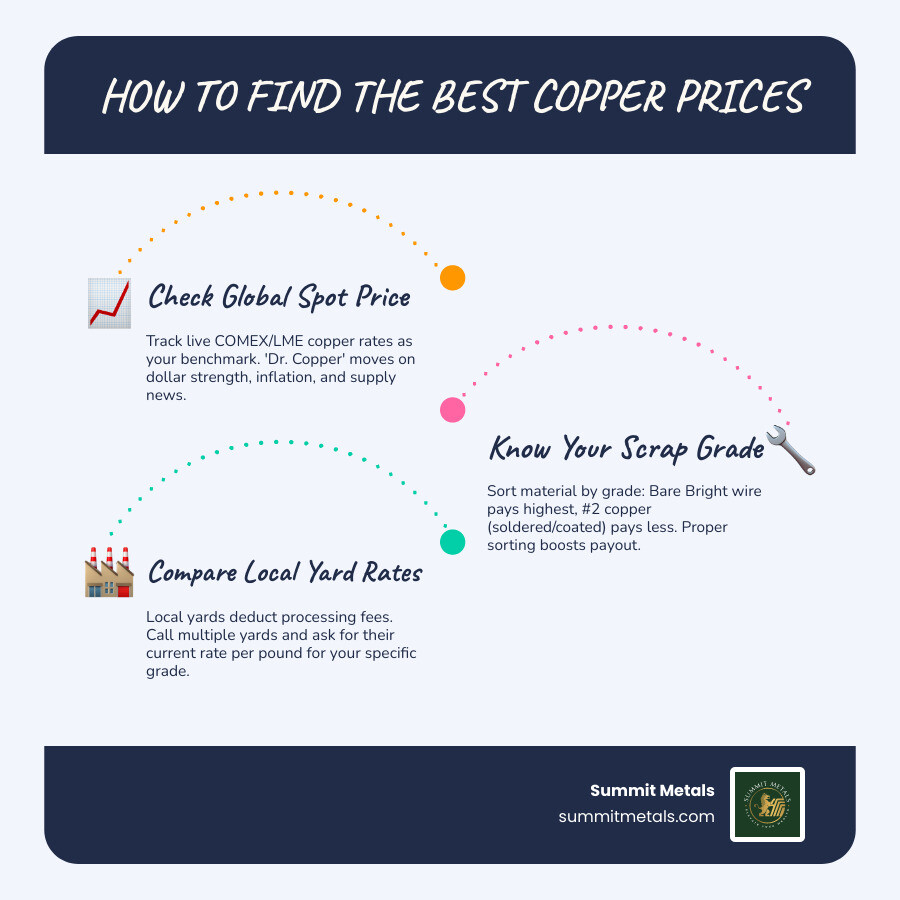
Simple guide to Best copper prices terms:
Strategy 1: Understand the Difference Between Spot Market and Local Scrap Yard Rates

When navigating the physical metal markets, the first hurdle is realizing that the price flashing on your financial dashboard is not the price you will receive at a local scale. The global market index acts as a benchmark, but local retail transactions operate under different economic rules.
Tracking the global index through platforms like Copper Price Today Live | Per Kg, Pound (lb) & Ton Rates + Charts – copper price today with live updates. View copper rates per kg, pound (lb), and ton with real-time charts, trends, and market insights. gives you an excellent baseline. However, translating that baseline into a real-world transaction requires understanding how local processing, logistics, and regional supply networks alter the final payout.
Tracking the Live Spot Price vs. Local Scale Payouts
The live spot price is determined on major global exchanges like the Commodity Exchange (COMEX) and the London Metal Exchange (LME). This represents the value of highly refined, investment-grade copper for immediate delivery. You can easily track these movements using resources like Copper Spot Price Today | Live Chart, Per-Pound & Per-Ounce Prices | FindBullionPrices.com .
Local scrap yards, on the other hand, do not pay the spot price. Instead, they offer a discounted rate known as the scale price. This discount exists because scrap yards are not buying pure, refined copper ready for industrial manufacturing. They are buying raw, unrefined scrap that requires sorting, cleaning, consolidating, and shipping to a secondary smelter or broker.
Why Local Yards Charge Processing Fees and Minimums
To run a sustainable business, local recycling facilities must account for significant operational overhead. This includes the cost of heavy machinery, labor, land leases, and environmental compliance.
Additionally, many yards apply specific transaction terms, such as:
- ATM and Cash Payout Fees: Some recyclers utilize automated cash dispensing machines for customer payouts, applying a small sliding fee on transactions below certain thresholds.
- Weight Minimums: To justify the administrative time of weighing and logging a transaction, yards may require minimum weights for premium grades.
- Transportation and Freight Costs: Getting heavy, bulky metal from a local facility to a major shipping hub or smelter is expensive.
To see how these local factors influence pricing in our home state, you can review local guidelines such as the Pricing & Metals Guide or check regional updates like Scrap Metal Prices in Salt Lake City, Utah, United States to benchmark local scale behavior.
Strategy 2: Master the Grading System to Secure the Best Copper Prices

If you walk into a recycling facility with a mixed bucket of copper, you will almost certainly be paid the rate of the lowest-value item in that bucket. To secure the best copper prices, you must understand how copper is graded and keep your materials strictly separated.
Different grades reflect the purity of the metal and the ease with which it can be melted down. Understanding these categories is as essential for scrap collectors as knowing Copper bar types 101 is for physical metal investors.
Bare Bright Wire vs. #1 Copper Tubing
The undisputed king of the scrap pile is Bare Bright Copper Wire. This grade consists of clean, uncoated, unalloyed copper wire that is completely free of insulation, paint, solder, or heavy corrosion. Because of its exceptional purity, it commands the absolute highest scrap value.
Just a notch below Bare Bright is #1 Copper. This grade includes clean copper tubing, bus bars, and clippings. To qualify as #1 copper, the material must be free of solder, brass fittings, paint, and excessive oxidation. It represents highly pure metal that requires minimal processing, which is why its value closely mirrors premium investment-grade products like 999 fine copper bars.
Identifying #2 Copper and Alloy Downgrades
Once copper shows signs of contamination, it drops to #2 Copper. This category includes:
- Tubing with solder joints, paint, or heavy corrosion.
- Wire that has been burnt to remove insulation (which leaves a dark residue).
- Tin-coated copper wire, which has a silver exterior and can easily be mistaken for lower-value aluminum.
Additionally, copper alloys like red brass (which typically contains 85% copper and 15% zinc) are priced differently than pure copper. Mixing these alloys with pure copper tubing will result in a significant downgrade at the scale. Keeping a close eye on the Price of copper ingots per pound and understanding how these purity tiers function will protect you from unnecessary losses.
Strategy 3: Track Macroeconomic Drivers and the 2026 Supply Crunch
Copper is the physical backbone of modern technology, meaning its price is highly sensitive to global economic shifts. As we navigate July 2026, several structural forces are reshaping the supply and demand dynamics of the copper market, driving long-term forecasts upward.
To stay ahead, investors and sellers must watch these macroeconomic trends, which are outlined in publications like the Copper price: BMI hikes forecasts – structural deficits to bring $17,000 next decade - MINING.COM .
How AI Infrastructure and EVs Drive the Best Copper Prices
The global transition toward green energy and high-performance computing is placing unprecedented demand on copper supplies.
- Electric Vehicles (EVs): A standard battery electric vehicle requires more than double the amount of copper found in a traditional internal combustion engine vehicle, primarily for battery packs, internal wiring, and electric motors.
- Wind and Solar Energy: Renewable energy systems are incredibly copper-intensive. An offshore wind turbine can require massive amounts of copper per megawatt of capacity to transport power back to the grid.
- AI Data Centers: The rapid buildout of artificial intelligence infrastructure requires massive power distribution networks. Heavy-gauge cabling, bus bars, and cooling systems in data centers are consuming copper at an accelerating pace.
For a deeper dive into how these industrial shifts affect the broader physical metals ecosystem, consult our Copper investment complete guide.
Long-Term Structural Deficits and Price Forecasts
While demand is surging, supply is struggling to keep pace. Mining projects are notoriously slow to develop, often taking 10 to 15 years from initial discovery to commercial production.
Furthermore, supply constraints in major producing countries like Chile have led research firms like BMI to cut their global mine production growth forecasts. While global inventory levels across exchanges like the LME, COMEX, and SHFE have seen temporary periods of elevation, the long-term outlook points toward structural deficits. You can monitor these supply-side pressures and exchange stocks on Copper Price | BullionData.com .
Strategy 4: Properly Prepare and Sort Your Metals to Maximize Payouts
Securing the best copper prices isn't just about watching the markets; it is about physical preparation. Scrap yards pay for convenience. If you do the work of cleaning, stripping, and sorting your metal beforehand, the yard doesn't have to, and they will pass that value back to you.
Developing a systematic approach to preparing your material is a highly effective way to extract maximum value, much like the strategies highlighted in Unearthing value a sellers handbook for copper ingots.
Stripping, Cleaning, and Separating Your Haul
To upgrade your copper to the highest possible pricing tier, follow these best practices:
- Strip Insulated Wire: Insulated wire (like Romex or THHN) is bought at a lower rate because the plastic coating adds weight and must be removed. Using a manual or motorized wire stripper to expose the clean, bare copper inside can significantly boost your return.
- Cut Off Contaminants: If you have #1 copper tubing with soldered joints or brass fittings on the ends, use a tubing cutter to snip those contaminated sections off. This separates your load into clean #1 copper and a small pile of #2 copper or brass, preventing the clean tubing from being downgraded.
- Sort by Grade: Keep distinct bins for Bare Bright, #1 copper, #2 copper, and brass. Never mix them.
For those interested in how these physical preparation steps translate to high-purity refined assets, check out The shiny truth unpacking what copper bullion really is.
Avoiding Blended Rates at the Scale
When you arrive at a recycling facility, ensure the scale operator weighs each of your sorted grades separately. If your load is mixed, yards will often apply a "blended rate," paying you the price of the lowest-value metal for the entire batch.
Using a reputable, transparent yard that utilizes certified scales is crucial. For more tips on navigating the transition from raw metal to liquid capital, explore From bar to bank your guide to selling copper bullion.
Strategy 5: Compare Physical Bullion Premiums Against Scrap Value
For physical metal investors, copper is often viewed as an accessible, entry-level hard asset. However, comparing retail copper bullion to the industrial spot price reveals a significant gap.
Because copper is an industrial base metal with a relatively low spot value per pound compared to precious metals, the cost to manufacture, transport, and distribute physical copper bars and rounds represents a much larger percentage of the product's total cost. This results in high retail premiums.
Evaluating the Best Copper Prices for Physical Bullion
When purchasing physical copper, buying in bulk is the most effective way to minimize these premiums. Options like a 100 oz copper bar, Pure copper pure value navigating 1kg ingot prices, or Bulk copper bars offer much lower per-ounce fabrication costs than small fractional rounds.
Before committing capital, it is wise to ask: Is a 1kg copper bar your next long-term investment?
To help put these physical metal choices into perspective, compare copper bars against highly liquid precious metals that may be easier to store, authenticate, and sell when you need cash:
| Asset Type | Primary Value Driver | Portability & Storage | Fraud & Face Value Protection | Best Fit |
|---|---|---|---|---|
| Sovereign Gold Coins | High precious metal density and collector/investor demand | Extremely compact; high value-to-weight ratio | Backed by government mints; legal tender face value adds an extra layer of authenticity and anti-counterfeit protection | Investors who want recognizable, liquid metal with strong resale confidence |
| Gold Bars | Lowest possible premium over gold spot in many sizes | Compact, but larger bars can be less flexible to sell in partial amounts | Depends heavily on refiner reputation, assay packaging, and dealer verification | Buyers focused on maximizing gold weight per dollar |
| Standard Copper Bars | Industrial demand and metal volume | Bulky and heavy; requires significant physical storage space | Rely entirely on physical assays and brand reputation; no government-backed face value | Collectors or investors comfortable with storage needs and wider retail premiums |
Dollar-Cost Averaging with Autoinvest and Planning Your Exit Strategy
At Summit Metals, we believe a balanced physical portfolio should focus heavily on highly liquid, authenticated precious metals like gold and silver. To make physical metal investing seamless, we offer an Autoinvest program. This service allows you to dollar-cost average your purchases by automatically shopping with us every month—acting just like a disciplined contribution to a 401(k) to build your hard asset wealth over time.
Additionally, we emphasize the importance of a clear exit strategy. When you store your authenticated precious metals in a secure, private vault, you keep your assets safe while maintaining maximum liquidity. When the time comes to sell, you can take advantage of our robust Sell to us program, ensuring a fast, transparent, and secure liquidation process.
Frequently Asked Questions About Copper Prices
Navigating the copper market can bring up a lot of questions, especially when comparing it to other assets. For a broader look at how copper interacts with other physical assets, see Copper silver and gold prices.
Where can I find the best copper scrap prices near me?
To secure the best local rates, start by checking online scrap directories and local yard websites in the Salt Lake City area. Always call ahead to confirm their daily scale prices, ask about any weight minimums, and verify if they apply any transaction or ATM fees. Keeping your metals strictly sorted before you arrive is the best way to guarantee you receive the correct rate for each grade.
Why are physical copper bullion premiums higher than the spot price?
Physical copper bullion requires mining, smelting, refining, minting, and shipping. Because the base spot value of copper is relatively low, these fixed manufacturing and heavy shipping costs make up a large portion of the retail price, resulting in a higher percentage premium over spot than you would typically see on dense precious metals like gold or silver.
Is physical copper eligible for a precious metals IRA?
No. Under current IRS regulations, precious metal IRAs are strictly limited to gold, silver, platinum, and palladium that meet specific purity standards. Physical copper, as an industrial base metal, is not eligible for inclusion in an IRA.
Conclusion
Whether you are recycling copper wire from a local renovation or looking to diversify your hard asset holdings, comparing copper prices requires a clear understanding of the market. By mastering the grading system, preparing your metals properly, and keeping an eye on global macroeconomic trends, you can make highly informed decisions that protect your bottom line.
At Summit Metals, based in Salt Lake City, Utah, we specialize in helping investors secure their wealth through authenticated gold and silver precious metals. We focus on providing competitive rates, real-time pricing, and trusted shipping options, including FedEx Express delivery once payments are verified.
To learn more about physical metal strategies, check out our educational YouTube channel. Ready to explore secure physical metal investing? Read our guide on don't get bent out of shape: how to buy metal online and start building your portfolio today.