What Is a 1 oz Silver Prospector Round?
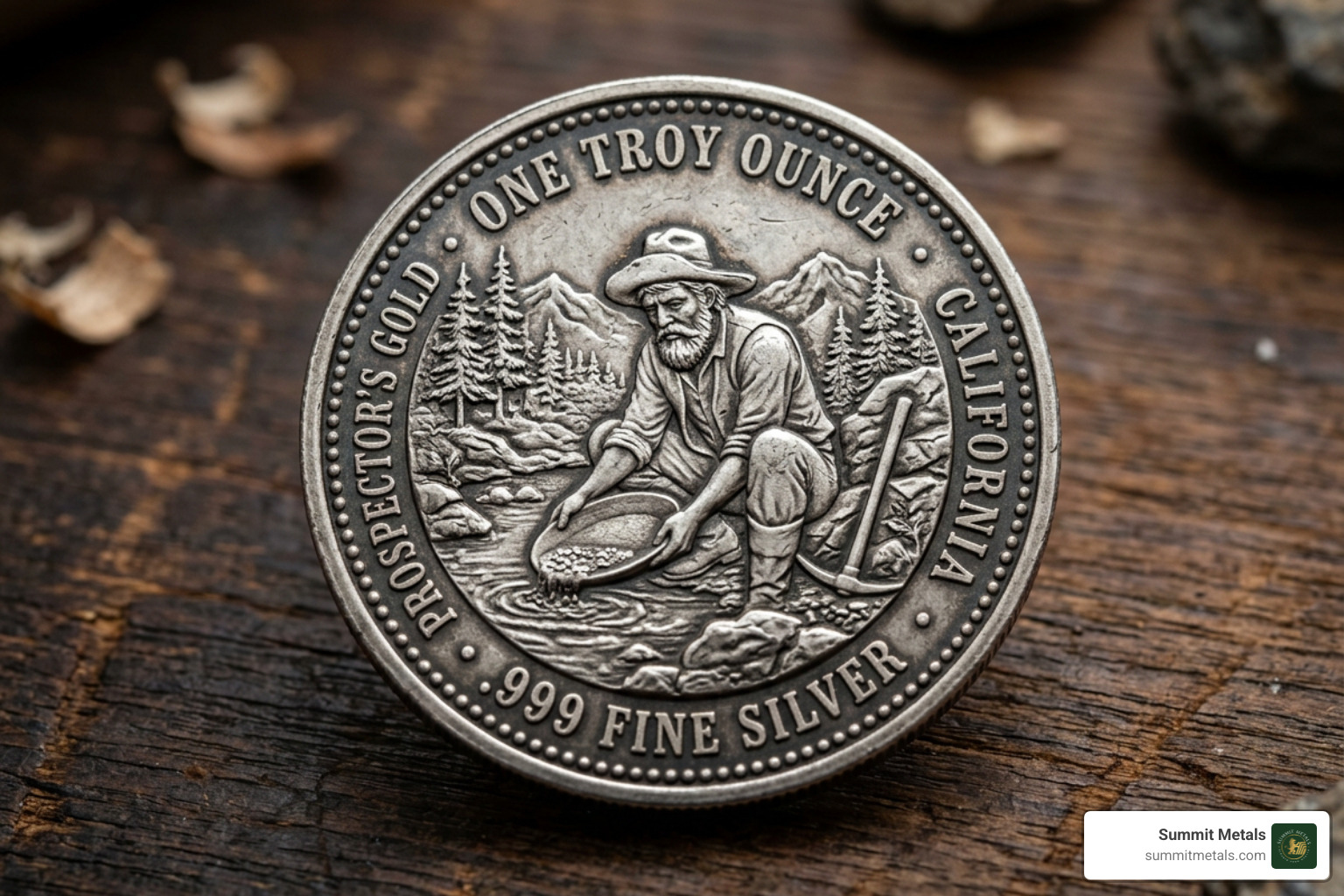
A 1 oz silver prospector round is a privately minted, .999 fine silver bullion piece weighing exactly one troy ounce. Here is a quick snapshot of what you need to know:
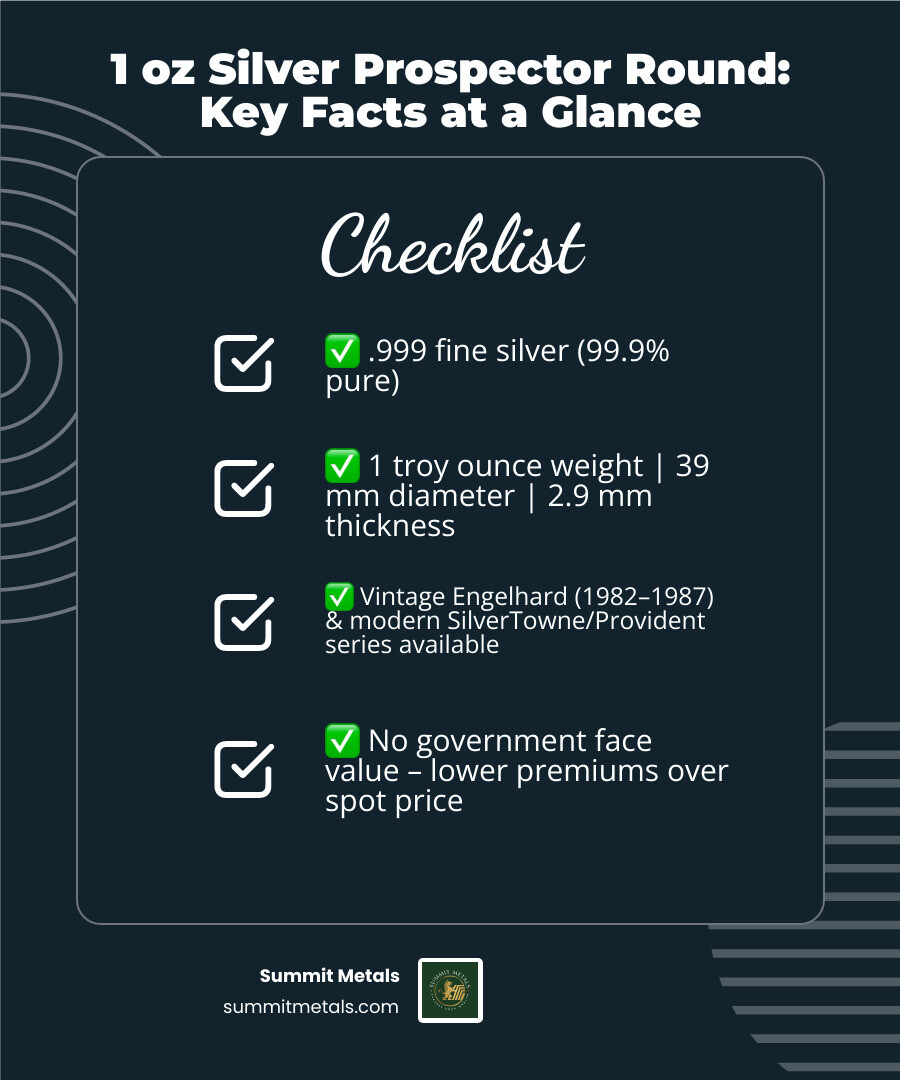
- Metal: .999 fine silver (99.9% pure)
- Weight: 1 troy ounce
- Diameter: 39 mm | Thickness: 2.9 mm
- Two main versions: Vintage Engelhard (1982–1987) and modern SilverTowne/Provident series
- Key difference from coins: No government face value — lower premiums over spot price
- Collectible appeal: Engelhard rounds are discontinued, making them finite vintage assets
- IRA eligible: Yes, when sourced from an ISO 9001 certified mint
Before the American Silver Eagle dominated the bullion market, one private round set the standard for silver stackers everywhere. The Engelhard Prospector — featuring a lone miner panning for gold on its obverse — became the most recognized private silver round ever produced. Today, both vintage Engelhard pieces and the modern SilverTowne Prospector series attract investors and collectors who want physical silver that carries a story as well as real monetary value.
I'm Eric Roach, a former Wall Street investment banker and M&A advisor who has helped clients allocate physical silver — including the 1 oz silver prospector round — as a resilient hedge within diversified portfolios. In this guide, I'll walk you through everything you need to know to buy with confidence.
History and Evolution of the Prospector Series
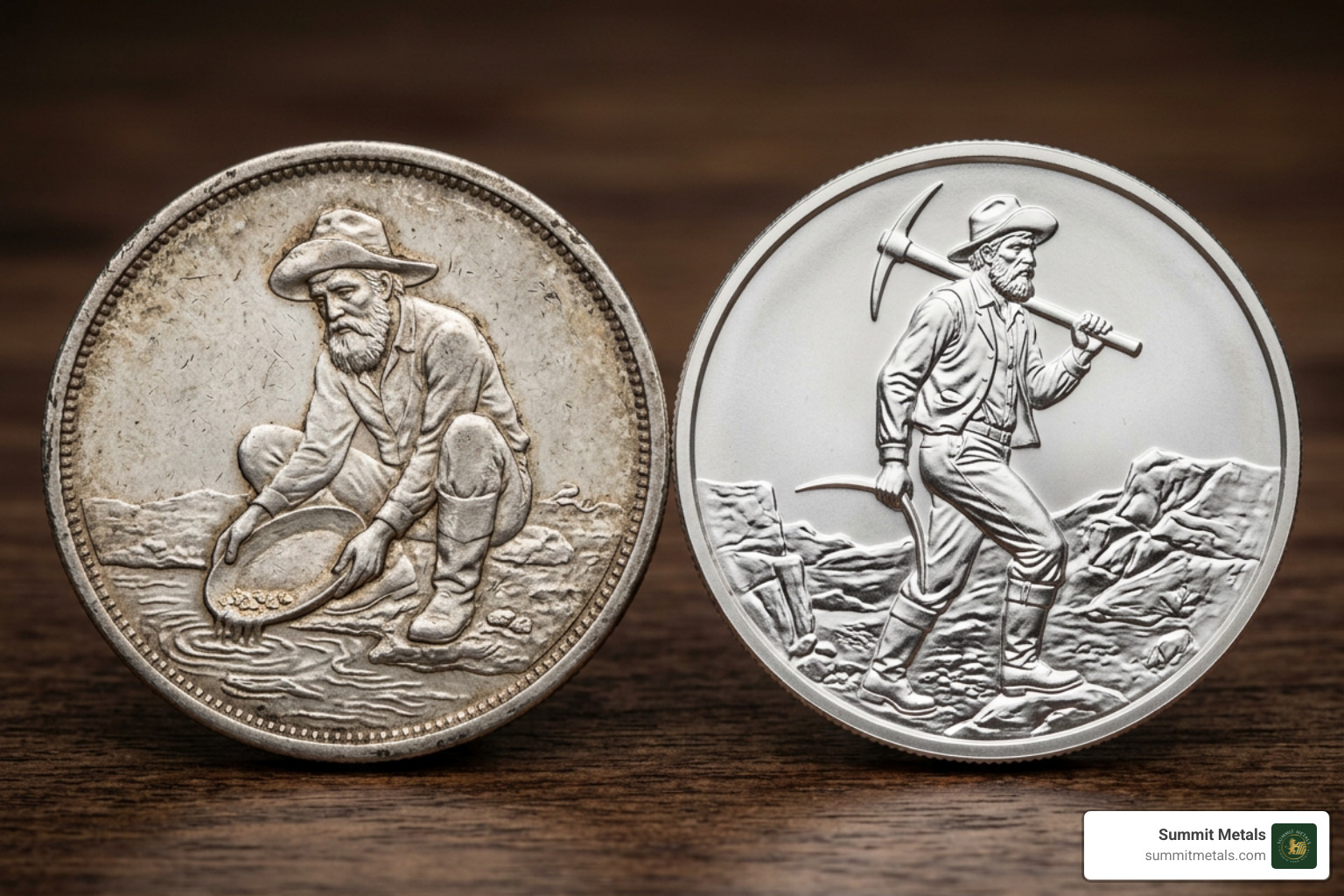
The journey of the prospector-themed silver round is a fascinating tale of two eras. It bridges the gap between the birth of modern retail silver stacking in the early 1980s and the highly artistic, themed private mint series of today.
Historically, the concept of a "prospector" round represents the ultimate spirit of precious metals ownership: discipline, patience, and the search for long-term value. Whether you are looking at a vintage piece from the 1980s or a modern release, these rounds pay homage to the rugged pioneers who shaped the American West.
To understand their full history, we must look at the definitive cataloging of private mint rounds, such as those documented on AG | Rounds, which highlights how these simple bullion pieces evolved into highly sought-after collector items.
History of the Engelhard 1 oz Silver Prospector Round
The Engelhard Prospector round was first introduced in 1982 by the legendary Engelhard Mint. At the time, standard public bullion rounds were a brand-new concept. Engelhard became the pioneer, marketing these rounds directly to retail investors who wanted a highly recognizable, trusted private alternative to sovereign coins.
Standard production of the Engelhard Prospector ran from 1982 through 1987. Because Engelhard ceased all precious metals minting operations after being acquired by the chemical giant BASF in 2006, these rounds are now finite, vintage assets.
While millions of these rounds were struck over their six-year run, certain years are far scarcer than others:
- 1983 and 1987: These standard years are widely believed to have considerably lower mintage numbers, making them highly prized by collectors.
- 1985 Fractional Sizes: In 1985, Engelhard experimented with fractional silver rounds, releasing them in 1/2 oz, 1/4 oz, and 1/10 oz sizes. The 1985 1/4 oz Prospector is particularly rare, with an estimated mintage of less than 25,000 units.
If you are looking to acquire these vintage treasures, you will find them highly liquid on the secondary market. You can explore options through trusted precious metals dealers to see how these legacy pieces have aged and continue to hold their value.
Modern Alternatives: SilverTowne 1 oz Silver Prospector Round
As the vintage Engelhard rounds grew more collectible (and carried higher secondary-market premiums), modern private mints stepped in to fill the demand for prospector-themed bullion. Chief among these is SilverTowne, a highly respected private mint that manufactures the popular Provident Prospector series.
Rather than just reproducing the classic Engelhard design, the modern SilverTowne and Provident series expanded the concept into a full-scale tribute to the Wild West. Instead of a single static design, this modern series features a rotating cast of characters on the obverse, while maintaining a consistent, beautifully detailed reverse depicting a sleepy Wild West boomtown main street, complete with a saloon, hotel, and wooden boardwalks.
The modern Prospector series includes several highly detailed releases:
- The Prospector: The flagship design featuring a rugged pioneer and his faithful pack mule set against the Sierra Nevada mountains.
- The Gunslinger: Depicting a classic Western outlaw or lawman ready for a duel.
- The Pony Express: Honoring the brave riders who carried mail across the frontier.
- The Can Can Girl: Capturing the lively entertainment of 19th-century saloons.
- The Sheriff: Showcasing the rugged law enforcement of lawless boomtowns.
- The Gambler: A highly detailed, first-person perspective of a high-stakes poker game.
Why the 1 oz Silver Prospector Round is a Premier Investment
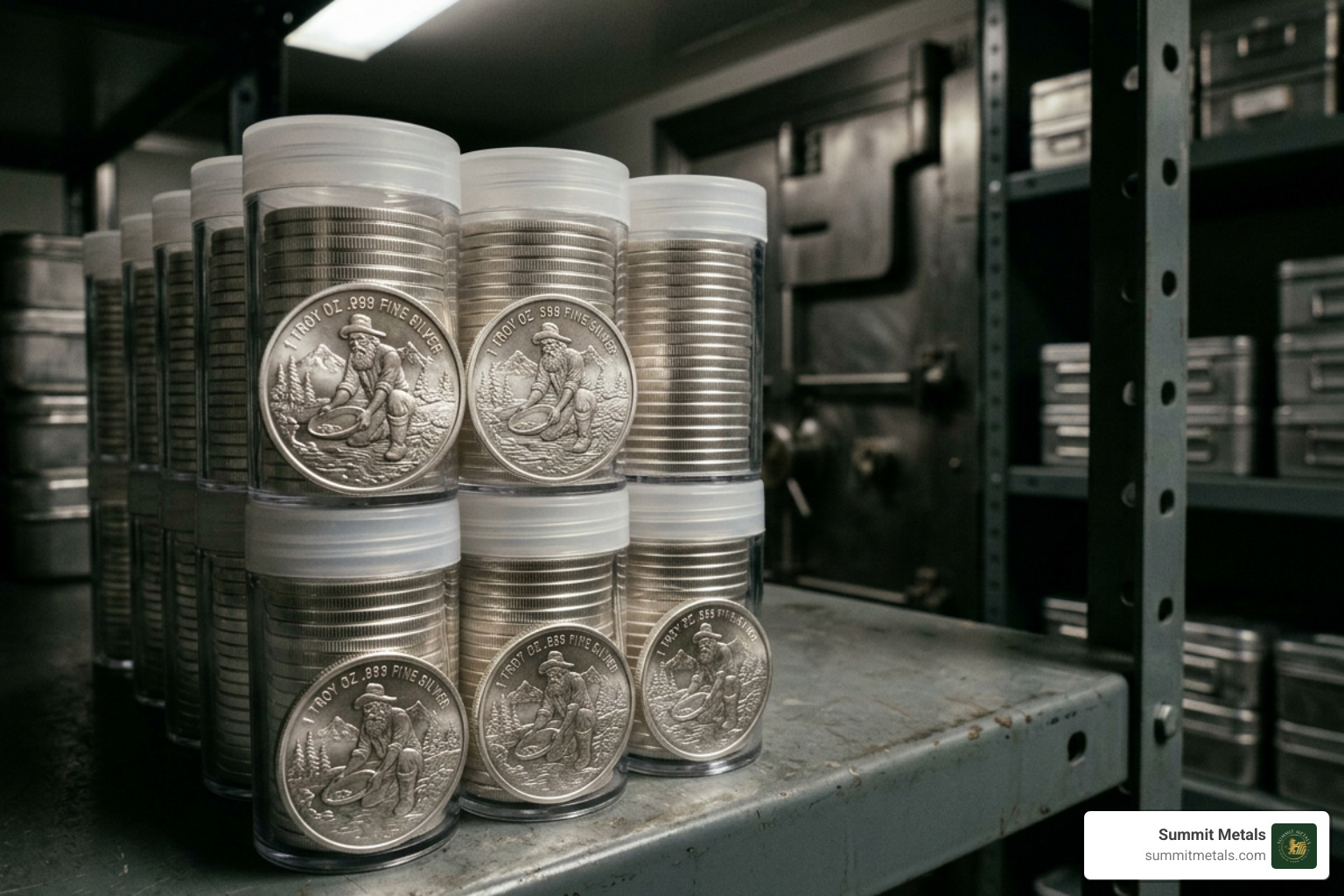
Whether you choose a vintage Engelhard or a modern SilverTowne release, adding a 1 oz silver prospector round to your portfolio can be a practical way to build physical silver exposure. Physical silver has served as a store of value for generations, and privately minted rounds are often favored by stackers who want recognizable bullion without paying the higher premiums often attached to sovereign coins.
For many buyers, rounds are attractive because they help maximize total silver weight for the budget. By choosing private mint rounds over government-issued coins, you typically reduce the premium paid over the spot price of silver and acquire more ounces for the same dollar amount. To dive deeper into this strategy, check out our guides on Beyond the Digital: Making Your Move into Physical Silver and Bars or Coins: Your Ultimate Silver Investment Guide.
Dollar-Cost Averaging with Summit Metals Autoinvest
A challenge for precious metals investors is trying to "time the market." Silver spot prices fluctuate daily, and waiting for the perfect dip can lead to hesitation and missed opportunities.
That is why Summit Metals offers Autoinvest: a simple way to dollar-cost average into physical precious metals by shopping with Summit Metals on a recurring schedule. Just like you contribute to a 401(k) or retirement account every month, Autoinvest lets you set up automatic, monthly purchases so your silver stack grows with discipline instead of emotion.
When silver prices are lower, your monthly budget automatically buys more ounces; when prices are higher, you buy fewer ounces. Over time, this hands-off approach can smooth out entry points, reduce the stress of watching daily charts, and help you build a substantial physical stack one month at a time.
Private Mint Rounds vs. Sovereign Coins
When building your stack, it is essential to understand how private mint rounds compare to sovereign government coins. Rounds are usually better for low-cost silver accumulation, while sovereign coins can offer added recognition and legal-tender characteristics.
| Feature | Private Mint Rounds (e.g., Prospector) | Sovereign Coins (e.g., American Silver Eagle) |
|---|---|---|
| Issuer | Private mints such as SilverTowne or Engelhard | Sovereign governments such as the U.S. Mint or Royal Canadian Mint |
| Face value | No face value; value is based on metal content, mint reputation, and demand | Legal-tender face value, which can add recognition and fraud deterrence |
| Premium over spot | Usually lower, helping you buy more silver ounces per dollar | Usually higher because of government minting costs, seigniorage, and collector demand |
| Best use case | Cost-efficient stacking and larger silver accumulation | Highly recognizable bullion, gifting, and buyers who value sovereign backing |
| Collectibility | High for vintage or limited private series, especially Engelhard | High for proofs, key dates, limited releases, and popular government series |
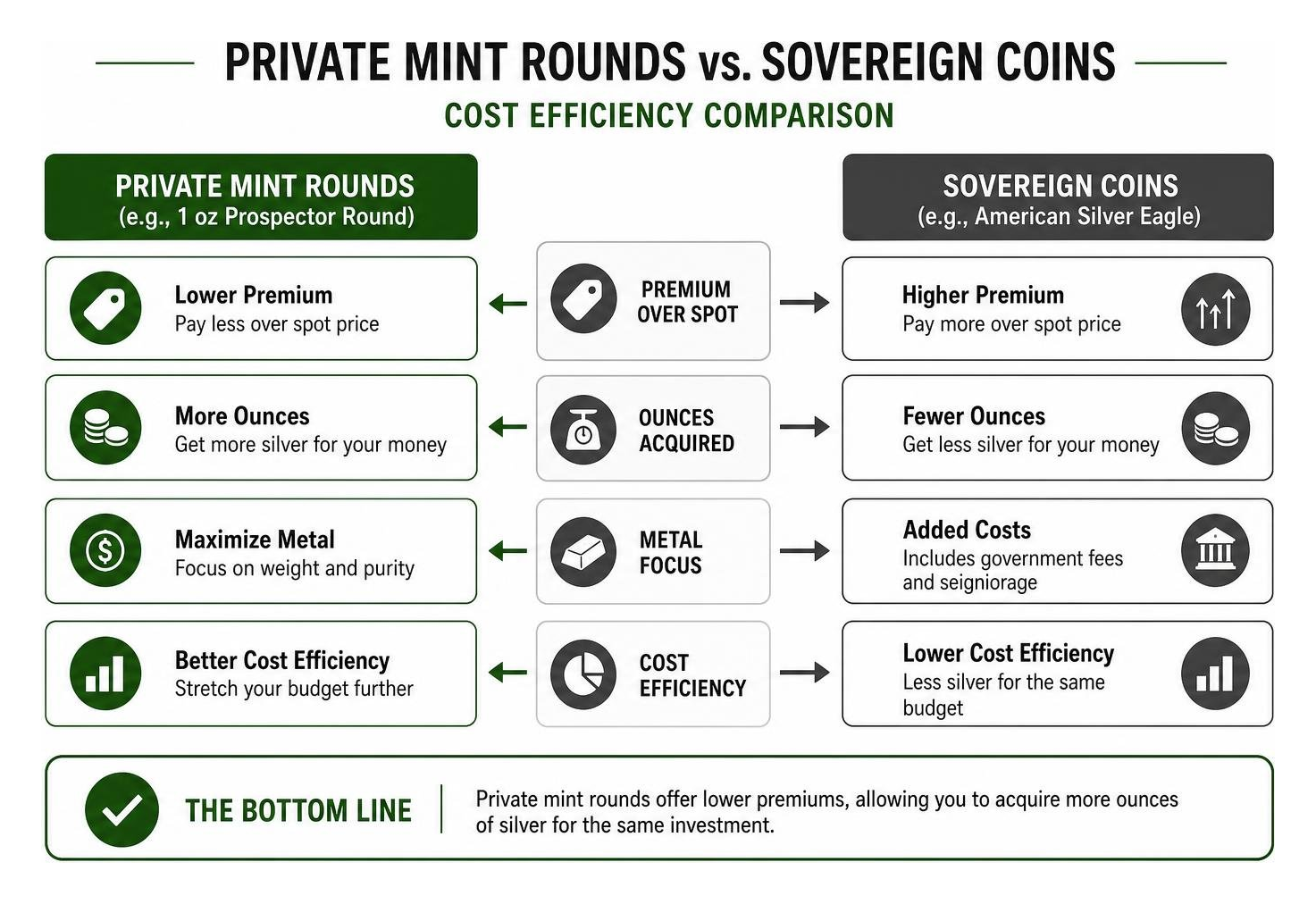
As shown in the comparison chart, private rounds are generally the most cost-efficient choice when your main goal is to accumulate the maximum amount of pure silver weight. Sovereign coins, however, may appeal to buyers who want government-issued legal tender with broad market recognition. You can learn more about lower-premium stacking options in our articles The Best Bang for Your Buck: Generic Silver Bars Explained and Silver Bars: The Most Cost-Efficient Way to Hold Your Wealth.
IRA Eligibility and Purity Standards
Can you include a 1 oz silver prospector round in your retirement portfolio? In many cases, yes, if the round meets IRS purity and manufacturing requirements and is held through a qualified self-directed IRA custodian.
To qualify for a self-directed Precious Metals IRA, silver bullion must meet strict purity and manufacturing standards set by the IRS. Specifically, the silver must be at least .999 fine (99.9% pure) and be produced by an ISO 9001 certified facility or a national government mint.
Prospector rounds that meet those requirements may be eligible for tax-advantaged retirement storage, but investors should verify the exact product, mint accreditation, and custodian rules before purchasing for an IRA.
Key Design Variations and Collectible Rarity
Part of the joy of collecting prospector rounds is hunting down the numerous design variations that have appeared over the decades. These subtle differences can have a massive impact on a round's collectible value and secondary-market premium.
Engelhard Reverse Variations: Large E vs. Eagle
If you are collecting vintage Engelhard Prospector rounds, the obverse remains virtually identical across all years, featuring the iconic image of a bearded prospector panning for gold in a riverbed, surrounded by the words "The American Prospector" and "U.S.A."
However, the reverse design went through a major transition:
- 1982–1984 (The Large "E" Reverse): The earliest releases featured a large, stylized Engelhard "E" logo in the center, surrounded by a circular border detailing the weight and purity.
- 1984–1987 (The Eagle Reverse): In 1984, Engelhard transitioned the reverse to a bold American Eagle design clutching an olive branch and arrows, carrying the weight and purity around the rim.
- The 1984 Transition Year: Because 1984 was the transition year, you can find 1984 rounds featuring either the Large "E" or the Eagle reverse. The 1984 Large "E" is highly sought after and, unfortunately, is also one of the most frequently counterfeited vintage rounds on the market.
Beyond these standard issues, Engelhard occasionally produced ultra-rare varieties. These include special proof finishes originally issued in protective plastic capsules, promotional rounds featuring corporate stamps like the "Stevcowovens/Stevcoknit" brand, and the incredibly rare 1988 Summit Bancorporation counterstamped round, which has an estimated mintage of less than 100 pieces.
Wild West Series Releases
For the modern Provident/SilverTowne series, the design variations are built directly into the collection's release schedule.
While the obverse changes with each release to feature different characters of the Old West, the reverse designs also carry unique details. For instance, the highly sought-after Provident Prospector V1 round does not feature the standard Wild West town on the reverse. Instead, it focuses on the tools of the pioneer's trade—depicting a highly detailed sextant, compass, and a rolled-out treasure map.
Another fan favorite is the Gambler Round (the 6th release in the series). Its obverse places the viewer in a first-person perspective sitting at a dusty saloon table, holding a poker hand of two pairs: Aces and threes (famously known as the "Dead Man's Hand").
How to Authenticate and Safely Buy Vintage Silver
Because vintage Engelhard Prospector rounds have been out of production for nearly four decades and command high premiums, they are frequent targets for counterfeiters. Protecting yourself from fakes is paramount when buying on the secondary market.
Fortunately, you do not need a multi-million dollar laboratory to spot a counterfeit. You can protect your investment by following a few simple best practices:
- Verify the Dimensions: Genuine 1 oz prospector rounds have very specific physical dimensions. Use a digital caliper and a pocket scale to verify that the round is exactly 39 mm in diameter, approximately 2.9 mm thick, and weighs exactly 31.1 grams (one troy ounce). Copper or base-metal counterfeits will either be too light or noticeably too thick to match the correct weight.
- Watch the Packaging: Be highly skeptical of "proof-like" vintage Engelhard rounds being sold in cheap, hard plastic air-tite capsules, especially if they are shipped directly from overseas. Many modern Chinese counterfeits are packaged this way to mimic rare proof editions.
- The "Ping" Test: Pure silver has a distinct, high-pitched, long-lasting ring when gently tapped. Base metals like copper or lead produce a dull, short thud.
- Buy from Trusted Dealers: The absolute best way to avoid counterfeits is to buy from reputable, established dealers who physically test and authenticate every piece of secondary-market bullion they acquire.
To learn more about safe buying practices, check out our guides on How to Start Buying Silver at Spot in Less Than an Hour and Silver Bullion Dealers: A Roundup of Top Online Retailers.
Frequently Asked Questions About Prospector Silver Rounds
Are Engelhard Prospector rounds still being produced?
No. Engelhard ceased all standard production of the Prospector round series in 1987 (with a few specialty/corporate runs extending into 1988). The Engelhard brand itself was acquired by BASF in 2006, ending the mint's historic run. Any authentic Engelhard Prospector round you purchase today is a vintage, secondary-market item.
Why do Engelhard Prospector rounds carry a higher premium than generic rounds?
While they contain the exact same amount of silver as a generic round, Engelhard Prospector rounds carry a premium due to their historical significance, finite supply, and massive brand recognition. They are widely considered the most famous private silver rounds ever minted, bridging the gap between pure bullion and numismatic collectibility.
Can I include 1 oz silver prospector rounds in a self-directed IRA?
Yes. Because both vintage Engelhard and modern SilverTowne Prospector rounds are minted to a purity of .999 fine silver and are manufactured by highly respected, accredited facilities, they meet the IRS guidelines for inclusion in a self-directed Precious Metals IRA.
Conclusion
The 1 oz silver prospector round remains a cornerstone of the precious metals community. Whether you are hunting down a rare vintage Engelhard with an "E" logo reverse or stacking a modern prospector-themed series, these rounds offer a blend of low-premium silver weight, strong liquidity, and rich historical storytelling.
At Summit Metals, based in Salt Lake City, Utah, we are dedicated to helping you build a physical portfolio you can trust. We offer authenticated gold and silver bullion, real-time competitive pricing, and secure, fully insured FedEx Express shipping on verified orders. To learn more about our process and build your precious metals knowledge, check out our educational YouTube channel or explore our silver collection today.
Planning Your Exit Strategy
When investing in physical precious metals, buying is only half the battle. A truly savvy investor establishes a clear exit strategy before making the first purchase. That means thinking about where the metal will be stored, how it will stay authenticated, and how quickly it can be liquidated when it is time to sell.
That is why Summit Metals offers a robust Sell to us program. We do not just sell you silver and leave you to figure out the rest; we also support the eventual exit. For investors who want the smoothest path to liquidity, high-security private vault storage can help keep physical silver in pristine, authenticated condition. When you decide to sell, vaulted holdings may already be verified, highly liquid, and ready for a faster transaction without the hassle of shipping or re-testing.
Learn more about future liquidity by visiting our Sell to us exit strategy page today.