What You Need to Know About Junk Silver Dollars Before You Buy
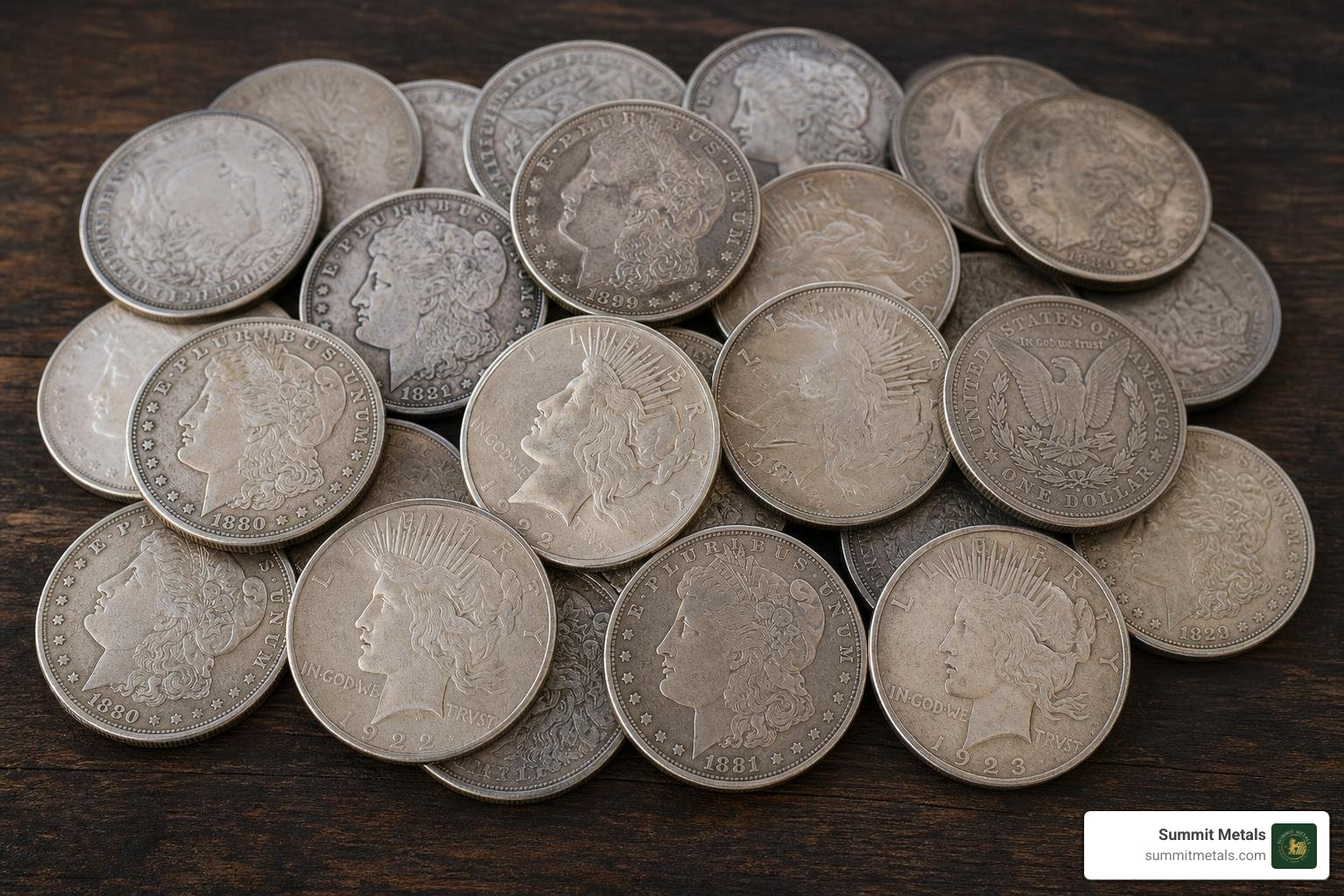
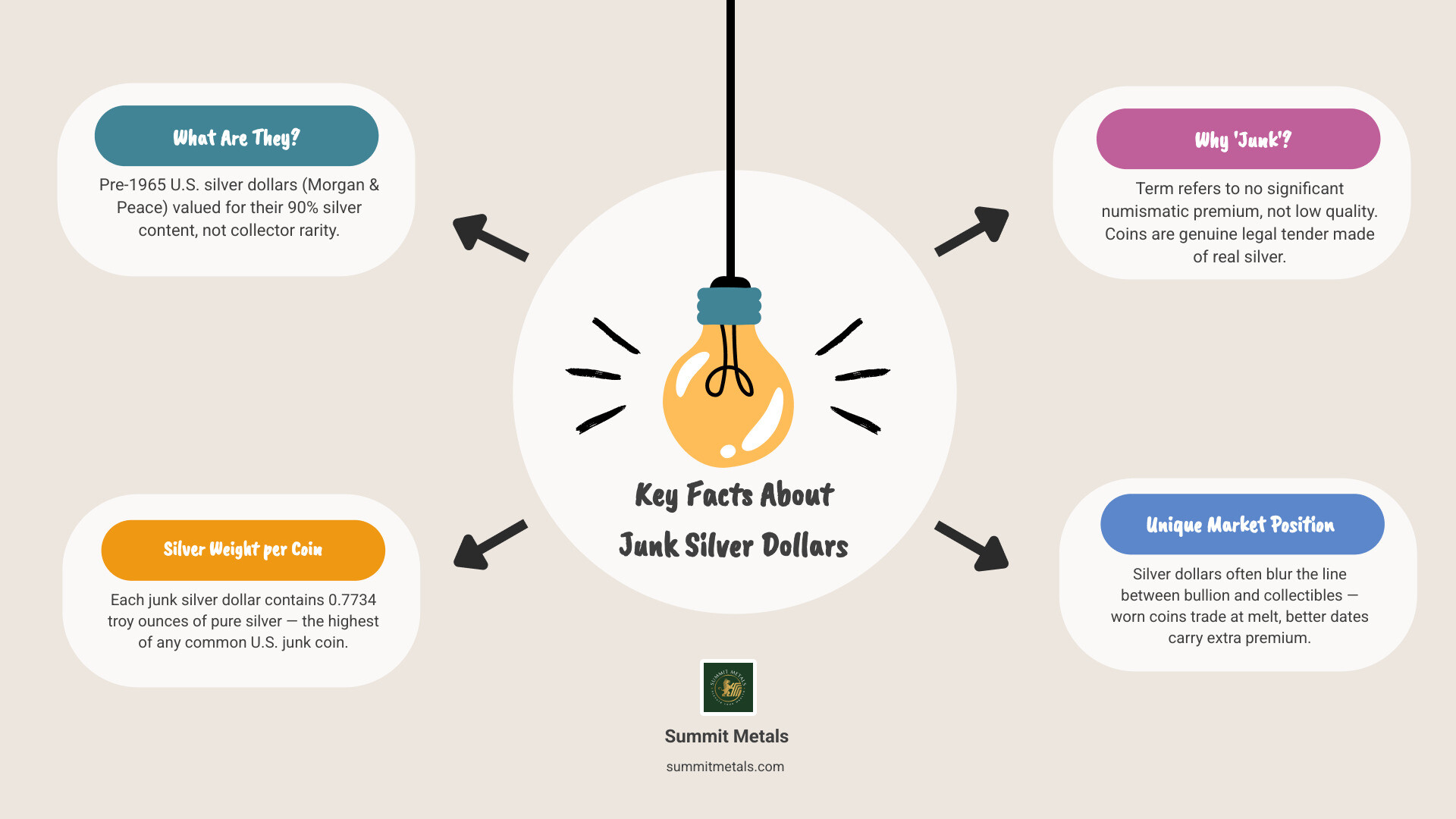
Junk silver dollars are pre-1965 U.S. silver dollar coins — primarily Morgan and Peace dollars — that are valued for their silver content rather than any collector or rarity premium. Here's a quick snapshot:
| Feature | Details |
|---|---|
| Main types | Morgan Dollar (1878–1921), Peace Dollar (1921–1935) |
| Silver content | 90% silver, 10% copper |
| Silver weight | 0.7734 troy oz of pure silver per coin |
| Why "junk"? | No significant numismatic value — priced on metal content |
| Key difference from other junk silver | Higher silver weight per coin than dimes, quarters, or halves |
| Also called | Constitutional silver |
The word "junk" has nothing to do with quality. These coins are genuine U.S. legal tender, struck at federal mints, and made of real silver. The term simply means the coin has no special collector premium — it trades primarily on its metal value, while still carrying the recognition and history that make Morgan and Peace dollars more distinctive than ordinary scrap.
That said, silver dollars occupy a unique and sometimes complicated space in the junk silver market. Unlike dimes, quarters, or half dollars — which are routinely bought and sold in bulk bags by the pound — silver dollars often blur the line between raw bullion and collectible coins. A heavily worn 1921 Morgan dollar, for example, carries a minimum value based entirely on its 0.7734 troy oz of silver. But the same date in better condition might command a meaningful premium above that melt floor.
Understanding where that line sits — and how to calculate, buy, sell, and build a repeatable buying strategy around these coins — is exactly what this guide covers. We will also compare silver dollars with fractional junk silver and bullion bars so you can decide which format fits your goals.
I'm Eric Roach, a former Wall Street investment-banking and M&A advisor who now helps everyday investors build resilient portfolios using physical precious metals, including junk silver dollars. My institutional background in risk management and market cycles gives me a clear-eyed view of where these coins fit as a practical wealth-preservation tool.
Glossary for junk silver dollars:
What Are Junk Silver Dollars and How Do They Differ?
To the uninitiated, the term "junk" implies something destined for a landfill. But in the precious metals space, "junk" is an affectionate nickname. When we talk about constitutional silver, we are referring to historical U.S. coins that circulated as everyday currency before the federal government took us on a wild paper-money experiment.
The turning point was the Coinage Act of 1965. Prior to this legislation, dimes, quarters, half dollars, and silver dollars were minted with a high concentration of precious metal. When the rising market price of silver began to outpace the face value stamped on the coins, citizens did what any sensible people would do: they started hoarding them. Congress stepped in and replaced the silver in circulating dimes and quarters with a copper-nickel alloy.
While smaller denominations like dimes and quarters are widely traded in bulk purely for their weight, junk silver dollars sit in a class of their own. They represent the heavyweights of American coinage history.
To understand how they compare to other formats, it is helpful to look at the broader landscape of constitutional coinage. If you want a deep dive into the overall market, check out The Complete Guide to Buying Junk Silver Coins (2026) | Lode as well as our own resource, A Comprehensive Guide to Junk Silver Value. The primary difference comes down to face value ratios and individual coin weight.
While ten silver dimes theoretically contain the same amount of silver as a single silver half dollar, a silver dollar does not play by the same mathematical rules. A silver dollar contains significantly more silver than its equivalent face value in smaller, fractional coins.
The Unique Status of Junk Silver Dollars
Why do junk silver dollars enjoy such a prestigious reputation? It mostly comes down to the legendary Morgan and Peace silver dollars. These coins are physical monuments to America's Gilded Age and westward expansion.
Because of their beauty and historical significance, collector demand is incredibly resilient. While a heavily worn Washington quarter is almost never collected for its beauty, a worn Morgan dollar is still highly prized by history buffs.
This creates a high baseline of demand. Even if a silver dollar is heavily circulated, cleaned, or scratched, it is rarely treated as mere scrap metal. It retains a "gray zone" status: too historic to be melted down, but too common to command elite collector pricing. For a thorough exploration of this phenomenon, you can read our Ultimate Morgan Silver Dollars Buying Guide.
Types of Junk Silver Dollars: Years, Compositions, and Specifications
If you want to stack junk silver dollars successfully, you need to know exactly what you are looking at. You cannot simply grab any large coin with "One Dollar" stamped on the back and assume it is packed with precious metal.
There are three main types of dollar coins you will encounter from the modern era: the Morgan Dollar, the Peace Dollar, and the Eisenhower Dollar. Each has its own unique mintage years, weight, and silver purity.
To make this simple, we have compiled a specifications table comparing these major dollar types alongside standard 90% fractional coins:
| Coin Type | Mint Years | Silver Purity | Total Weight (Grams) | Actual Silver Weight (ASW) |
|---|---|---|---|---|
| Morgan Dollar | 1878–1921 | 90% Silver, 10% Copper | 26.73 g | 0.7734 troy oz |
| Peace Dollar | 1921–1935 | 90% Silver, 10% Copper | 26.73 g | 0.7734 troy oz |
| Eisenhower Dollar (Silver) | 1971–1976 | 40% Silver, 60% Copper | 24.59 g | 0.3162 troy oz |
| Eisenhower Dollar (Clad) | 1971–1978 | 0% Silver (Copper-Nickel) | 22.68 g | 0.0000 troy oz |
| 90% Fractional Half Dollar | Pre-1965 | 90% Silver, 10% Copper | 12.50 g | 0.3617 troy oz |
| 90% Fractional Quarter | Pre-1965 | 90% Silver, 10% Copper | 6.25 g | 0.1808 troy oz |
| 90% Fractional Dime | Pre-1965 | 90% Silver, 10% Copper | 2.50 g | 0.0723 troy oz |
90% Silver Dollars vs. 40% Silver Dollars
As you can see from the specifications, there is a massive divide between the classic 90% silver dollars and the 40% silver Eisenhower dollars minted in the 1970s.
The classic Morgan and Peace dollars contain exactly 0.7734 troy ounces of pure silver. They are hefty, satisfying coins that clink with a distinct high-pitched ring when handled.
On the other hand, the Eisenhower dollar is a bit of a trickster. The vast majority of "Ikes" you find in old jars or bank vaults are copper-nickel clad coins containing absolutely zero silver. However, the U.S. Mint did produce special 40% silver versions of the Eisenhower dollar between 1971 and 1976 for collectors. These contain only 0.3162 troy ounces of pure silver.
Understanding this difference is critical so you do not accidentally pay 90% prices for 40% silver content. For a detailed breakdown of the Ike dollar's complex history, check out our guide on Coining a Legacy Understanding the Ike Silver Dollar.
How to Calculate the Melt Value of Junk Silver Dollars
Before you buy or sell any precious metals, you must know how to calculate their baseline value. In the coin industry, this baseline is known as the "melt value" — the raw, intrinsic value of the silver contained within the coin if it were melted down into a bar.
To find this number, you do not need a degree in advanced mathematics. You just need two variables:
- The Actual Silver Weight (ASW) of the coin (measured in troy ounces).
- The current silver spot price per troy ounce.
For a comprehensive calculation tool that covers various denominations and purities, you can use the Junk Silver Calculator: How to Value Coins, Dimes, and 800 Silver (2026) | CalculatorFlux. If you prefer to understand the math behind the curtain, we also offer our guide on Calculating Silver in Junk Silver.
Step-by-Step Melt Calculation for Junk Silver Dollars
Let's walk through a real-world calculation for a standard 90% Morgan or Peace silver dollar.
Since these coins contain 0.7734 troy ounces of pure silver, the formula is incredibly straightforward:
Melt Value = 0.7734 x Current Silver Spot Price
For example, if the current silver spot price is $30.00 per troy ounce, your calculation would look like this:
0.7734 x $30.00 = $23.20
This means the raw silver inside that single coin is worth $23.20. If the spot price rises to $50.00 per troy ounce, the melt value jumps to:
0.7734 x $50.00 = $38.67
That heavily circulated coins can lose about 1% to 2% of their total weight over decades of rubbing against other coins in pockets and cash registers. However, unless a coin is severely damaged, holed, or shaved, the industry standard is to calculate its value using the original mint specifications.
To stay updated on how market movements affect these numbers, you can check out our analysis on Junk Silver A Deep Dive into Current Values and Melt Prices.
Investing in Junk Silver Dollars vs. Fractional Coins and Bullion
When building a physical silver portfolio, every investor faces a fork in the road: should you stack junk silver dollars, fractional coins (dimes, quarters, halves), or modern pure bullion like 1-ounce rounds and bars?
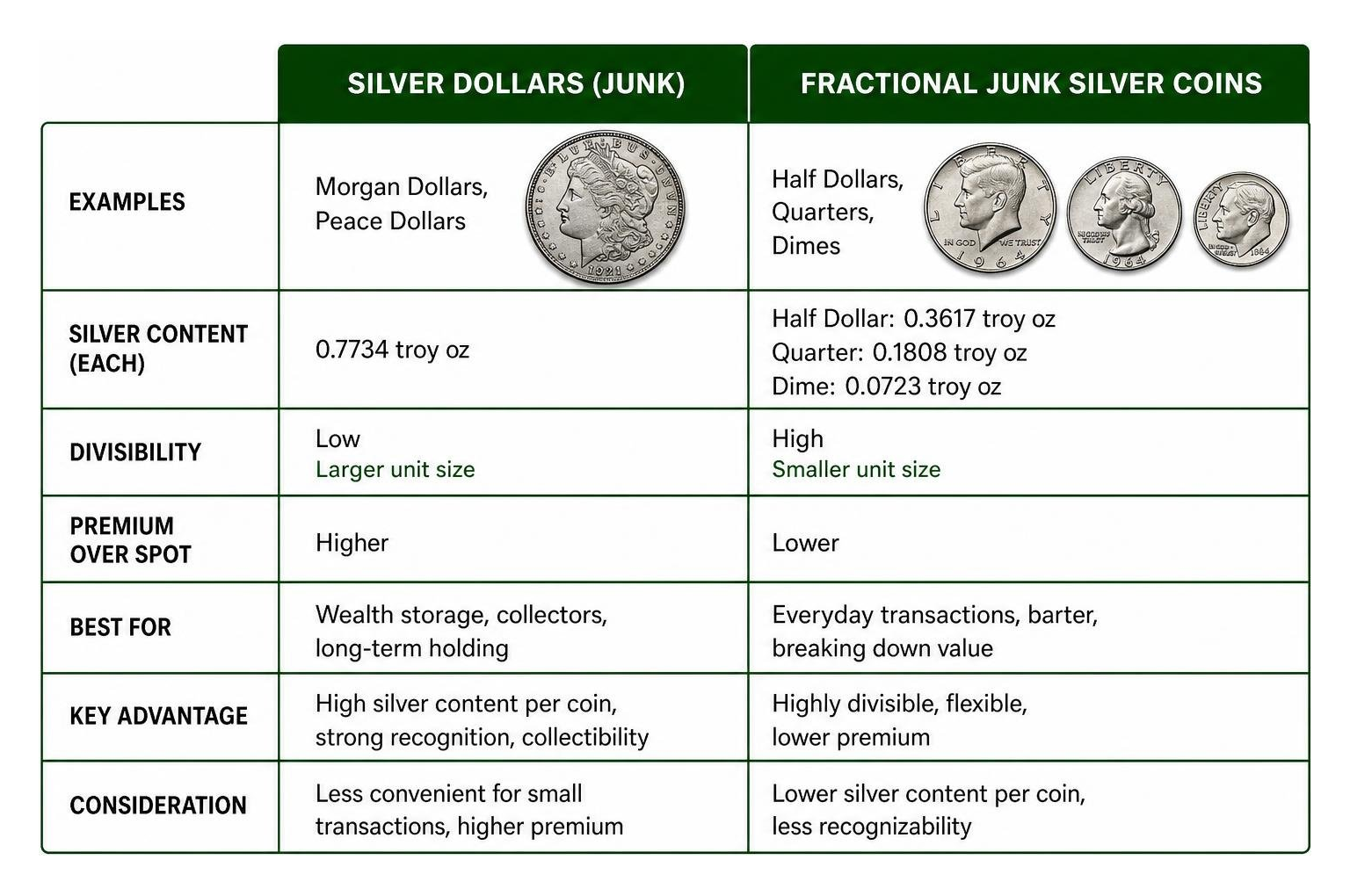
Each format serves a different strategic purpose. Fractional coins, such as 90% silver dimes and quarters, are incredibly popular for economic uncertainty or bartering scenarios. Because they are smaller, they allow for highly divisible transactions. It is much easier to buy a loaf of bread with a silver dime than it is with a large silver dollar. If you are curious about the math of fractional stacking, read our guide on How Much Junk Silver Equals an Ounce.
However, junk silver dollars offer something fractional coins cannot: high individual weight and massive historical appeal. They are highly recognizable worldwide. While a foreign merchant might look puzzled at a worn Mercury dime, almost everyone recognizes the silhouette of a classic American silver dollar.
The downside? Silver dollars carry a higher premium over spot than dimes and quarters. Because collectors love them, you will almost always pay a higher markup to buy them, but you will also recoup some of that premium when it is time to sell.
Junk Silver Dollars vs. Fractional Coins vs. Bullion Bars
| Feature | Junk Silver Dollars | Fractional Junk Silver | Private Bullion Bars |
|---|---|---|---|
| Best Use Case | Recognizable silver with historic appeal | Small, divisible silver for flexible transactions | Low-premium silver accumulation |
| Silver Per Piece | 0.7734 troy oz for Morgan/Peace dollars | Smaller amounts per dime, quarter, or half | Usually marked by exact weight |
| Premium Profile | Often higher because of collector demand | Usually more bullion-driven | Often lower over spot |
| Liquidity | Very strong; Morgan and Peace dollars are widely recognized | Strong in bulk bags or rolls | Strong, but brand and assay matter |
| Decision Advantage | Balances bullion value with U.S. coin history | Easier to trade in small increments | Efficient for maximum ounces per dollar |
Stacking Strategy: Coins vs. Bars and Autoinvesting
To make an informed decision, it helps to compare sovereign coins directly with private-mint bullion bars.
| Feature | Sovereign Silver Coins (e.g., Morgan/Peace) | Private Bullion Bars |
|---|---|---|
| Legal Tender Status | Yes (has a government-backed face value) | No (valued purely by weight) |
| Counterfeit Protection | High (severe federal penalties for counterfeiting) | Moderate (easier to replicate without federal oversight) |
| Liquidity | Extremely High (universally recognized) | High (requires verification of assay/brand) |
| Premiums | Higher over spot price | Lower over spot price |
Sovereign coins carry a government-backed face value. This legal tender status acts as a built-in layer of fraud protection. Counterfeiting a U.S. coin is a federal crime investigated by the Secret Service, which keeps bad actors on their toes. Bullion bars, while highly cost-effective, do not carry this same level of legal protection.
If you are looking to build a large position in physical metals without trying to perfectly time the market, consider Summit Metals' Autoinvest program. Just like you would dollar-cost average into a 401(k) or index fund, Autoinvest lets you shop with Summit Metals on a recurring monthly schedule so you can steadily add physical gold or silver over time. It is a simple way to build real wealth without waiting for the "perfect" silver price. To learn more about incorporating constitutional coins into your portfolio, read Junk Silver Coins Your Go-To Guide for Smart Purchases.
What to Watch Out For: Counterfeits, Cleaned Coins, and Key Dates
The world of vintage coinage is incredibly rewarding, but it is not without its traps. If you are buying junk silver dollars, there are three major hazards you must avoid: counterfeits, cleaned coins, and overlooking key dates.
First, counterfeits are a growing issue in the precious metals industry. High-quality fakes, often originating overseas, can look incredibly convincing to the untrained eye. Always perform basic diagnostic tests: check the weight on a digital scale (a genuine Morgan or Peace dollar should weigh 26.73 grams), use a rare-earth magnet (silver is non-magnetic), and perform a ping test (genuine silver rings with a long, clear, high-pitched chime).
Second, watch out for cleaned coins. Well-meaning people often ruin the value of vintage coins by scrubbing them with polish or baking soda to make them "shiny."
Never clean your silver coins.
Cleaning removes the natural patina (or "toning") and leaves microscopic abrasive scratches on the surface. To a collector, a cleaned coin is permanently damaged and its value is significantly reduced. Keep them in their natural, weathered state.
Finally, always check your coins for key dates and mint marks before treating them as cheap junk. You do not want to accidentally sell a rare, high-value coin for its raw metal weight. For a closer look at how to evaluate your coins before selling, consult our Ultimate Guide to Sell Silver Dollar Coins.
Where to Buy and Sell Junk Silver Dollars
When you are ready to acquire junk silver dollars, you have a few options. You can visit local coin shops, browse online auctions, or buy from reputable online bullion dealers.
Local coin shops are fantastic for immediate, face-to-face transactions, but their inventory can be highly inconsistent. Online dealers offer massive inventories and consistent pricing, but you must ensure you are buying from a trusted source that guarantees authenticity.
At Summit Metals, based in Salt Lake City, Utah, we pride ourselves on being a premier destination for physical precious metals. We sell fully authenticated gold and silver coins, ensuring that every piece of constitutional silver that leaves our vault is 100% genuine.
Equally important to your buying strategy is your exit strategy. Storing precious metals at home is common, but for larger portfolios, you may want to consider secure storage in a private vault. This can help protect your metals from theft while keeping your holdings organized and ready to liquidate when market conditions or personal needs change.
When you are ready to convert metals back into cash, Summit Metals' Sell to Us program gives you a straightforward way to sell authenticated precious metals back into a liquid market. Thinking about the exit before you buy helps you avoid getting stuck with products that are difficult to resell, especially if you plan to build a larger physical metals position over time.
Frequently Asked Questions about Junk Silver Dollars
Are Eisenhower dollars made of silver?
The short answer is: usually no, but sometimes yes.
The vast majority of Eisenhower dollars (1971–1978) minted for general circulation are copper-nickel clad coins and contain no silver whatsoever. However, the U.S. Mint produced special 40% silver versions for collectors. These are often referred to as "Blue Ikes" (packaged in blue envelopes) or "Brown Ikes" (packaged in plastic cases inside brown boxes).
Always check the edge of the coin; if you see a distinct copper stripe around the rim, it is a clad coin. If the edge is solid silver-colored, you likely have a 40% silver version. For a guide on where to source these unique coins, read Coining History Where to Find Eisenhower Silver Dollars.
Why do silver dollars carry higher premiums than dimes and quarters?
Silver dollars carry higher premiums because they are highly collectible. While dimes and quarters are valued almost entirely for their metal content, Morgan and Peace dollars possess immense historical appeal and aesthetic beauty.
Because collectors are willing to pay extra to own these iconic pieces of American history, dealers must pay more to acquire them, which raises the retail premium. To understand how these premiums behave during market fluctuations, check out the Silver Dollar Coins Selling Guide 2026.
How do I identify a genuine pre-1935 silver dollar?
Identifying a genuine Morgan or Peace dollar involves a few simple steps:
- Weight Test: A genuine, uncirculated coin must weigh 26.73 grams. Heavily worn coins may weigh slightly less, but any coin weighing under 26 grams is highly suspicious.
- Magnet Test: Silver is diamagnetic. If a strong magnet sticks to your coin, it is a counterfeit made of steel or nickel.
- Ping Test: Gently tap the coin with a pen or another coin. Real silver produces a clear, bell-like ring that resonates for several seconds. Base metals produce a dull, short "thud."
For more tips on protecting yourself from counterfeit coins, read Don't Get Scrapped Uncover the True Value of Your Silver Coins.
Conclusion
Junk silver dollars represent one of the most satisfying ways to invest in physical precious metals. They combine the raw wealth-preservation power of physical silver with the rich, tangible history of the American West. Whether you are stacking Morgan dollars for their beauty or Peace dollars for their clean design, these coins are a timeless addition to any portfolio.
The key is to match the product to your strategy. Fractional junk silver gives you small, divisible pieces; bullion bars can maximize ounces per dollar; and silver dollars offer a blend of silver weight, recognizability, U.S. legal tender status, and historical appeal. For investors who want to build gradually, Summit Metals' Autoinvest program can make monthly precious-metals purchases feel as routine as contributing to a 401(k).
At Summit Metals, located in Salt Lake City, Utah, we are dedicated to helping you navigate the precious metals market with confidence. We offer fully authenticated gold and silver, competitive pricing, and secure, fully insured FedEx Express shipping on all verified orders.
We also invite you to subscribe to our educational YouTube channel, where we break down complex market trends, explain coin grading, and share practical tips to help you make smart investment decisions.
Ready to start or expand your stack? Explore our curated selection of Constitutional Silver Junk Silver, set up a recurring buying plan with Autoinvest, or use Sell to Us when it is time to turn your holdings back into cash.