Why Tracking the Live Silver Gram Price Matters for Every Investor
The live silver gram price is one of the most practical numbers a precious metals investor can monitor — it tells you the real-time value of silver broken down into its smallest tradeable unit.
Here is what you need to know right now:
| Metric | Value (as of July 2026) |
|---|---|
| Silver price per gram (USD) | ~$1.85 – $1.93 |
| Silver price per troy ounce (USD) | ~$57 – $60 |
| Silver price per kilogram (USD) | ~$1,850 – $1,930 |
| Grams in a troy ounce | 31.1035 |
| How to calculate gram price | Spot price ÷ 31.1035 |
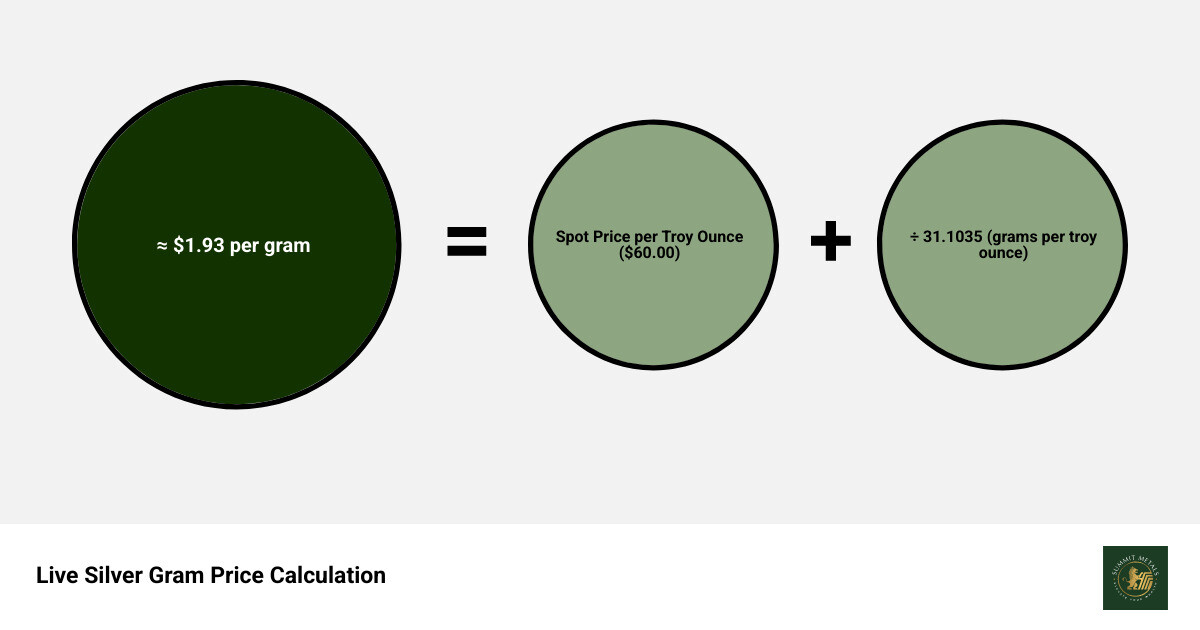
Quick answer: To find the live silver price per gram, divide the current spot price per troy ounce by 31.1035. For example, a $60/oz spot price equals roughly $1.93 per gram.
Silver prices move constantly — driven by industrial demand, currency shifts, and global supply pressures. Knowing the gram price helps you evaluate smaller purchases, calculate the value of scrap silver, and time your buying decisions with precision.
Whether you hold a handful of coins or a full kilo bar, the gram price is your baseline.
I'm Eric Roach — a former Wall Street investment banker who spent over a decade advising Fortune 500 companies on multi-billion-dollar transactions before turning my focus to helping everyday investors use physical gold and silver to protect their wealth. Tracking the live silver gram price is something I walk clients through regularly, because understanding this single number is often the gateway to smarter, more confident precious metals investing. Let's break down exactly how it works.
Live silver gram price terminology:
Understanding the Live Silver Gram Price and How It Is Calculated
To navigate the precious metals market successfully, we must first understand the relationship between the standard weights used by global trading desks and the smaller, more practical weights used by everyday stackers.
The global gold and silver markets operate primarily on the troy ounce. However, most of the physical world uses the metric system. If you are holding a sterling silver fork, a small fractional bar, or a European-minted coin, you are dealing with grams.
A troy ounce is not the same as the standard kitchen (avoirdupois) ounce you use to weigh ingredients. A troy ounce is approximately 10% heavier, weighing exactly 31.1035 grams compared to a standard ounce which is only 28.35 grams. This 10% difference is a classic trap for beginners, but once you master the conversion, you can easily track the real time silver spot price in any unit of measurement.
Global spot prices are discovered on major futures exchanges like the COMEX (a division of the Chicago Mercantile Exchange) and the London Bullion Market Association (LBMA). The spot price is the average midpoint of wholesale quotes for raw, bulk silver scheduled for immediate delivery. Because these exchanges trade in massive quantities—such as standard 5,000-ounce futures contracts—investors need a reliable way to translate those massive wholesale figures into retail-friendly metrics. This is why tracking the Silver Price per Gram | Live Silver Spot Price in Grams is so critical. It levels the playing field for the retail investor who wants to buy physical metal without purchasing a literal ton of it at once.
How to Calculate the Live Silver Gram Price from the Ounce Spot Price
Calculating the live price per gram is straightforward once you know the industry-standard divisor. Because there are exactly 31.1035 grams in a single troy ounce, you simply take the current spot price per ounce and divide it by 31.1035.
The mathematical formula looks like this:
$$\text{Live Silver Gram Price} = \frac{\text{Spot Price per Troy Ounce}}{31.1035}$$
For example, if the current spot price is $60.00 per troy ounce, the calculation is:
$$\$60.00 \div 31.1035 = \$1.929 \text{ per gram}$$
By mastering this simple math, you can easily evaluate any physical product you find. If you are reading our spot on your live silver price per ounce guide, you can instantly convert those numbers to grams to see if a local coin shop or an online dealer is offering you a fair deal on fractional items.
Tracking the Live Silver Gram Price in Volatile Markets
Precious metals markets operate 24 hours a day during the trading week, pausing only for a brief 60-minute window from 5:00 PM to 6:00 PM EST on weekdays. Because prices react instantly to breaking news, economic reports, and currency fluctuations, watching the charts constantly is simply not practical for most of us.
This is where modern technology comes to the rescue. By utilizing a live metals price tracker, smart investors set up automated price alerts. Instead of staring at a screen, you can program alerts to trigger when the price of silver moves by a specific percentage (such as a 1% drop in an hour) or when it crosses a specific price threshold. This allows you to go about your day and only step in to buy when a sudden dip presents a perfect buying window.
Key Factors Driving Daily Fluctuations in Silver Prices
To understand why the live silver gram price fluctuates from minute to minute, we have to look at the dual nature of silver. Unlike gold, which is primarily held as a monetary reserve and a wealth-preservation asset, silver is both a financial safe haven and an indispensable industrial commodity.
This dual identity means silver is highly sensitive to both macroeconomic trends and industrial manufacturing cycles. Here are the primary drivers that cause daily movements in the silver market:
- Industrial Demand and the Green Revolution: Over half of the global supply of silver is consumed by heavy industry. Silver has the highest electrical and thermal conductivity of any metal, making it irreplaceable in modern electronics. The rapid global transition to green energy has accelerated this demand. Solar photovoltaics (solar panels) consume massive quantities of silver, with solar demand alone requiring hundreds of millions of ounces annually. Additionally, the rise of electric vehicles (which use double the amount of silver of internal combustion vehicles), 5G telecommunications, and AI microchips keeps industrial demand incredibly robust.
- The Six-Year Supply Deficit: The global silver market has been in a structural physical supply deficit for six consecutive years leading up to 2026. This means the world is consuming far more silver than mining companies are pulling out of the ground. When demand consistently outstrips supply, above-ground stockpiles are depleted, creating a highly coiled spring for prices.
- The 2025-2026 Tariff Stockpiling Squeeze: Geopolitical shifts have added fuel to the fire. Fearing supply chain disruptions and impending import tariffs, major U.S. manufacturing companies stockpiled over 500 million ounces of physical silver domestically. This massive corporate hoarding drained the London exchanges, causing lease rates to spike temporarily by over 30 times their historical averages. This severe physical tightness is a prime example of why tracking the silver lining how to track and understand silver prices is essential for timing the market.
- U.S. Dollar Strength and Inflation: Because silver is globally priced and traded in U.S. dollars, there is a strong inverse relationship between the strength of the greenback and the price of precious metals. When the U.S. dollar weakens, it takes more dollars to purchase the same gram of silver, causing the nominal price to rise. Conversely, high inflation historically drives investors toward physical assets as a hedge against the steady erosion of fiat currency purchasing power.
Physical Silver vs. Spot Price: Understanding Dealer Premiums and Spreads
One of the most common points of confusion for new investors is the realization that they cannot buy physical silver at the exact live spot price. If you see the spot price of silver per gram listed on a chart, and you walk into a coin shop expecting to pay that exact price for a 10-gram bar, you are going to be disappointed.
To understand why this is the case, we must look at how the physical supply chain works. The spot price represents raw, unprocessed silver traded in massive, wholesale quantities (like 1,000-ounce or 5,000-ounce industrial bars) sitting in a secure exchange vault.
To turn that raw wholesale metal into a beautiful, authenticated coin or bar that you can hold in your hand, several steps must occur:
- Refining and Minting: The raw silver must be melted down, purified to at least .999 fine purity, and fabricated into specific weights and sizes.
- Manufacturing Costs: Minting presses, custom dies, security packaging, and quality control all require specialized labor and energy.
- Shipping and Insurance: Heavy physical metal must be securely transported under armed guard and fully insured from the mint to the distributor, and finally to the retail dealer.
- Dealer Overhead: Retail dealers have operating costs, including secure storage vaults, expert authentication equipment, and administrative staff.
The markup added to the spot price to cover these costs is known as the dealer premium. Premiums are typically expressed as a percentage over the spot price and can range from 2% to 15% or more, depending on the product's weight, design, and current market demand. To get a deeper understanding of this pricing structure, you can read our guide on spot price vs premium how precious metals pricing works.
Additionally, dealers operate on a bid-ask spread. The "Ask" price is what the dealer charges you to buy the metal, while the "Bid" price is what the dealer is willing to pay you when you sell it back. The difference between these two numbers is the spread, which ensures the dealer can maintain liquidity and stay in business.
Silver Coins vs. Silver Bars: A Comparison
When deciding how to build your physical silver portfolio, you will primarily choose between sovereign coins and industrial bars. Both have unique advantages, and understanding the differences is key to matching your investment with your personal goals.
Sovereign coins, such as the American Silver Eagle or the Canadian Silver Maple Leaf, are minted by official government mints. They carry a nominal face value and legal tender status. Because they are backed by a sovereign government, counterfeiting them is a federal crime, which provides an incredibly high level of built-in fraud protection. However, because of their intricate designs and government backing, they carry higher premiums.
On the flip side, silver bars are minted by private refineries. They do not have a face value, but they are highly efficient. Because they are easier to manufacture in bulk, they carry significantly lower premiums over the spot price, allowing you to acquire more ounces of pure silver for every dollar spent.
| Feature | Sovereign Silver Coins | Silver Bars |
|---|---|---|
| Issuer | Government Mint (e.g., US Mint) | Private Refinery |
| Legal Tender | Yes (has nominal face value) | No |
| Fraud Protection | High (counterfeiting is a federal crime) | Standard (relies on assay cards/serial numbers) |
| Premium Over Spot | Higher | Lower |
| Best For | Maximum liquidity, legal tender protection | Accumulating raw weight at the lowest cost |
Historical Performance and All-Time Highs of Silver per Gram
To gain perspective on where silver prices are today, we must look at how the metal has performed over longer time horizons. Silver has a rich history of explosive bull runs, often driven by a combination of monetary panic and physical supply squeezes.
Over the past several decades, silver has experienced massive shifts:
- The 1-Year, 5-Year, and 10-Year Trend: Looking back from our vantage point in July 2026, silver has put on a spectacular performance. Over the past decade, silver has climbed significantly, driven by persistent inflation, industrial demand from the solar industry, and a multi-year mining deficit.
- The Historic 2025-2026 Bull Run: On January 29, 2026, silver reached a nominal all-time high of $121.67 per troy ounce. This historic run was sparked by intense corporate stockpiling to avoid tariff risks, combined with a severe physical shortage on the COMEX and London exchanges.
- The Inflation-Adjusted 1980 Peak: While the nominal high of 2026 is the highest dollar figure ever recorded, long-term investors often look at the inflation-adjusted high of 1980. In January 1980, during the famous Hunt Brothers cornering attempt, silver peaked at a nominal $49.45 per ounce. When adjusted for decades of inflation, that 1980 peak equals roughly $194 to $200 in modern purchasing power. This historical comparison is why many sound-money advocates believe that even at today's elevated levels, silver remains fundamentally undervalued.
To study these long-term trends and plan your entry points, you can monitor the interactive charts at Silver Price Today - Live Silver Spot Price Charts .
Smart Investment Strategies: Autoinvest and Exit Planning
Building a successful precious metals portfolio requires discipline and a long-term perspective. Trying to perfectly time the market's daily ups and downs is a stressful game that rarely ends well for retail investors. Instead, we highly recommend utilizing smart, automated wealth-building strategies.
The most effective way to accumulate silver is through dollar-cost averaging (DCA). With DCA, you invest a fixed dollar amount into silver at regular intervals (such as once a month), regardless of whether the price is up or down. When the live silver gram price is low, your fixed dollar amount automatically buys more grams. When the price is high, you buy fewer grams. Over time, this strategy smooths out market volatility and lowers your average cost basis.
At Summit Metals, we make this incredibly simple with our Autoinvest program. Think of it like a 401(k) for physical precious metals. You can set up a recurring monthly purchase that fits your budget, allowing you to steadily build a tangible foundation of wealth completely on autopilot.
Equally important to accumulating metal is having a clear exit strategy. True financial security means knowing exactly how you will liquidate your assets when the time comes. If you store your precious metals in a secure, private vault facility, you maintain maximum security while keeping your assets highly liquid.
When you are ready to sell, you do not have to worry about finding a buyer on the street. Through our secure buyback program, you can easily liquidate your holdings at competitive, real-time market rates. You can monitor real time precious metals prices to time your exit perfectly.
Ready to start your journey? You can Secure your physical silver investments today through our secure online platform, and when you are ready to lock in your profits, you can Plan your exit strategy with our buyback program.
Frequently Asked Questions about Silver Gram Pricing
Why can't I buy physical silver at the spot price per gram?
The live spot price of silver represents raw, unprocessed metal traded in massive wholesale contracts on global exchanges. To make this metal usable for retail investors, it must be refined, minted into specific weights, packaged, insured, and securely shipped. These fabrication, distribution, and dealer overhead costs are covered by a retail premium added to the spot price.
What is the difference between the bid and ask price for silver?
The Ask price is the price a dealer charges you to buy silver. The Bid price is the price a dealer is willing to pay you to buy your silver back. The difference between these two prices is the spread, which covers the dealer's transaction costs and ensures they can maintain market liquidity.
How do I use a calculator to determine the value of my silver in grams?
To calculate the intrinsic value of your silver, you need to know its weight in grams, its purity, and the current spot price.
- Step 1: Identify the purity. Pure bullion is .999 fine (99.9% pure). Sterling silver is .925 fine (92.5% pure).
- Step 2: Multiply the weight of your item by its purity decimal to find the net weight of pure silver. (e.g., a 100-gram sterling silver tray contains 92.5 grams of pure silver).
- Step 3: Multiply that pure weight by the current live silver price per gram. For deeper insights into daily valuations, you can read our guide on unlocking todays value what is the current price of gold and silver.
Conclusion
Understanding the live silver gram price is the ultimate key to becoming a confident, strategic precious metals investor. By breaking down global market trends into this highly precise, accessible unit, you can easily calculate the true value of your holdings, bypass the confusion of dealer premiums, and time your purchases with absolute precision. To keep your finger on the pulse of the market, make sure to check out live metal prices your daily dose of market insights regularly.
At Summit Metals, based in Salt Lake City, Utah, we are dedicated to helping you build and protect your wealth with authenticated gold and silver. We offer real-time, transparent pricing and competitive rates sourced from our bulk purchasing power. To ensure your investments are handled with the utmost care, we provide fully insured FedEx Express shipping after your payment has been processed and verified through our advanced fraud-prevention protocols.
We also believe that an educated investor is a successful investor. We host an educational YouTube channel where we pull back the curtain on the precious metals industry, helping you understand market mechanics and build trust in our business.
Whether you are ready to start a monthly Autoinvest plan or want to diversify your portfolio further, we are here to support you every step of the way. Explore our gold products to diversify your portfolio and take control of your financial sovereignty today.