Why the Real Time Silver Spot Price Is Your Most Important Number Before You Buy
The real time silver spot is the live market price for one troy ounce of .999 fine silver available for immediate delivery — and it changes by the second.
Here's what you need to know right now:
| Key Fact | Detail |
|---|---|
| Current spot price | ~$84–$89 per troy ounce (at time of publication) |
| Where it's set | COMEX futures exchange, New York |
| Standard unit | 1 troy ounce = 31.1035 grams |
| Bid vs. Ask | Bid: what buyers pay / Ask: what sellers accept |
| Can you buy at spot? | No — physical silver carries a premium of 5–30% above spot |
| 52-week range | $29.115 – $121.785 (silver futures) |
| All-time nominal high | $121.67 per troy ounce (January 29, 2026) |
Silver has had a remarkable run. A year ago, analysts considered $100 silver unlikely in the near term — yet it crossed that threshold in early 2026, driven by supply deficits, geopolitical tensions, and surging industrial demand from solar panels and electric vehicles.
Whether you're buying your first ounce or adding hundreds to a growing stack, knowing the live spot price is the foundation of every smart purchase decision.
I'm Eric Roach, former investment banker and M&A advisor who has guided Fortune-500 companies through complex hedging programs — experience I now apply directly to helping everyday investors navigate the real time silver spot market and build physical precious metals positions with the same discipline institutional traders use. In the sections ahead, I'll break down exactly how spot pricing works, how to find the best bulk deals, and how Summit Metals' Autoinvest program makes consistent accumulation effortless.
Understanding the Real Time Silver Spot Price
When we talk about the real time silver spot, we are looking at a global heartbeat. This number isn't just a random figure pulled from a hat; it represents the consensus value of silver across the world's major financial hubs. Because silver is traded 24 hours a day, five days a week, the price you see on your screen at 2:00 PM in Salt Lake City is influenced by trades happening in London, Hong Kong, and New York.
The "spot" price refers to the price for "on the spot" delivery. However, it is important to understand the mechanics of the bid-ask spread. The Bid is the highest price a buyer is willing to pay, while the Ask is the lowest price a seller is willing to accept. When you see a Live Silver Price update, you are usually seeing the "Last" price traded or a midpoint between the bid and ask. For a deeper dive into how to read these charts like a pro, check out our spot-on-your-live-silver-price-per-ounce-guide.
How Global Exchanges Determine the Real Time Silver Spot
The heavy lifting of price discovery happens on massive commodity exchanges. The two biggest players are the COMEX (part of the Chicago Mercantile Exchange in New York) and the LBMA (London Bullion Market Association).
These exchanges use a continuous auction process. Thousands of participants—from mining companies and industrial manufacturers to hedge funds and private investors—place orders for silver futures contracts.
- Futures Markets: These are agreements to buy or sell silver at a specific date in the future.
- Price Discovery: The real time silver spot is actually derived from the most active, near-term futures contract.
- Paper Silver: This includes ETFs, futures, and options. While these "paper" instruments drive the spot price, they rarely involve the actual movement of physical metal.
Industrial Innovation and the Real Time Silver Spot
Unlike gold, which is primarily a monetary asset, silver is a workhorse. About 50% of annual silver demand comes from industrial applications. This dual nature—being both a "safe haven" and a "raw material"—is why silver is often more volatile than gold.
Current trends in the "Green Revolution" are putting massive upward pressure on the silver-per-ounce-right-now.
- Photovoltaics: Solar panels require silver for their conductive paste. In 2023 alone, solar demand for silver jumped over 63%.
- Electric Vehicles (EVs): An internal combustion engine car uses about 0.5 ounces of silver. An EV uses about 1.0 ounce. As the world shifts to EVs, silver demand effectively doubles per vehicle.
- 5G Technology: The infrastructure for 5G networks requires silver for its superior electrical conductivity, ensuring your data moves at the speed of light.
Physical Silver vs. Paper: Navigating Premiums and Products
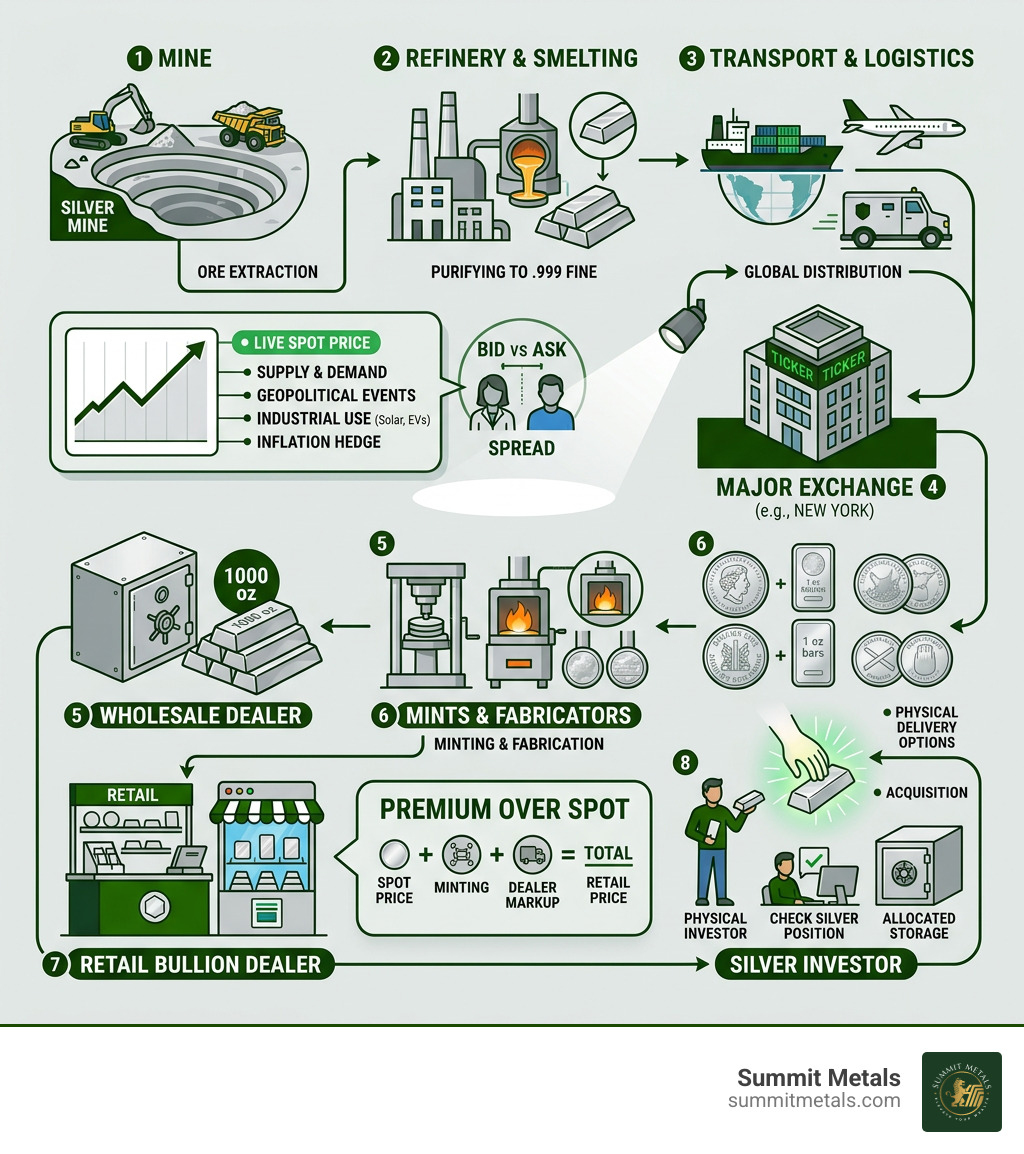
If the real time silver spot is $85, why does a one-ounce coin cost $95? This is the question every new investor asks. The difference is called the premium.
Premiums cover the costs of mining, refining, minting, insurance, and the dealer's small margin. When you buy "paper silver," you might stay closer to spot, but you take on counterparty risk—the risk that the institution holding your "paper" might fail. With physical silver in your hands, that risk disappears. To understand how these costs break down, read our guide on spot-price-vs-premium-how-precious-metals-pricing-works.
Comparing Bullion Formats for Bulk Buys
When you're looking for the "best deals," your choice of format matters. Are you looking for the lowest price per ounce, or do you want something that is easy to recognize and sell later?
| Feature | Silver Coins (Sovereign) | Silver Bars (Private Mint) |
|---|---|---|
| Legal Tender | Yes (e.g., American Silver Eagle) | No |
| Premiums | Higher (due to minting & trust) | Lower (best for bulk buys) |
| Fraud Protection | High (government backing/face value) | Moderate (requires testing) |
| Storage | Tubes/Boxes (can be bulky) | Uniform shapes (stack easily) |
| Numismatic Potential | Yes (collectors may pay more) | No (valued for metal content only) |
For those looking to maximize their "ounces per dollar," silver bars are often the winner. However, many of our clients in Wyoming and Utah prefer coins for their government guarantee. You can track the volatility of both using our dont-miss-a-beat-real-time-precious-metal-charts-for-savvy-investors.
Market Indicators: Contango and Backwardation
In the real time silver spot, two technical terms often signal what's coming next: Contango and Backwardation.
- Contango: This is the "normal" state where the futures price is higher than the spot price. It accounts for the costs of storing and insuring the metal over time.
- Backwardation: This is the "emergency" state where the spot price is higher than the futures price. This happens when there is a massive shortage of physical silver and people are willing to pay a premium to get it now.
If you see the market move into backwardation, it’s a sign of extreme supply stress. Learn more about these signals in the-silver-lining-how-to-track-and-understand-silver-prices.
Strategic Wealth Building: Autoinvest and the Gold-to-Silver Ratio
Investing in silver shouldn't be a gamble; it should be a strategy. One of the best ways to build wealth is to stop trying to "time the market" perfectly and start using Dollar Cost Averaging (DCA).
Leveraging the Gold-to-Silver Ratio
The gold-to-silver ratio tells you how many ounces of silver it takes to buy one ounce of gold. Historically, this ratio has sat between 40:1 and 60:1. In recent years, it has climbed as high as 100:1, and currently sits around 75:1.
Investors use this as a "value" indicator. When the ratio is high (like 80 or 90), silver is considered "cheap" relative to gold. Many savvy investors will trade their gold for silver when the ratio is high, then trade that silver back for gold when the ratio drops, effectively increasing their total metal holdings without spending more cash. Stay updated on these ratios with live-metal-prices-your-daily-dose-of-market-insights and compare them to the spot-price-gold-oz.
Autoinvest: The 401k Approach to Precious Metals
We often hear from clients who want to buy silver but are waiting for the "perfect" dip. The problem? By the time the dip happens, they've missed the real time silver spot moving up $10 an ounce.
This is why we created Autoinvest. Just like your 401k, Autoinvest allows you to set a fixed dollar amount every month to purchase silver.
- Discipline: You buy more ounces when the price is low and fewer when the price is high.
- Ease: No more staring at tickers all day.
- Wealth Preservation: You are consistently moving paper currency into a hard asset that has served as a store of wealth for 5,000 years.
Securing Your Gains: Storage and Exit Strategies
Buying silver is only half the battle. You also need a plan for where to put it and, eventually, how to sell it. While a home safe is great for small amounts, large bulk buys often require more professional security.
The "Sell to Us" Advantage
At Summit Metals, we don't just want to sell you silver; we want to be your long-term partner. This means considering your exit strategy from day one.
We recommend integrating private vault storage. By keeping your silver in a high-security, third-party vault, your assets remain "liquid." Because the metal is already authenticated and held in a secure chain of custody, we can buy it back from you instantly at competitive rates without the need for shipping or re-testing. This allows you to time the market perfectly when you're ready to take profits.
Frequently Asked Questions about Silver Pricing
What is the difference between the bid and ask price?
The bid is what a dealer or market maker is willing to pay you for your silver. The ask is the price at which they are willing to sell it to you. The difference between the two is the "spread," which represents the liquidity of the market.
Why can't I buy silver at the exact spot price?
The real time silver spot represents raw, industrial-sized bars (usually 1,000 ounces) sitting in a central exchange vault. To get that silver to you in the form of a beautiful 1-ounce coin or 10-ounce bar, it has to be refined, minted, assayed, insured, and shipped. The premium you pay covers these essential steps in the supply chain.
How does the gold-to-silver ratio help investors?
It acts as a relative value gauge. If the ratio is historically high, it suggests silver is undervalued compared to gold, signaling a potential "buy" opportunity for silver. If the ratio is low, it might be time to rotate some silver profits back into gold.
Conclusion
Navigating the real time silver spot doesn't have to be intimidating. By understanding how the price is set, choosing the right products for your goals, and using tools like Autoinvest, you can build a formidable precious metals portfolio.
Based in Wyoming, Summit Metals is committed to transparency. We provide real-time pricing and leverage our bulk purchasing power to ensure you get the best possible value, whether you're in Salt Lake City or anywhere else in the region. Ready to stop watching the charts and start building your stack?
Start your Autoinvest journey today and treat your silver holdings with the same professional discipline as your retirement account.