Why Tracking Precious Metal Prices in Real Time Matters for Your Portfolio
Keeping an eye on the precious metal prices chart today provides critical data that can make or break your investment decisions. The market moves every few seconds during trading hours, meaning the price you see at 9 AM can be drastically different by 3 PM. A single Fed announcement can swing gold prices, while supply disruptions can send others soaring overnight.
Without access to real-time charts, you're investing blind. Here's a snapshot of the market as of publication:
| Metal | Spot Price | 24-Hour Change | % Change |
|---|---|---|---|
| Gold | $4,085.83/oz | -$89.60 | -2.15% |
| Silver | $50.58/oz | -$1.73 | -3.32% |
| Platinum | $1,537.75/oz | -$40.00 | -2.53% |
| Palladium | $1,381.00/oz | -$29.00 | -2.06% |
Whether you're hedging against inflation, diversifying from volatile stocks, or building long-term wealth protection, live price data is your foundation. These numbers are signals about currency strength, geopolitical stability, and global economic health. Price charts are your market radar, revealing whether you're buying at a peak or catching a strategic dip.
While the precious metals market includes four major metals, they respond to different forces. Gold and silver are the cornerstones of investment, acting as safe havens and inflation hedges. Platinum and palladium are primarily industrial metals tied to automotive trends. Understanding these dynamics transforms you from a reactive buyer into a strategic investor.
I'm Eric Roach, and I've spent over a decade advising on multi-billion-dollar hedging strategies in New York investment banking. Today, I help individual investors apply those same institutional tactics to steer the precious metal prices chart today and build resilient portfolios through physical gold and silver.

Today's Live Precious Metal Prices & Market Snapshot
The precious metal prices chart today tells a story that's constantly being written. Right now, the market is showing movementand that's what creates both challenges and opportunities for investors.
As of this publication, Gold is trading at $4,085.83 per ounce, down 2.15%. Silver sits at $50.58 per ounce, a pullback of 3.32%. The industrial metals are also down, with Platinum declining 2.53% to $1,537.75 and palladium at $1,381.00, a 2.06% drop.
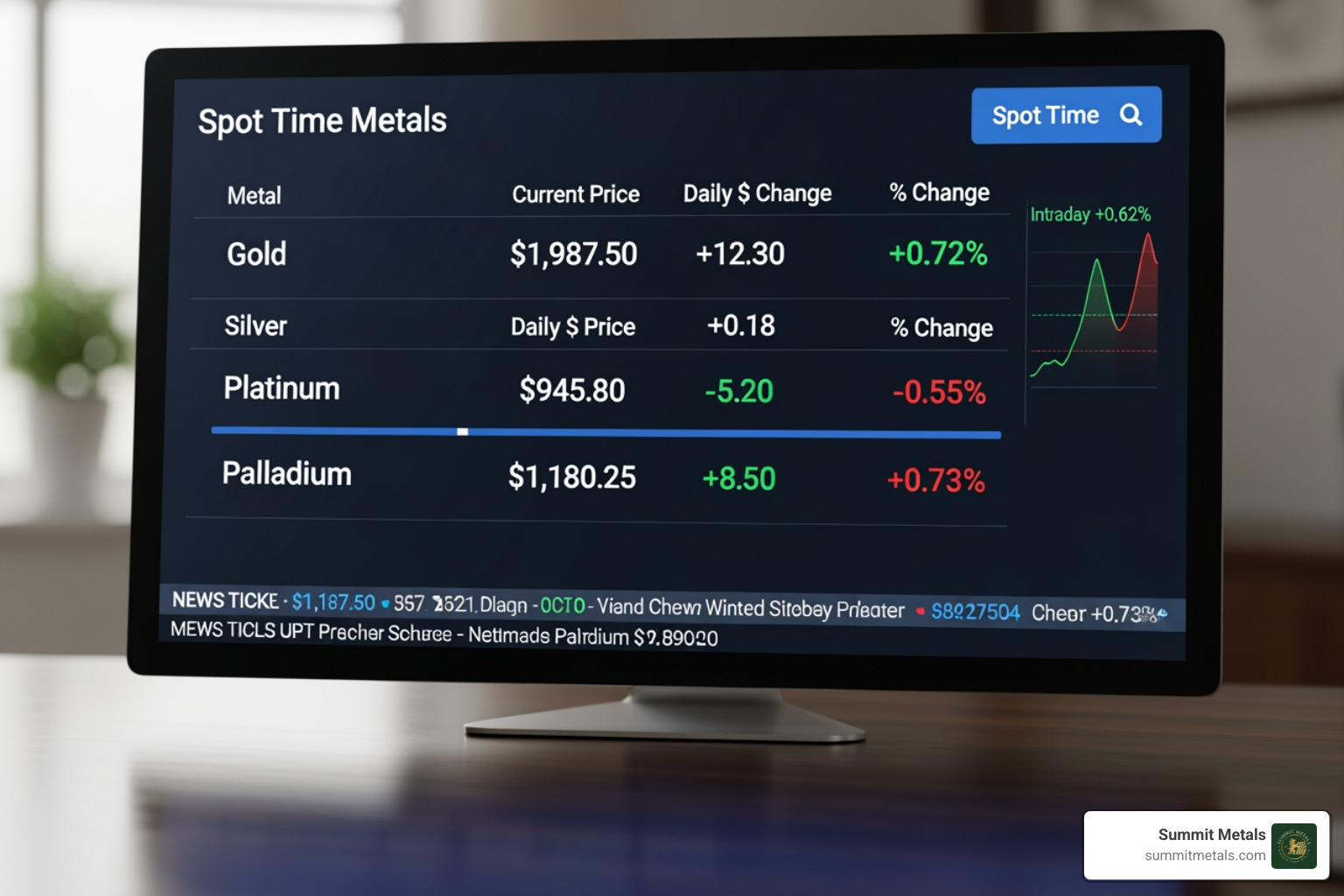
Before reacting to those red numbers, remember: short-term dips are just snapshots, not the full picture. These 24-hour movements reflect immediate market sentiment, but they don't define the long-term trend. The real value in watching the live gold price and live silver price isn't to react to every wiggle. It's to understand when you're buying and whether you're getting fair value.
Market sentiment is currently cautious with a touch of volatilityan environment where informed investors often find opportunities. For real-time tracking, bookmark Summit Metals' live pricing and market insights and neutral sources like CME Group metals quotes and the World Gold Council's data hub.
These prices will be different tomorrow. That's why strategic investors don't try to time the perfect moment. Instead, they use approaches like dollar-cost averaging through programs like Summit Metals' Autoinvest to build positions consistently over time, just as you would with a 401(k).
The beauty of live pricing is transparency. You know exactly what you're paying relative to the global market. At Summit Metals, our real-time pricing reflects current spot prices plus our competitive premiumsnothing hidden, everything clear.
How to Read and Analyze a Precious Metal Prices Chart Today
Reading a precious metal prices chart today is like learning to read a weather forecast. Once you understand the basics, you can spot patterns and make smarter decisions.
Every chart has a vertical Y-axis showing the price per ounce and a horizontal X-axis showing time (minutes, days, or years). You'll typically see two chart types: Line charts, which offer a clean view of overall trends, and Candlestick charts, which pack more data into each "candle" to show opening, closing, high, and low prices for a period. Each candle tells a story about whether buyers or sellers had the upper hand.
Understanding Key Pricing Terms
To understand the charts, you need to know the language of the market.
- Spot Price: The current market price for immediate delivery of a raw precious metal. This is the benchmark price that changes constantly, but it's not the price for physical, fabricated products.
- Bid Price: The price a dealer will pay to buy metal from you.
- Ask Price: The price a dealer will charge to sell metal to you (also called the offer price).
- Spread: The difference between the bid and ask prices. A tight spread indicates a liquid, competitive market.
- Premium: The amount added to the spot price for a physical product like a coin or bar. It covers costs like fabrication, shipping, insurance, and dealer operations. We explain this in detail in our guide on Spot Price vs. Premium: How Precious Metals Pricing Works.
- Market Liquidity: How easily a metal can be bought or sold without affecting its price. Gold and silver are highly liquid assets.
Short-Term vs. Long-Term Analysis on a precious metal prices chart today
The timeframe you choose completely changes what you see. A 24-hour chart shows intraday volatility, which is mostly noise for long-term investors. Obsessing over hourly swings is stressful and counterproductive.
Zoom out to a 1-year chart, and patterns emerge. You can spot seasonal trends and identify uptrends or downtrends, helping you avoid buying at temporary peaks.
The real magic happens on a 10-year chart. This long-term view smooths out the daily drama and reveals the metal's true performance through multiple economic cycles. It shows why precious metals have served as wealth preservation tools for generations. Our guide on Gold Prices Today Live Gold Price Chart Historical Data explores why this historical perspective is so important.
At Summit Metals, we recommend using both. The short-term view helps time a purchase, while the long-term view reminds you why you're investing in the first place: wealth protection and diversification.
Comparing the Big Four: Gold, Silver, Platinum & Palladium
Each precious metal has a unique personality. Understanding what drives each helps you interpret their movements.
Gold is the classic safe-haven asset. When markets panic, currencies weaken, or inflation rises, investors flee to gold. Its price often moves inversely to the U.S. dollar. As a store of value for millennia, it offers stability compared to other metals.
Silver has a dual personality. It's an investment metal like gold but also has significant industrial uses in electronics, solar panels, and medical applications. This means silver's price responds to both investment demand and economic growth, making it more volatile but also offering unique opportunities. Our article The Silver Lining: How to Track and Understand Silver Prices explores this dynamic.
Platinum and Palladium are primarily industrial metals. Their prices are closely tied to the automotive industry, where they are used in catalytic converters. Because their value is linked to manufacturing trends and concentrated supply chains (mainly Russia and South Africa), they are subject to different market forces than gold and silver. At Summit Metals, we focus on gold and silver as the foundational assets for long-term wealth protection.
Understanding these differences helps you build a diversified portfolio. By focusing on gold and silver, you are investing in assets with a long history as monetary metals and safe havens.
Key Factors Driving Today's Precious Metal Prices
Understanding the movements on a precious metal prices chart today means looking beyond the numbers to the powerful forces that drive them. These aren't random fluctuations; they are responses to global events and economic indicators.
Think of precious metal prices as a reflection of the world's financial health. Every central bank decision, geopolitical headline, and supply disruption sends ripples through these markets. The main drivers fall into several categories, which we discuss in articles like Key Factors Influencing Gold & Silver Prices: Supply, Demand, Geopolitics.
Macroeconomic Movers: Inflation, Interest Rates, and the Dollar
These three interconnected forces are crucial for reading any precious metal prices chart today.
Inflation is gold and silver's best friend. When the purchasing power of currency erodes, investors seek hard assets that hold their value. Gold has been the go-to inflation hedge for centuries, and its price often climbs on inflation fears.
Interest rates create a tug-of-war. Higher rates make interest-bearing assets like bonds more attractive than non-yielding precious metals. Conversely, low interest rates reduce the opportunity cost of holding gold and silver, making them more appealing. This is why Fed meeting days can create wild swings in the metals markets.
U.S. Dollar strength is critical because metals are priced in dollars globally. A stronger dollar makes gold more expensive for foreign buyers, which can reduce demand and lower prices. A weaker dollar has the opposite effect. This inverse relationship is one of the most reliable patterns in financial markets, as we explore in The Interplay of Interest Rates, the Dollar, and Gold Prices.
Economic uncertainty and geopolitical events act as rocket fuel for precious metals. When recession fears spread or conflicts erupt, investors flee to the safety of gold and silver.
Understanding Metal Ratios for a precious metal prices chart today
Beyond individual prices, savvy investors track metal ratios to spot opportunities. The most important is the Gold/Silver Ratio.
The Gold/Silver Ratio tells you how many ounces of silver it takes to buy one ounce of gold. With gold around $4,086 and silver at $50.58, the ratio is roughly 80:1. Historically, this ratio has fluctuated significantly.
When the ratio is high (e.g., above 80), it suggests silver is undervalued relative to gold. When it's low (e.g., below 50), gold may be the better value. Many investors use this ratio to decide which metal to buy or even to swap between them to increase their total ounces over time.
This ratio is a practical tool that professional investors use to optimize their holdings. We break it down in Understanding the Gold and Silver Ratio: A Key Indicator for Precious Metals Investors.
Smart Investment Strategies Using Price Charts
Once you can read a precious metal prices chart today, the next step is putting that knowledge to work. At Summit Metals, we believe the key is not just watching charts, but knowing how to act on what they tell you. As we explore in Price of Gold and Silver Bullion: Essential Investments for Wealth Protection Amid Economic Uncertainty in 2024, building a resilient portfolio means combining market awareness with disciplined action.
The Power of Consistency: Dollar-Cost Averaging and Autoinvest with Summit Metals
I'm often asked, "When's the best time to buy gold?" My answer is simple: every month.
Dollar-Cost Averaging (DCA) is the strategy that removes the guesswork from market timing. Instead of trying to predict price moves, you invest a fixed amount at regular intervals—say, $500 every month. When prices are low, your money buys more ounces; when prices are high, it buys less. Over time, this smooths out volatility and builds your holdings steadily.
DCA removes emotion from investing. No more stress about timing the perfect dip or regret about missing a price run. You simply stick to your plan.
At Summit Metals, we've made this easy with our Autoinvest program. Set it up once, and we'll automatically purchase gold or silver for you every month, just like a 401(k) contribution. It's hands-off, disciplined wealth building that works while you live your life. Consistent investing, as we discuss in Silver Price: The Bullish Case for Silver with a Potential 20% Upside and What It Means for Precious Metals Investors, positions you to capture long-term gains without the stress.
Choosing Your Asset: Coins vs. Bars
When buying physical metal, you'll choose between coins and bars. Both are excellent, but they serve slightly different portfolio roles.
| Feature | Gold Coins | Gold Bars |
|---|---|---|
| Premiums | Generally higher due to minting costs and design | Generally lower, especially on larger bars |
| Liquidity | Extremely high—universally recognized and easy to sell | High for standard sizes, slightly less for unusual weights |
| Divisibility | Excellent—available in 1/10 oz, 1/4 oz, 1/2 oz, and 1 oz sizes | Less flexible, though smaller bars exist |
| Face Value | Yes—legal tender with nominal value (e.g., $50 for 1 oz American Gold Eagle) | No face value |
| Fraud Protection | Superior—backed by sovereign mints with legal tender status and security features | Relies on assay certificates and dealer reputation |
| Storage | Compact but more individual pieces per ounce | More efficient for storing large quantities |
The standout advantage of gold coins is their face value. While nominal, this legal tender status provides powerful fraud protection. Sovereign mints like the U.S. Mint stake their reputation on every coin, and counterfeiting legal tender is a serious crime. This makes coins easier to authenticate and more widely accepted by dealers, making them a great choice for flexibility and security.
Gold bars shine for larger investments. Their lower premiums mean more of your money goes into the metal itself. For investors accumulating significant holdings, bars offer efficiency and value.
Most portfolios benefit from both. Start with coins for liquidity and security, then add bars as your holdings grow. We dive deeper in Unlocking Value: Understanding Gold and Silver's Current Worth.
Frequently Asked Questions about Precious Metal Charts
After years of working with investors at Summit Metals, I've noticed the same thoughtful questions come up time and again. Let me address the most common ones.
Why can't I buy precious metals at the spot price?
The spot price is for raw, unrefined metal in industrial quantities. The physical gold or silver you buy from Summit Metals is a finished, authenticated product. The premium you pay above spot covers real-world costs:
- Fabrication: Minting, stamping, and refining raw metal into a coin or bar.
- Operational Costs: Secure storage, authentication by our expert staff, and the services that keep our business running to serve you.
- Shipping and Insurance: Moving precious metals safely requires specialized carriers and comprehensive coverage.
Premiums can also rise with demand during times of economic uncertainty. We believe in transparency, which is why we've written about this in The Price of Shine: Understanding Your Bullion's Premium. Understanding premiums helps you recognize a fair deal.
Where can I find reliable, real-time precious metal charts?
In a market where prices change by the second, trustworthy data is essential. Here are the platforms I rely on and recommend:
- Summit Metals: Real-time pricing and transparent premiums.
- Bloomberg.com: Offers institutional-grade financial data, allowing you to see how metals correlate with other assets.
- CME Group: Live futures quotes and market depth for metals.
- World Gold Council: Independent research and data on gold.
- LBMA: Benchmark prices and market data for precious metals.
And of course, Summit Metals provides transparent, real-time pricing directly on our website. We update our prices constantly throughout the trading day to reflect the live market. Because we purchase in bulk and operate with lower overhead, our prices reflect genuine value. My advice is to cross-reference non-competing sources before a major purchase to ensure you're seeing an accurate market rate.
How often do precious metal prices change?
Precious metal prices move constantlyiterally every few seconds during active trading hours. The global market operates nearly 24/7 during the week, with major trading hubs in Hong Kong, Zurich, London, and New York creating a continuous chain of price findy.
This constant motion is driven by breaking news, economic data releases, and shifts in supply and demand. A single news headline can cause an immediate price jump or dip. This dynamic environment is exactly why we emphasize real-time data and strategic approaches like dollar-cost averaging through our Autoinvest program. You can't time every market movement, but you can build your position consistently over time.
Conclusion
The journey through understanding a precious metal prices chart today isn't just about watching numbers on a screen. It's about equipping yourself with the knowledge to make decisions that protect and grow your wealth in an uncertain world.
When you grasp the fundamentals—how to read the charts, why the spread matters, what drives gold up when the dollar weakens—you're no longer guessing. You're strategizing. You understand why gold and silver shine during geopolitical turmoil and act as a hedge against inflation.
The macroeconomic forces we've explored—inflation, interest rates, dollar strength, and global events—are the real-world drivers that impact your portfolio. By keeping one eye on short-term fluctuations and the other on long-term trends, you develop the perspective that separates reactive buyers from strategic investors.
Perhaps most importantly, you've learned that timing the market perfectly is nearly impossible. That's why strategies like Dollar-Cost Averaging through our Autoinvest program are so powerful. By consistently investing every month, like a 401(k) contribution, you remove the emotional rollercoaster and build your holdings steadily.
Whether you choose the fraud protection of coins or the lower premiums of bars, you're now equipped to make that decision for your goals. You know where to find reliable data and you understand the nature of these markets.
At Summit Metals, we've built our reputation on transparent, real-time pricing and authenticated bullion because informed investors are successful investors. We provide the tools, knowledge, and competitive rates that help you steer these markets with confidence.
The precious metals market will continue to fluctuate, but now you have the framework to turn those challenges into opportunities.
Start building your precious metals portfolio with our comprehensive guides and real-time pricing. Your future self will thank you for the strategic decisions you make today.