Why Real-Time Precious Metals Prices Matter Right Now

Real-time precious metals prices give you the live market data you need to buy, sell, or hold with confidence. Here's a quick snapshot of where major metals stand (prices at time of publication):
| Metal | Spot Price (USD/troy oz) | Daily Change | Daily Range |
|---|---|---|---|
| Gold | $5,081.10 | +$0.80 (+0.02%) | $5,051.20 - $5,195.60 |
| Silver | $82.68 | +$0.54 (+0.65%) | $78.71 - $85.69 |
| Platinum | $2,122.00 | +$4.00 (+0.19%) | $2,097.00 - $2,228.00 |
| Palladium | $1,623.00 | +$5.00 (+0.31%) | $1,603.00 - $1,723.00 |
| Rhodium | $11,100.00 | - | - |
Note: Gold hit an all-time high of $5,602.22 on January 28, 2026. Current prices remain well above historic averages, making accurate, up-to-the-minute data more critical than ever.
Precious metals markets move fast. Geopolitical tension, a shifting US dollar, or a single central bank announcement can swing prices by hundreds of dollars in a single session. If you're working with stale data, you're making decisions in the dark.
This guide walks you through how to read live prices, what actually drives them, and how to use that information to protect and grow your wealth.
I'm Eric Roach, a former Wall Street investment banker and M&A advisor who has spent over a decade helping clients navigate complex markets — and I now specialize in translating real-time precious metals prices into clear, actionable strategies for everyday investors. Let's break it all down so you can make your next move with confidence.
Understanding Real-Time Precious Metals Prices and Market Drivers
When we talk about real-time precious metals prices, we are looking at a living, breathing global auction. Unlike a grocery store where the price of milk stays the same from morning until night, the "spot price" of gold or silver can change every few seconds.

Several major levers pull on these prices simultaneously. Currently, the primary drivers include:
- Geopolitical Tensions: Conflict in regions like the Middle East often triggers a "flight to safety." For instance, recent tensions involving Iran caused gold to surge briefly as investors sought shelter from equity market volatility.
- The US Dollar (USD) Strength: There is traditionally an inverse correlation between the dollar and metals. When the USDX rallies, precious metals often face downward pressure.
- Central Bank Activity: Central banks are massive players. Some nations, like Poland, have recently considered selling reserves to fund defense budgets, while others continue to stack gold at record rates.
- Economic Data: Downbeat U.S. jobs data or a drop in retail sales (like the -0.2% dip seen in January) often sends gold prices higher as investors bet on future interest rate cuts.
To ensure global consistency, organizations like the ICE Benchmark Administration (IBA) and the London Metal Exchange (LME) provide the "fixes" or benchmarks that the rest of the world uses to settle contracts.
How to Interpret Real-Time Precious Metals Prices for Gold and Silver
Reading a price ticker is one thing; understanding it is another. To get the full picture, we look at more than just the "Last" price.
- Bid/Ask Spread: The "Bid" is what a dealer will pay you for your metal. The "Ask" is the price at which they will sell it to you. A narrow spread usually indicates high market liquidity.
- Intraday Highs and Lows: Today, gold has seen a wide range between $5,051.20 and $5,195.60. If the current price is hugging the daily high, market sentiment is likely bullish.
- Market Sentiment: This is the "mood" of the room. Are traders fearful (buying gold) or greedy (selling gold to buy stocks)? You can find excellent Live Metal Prices: Your Daily Dose of Market Insights to help gauge whether the current move is a temporary spike or a long-term trend.
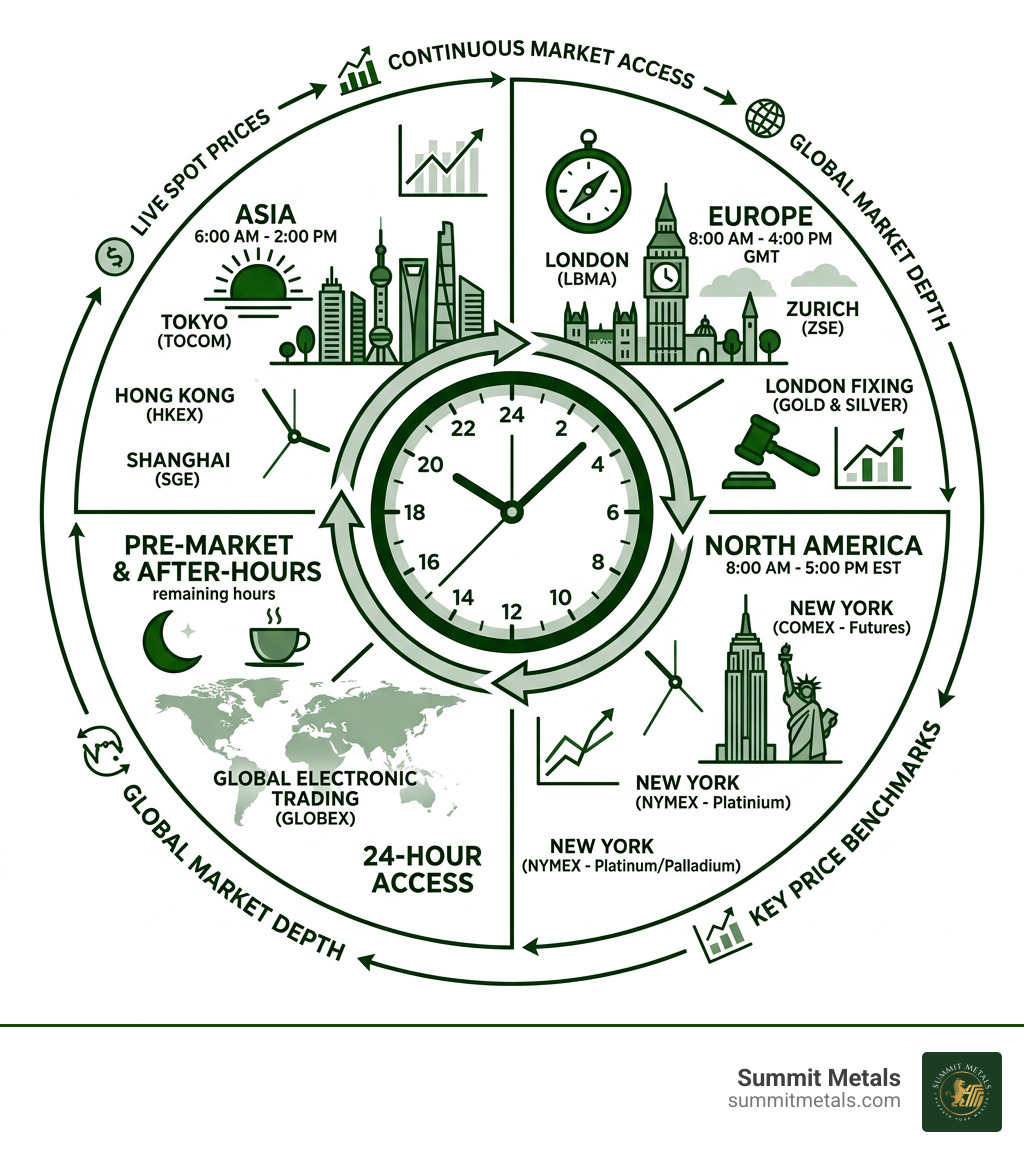
The Role of Global Exchanges in Real-Time Precious Metals Prices
The sun never sets on the metals market. It starts in Asia, moves to London, and then hits New York.
- COMEX (New York): This is where futures contracts (like the Apr 2026 Gold contract) are traded. These futures prices often lead the spot price.
- LBMA (London): The London Bullion Market Association sets the "Gold Fix" twice daily, which serves as the global benchmark for physical delivery.
- Shanghai Gold Benchmark: Increasingly, price discovery is migrating East. The Shanghai market often shows different premiums than Western markets due to local supply constraints or high demand.
For a deeper dive into how these regional prices affect your local buying power, check out our Spot On: Your Live Silver Price Per Ounce Guide.
Spot Price vs. Physical Premiums: What Investors Actually Pay
A common point of confusion for new investors is why they can’t buy a Silver Eagle for the exact spot price of $82.68. The answer lies in the "premium."
The spot price represents "paper" metal—large, industrial-sized bars sitting in a vault. To turn that into a beautiful, 1-ounce coin in your hand, there are costs for refining, minting, insurance, and shipping. This is known as the transactional spread.
At Summit Metals, we use our bulk purchasing power to keep these premiums as low as possible. We believe in transparency; you should always know exactly how much of your investment is going toward the metal's "melt value" versus the fabrication cost. You can learn more about this in our guide on Spot Price vs. Premium: How Precious Metals Pricing Works. Understanding The Price of Shine: Understanding Your Bullion's Premium is the first step to becoming a savvy stacker.
Comparing Investment Formats: Coins vs. Bars
Should you buy bars or coins? It depends on your goals. Bars are generally more "efficient" (lower premium per ounce), but coins offer unique protections.
| Feature | Gold/Silver Coins | Gold/Silver Bars |
|---|---|---|
| Premium | Higher (due to minting) | Lower (bulk format) |
| Legal Tender | Yes (has face value) | No |
| Fraud Protection | High (Government backed) | Moderate (Dealer backed) |
| Liquidity | Very High (recognizable) | High |
| Storage | Tubes/Monster boxes | Stackable sheets/Individual |
Why we love coins: Because coins like the Silver Eagle have a legal tender "face value," they carry extra layers of protection against counterfeiting. If someone fakes a government coin, they aren't just a scammer; they're a federal counterfeiter. To see how this affects current market rates, see Stay Ahead of the Market: Silver Eagle Prices Today.
Strategic Trading: Using Ratios and Historical Data
If you want to move beyond just "buying and holding," you need to look at the relationship between metals.
- The Gold/Silver Ratio: This tells you how many ounces of silver it takes to buy one ounce of gold. Historically, when this ratio is very high (e.g., above 80), silver is considered "cheap" relative to gold. Many investors use this as a signal to swap some gold for silver, then swap back when the ratio drops.
- Support and Resistance: These are the "floors" and "ceilings" of the market. If gold repeatedly fails to drop below $5,050, that’s a strong support level—a potential buying opportunity.
For real-time tracking of these levels, we recommend using Don't Miss a Beat: Real-Time Precious Metal Charts for Savvy Investors. You can also jump into market sentiment discussions on Kitco Forum to see what other traders are watching.
Analyzing All-Time Highs and Market Cycles
We are currently in a historic period. Gold hit a record $5,602.22 in early 2026. While "buying the top" can feel scary, gold is an inflation hedge. As the currency devalues, the nominal price of gold must rise just to maintain its purchasing power.
Reviewing Gold Prices Today: Live Gold Price Chart & Historical Data helps you identify whether we are in a parabolic spike or a steady climb. This historical context is vital for risk mitigation.
Building a Liquid Portfolio with Summit Metals
We founded Summit Metals in Wyoming with a simple mission: to make precious metals as easy to own as a stock portfolio, but with the security of physical assets.
One of our favorite tools for long-term wealth is Autoinvest. Just like your 401k, you can set up a monthly purchase to "dollar cost average." By buying a set dollar amount every month, you naturally buy more ounces when prices are low and fewer when prices are high. It takes the emotion out of the "real-time" price swings.
Whether you are in Salt Lake City, Utah, or anywhere across the country, we provide authenticated bullion that has been rigorously tested. You can find out more about Unlocking Today's Value: What is the Current Price of Gold and Silver? on our site.
Exit Strategies and the "Sell to Us" Advantage
An investment is only as good as your ability to exit it. We don't just want to sell you gold; we want to be your long-term partner.
We offer private vault storage options that keep your metals secure but highly liquid. If you need cash, you don't have to worry about finding a buyer on the street. With our "Sell to Us" program, we offer a guaranteed two-way market. Because we know the provenance of the metal (since we sold it to you and stored it), we can offer top-tier buyback rates.
This is especially important for rarer metals; for example, see Platinum Bullion and Spot Price: What You Need to Know regarding the liquidity of PGMs.
Frequently Asked Questions about Precious Metals Pricing
Why is the spot price different from the price I pay at checkout?
The spot price is for 400-ounce industrial bars. Your price includes the "premium," which covers the cost of minting smaller units (like 1-oz coins), insurance, and the dealer's operational costs.
How often do real-time precious metals prices update?
During active market hours, prices update every 60 seconds or less. Markets are generally open from Sunday evening (EST) through Friday afternoon, following the global trading clock from Sydney to New York.
What is the gold/silver ratio and why does it matter for my portfolio?
It measures the relative value of the two metals. A high ratio suggests silver is undervalued; a low ratio suggests gold might be the better buy. Savvy investors use this ratio to "rebalance" their physical holdings without needing to inject new cash.
Conclusion
In a world of digital uncertainty, precious metals remain the ultimate "truth" in finance. They cannot be printed, they cannot be deleted, and they have no counterparty risk when held in physical form. By keeping a close eye on real-time precious metals prices, you aren't just watching numbers on a screen—you are watching the pulse of global wealth.
Whether you're looking to make a one-time purchase or start a disciplined monthly habit with Autoinvest, we're here to help. Start your investment journey with Summit Metals today and experience the value of transparent, real-time pricing.