What Is the Gold Spot Price Oz — and Why Does It Matter Right Now?

The gold spot price oz is the live price at which one troy ounce of gold can be bought or sold right now on the global market. At the time of this publication, gold is trading at approximately $5,359.60 per ounce (bid), with an ask price of $5,361.60.
Here's a quick snapshot of what you need to know:
| Metric | Value (at time of publication) |
|---|---|
| Gold Spot Price (Bid) | $5,359.60 / oz |
| Gold Spot Price (Ask) | $5,361.60 / oz |
| Gold per Gram | $172.32 |
| Gold per Kilo | $172,317.78 |
| All-Time High | $5,602.22 (Jan 28, 2026) |
| Day's Range | $5,275.00 – $5,394.10 |
The spot price is the universal benchmark for every gold transaction on earth — from central bank reserves to the coin you hold in your hand. It moves constantly, driven by inflation, interest rates, geopolitical tension, and currency shifts. Understanding it isn't just for Wall Street traders. It directly affects what you pay, what you earn, and whether your wealth is protected.
Gold has delivered an average annual return of roughly 7.78% from 1971 to 2022 — and it hit record highs as recently as January 2026. Whether you're a first-time buyer or a seasoned investor, knowing how the spot price works is the foundation of every smart precious metals decision.
I'm Eric Roach — a former investment-banking and M&A advisor who spent over a decade structuring multi-billion-dollar hedging programs for Fortune 500 companies before turning my focus to helping everyday investors use physical gold and silver to protect their wealth. I've built this guide to give you the same clear-eyed understanding of the gold spot price oz that institutional traders use — without the jargon.
What is the Gold Spot Price Oz and How is it Calculated?
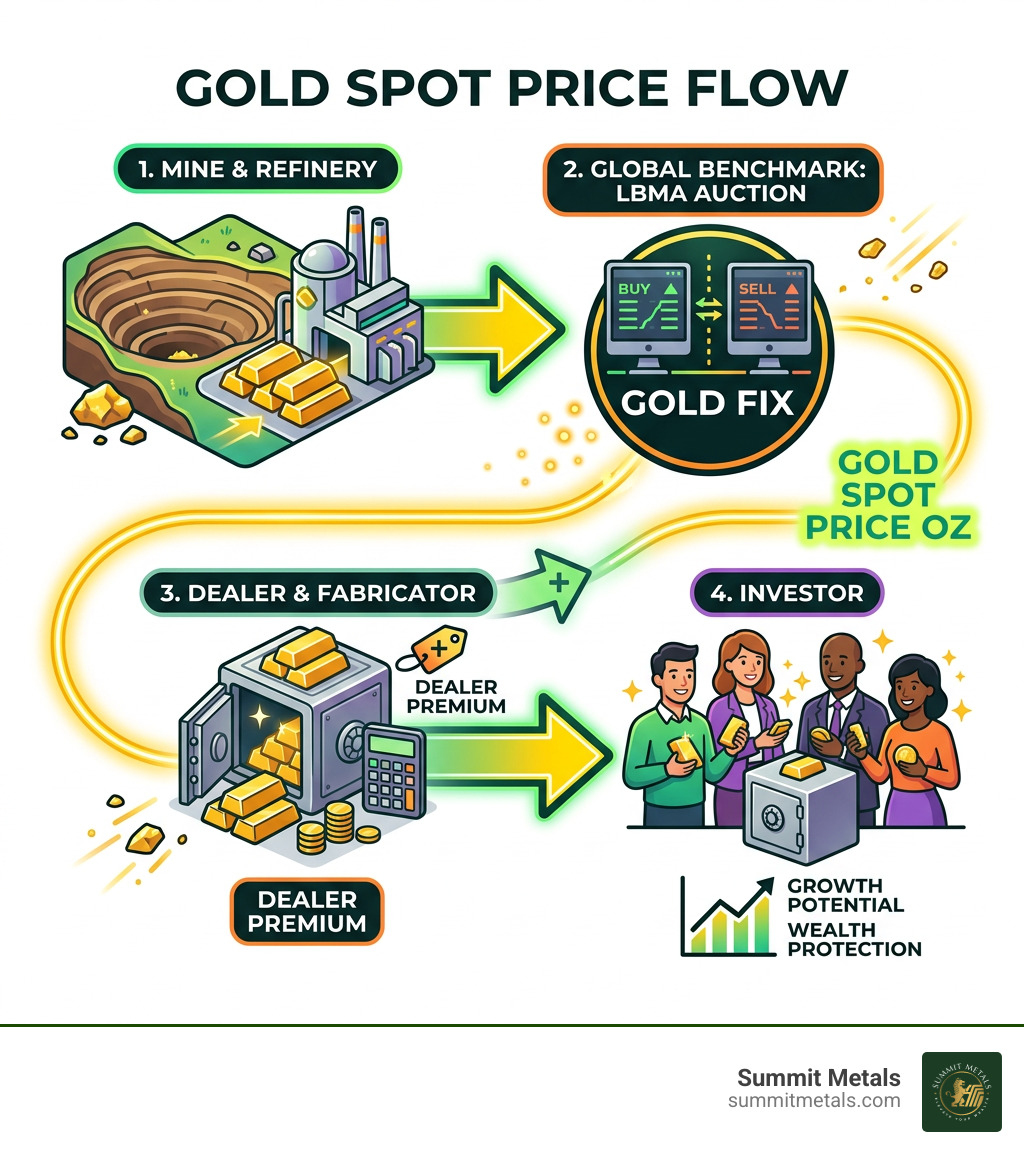
When we talk about the gold spot price oz, we are referring to the price for immediate delivery of gold. Unlike a "future" price, which is a bet on what gold will cost months from now, the spot price is the "right now" value. But how is that number actually reached? It isn't just a random guess; it's a sophisticated global balancing act.
The primary benchmark for the global market is the LBMA Gold Price. The London Bullion Market Association (LBMA) conducts electronic auctions twice daily. During these auctions, major international banks, refiners, and institutional investors submit buy and sell orders. When the supply and demand reach an equilibrium, the "fix" is set. (For background on how spot pricing works in commodities markets, see Spot price.)
Parallel to this, the COMEX (part of the Chicago Mercantile Exchange) plays a massive role through gold futures contracts. Because these contracts represent such a high volume of trading, the "front-month" contract (the one closest to expiration) heavily influences the live spot price you see on professional market data feeds.
Understanding the Bid/Ask Spread
In the precious metals world, you will always see two numbers:
- The Bid: What the market is willing to pay you for your gold.
- The Ask: The price at which the market is willing to sell gold to you.
The difference between these two is the "spread." At Summit Metals, we believe in live-metal-prices-your-daily-dose-of-market-insights to ensure our clients in Salt Lake City and beyond always see the most accurate data.
Troy Ounce vs. Standard Ounce
It is vital to remember that gold is measured in troy ounces, not the standard "avoirdupois" ounces used for groceries. A troy ounce is heavier, weighing approximately 31.103 grams, compared to the 28.35 grams in a standard ounce. When you look at live market data, always ensure you are calculating based on the troy measurement.
Why You Should Never Buy Below the Gold Spot Price Oz
It is a classic "too good to be true" scenario. If someone offers you a gold spot price oz that is significantly lower than the live market rate, walk away.
Why? Because the supply chain has real, fixed costs. From the energy used in mining to the security required for refining and the minting process, there is a baseline cost to bringing gold to market. Any offer below spot is almost certainly a scam involving counterfeit gold or misrepresented purity.
As we explain in our guide on spot-price-vs-premium-how-precious-metals-pricing-works, premiums are a normal part of a legitimate, authenticated transaction.
Global Markets and the 24-hour Trading Cycle
Gold never sleeps. Because it is a global asset, the market follows the sun.
- London and Zurich: The historical heart of physical gold trading.
- New York (COMEX): The powerhouse of futures and paper trading.
- Hong Kong and Singapore: Crucial hubs for Asian demand.
As one market closes, another opens, ensuring that the gold spot price oz is updated every few seconds. This constant movement is also affected by currency fluctuations. Since gold is primarily traded in U.S. Dollars (XAU/USD), if the dollar weakens, the gold price often appears to rise, and vice versa.
Quick Decision Chart: What the Spot Price Tells You (and What It Doesn't)
Use this simple chart to avoid common mistakes when you see live pricing:
| If you are looking at... | It usually reflects... | What it does not include |
|---|---|---|
| Spot price (XAU/USD) | "Raw" wholesale value of gold in large-market trading | Minting/fabrication, shipping, insurance, dealer margin |
| Dealer price for a 1 oz coin | Spot price + premium | It is not a "rip-off" by default; it is the finished product cost |
| "Below spot" offer | Almost always misrepresentation or fraud risk | Legitimate supply chain costs cannot disappear |
If you want to reduce timing stress, one of the simplest ways to use the spot price intelligently is to dollar cost average. With Summit Metals Autoinvest, you can buy every month, 401k-style, regardless of short-term volatility, instead of trying to guess the perfect day to buy.
The Economic Forces Driving the Gold Spot Price Per Ounce Today
If you’ve noticed the gold spot price oz climbing toward record highs—like the peak of $5,602.22 reached in early 2026—you’re seeing the result of several "perfect storm" economic factors.
US Dollar Strength and Inflation
Gold and the U.S. Dollar generally have an inverse relationship. When the dollar is strong, gold becomes more expensive for investors holding other currencies, which can dampen demand. Conversely, when inflation rises and the purchasing power of the dollar drops, investors flock to gold as a "store of value." With US inflation recently sitting around 2.40%, many have used gold to hedge against the eroding value of their cash.
How Interest Rates Impact the Gold Spot Price Oz
The Federal Reserve’s interest rate policy is perhaps the biggest "price mover." Gold does not pay a dividend or interest. Therefore, when the Fed Funds Rate is high (recently at 3.75%), there is an "opportunity cost" to holding gold—you could be earning interest in a savings account or bond instead.
However, when the Fed hints at rate cuts, the opportunity cost drops, making gold much more attractive. This is why you’ll often see a "spike" in the gold spot price oz immediately following a Fed announcement. You can track these movements in real-time through our live pricing data.
Geopolitical Risk and Safe Haven Demand
Gold is the ultimate "crisis commodity." In times of war, trade tariffs, or election uncertainty, investors seek safety. We saw this clearly during the price surges following major geopolitical events in 2024 and 2025. When the world feels unstable, the "safe haven" demand for gold increases, driving up the gold spot price oz. You can see how these events correlate with price spikes in our look at gold-prices-today-live-gold-price-chart-historical-data.
Central Bank Reserves
Central banks are among the largest players in the market. In 2025, the United States held a massive 8,133.46 tonnes of gold, while countries like China and Russia have been aggressively adding to their reserves. When central banks buy gold, they take supply off the market, which provides a strong "floor" for the spot price.
Physical Gold vs. Paper Derivatives: Understanding the Real Cost
Many investors are tempted by "paper gold"—ETFs (Exchange Traded Funds) or futures. While these are convenient, they come with hidden costs and risks that physical gold does not.
The Hidden Cost of ETFs
A gold ETF tracks the gold spot price oz, but you don't actually own the metal. You own a share in a trust. Over time, management fees (often 0.25% to 0.40% annually) eat into your returns. Research shows that over a 30-year period, the compounding fees of an ETF can cost an investor tens of thousands of dollars more than the one-time premium paid for physical bullion.
Spot Price vs. Dealer Premiums
When you buy a physical 1 oz gold bar or coin, you will pay a "premium" over the spot price. This covers the cost of minting, security, and the dealer's small margin. For example, if the spot price is $5,073.00, a 1 oz bullion bar might have an ask price of $5,182.00.
At Summit Metals, we pride ourselves on transparent pricing. We use our bulk-purchasing power to keep these premiums as low as possible for our clients.
Comparison: Gold Coins vs. Gold Bars
Choosing between coins and bars is more than just an aesthetic choice. Here is how they stack up:
| Feature | Gold Bullion Coins | Gold Bullion Bars |
|---|---|---|
| Legal Tender | Yes (Face Value) | No |
| Fraud Protection | High (Government Minted) | Moderate |
| Premiums | Slightly Higher | Lower |
| Recognition | Universal | High |
| Best For | Small-scale investors & liquidity | Large-scale wealth preservation |
Why we love coins: Coins like the American Eagle or South African Krugerrand are legal tender. This gives them an extra layer of government-backed fraud protection. In some jurisdictions, having a face value can also offer distinct legal or tax advantages.

Historical Trends
Looking back, gold's journey is remarkable. From being fixed at $35/oz during the Bretton Woods era to hitting $1,924 in 2011 and eventually smashing through $5,000 in 2026, the trend is clear. While the gold spot price oz fluctuates daily, its long-term trajectory has historically served as a powerful wealth protector. Check out our historical-price-of-silver-graph to see how other precious metals compare over the same timeline.
Strategic Investing: From Autoinvest to Your Exit Strategy
Investing in gold shouldn't be a "one and done" event. The most successful investors use a strategy called Dollar Cost Averaging (DCA).
Building Wealth with Autoinvest
We often get asked, "Is now the right time to buy?" The truth is, even the pros can't perfectly time the gold spot price oz. That’s why we developed Summit Metals Autoinvest.
Just like a 401k, our Autoinvest program allows you to set a monthly budget. Whether the price is up or down, you purchase a set dollar amount of gold every month. When prices are low, your dollars buy more gold; when prices are high, you buy less. Over time, this lowers your average cost basis and removes the emotional stress of watching daily price swings. You can Explore Autopays to see how easy it is to start building your "Gold 401k."
Planning Your Exit: Liquidity and Private Storage
An investment is only as good as your ability to sell it when you need the cash. This is where many investors get stuck—they store gold in a basement or a bank safe deposit box, making it difficult to liquidate quickly.
We recommend a two-pronged approach:
- Private Vault Storage: By storing your gold in a secure, third-party private vault, you maintain maximum security while keeping the asset "in the system." This allows for near-instant liquidity.
- Sell to Us: At Summit Metals, we don't just sell gold; we buy it back. Whether you stored it with us or have it in hand, we offer competitive buy-back rates based on the current gold spot price oz. Having a clear exit strategy is just as important as the initial purchase. Sell Your Gold to Us to learn more about our streamlined process.
Frequently Asked Questions about Gold Spot Price Oz
Why is the spot price different from the price I pay at a dealer?
The spot price is the "raw" price of the metal in the professional markets (like 400 oz bars in London). When you buy a 1 oz coin, you are paying for the "finished product." This includes the cost of refining the gold to .9999 purity, the minting process, shipping, insurance, and the dealer’s operating costs. This is known as the "premium."
How often does the gold spot price change?
During market hours, the gold spot price oz changes every few seconds. It is a live, breathing market. If you are looking at a live market chart, you will see it tick up and down constantly based on global trade flow.
Is the gold spot price the same in every country?
Theoretically, yes. An ounce of gold is the same in Salt Lake City as it is in Tokyo. However, the local price will vary based on the strength of the local currency against the U.S. Dollar. Additionally, local taxes, import duties, and regional supply levels can affect the final price you pay at a local shop.
Conclusion
The gold spot price oz is more than just a number on a screen; it is a pulse check on the global economy. From the halls of the LBMA in London to our offices in Salt Lake City, this price dictates the flow of wealth across the globe.
At Summit Metals, our mission is to make this market accessible and transparent. Whether you are looking to make a one-time purchase of a 10 oz bar or want to start a consistent subscription through our Autoinvest program, we provide the real-time data and authenticated products you need to invest with confidence.
Gold has stood the test of time for thousands of years. In an era of digital currency and economic uncertainty, owning a tangible asset whose value is recognized in every corner of the world is the ultimate peace of mind. Ready to secure your future? Buy gold from a partner you can trust.