What Is a Precious Metal — and Why Does It Matter for Your Wealth?
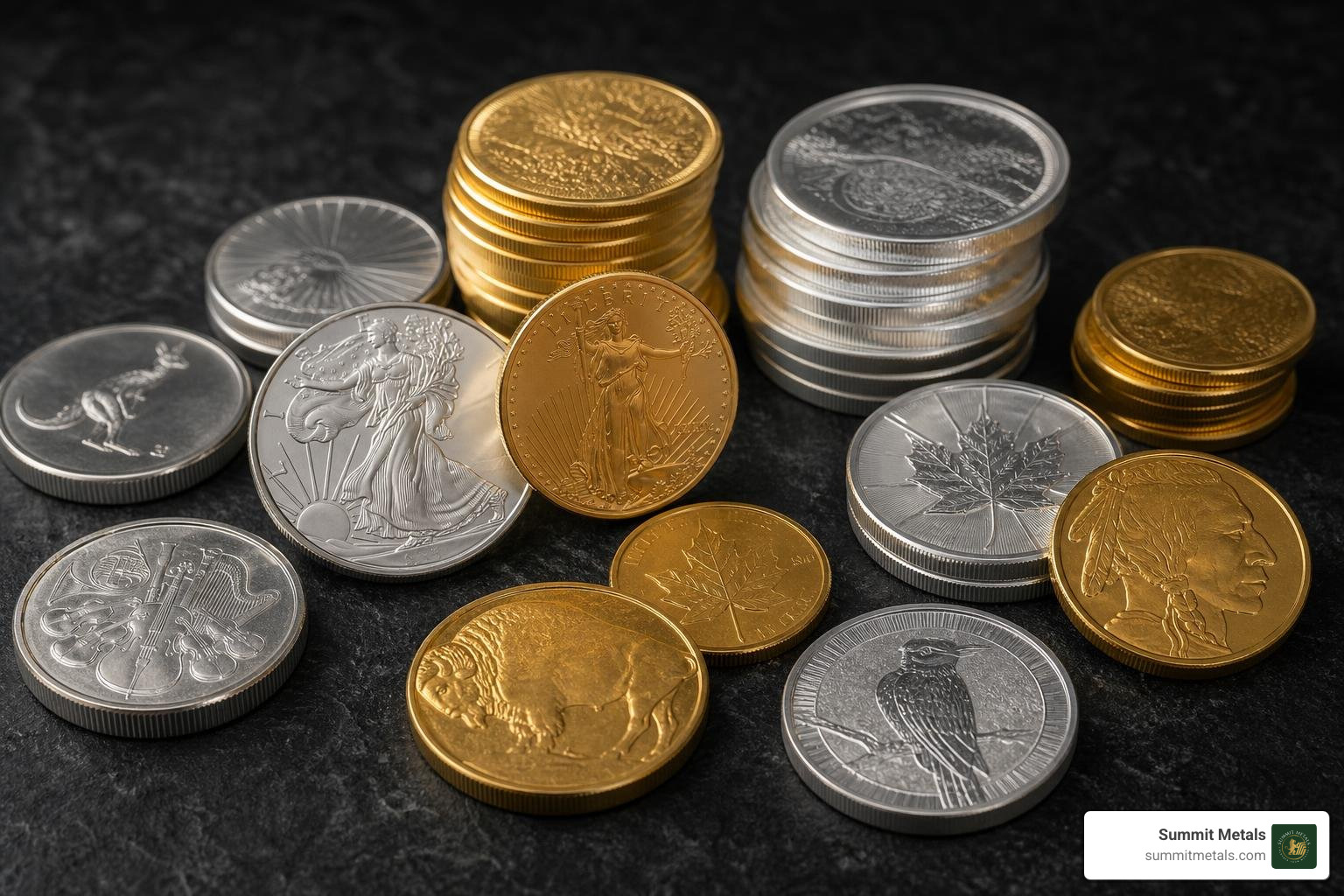
A precious metal is a naturally occurring metallic element that is rare, chemically stable, and recognized globally as a store of value. Here is a quick overview of the four most important ones:
| Metal | Symbol | Primary Role | Key Property |
|---|---|---|---|
| Gold | Au | Investment, jewelry | Most malleable metal; corrosion-proof |
| Silver | Ag | Investment, industry | Best electrical conductor of all elements |
| Platinum | Pt | Industry, investment | Extreme heat and chemical resistance |
| Palladium | Pd | Automotive, investment | Critical for catalytic converters |
These four metals share three defining traits:
- Rarity — Gold makes up only about 4 parts per billion of the Earth's crust
- Durability — They resist corrosion, tarnish, and chemical breakdown over thousands of years
- Universal value — Every major economy recognizes them as a store of wealth
That combination — scarce, indestructible, and universally accepted — is exactly why precious metals have served as money, insurance, and a hedge against economic chaos for millennia.
And right now, that case is stronger than ever.
Inflation erodes the purchasing power of cash. Stock markets swing violently on a single headline. Fiat currencies lose value over time — the U.S. dollar has lost an estimated 95–97% of its purchasing power since 1913. Physical precious metals sit outside that system. You own them outright. No counterparty. No default risk.
Whether you are a first-time buyer trying to understand the basics or a seasoned investor looking to refine your strategy, this guide covers everything — from how spot prices work, to the smartest ways to buy, store, and eventually sell your metals.
I'm Eric Roach, a former investment banker and M&A advisor who spent over a decade guiding Fortune 500 companies through multi-billion-dollar deals on Wall Street before turning my focus to helping everyday investors build resilient wealth through precious metal ownership. I've seen how the same defensive strategies blue-chip companies use to protect their balance sheets can be applied — simply and effectively — by individual investors like you.
Quick Decision Chart: Which Precious Metal Fits Your Goal?
| Investor Goal | Best Fit | Why It Works |
|---|---|---|
| Long-term wealth preservation | Gold coins or bars | Gold has deep liquidity, global recognition, and a long monetary history. |
| Lower-cost monthly accumulation | Silver coins or rounds | Silver lets investors build ounces gradually while still owning physical metal. |
| Automated discipline | Summit Metals Autoinvest | Autoinvest helps you buy every month, similar to contributing to a 401k, so you can dollar cost average without trying to time the market. |
| Easier future liquidation | Vaulted gold or silver | Private vault storage can make your exit strategy smoother when you are ready to sell. |
Learn more about precious metal:
Defining the Precious Metal: History, Science, and Key Properties
To fully appreciate why a precious metal holds its value, we have to look at the intersection of chemistry and history. In scientific terms, many of these elements belong to a group known as "noble metals." These are metals that resist oxidation and corrosion in moist air. Unlike iron, which rusts away, or copper, which turns green, noble metals remain pristine.
According to the official federal and scientific regulations (such as those outlined in 41 CFR 109-27.5101), there are eight primary metals officially classified as precious: gold, silver, platinum, palladium, rhodium, iridium, ruthenium, and osmium. In scientific research, these are often held in raw forms like shot, sponge, or grain.
Their physical properties are nothing short of miraculous:
- Malleability and Ductility: They can be hammered into incredibly thin sheets or drawn into microscopic wires.
- Conductivity: They allow heat and electricity to flow with minimal resistance.
- Non-Reactivity: They do not react with most acids or chemicals, preserving their pure metallic state indefinitely.
To learn more about the scientific building blocks of these elements, you can explore the Gold - Element information, properties and uses | Periodic Table .
Geologists have discovered that these elements are incredibly scarce. For instance, gold makes up approximately 4 parts per billion of the Earth's crust. But how did it get here?
Cosmic science tells us that almost all the gold on Earth was forged in the violent collisions of neutron stars and giant magnetar flares billions of years ago. It arrived on our planet via intense asteroid bombardments during the Earth's early development.
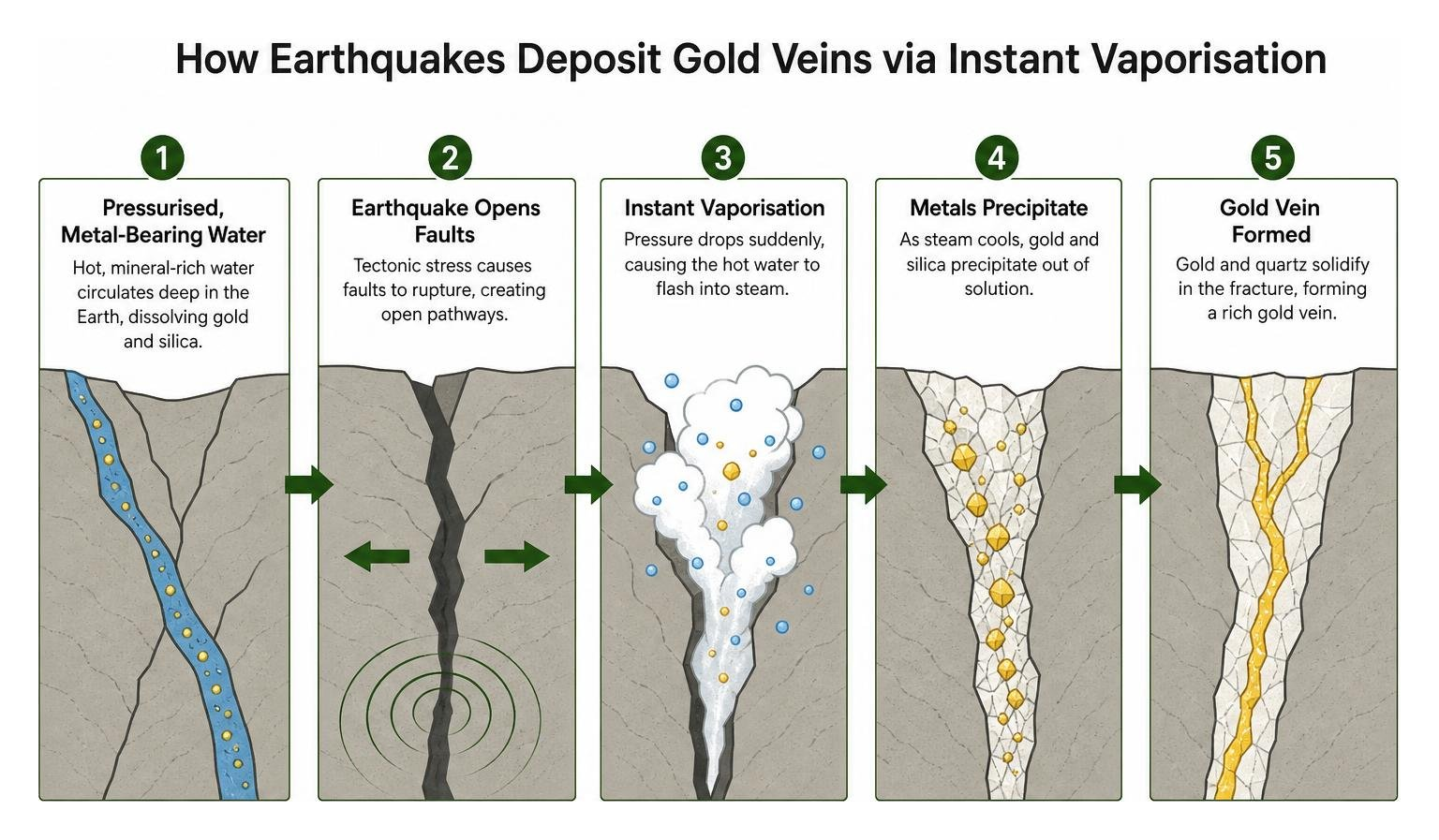
Once inside the Earth, geological forces took over. During earthquakes, fault lines open suddenly, causing highly pressurized, metal-bearing water to instantly vaporize into steam. This process flashes the metal and silica out of the solution, depositing veins of pure gold and quartz directly into the rock.
Gold: The Ultimate Precious Metal
Gold is the king of the precious metal world. It has only one stable isotope, 197Au, making it both a mononuclidic and monoisotopic element. This atomic stability is why gold never tarnishes, degrades, or corrodes.
Its density is incredibly high at 19.3 g/cm³. To put that into perspective, it is almost identical to tungsten (19.25 g/cm³), which is why tungsten is the most common core material used by counterfeiters. It is also incredibly soft; a single gram of gold can be beaten into a sheet of one square meter, so thin that it becomes semi-transparent and transmits a greenish-blue light.
Throughout history, humans have been mesmerized by this metal. Ancient Egyptians used it for King Tutankhamun’s coffin, which contained 112 kilograms of pure gold. In 1324, Mansa Musa of the Mali Empire gave away so much gold during his pilgrimage to Mecca that he devalued the metal and caused massive inflation in Egypt for over a decade.
Today, above-ground gold stocks total roughly 201,296 tonnes. The world's consumption of this supply is split:
- 50% goes into jewelry
- 40% is held as private and central bank investments
- 10% is utilized in industrial applications, such as micro-electronics and reflective coatings on space visors and skyscraper windows.
To understand how to build this asset into your portfolio, take a look at Shine On: Your Essential Guide to a Gold and Silver Portfolio and read the scientific profile of Gold | Facts, Properties, & Uses | Britannica .
Silver: The High-Conductivity Monetary Asset
Silver is the ultimate dual-purpose metal. While gold is primarily driven by investment and jewelry, silver is a critical industrial workhorse. It possesses the highest electrical and thermal conductivity of all elements on the periodic table.
If you are using a smartphone, a computer, or a solar panel, you are relying on silver. Its natural antibacterial, non-toxic properties also make it highly valuable in medical implants and water purification systems.
This high industrial demand makes silver incredibly dynamic. In times of economic expansion, industrial manufacturing drives silver consumption. In times of economic crisis, investors flock to silver as "the poor man's gold."
This dual demand can lead to massive spikes in retail buying. For instance, in March 2020, the U.S. Mint sold 5,482,500 ounces of one-ounce Silver Eagles, up from just 850,000 ounces in March 2019.
If you are ready to explore physical silver options, you can browse our curated Silver Bullion Collection.
Why Gold and Silver Stand Apart as Investment Metals
While platinum and palladium are highly valuable, they are heavily exposed to specific industrial cycles—particularly the automotive sector, where they are used in catalytic converters. If car manufacturing slows down, the prices of platinum and palladium can drop significantly. Furthermore, all the platinum ever mined in human history could practically fit inside an average-sized home, highlighting its extreme scarcity.
Gold and silver, however, carry thousands of years of monetary history. They have survived the collapse of empires, the hyperinflation of paper fiat currencies, and countless economic depressions. They represent true borderless liquidity.
When you own physical gold and silver, you are holding assets that cannot be printed, deleted, or devalued by central banks. They remain the premier choices for physical wealth preservation.
Understanding Spot Prices, Futures, and Market Dynamics
When you begin looking at the precious metal markets, you will notice that prices are constantly moving. These fluctuations are tracked in real-time through the global spot price.
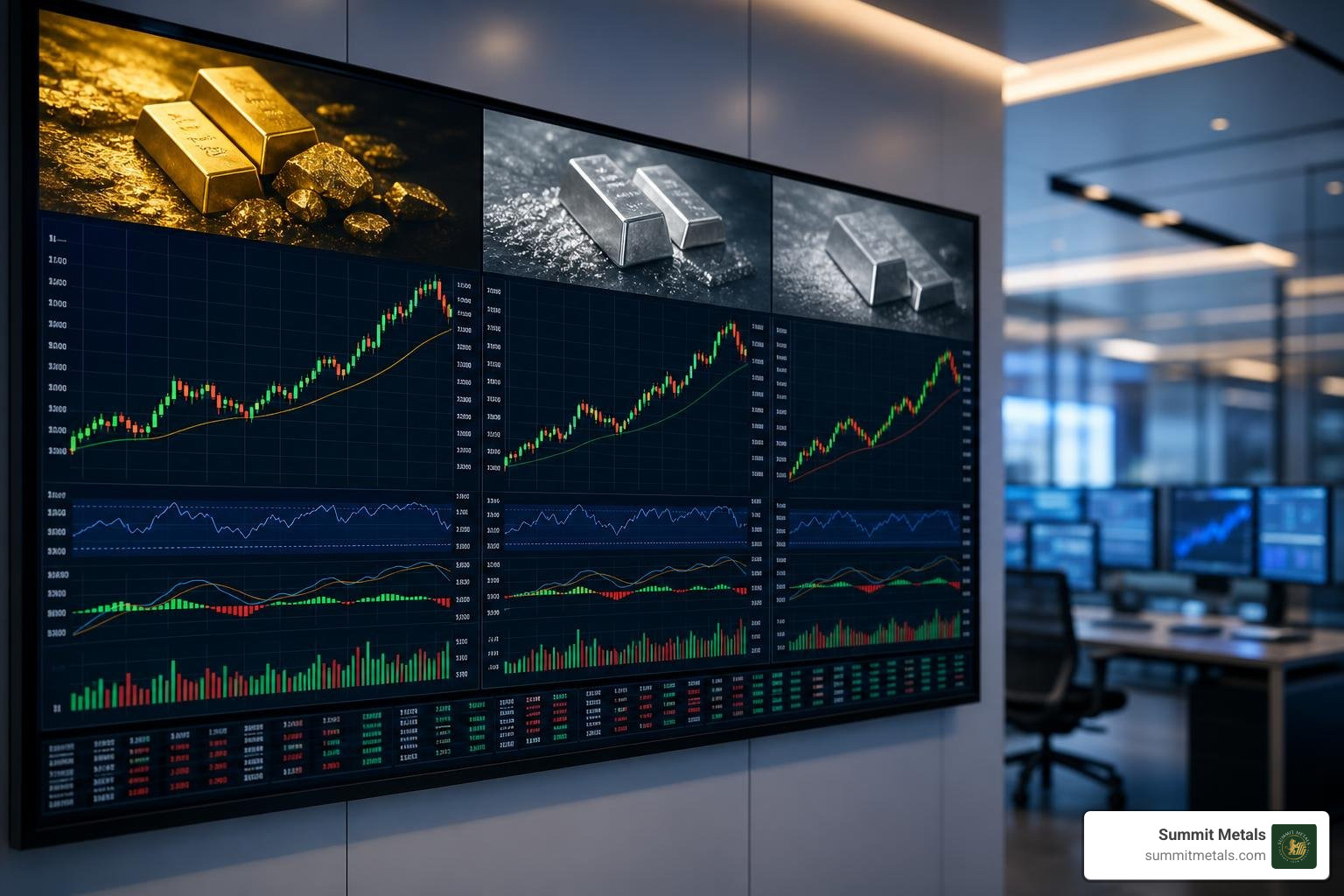
To keep a close eye on these movements, we recommend bookmarking our Real-Time Precious Metals Prices tracker.
Spot Price vs. Futures and the LBMA Fix
To navigate the market like a pro, you must understand the difference between the three primary pricing mechanisms:
- The Spot Price: This is the current cash price for immediate delivery of physical metal. It is calculated continuously throughout the trading week based on activity in the global over-the-counter (OTC) markets.
- The Futures Price: This is the agreed-upon price today for the delivery of a metal contract at a specified future date on exchanges like the COMEX. The futures price factors in interest rates, storage, insurance, and market expectations of where the price is headed.
- The LBMA Fix: The London Bullion Market Association (LBMA) establishes a daily "fix" price once per day for silver and twice per day for gold. This benchmark is used by global mining companies, central banks, and industrial users to facilitate large-scale contract hedging.
When you buy physical metal as a retail investor, you will pay the spot price plus a "premium." This premium covers the costs of refining, minting, shipping, insuring, and retailing the physical bar or coin.
Why Precious Metal Prices Fluctuate
Precious metal prices are driven by a delicate balance of economic forces:
- Inflation: When the purchasing power of fiat currency falls, the nominal price of precious metals tends to rise to preserve real wealth.
- Interest Rates: Rising real interest rates can create a headwind for gold and silver because physical metals do not pay a dividend or yield. Conversely, falling or negative real interest rates make non-yielding precious metals highly attractive.
- Geopolitical Events and Currency Dilution: War, political instability, and massive government spending increase safe-haven demand.
- Historical Precedents: During the Great Depression, gold and silver gained massive purchasing power relative to collapsing real estate and stock markets. In 2011, sovereign debt crises pushed gold to a major nominal peak of $1,900 per ounce (which equates to over $3,300 in modern inflation-adjusted dollars).
Physical Bullion vs. Paper Markets: Making the Right Choice
A common trap for new investors is failing to distinguish between physical bullion and paper-based precious metal investments, such as Exchange-Traded Funds (ETFs) or futures contracts.
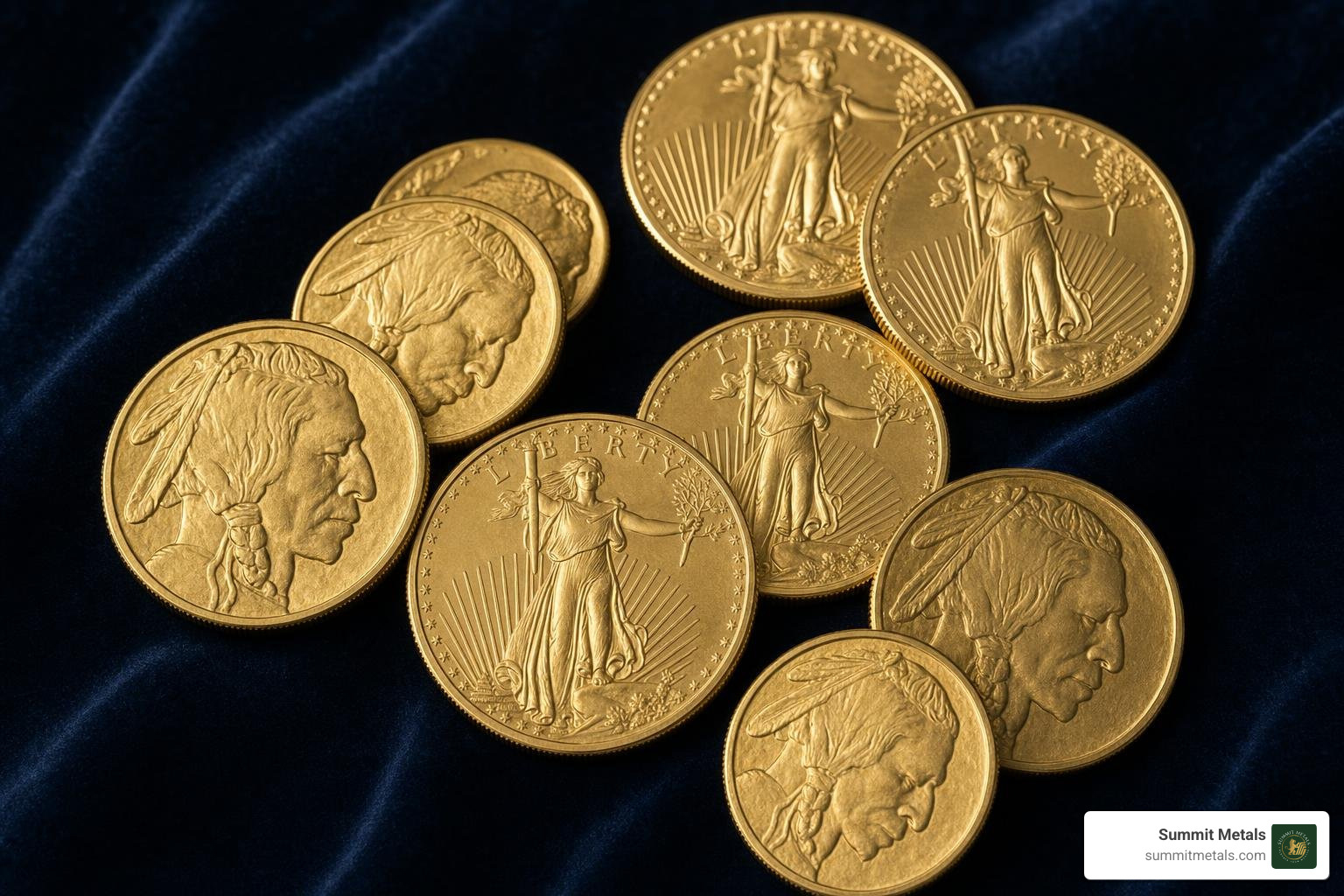
When you buy a gold or silver ETF, you do not own the underlying physical metal. You own a share in a trust that tracks the price of the metal. If the financial system experiences a systemic crisis, you are exposed to counterparty risk, management fees, and potential liquidity freezes.
Furthermore, the paper futures market is highly leveraged. There are often far more paper claims to an ounce of gold than there is actual physical gold sitting in exchange vaults.
If you want true wealth protection, physical bullion is the only asset that carries zero counterparty risk. For a deep dive into this comparison, read our guide on Physical Bullion vs Gold & Silver ETFs: Pros and Cons.
Coins vs. Bars: Protecting Your Wealth
Once you decide to buy physical metal, you must choose between sovereign-minted coins and privately minted bars. Here is how they compare:
| Feature | Sovereign Bullion Coins | Privately Minted Bars |
|---|---|---|
| Legal Tender Status | Yes (Backed by issuing government) | No |
| Fraud & Counterfeit Protection | High (Sovereign security features & legal penalties) | Moderate (Relies on private assay cards) |
| Premiums Over Spot | Higher | Lower |
| Liquidity | Extremely High (Recognized globally) | High |
| Best For | Security, fractional buying, and fraud defense | Bulk investing and low-cost accumulation |
Sovereign-minted coins, such as the American Eagle or South African Krugerrand, carry an official face value. While you would never spend a gold coin at its nominal face value, this legal tender status is backed by federal laws, making counterfeiting a severe federal crime. This added layer of government protection makes coins highly secure and easy to liquidate.
Privately minted bars, on the other hand, offer the lowest possible premium over the spot price, making them the most cost-effective way to stack pure weight.
Gold Coins vs. Gold Bars: Decision Chart
| Buyer Priority | Gold Coin Advantage | Gold Bar Advantage |
|---|---|---|
| Fraud protection | Sovereign coins carry government-backed designs, legal tender status, and stronger anti-counterfeit recognition. | Bars rely more heavily on assay packaging, refiner reputation, and dealer verification. |
| Recognizability | Widely known coins such as American Eagles and Krugerrands are easy for dealers and investors to recognize. | Large bars may be efficient but can require extra verification when reselling. |
| Premium efficiency | Coins usually cost more over spot because of minting and demand. | Bars usually offer a lower premium per ounce, especially at larger sizes. |
| Flexibility | Fractional coins make it easier to sell part of your holdings. | Larger bars are better for bulk accumulation but less flexible for partial liquidation. |
| Best use case | Security, liquidity, and smaller recurring purchases. | Lowest-cost ounce accumulation for larger purchases. |
If you are looking for an affordable, highly secure entry point, we recommend exploring our Fractional Gold Coins and Bars collection.
Strategic Investing: Dollar-Cost Averaging and Exit Strategies
Investing in a volatile market requires a disciplined strategy. Trying to time the market's short-term swings is incredibly difficult and often leads to emotional decision-making and unnecessary losses.
For a solid foundation on how to approach your portfolio, consult our comprehensive Precious Metals Investment Guide.
Autoinvest: Building Wealth Like a 401k
The most efficient way to build a physical metals portfolio is through dollar-cost averaging (DCA). Rather than trying to guess when prices have hit a bottom, you commit to purchasing a fixed dollar amount of metal at regular, consistent intervals (such as once per month).
We developed our Autoinvest program specifically to make this process seamless. Just like contributing to a 401k, our Autoinvest program allows you to set up automated, monthly purchases of authenticated gold and silver.
When prices are low, your monthly contribution buys more physical ounces; when prices are high, it buys fewer. Over time, this averages out your entry cost, dampens market volatility, and steadily builds your wealth without the stress of watching daily charts.
To understand the mathematics behind this strategy, read The Strategic Approaches to Investing in Gold and Silver: Dollar Cost Averaging and Value Averaging.
Planning Your Exit: Vault Storage and Liquidity
A complete investment plan must include an exit strategy. If you store all of your physical metals at home, liquidating them can sometimes be a logistical challenge involving secure shipping, local dealer negotiations, and security risks.
By utilizing secure, private vault storage, you get the best of both worlds: maximum security and instant liquidity.
Through our "Sell to us" program, you can store your authenticated gold and silver in our secure, insured partner vaults. If you ever decide to take profits, rebalance your portfolio, or raise cash, you can liquidate your vaulted assets back to us instantly at competitive rates. This ensures your physical wealth remains as liquid as a stock on a screen, without ever having to handle shipping or security yourself.
Ready to learn more? Check out our Sell to Us Program page.
Frequently Asked Questions about Precious Metals
What is the gold-to-silver ratio and how do I use it?
The gold-to-silver ratio measures how many ounces of silver it takes to purchase a single ounce of gold. It is calculated by dividing the spot price of gold by the spot price of silver.
Investors use this ratio to determine which metal is historically undervalued relative to the other. When the ratio is exceptionally high, it suggests that silver is cheap compared to gold, signaling a potential buying opportunity for silver. When the ratio drops, investors often trade some of their silver back into gold to lock in gains.
For a complete breakdown of this timeless market indicator, read What is the Gold to Silver Ratio? Is It Important?.
Why was aluminium once considered more precious than gold?
In the mid-19th century, pure aluminium was incredibly difficult to extract from its raw bauxite ore. Because the refining process was so complex, aluminium was rarer and far more expensive than gold or silver.
In the 1850s, Napoleon III famously served his most honored guests with aluminium cutlery, while lesser guests had to dine with mere gold and silver. The capstone of the Washington Monument, completed in 1884, was made of 100 ounces of pure aluminium, which at the time was valued as a precious luxury metal.
This changed overnight in 1886 with the invention of the Hall-Héroult refining process, which made mass-producing aluminium cheap and easy. This historical shift serves as a great reminder of why gold and silver remain the ultimate standards of wealth—their physical rarity is dictated by nature, not by the limitations of human refining technology.
How do I safely store physical precious metals?
When it comes to storing physical bullion, you have three primary options:
- Home Safes: Provides immediate personal access but carries personal security risks and may require specialized home insurance riders.
- Bank Safety Deposit Boxes: Keeps the metal out of your home, but bank boxes are not insured by the FDIC, and access is restricted to banking hours.
- Private Vault Storage: Professional, ultra-secure depositories offer 24/7 armed security, climate-controlled environments, and full insurance coverage. This is the gold standard for high-value portfolios, providing the ultimate balance of security, peace of mind, and instant liquidity when you are ready to sell.
Conclusion
At Summit Metals, based in Salt Lake City, Utah, we are dedicated to helping you protect your hard-earned wealth with authenticated gold and silver bullion. We buy our inventory in massive volumes to secure competitive rates, passing those savings directly to you.
Once your payment is processed and verified through our advanced fraud-prevention systems, we ship your physical metals directly to your door or secure vault via fast, fully insured FedEx Express shipping.
We believe that an educated investor is a successful investor. That is why we maintain an active educational YouTube channel filled with market insights, coin guides, and practical wealth-preservation strategies to help you navigate the precious metals market with confidence.
To see how physical gold fits into your broader financial picture, read our comprehensive guide on The Strategic Role of Gold in Long-Term Portfolio Management.
Whether you choose to start small, set up a hands-off monthly plan with our Autoinvest program, or secure bulk bars for private vault storage, we are here to support your journey every step of the way.