What You Need to Know Before You Sell Silver Dollar Coins
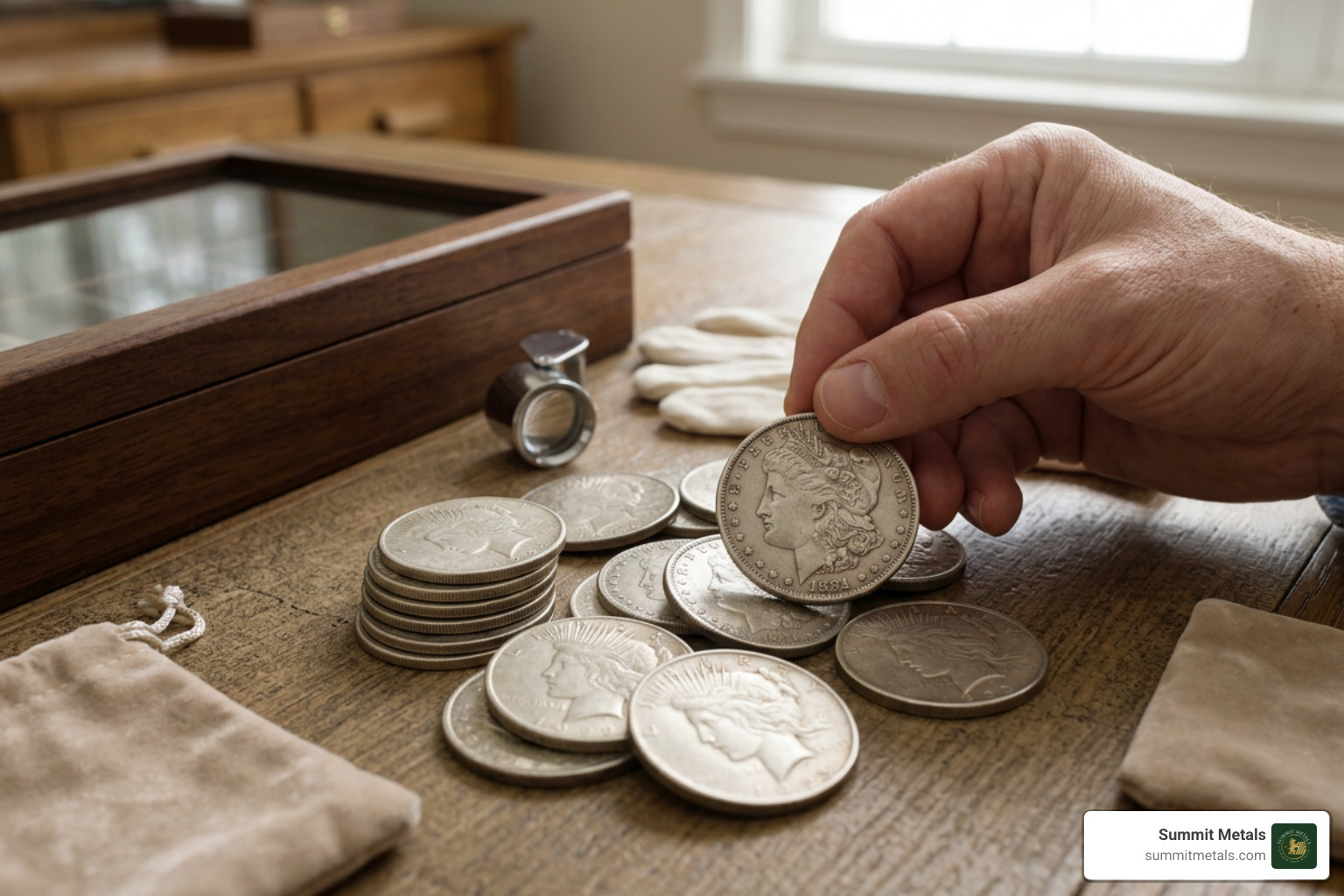
If you're looking to sell silver dollar coins, here is the short answer:
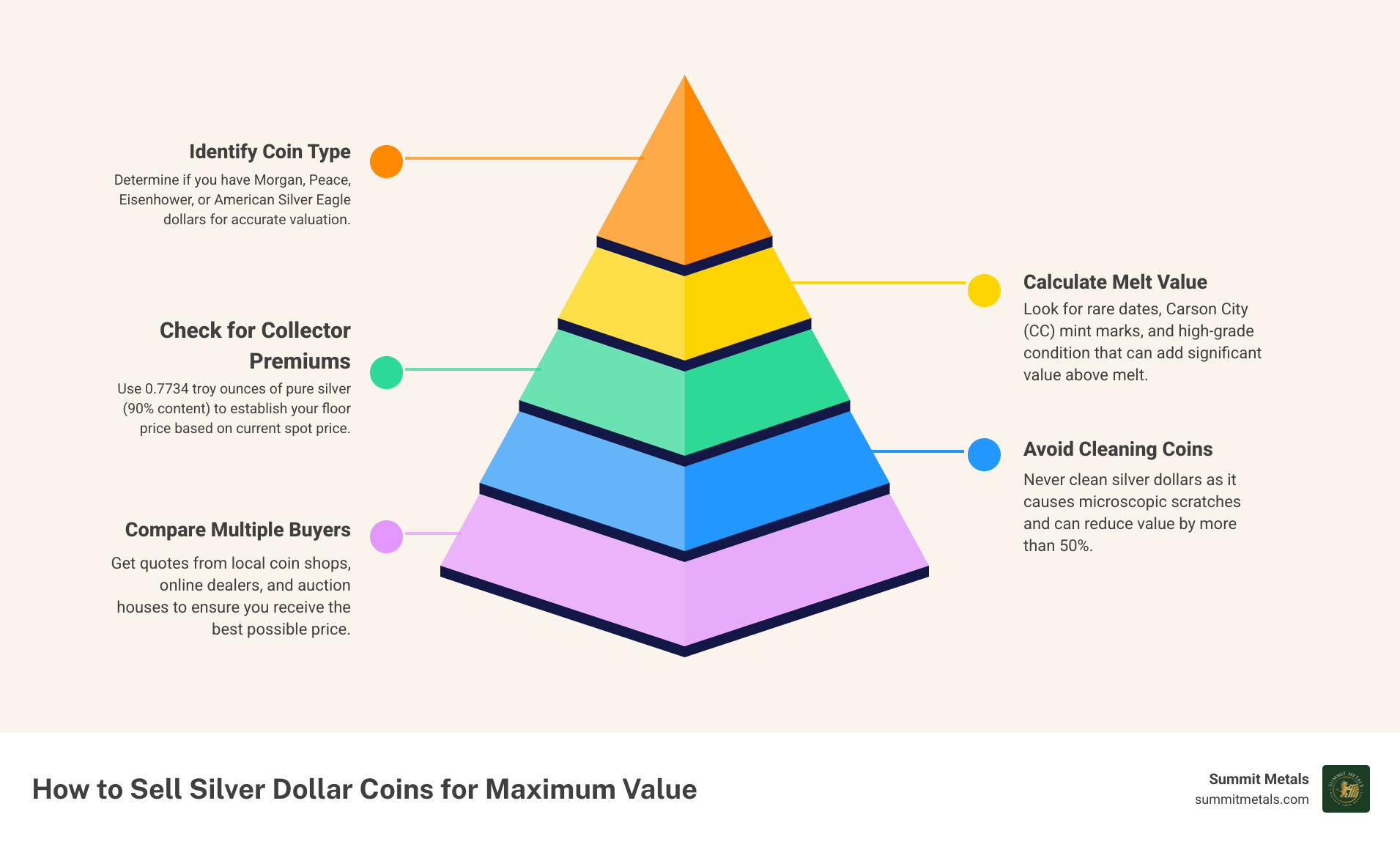
- Identify your coin type — Morgan, Peace, Eisenhower, or American Silver Eagle. Each has different silver content and collector demand.
- Check the melt value — Morgan and Peace dollars contain 0.7734 troy ounces of pure silver (90% silver). That gives you your floor price.
- Look for collector premiums — Rare dates, mint marks (especially "CC" for Carson City), and high-grade condition can push value far above melt.
- Never clean your coins — Cleaning can reduce value by more than 50%.
- Compare multiple buyers — Local coin shops, online bullion dealers, and auction houses all offer different rates. Get at least two to three quotes.
- Choose a trusted buyer with transparent pricing — Avoid pawn shops and unsolicited buyers. Stick to reputable dealers with verifiable buyback prices.
That old silver dollar sitting in a drawer or inherited from a family member could be worth far more than its face value — and in some cases, far more than its silver content alone. The challenge is that most people don't know where to start. Is it worth $30? $300? $3,000? The answer depends on several factors that are easy to understand once you know what to look for.
Silver dollars issued by the United States ran from 1794 all the way through 1935 for circulation strikes, with modern bullion versions continuing today. That's a long and rich history — and a wide range of values. Common circulated examples trade close to their silver weight, while rare dates or high-grade specimens can command serious premiums from collectors and investors alike.
The good news: with the right information and the right buyer, you don't have to leave money on the table.
This guide walks you through everything — from identifying what you have, to calculating what it's worth, to finding the safest and most profitable place to sell.
I'm Eric Roach, a former investment banker and M&A advisor who has helped clients navigate complex asset liquidations — including precious metals — for over a decade. I've guided investors through the process of how to sell silver dollar coins as part of broader portfolio strategies, from single-coin sales to large inherited collections. Throughout this guide, I'll share the same disciplined, transparent approach I use with my own clients so you can make a confident, informed decision.
Sell silver dollar coins further reading:
Understanding the Types of Silver Dollar Coins
Before we can talk about value, we have to talk about what you actually have. In the coin world, "silver dollar" can mean a lot of different things. Some are historic relics of the Old West, while others are modern investment-grade bullion.
To make matters more confusing, some modern "dollar" coins contain absolutely no silver at all. Knowing how to tell them apart is the first and most critical step when you prepare to sell silver dollar coins.
If you are sorting through a collection, we recommend separating your coins into categories based on their design and year of issue. For a deeper dive into historical context and specific design varieties, check out this comprehensive guide on How To Sell Old Silver Dollars (Old Silver Dollar Coins & Values) | U.S. Coins Guide.
Classic Morgan and Peace Silver Dollars
The two most famous vintage silver dollars are the Morgan dollar and the Peace dollar. These coins represent the golden age of American coinage.
- The Morgan Silver Dollar (1878–1904, 1921): Named after its designer, George T. Morgan, this coin features Lady Liberty on the obverse and a majestic eagle on the reverse. These coins are highly sought after by collectors. If you are looking to liquidate these specific classics, we have put together a detailed walkthrough on how to Sell Morgan Silver Dollars.
- The Peace Silver Dollar (1921–1935): Struck to commemorate the peace following World War I, this beautiful coin features a youthful Lady Liberty and an eagle resting on a mountain peak.
Both of these classic series contain exactly 0.7735 troy ounces of pure silver, alloyed with 10% copper for durability (making them 90% silver).
An interesting piece of history: under the Pittman Act of 1918, the US government melted down over 270 million Morgan dollars to sell to Great Britain or strike into new coins. This massive destruction of supply is one of the main reasons why surviving vintage silver dollars are so highly prized today.
Modern Silver Eagles and Bullion Dollars
If your silver dollars are dated 1986 or later, you likely have American Silver Eagles. Unlike vintage coins, which were minted to circulate as money, Silver Eagles are modern bullion coins minted specifically for investment.
- American Silver Eagles (1986–Present): These contain exactly one troy ounce of 99.9% pure silver. They carry a nominal face value of one dollar, backed by the US government.
- Sovereign Coins: Similar to the Silver Eagle, other nations produce their own official bullion coins, such as the British Silver Britannia. If you happen to own these international counterparts, you can learn more about liquidating them in our guide to Sell Silver Britannia.
These sovereign coins are highly liquid and highly recognizable worldwide. Because they carry an official government face value, they offer a unique layer of fraud protection and legal tender status that generic silver bars simply cannot match.
How to Determine Melt Value vs. Numismatic Value
When you are ready to sell, you will hear two terms constantly: melt value and numismatic value. Understanding the difference is the key to not getting ripped off.
- Melt Value (Bullion Value): This is the raw, intrinsic value of the silver contained within the coin. If you melted the coin down into a lump of metal, this is what the silver would be worth based on the current spot price.
- Numismatic Value (Collector Value): This is the premium that collectors are willing to pay for a coin based on its rarity, historical significance, mint mark, and condition.
If you have a common, heavily worn 1921 Morgan dollar, it will likely sell for close to its melt value. However, if you have a rare date in pristine condition, its numismatic value could be hundreds or even thousands of times higher than its raw silver weight.
To help you decide whether silver dollars are the right asset to sell, hold, or trade for another silver format, use this comparison:
| Feature | Sovereign Silver Coins (Silver Dollars / Silver Eagles) | Generic Silver Bars / Rounds |
|---|---|---|
| Legal Tender Status | Yes — government-issued coins carry a face value, creating an additional legal identity beyond metal content | No — private mint products have no face value |
| Fraud Protection | Stronger — counterfeiting U.S. legal tender is treated more seriously and designs are widely recognized | Moderate — private designs can be easier for counterfeiters to copy |
| Resale Confidence | Higher — buyers recognize Morgan dollars, Peace dollars, and Silver Eagles quickly | High for well-known brands, but often requires more testing |
| Collector Premium | Meaningful upside for rare dates, mint marks, and high-grade examples | Usually limited, unless the round or bar has unusual collector demand |
| Best Fit | Sellers who may have numismatic value or want maximum buyer trust | Sellers focused mainly on bulk silver weight and simple melt-value pricing |
The key takeaway: if you own recognizable U.S. silver coins, do not treat them like generic silver until you have checked for date, mint mark, and condition premiums. Their face value, legal-tender status, and collector demand can make them easier to authenticate and more attractive to buyers.
If you have highly worn or common-date coins that lack collector appeal, your best bet is to liquidate them based on their metal weight. You can read our advice on how to do this efficiently in our guide to Sell Coins for Melt Value.
Calculating the Melt Value of Your Coins
Calculating your coin's melt value is simple math. You do not need to be a financial analyst to figure it out.
The melt value formula is:
Melt Value = Pure Silver Content (in Troy Ounces) x Current Silver Spot Price
For a standard 90% silver dollar (Morgan or Peace), the pure silver content is 0.7734 troy ounces.
For example, if the current silver spot price is active in the market, you simply multiply that spot price by 0.7734 to find your coin's baseline value. This is the paper price of the raw metal. When selling, dealers must charge a small spread to cover their business costs, but knowing this number gives you a solid "floor" price. For a step-by-step breakdown of this math and how it applies to various denominations, see our Silver Dollar Coins Selling Guide 2026.
Identifying Rare Dates and Mint Marks
Before you sell any vintage silver dollar for its raw melt value, you must check the date and the mint mark. A tiny letter on the back of the coin can be the difference between a common coin and a small fortune.
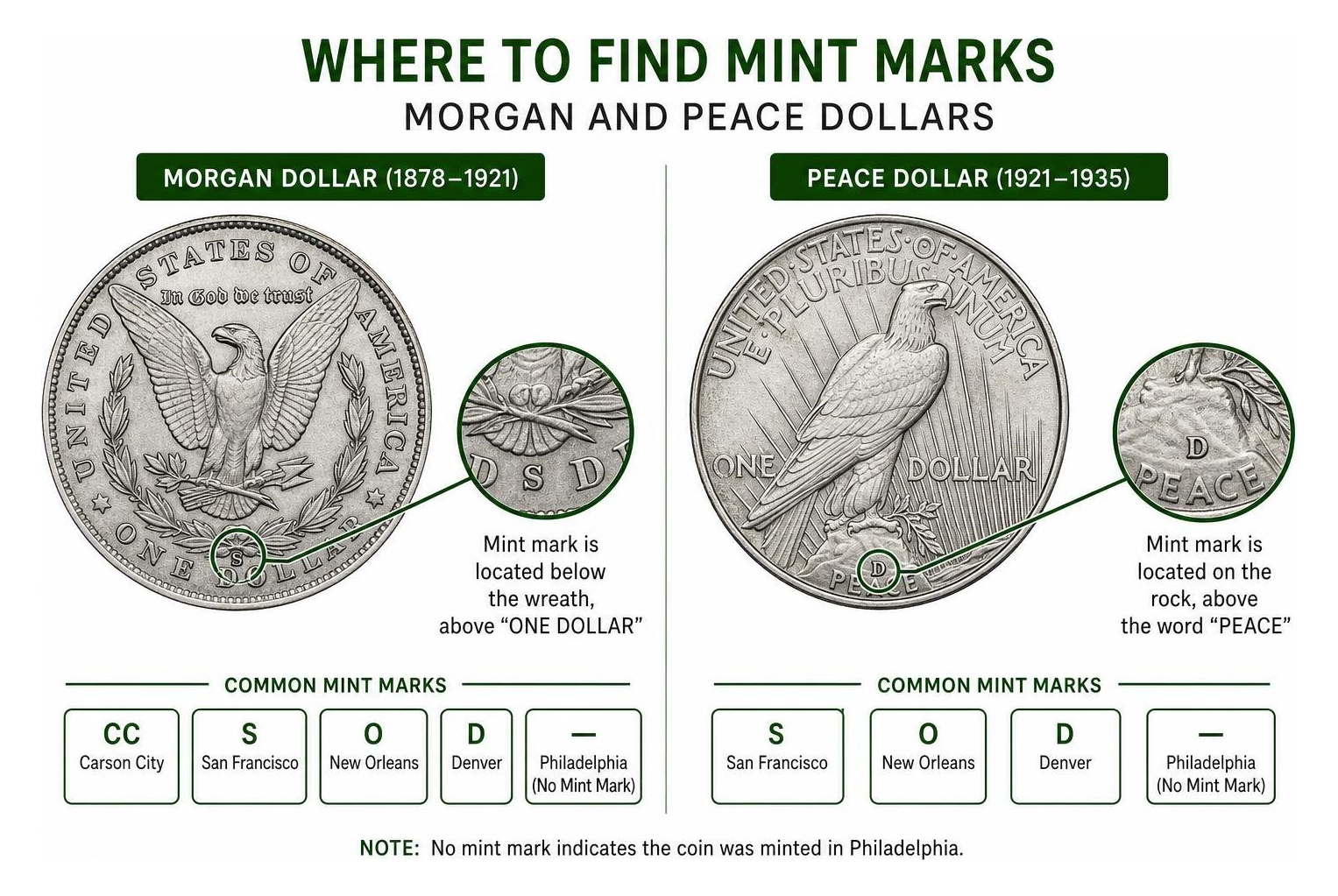
Look for these key mint marks:
- CC (Carson City): Coins struck in Carson City, Nevada, are highly prized because of their low mintages and connection to the Wild West.
- S (San Francisco), O (New Orleans), D (Denver), or No Mint Mark (Philadelphia): While many of these are common, certain year-and-mint-mark combinations are incredibly rare.
For example, an 1893-S Morgan dollar is one of the ultimate holy grails of American coin collecting. Even in heavily worn condition, it commands staggering premiums. Always research your dates and mint marks, or consult an independent coin appraiser before letting go of vintage silver.
Key Factors That Affect the Price When You Sell Silver Dollar Coins
Once you have established whether your coin is a common bullion piece or a rare collector's item, several physical factors will dictate the final offer you receive.
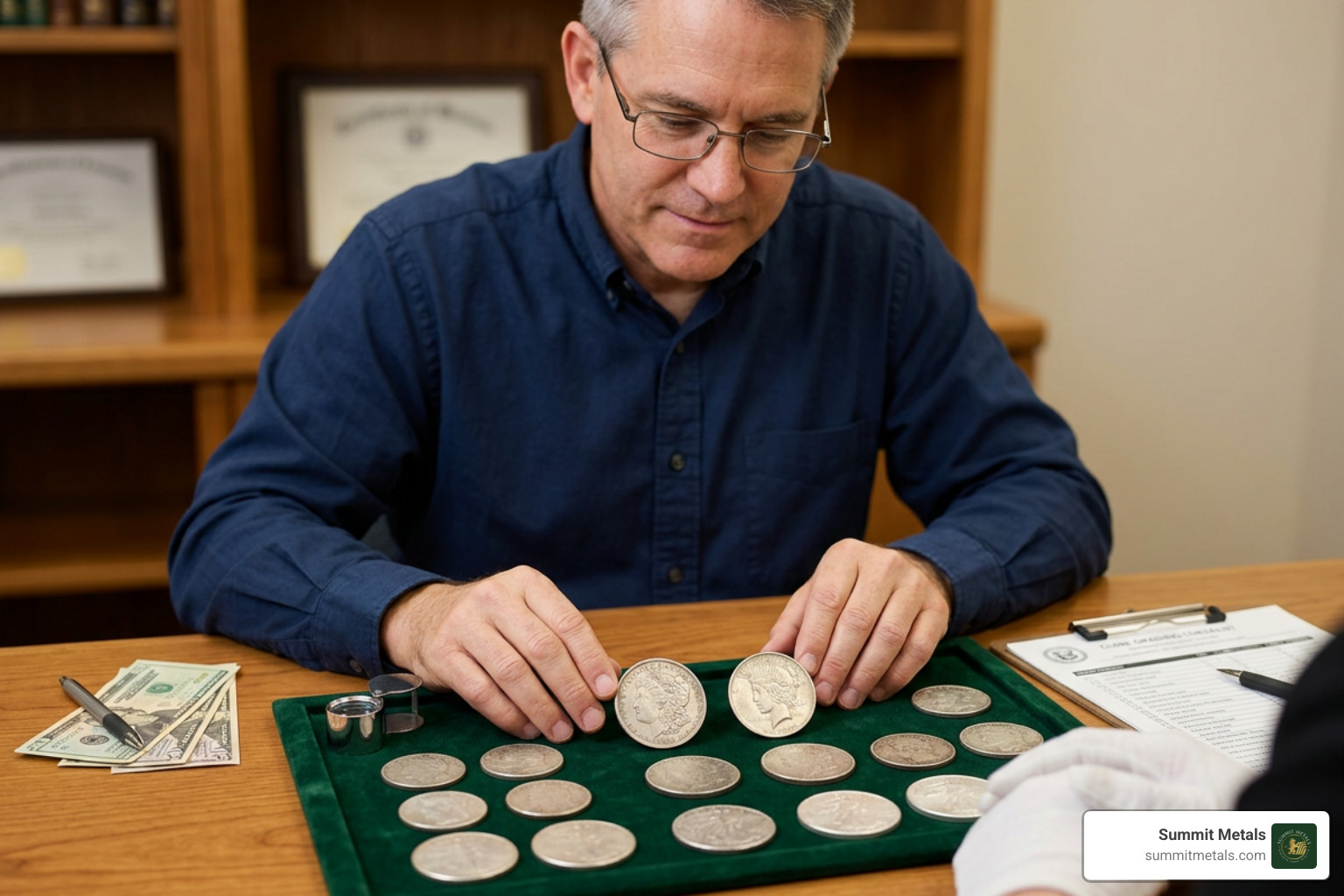
If you want to maximize your payout, you need to understand how the market evaluates these assets. For a practical look at how to turn these physical assets into liquid capital, read our guide on Selling Your Silver Dollars for Cash.
Coin Grading and Condition Standards
The condition of a coin is graded on a scale from 1 to 70, established by the numismatic community.
- Circulated (G, VG, F, VF, XF, AU): These coins show varying degrees of wear and tear from being spent in daily life.
- Uncirculated / Mint State (MS 60 to MS 70): These coins never entered circulation and retain their original mint luster.
A single grading point difference in Mint State coins can mean thousands of dollars in value. For high-value coins, third-party grading services like PCGS, NGC, or ANACS are the gold standard. They authenticate, grade, and seal the coin in a protective plastic slab, giving buyers absolute confidence. If you are inspecting your coins at home, use a high-quality coin magnifier to look for hairline scratches, rim dings, and signs of wear on the highest points of the design.
Why You Should Never Clean Your Silver Dollars
We cannot emphasize this enough: do not clean your coins. It is the single most common and costly mistake we see.
Many people find old, tarnished silver dollars and think, "I'll polish these up so they look shiny and valuable."
Please, stop! Cleaning a coin with polish, baking soda, or even a soft cloth causes microscopic scratches. It strips away the original mint luster and the natural aging process (known as "patina" or "toning") that collectors love. Cleaning a rare coin can instantly devalue it by 50% or more, turning a highly collectible piece into simple melt-value silver. Embrace the tarnish—it is proof of the coin's history!
Where to Sell Silver Dollar Coins for the Best Price
When you are ready to sell, you have several avenues available. Each option comes with its own set of trade-offs regarding speed, safety, and payout size.
Choosing the right partner is critical. To avoid lowball offers, we suggest checking out our guide on Where Can I Sell My Gold Coins for Best Price for tips on identifying top-tier buyers.
Local Coin Shops vs. Online Bullion Dealers
Many sellers default to driving down to their local coin shop or a nearby pawn shop. While a local shop offers the benefit of an immediate cash payout, they also have high overhead costs (rent, utilities, local security) which often means they must offer lower buyback prices to maintain their margins.
Large online bullion dealers, on the other hand, operate at massive scale. Because we buy and sell in huge volumes, we can offer much higher buyback prices and greater price transparency. The downside used to be the wait time, but modern secure shipping has made online selling incredibly fast and safe.
How to Safely Sell Silver Dollar Coins Online
Selling online does not have to be stressful. Reputable dealers have highly secure, insured mail-in programs designed to protect your assets every step of the way.
When you sell to us at Summit Metals, we provide step-by-step instructions to ensure a flawless transaction. We use secure, trackable shipping methods—including FedEx Express shipping options—and verify every incoming package under high-definition cameras for your peace of mind. To learn how to vet online buyers and ensure you are working with a trustworthy partner, read our guide on Where Can I Sell Gold Bullion Finding Trustworthy Buyers.
Preparing Your Collection for Liquidation
A little preparation goes a long way. If you walk into a dealer's office or submit an online request with a messy, unsorted pile of metal, you are likely to get a lower offer simply because of the time and risk involved in sorting it.
Taking the time to organize your holdings ensures you get paid every cent you deserve. For a complete checklist on preparing your metals, review our comprehensive How to Sell Gold Silver Guide.
Best Practices to Sell Silver Dollar Coins Safely
Before shipping or presenting your collection, follow these simple organizational steps:
- Group by Type: Separate your Morgans, Peace dollars, and Silver Eagles.
- Sort by Date and Mint Mark: Put them in chronological order.
- Protect the Coins: Use proper archival-quality holders, coin flips, or plastic coin tubes. Avoid cheap plastic baggies or PVC holders, which can damage the silver over time.
- Create an Inventory: Write down exactly what you have, including the quantity, date, mint mark, and estimated condition.
For more details on handling and shipping your metals securely, check out our Sell Gold Silver Coins Guide.
Planning Your Exit Strategy and Private Vault Storage
For serious investors, buying precious metals is only half the equation. You must also plan a smart exit strategy. If you keep all your physical assets in a home safe, you run security risks, and liquidating them quickly during a market peak can be a logistical headache.
This is where secure vaulting comes in. Through our Sell to Us program, we help investors plan a seamless exit strategy. By utilizing private vault storage, your physical silver remains safe, secure, and completely off the grid—yet highly liquid. When the market moves and you decide it is time to sell, you can liquidate your vaulted silver instantly without having to package, insure, or ship a single coin yourself.
Frequently Asked Questions About Selling Silver Dollars
We hear many of the same questions from clients looking to liquidate their silver. Here are the facts you need to know.
To make sure you are fully prepared for the administrative side of your transaction, we also suggest reading our guide on Selling Precious Metals Taxes.
What is the current melt value of a Morgan silver dollar?
The melt value of a Morgan silver dollar is directly tied to the current market spot price of silver. Because a Morgan dollar contains exactly 0.7734 troy ounces of pure silver, you can find its raw metal value at any moment by multiplying the current spot price by 0.7734. That collector demand can add a significant premium on top of this base price.
Do I have to pay taxes when I sell silver dollar coins?
Yes, precious metals are classified as collectibles by the IRS. When you sell them for a profit, you are generally subject to capital gains tax. The exact reporting requirements and tax rates depend on your overall income, how long you held the coins, and your state of residence. We always recommend consulting with a certified tax professional to understand your specific tax obligations.
How can I tell if my silver dollar is counterfeit?
Unfortunately, counterfeit silver dollars are quite common. You can run a few simple tests at home:
- The Magnet Test: Silver is non-magnetic. If your coin sticks to a strong magnet, it is a fake.
- Weight and Dimensions: A genuine Morgan or Peace dollar must weigh exactly 26.73 grams (though heavily worn coins may lose a tiny fraction of a gram). Use a digital scale and calipers to verify the weight and diameter.
- The Ping Test: Gently tap the coin with another coin or a wooden pencil. Real silver has a distinct, high-pitched, long-lasting ring. Base metals sound dull and flat.
Conclusion
When it comes to building and preserving wealth, physical silver remains one of the most reliable assets on earth. Whether you are looking to liquidate a family heirloom or optimize an investment portfolio, knowing how to sell silver dollar coins wisely ensures you get the maximum value for your hard-earned assets.
At Summit Metals, we are dedicated to bringing transparency, security, and education to the precious metals market. Operating out of Salt Lake City, Utah, we offer real-time pricing, highly competitive buyback rates, and secure, fully insured FedEx Express shipping on our transactions. We also host an educational YouTube channel to help investors understand the market and build trust in our process.
If you are looking to build your silver holdings over time rather than buying all at once, we highly recommend our Autoinvest program. Much like a traditional 401k, Autoinvest allows you to dollar-cost average by shopping with Summit Metals on a set monthly schedule. This disciplined approach removes the stress of trying to time the market, allowing you to build a robust physical silver position steadily over time.
Ready to explore our offerings or plan your exit strategy? Browse our complete Silver Collection today, and let us help you secure your financial future.