Why Selling Silver Dollars for Cash Is Easier Than You Think
Selling silver dollars for cash can open up significant value sitting in your drawer—but only if you know what you're doing. Here's what you need to know:
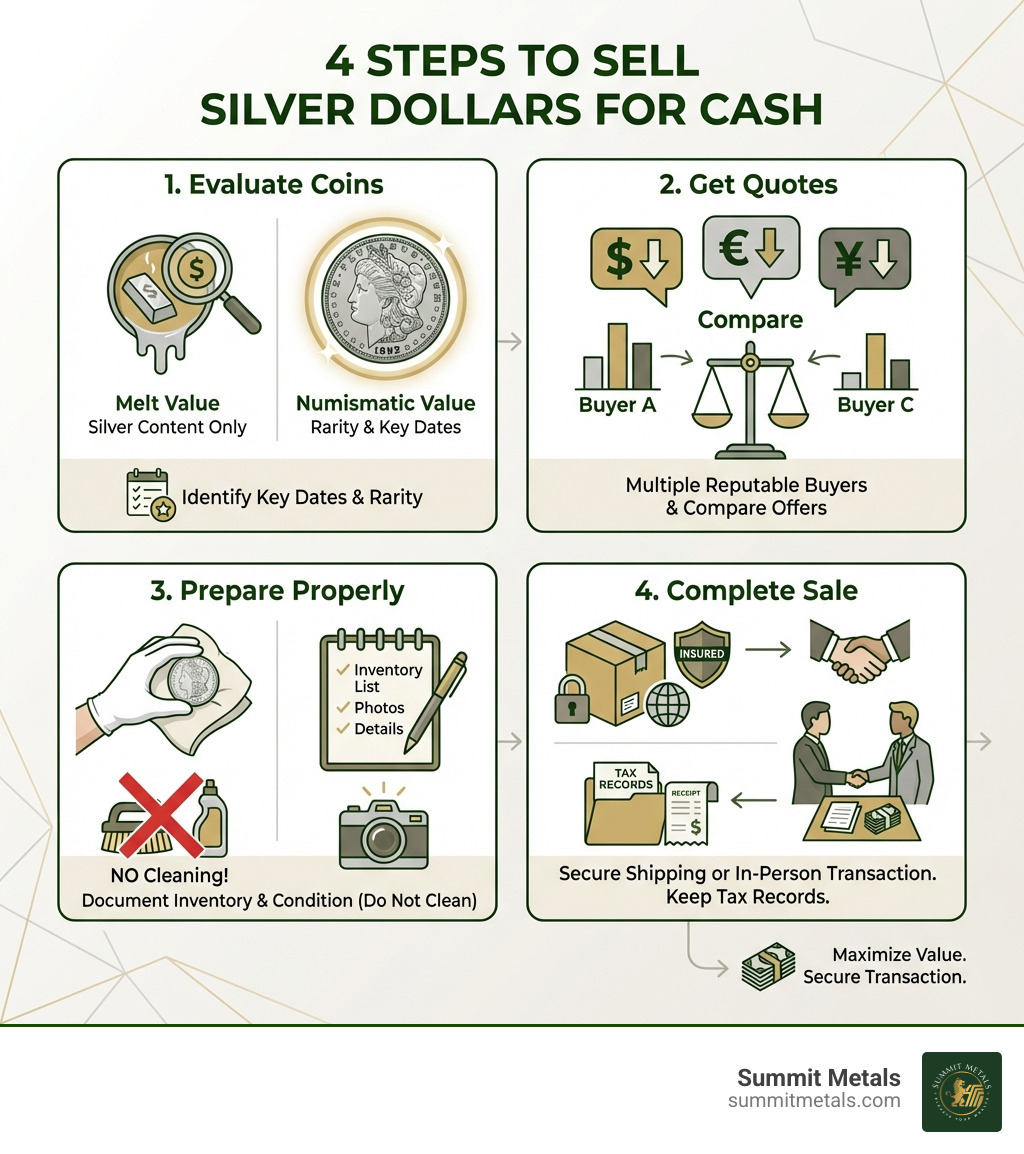
Quick Answer: How to Sell Silver Dollars for Cash
- Determine your coin's value - Check if it's worth more for its rarity (numismatic value) or just its silver content (melt value)
- Calculate the baseline - Current melt value for Morgan and Peace dollars is approximately $69.78 based on 90% silver content
- Look for key dates - Morgan dollars with 'CC' mint marks, 1893-S, or 1895 dates; Peace dollars from 1921, 1928, or 1934-S can be worth significantly more
- Choose your buyer - Compare offers from trusted dealers, local coin shops, or online platforms
- Complete the sale - Use insured shipping or secure in-person transactions, and keep records for tax purposes
Most silver dollars fall into two categories: common-date coins sold for their silver content (currently around $69.78 each at $90.23/oz silver), and rare coins that command collector premiums based on date, mint mark, and condition. The difference can mean hundreds or even thousands of dollars.
A 1921 Morgan dollar in worn condition? That's a melt-value coin. But a Morgan dollar with a 'CC' (Carson City) mint mark in uncirculated condition? You could be looking at a significant collector premium. The key is knowing which category your coins fall into before you sell.
I'm Eric Roach, and during my decade on Wall Street guiding Fortune-500 clients through complex transactions, I learned that informed sellers always get better deals—a principle that applies equally to selling silver dollars for cash. Today I help everyday investors steer precious metals markets with the same disciplined approach institutional investors use.
This guide walks you through the entire process: understanding what your silver dollars are really worth, finding trustworthy buyers who offer fair prices, and executing secure transactions. Whether you inherited a collection or are strategically liquidating assets, you'll learn how to maximize value while avoiding common pitfalls.
Simple guide to selling silver dollars for cash:
- buyer of silver
- investment in silver
- selling scrap gold and silver
Understanding Your Silver Dollar's Value
Before you even think about selling silver dollars for cash, the first and most crucial step is understanding what your coins are truly worth. This isn't just about the current price of silver; it's about discerning between a coin's intrinsic metal value and its potential collector appeal. Knowing this distinction can significantly impact your payout.
Melt Value vs. Numismatic Value
When we talk about the value of silver dollars, we're generally looking at two main categories:
- Melt Value: This is the intrinsic worth of the metal content if the coin were to be melted down. It's purely based on the coin's silver weight and the current market price of silver. For common silver dollars, especially those in worn or damaged condition, the melt value is often the primary driver of their price. For example, pre-1965 U.S. dimes, quarters, and half dollars typically contain 90% silver, while Morgan and Peace Dollars also boast a significant silver content.
-
Numismatic Value: This refers to the value a coin holds for collectors, which can be significantly higher than its melt value. Numismatic value is determined by several factors:
- Rarity: How many of these coins were originally minted, and how many still exist today? Limited mintage figures often lead to higher rarity.
- Condition (Grade): The better the condition of the coin (less wear, more original luster), the higher its numismatic value. Even slight differences in condition can mean a huge jump in price.
- Demand: How sought-after is this particular coin by collectors? Popular series or key dates always have higher demand.
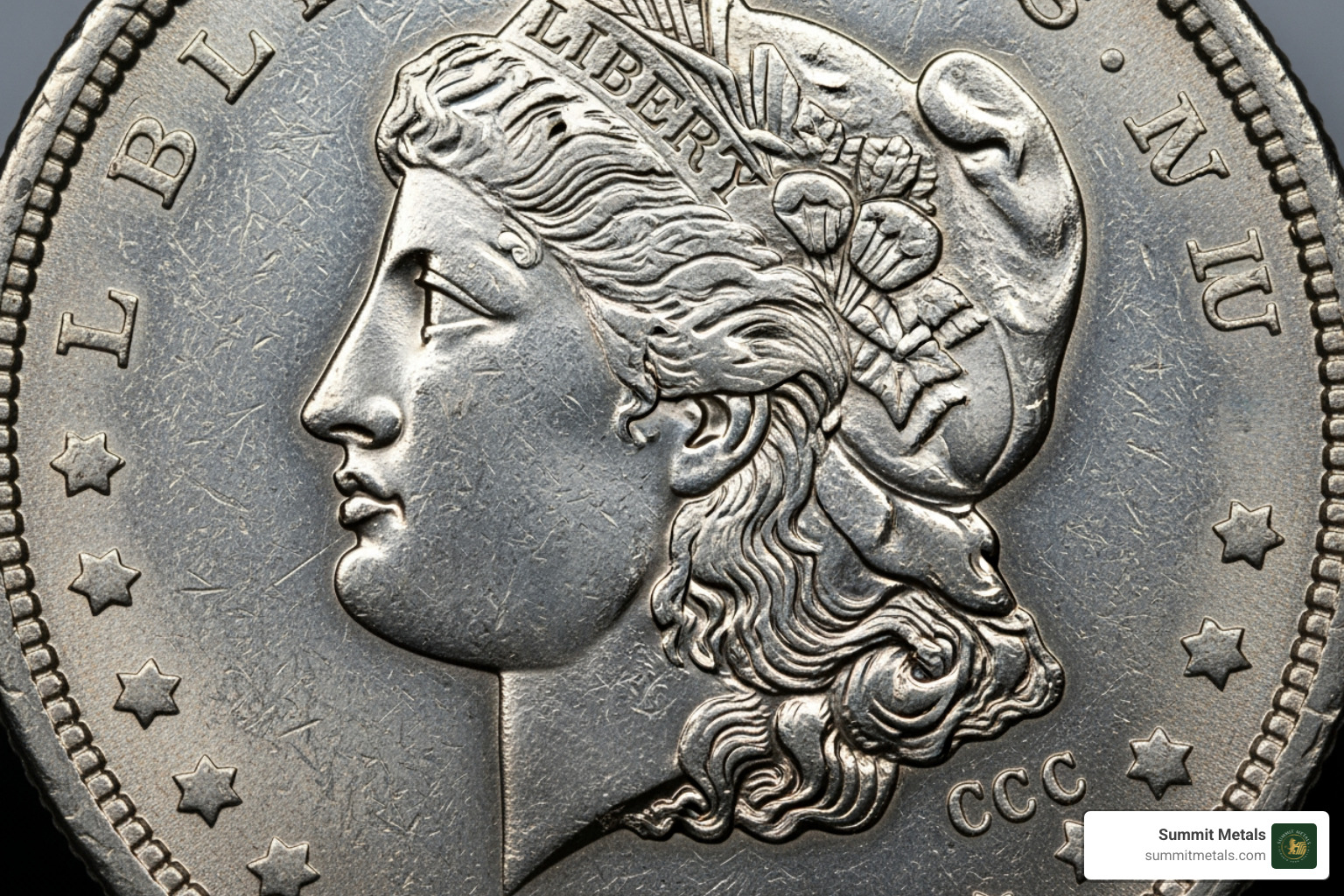
- Mint Mark: The mint where the coin was produced can make a coin more desirable. For instance, Carson City ('CC') mint marks are highly prized for Morgan Dollars.
It's important to separate any coins that might have significant numismatic value. Selling a rare coin for just its melt value would be a huge mistake! Many people sell silver coins for melt value when they are common or in bad condition, but you don't want to accidentally sell a hidden gem for less than it's worth. You can check current melt values using resources like NGC's coin melt value calculator.
How to Calculate the Melt Value of Your Coins
To determine the melt value of your silver dollars, you can use a straightforward formula:
Melt Price = Metal Price/Ounce × Weight of the Coin in Ounces × Metal Purity
Let's break down the components for common U.S. silver dollars:
- Silver Content: Both Morgan Dollars (1878-1921) and Peace Dollars (1921-1935) are composed of 90% silver and 10% copper.
- Actual Silver Weight (ASW): Each Morgan or Peace Dollar contains approximately 0.7734 troy ounces of pure silver.
- Current Silver Spot Price: This is the constantly fluctuating market price for one troy ounce of pure silver.
Based on a recent silver price of $90.23 per ounce (at the time of this publication), the melt value for a Morgan Dollar or a Peace Dollar is approximately $69.78. This melt value is dynamic and changes with the market, so always check the latest spot price.
It's worth noting that other U.S. silver coins also have significant melt value. For instance, pre-1965 U.S. dimes, quarters, and half dollars typically contain 90% silver. Kennedy half dollars minted between 1965 and 1970 contain 40% silver.
Key Dates, Grades, and Mint Marks to Look For
This is where the hunt for premium value begins! While many silver dollars are common, certain dates, mint marks, and conditions can lift a coin's value far beyond its melt content.
Morgan Dollars (1878-1921):
- Carson City ('CC') Mint Marks: Coins minted in Carson City are highly collectible due to the mint's short operating period and relatively low mintages. Look for the "CC" mint mark above the "DOLLAR" on the reverse.
-
Key Dates:
- 1889-CC
- 1893-S (San Francisco)
- 1895 (Proof only, extremely rare)
- 1895-O (New Orleans)
- 1895-S (San Francisco)
- Other Scarce Dates: Coins from 1892-1895, especially those from San Francisco ('S') or New Orleans ('O') mints, should be reviewed carefully.
- The 1921 Morgan dollars are the most common, but even these can bring a premium if they have 'D' (Denver) or 'S' (San Francisco) mint marks and are in uncirculated condition.
Peace Dollars (1921-1935):
-
Key Dates (especially in higher grades):
- 1921 (First year of issue, high relief)
- 1928 (Low mintage, especially without a mint mark)
- 1934-S (San Francisco, scarce in higher grades)
Coin Grading Conditions Explained:
The condition, or "grade," of your silver dollar dramatically affects its numismatic value. Professional grading services like PCGS and NGC use a 70-point scale, but we can simplify it for initial assessment:
- Uncirculated (MS-60 to MS-70): These coins show no trace of wear and retain their full original mint luster. A truly uncirculated coin will fetch the highest premiums.
- Almost Uncirculated (AU-50 to AU-58): A slight trace of wear on the highest points of the design, but most of the mint luster is still present.
- Extra Fine (XF-40 to XF-45): Most major details are still present, with clear lines and only slight flattening of the design.
- Very Fine / Very Good (VF-20 to VG-8): Some details are apparent, but significant wear is visible. The coin still has a distinct design, but major features are flattened.
- Cull / Worn: These coins are heavily worn, damaged, or severely scratched, often making them valuable only for their melt value.
If you believe you have a coin with a key date, a desirable mint mark, or one in exceptional condition, we strongly recommend seeking a professional appraisal. You can email high-resolution images to numismatic professionals for evaluation.
Where to Go for Selling Silver Dollars for Cash
Once you have a better idea of your silver dollars' potential value, the next step is deciding where to sell them. There are various options, each with its own advantages and disadvantages. For those of us in Wyoming and Salt Lake City, Utah, we have excellent local options, alongside reputable online buyers.
Selling Directly to Summit Metals: The Trusted Choice
At Summit Metals, we pride ourselves on being a transparent, reliable, and competitive option for selling silver dollars for cash. We understand that parting with your precious metals can be a significant decision, and we aim to make the process as straightforward and rewarding as possible.
Why choose Summit Metals?
- Competitive Pricing: We offer competitive rates, often reflecting real-time market prices, thanks to our efficient operations and bulk purchasing capabilities. You won't have to haggle or worry if you're getting a fair deal.
- Secure and Transparent Process: Your peace of mind is our priority. Whether you sell to us in person at our Salt Lake City, Utah, location or through our secure online process, we ensure every transaction is transparent and protected. Our authentication process happens in a secure vault, ensuring accuracy and trust.
- Immediate Payment Options: We offer convenient and timely payment methods once your items are verified, typically within 3-5 business days after authentication, assuming no discrepancies.
- Expert Evaluation: Our team is knowledgeable about numismatic and melt values, ensuring your coins are accurately assessed. If your silver dollar has collector value, we'll recognize it.
- Trusted Partner: With our strong reputation in Wyoming and Salt Lake City, Utah, we are dedicated to building long-term relationships based on trust and value. We're not just buyers; we're your partners in precious metals.
- Convenience and Exit Strategy: There's no need to spend hours shopping around for the best price. We strive to offer excellent value upfront, simplifying your selling experience. You can also store metals in our private vault so that when you are ready to sell, they are already authenticated and can be liquidated quickly.
To start the process of selling silver dollars for cash with us, you can visit our Sell Silver Dollars to Summit Metals page. You can submit details about your coins online or contact us directly. For larger collections, especially those with potential numismatic value, we welcome you to reach out for a personalized consultation.
Comparing Selling to Summit Metals vs. Other Options
To help you make an informed decision, here's how selling silver dollars for cash to Summit Metals compares with other common avenues:
| Criteria | Summit Metals (Local & Online) | Local Coin Shops (e.g., in Salt Lake City, Utah) | Online Marketplaces / Auctions (peer-to-peer) |
|---|---|---|---|
| Speed of Payment | Fast; typically within 3-5 business days after authentication | Usually same day if you accept the offer | Varies; you must list, wait for a buyer, then wait for funds |
| Price / Offer | Competitive, based on real-time pricing and bulk purchasing | Can be competitive, but varies widely by shop | Potentially higher, but after fees and shipping it may net less |
| Convenience | Online or in-person; clear process and support | Requires visiting multiple shops to compare | Must manage listings, messages, shipping, and returns |
| Security | Professional authentication in a secure vault, insured processes | Generally safe but depends on the specific shop's practices | Higher risk of scams, chargebacks, or counterfeit disputes |
| Seller Effort | Low; Summit handles evaluation, verification, and logistics | Moderate; you manage transport and negotiation | High; you handle photos, descriptions, and buyer issues |
| Trusted Reputation | Established precious metals specialist focused on investors | Varies significantly | Depends on individual buyer ratings |
| Exit Strategy | Integrated with private vault storage for easy future liquidation | Typically no storage or exit-strategy planning | No storage; you manage long-term planning on your own |
When you factor in price, security, and effort, many sellers find that dealing directly with Summit Metals is the most efficient way to convert silver dollars into cash while also planning a smart exit strategy for the rest of their precious metals portfolio.
Understanding Your Silver Dollar's Value
Before you even think about selling silver dollars for cash, the first and most crucial step is understanding what your coins are truly worth. This isn't just about the current price of silver; it's about discerning between a coin's intrinsic metal value and its potential collector appeal. Knowing this distinction can significantly impact your payout.
Melt Value vs. Numismatic Value
When we talk about the value of silver dollars, we're generally looking at two main categories:
- Melt Value: This is the intrinsic worth of the metal content if the coin were to be melted down. It's purely based on the coin's silver weight and the current market price of silver. For common silver dollars, especially those in worn or damaged condition, the melt value is often the primary driver of their price. For example, pre-1965 U.S. dimes, quarters, and half dollars typically contain 90% silver, while Morgan and Peace Dollars also boast a significant silver content.
-
Numismatic Value: This refers to the value a coin holds for collectors, which can be significantly higher than its melt value. Numismatic value is determined by several factors:
- Rarity: How many of these coins were originally minted, and how many still exist today? Limited mintage figures often lead to higher rarity.
- Condition (Grade): The better the condition of the coin (less wear, more original luster), the higher its numismatic value. Even slight differences in condition can mean a huge jump in price.
- Demand: How sought-after is this particular coin by collectors? Popular series or key dates always have higher demand.
- Mint Mark: The mint where the coin was produced can make a coin more desirable. For instance, Carson City ('CC') mint marks are highly prized for Morgan Dollars.
It's important to separate any coins that might have significant numismatic value. Selling a rare coin for just its melt value would be a huge mistake! Many people sell silver coins for melt value when they are common or in bad condition, but you don't want to accidentally sell a hidden gem for less than it's worth.
How to Calculate the Melt Value of Your Coins
To determine the melt value of your silver dollars, you can use a straightforward formula:
Melt Price = Metal Price/Ounce × Weight of the Coin in Ounces × Metal Purity
Let's break down the components for common U.S. silver dollars:
- Silver Content: Both Morgan Dollars (1878-1921) and Peace Dollars (1921-1935) are composed of 90% silver and 10% copper.
- Actual Silver Weight (ASW): Each Morgan or Peace Dollar contains approximately 0.7734 troy ounces of pure silver.
- Current Silver Spot Price: This is the constantly fluctuating market price for one troy ounce of pure silver.
Based on a recent silver price of $90.23 per ounce (at the time of this publication), the melt value for a Morgan Dollar or a Peace Dollar is approximately $69.78. This melt value is dynamic and changes with the market, so always check the latest spot price.
It's worth noting that other U.S. silver coins also have significant melt value. For instance, pre-1965 U.S. dimes, quarters, and half dollars typically contain 90% silver. Kennedy half dollars minted between 1965 and 1970 contain 40% silver.
Key Dates, Grades, and Mint Marks to Look For
This is where the hunt for premium value begins! While many silver dollars are common, certain dates, mint marks, and conditions can lift a coin's value far beyond its melt content.
Morgan Dollars (1878-1921):
- Carson City ('CC') Mint Marks: Coins minted in Carson City are highly collectible due to the mint's short operating period and relatively low mintages. Look for the "CC" mint mark above the "DOLLAR" on the reverse.
-
Key Dates:
- 1889-CC
- 1893-S (San Francisco)
- 1895 (Proof only, extremely rare)
- 1895-O (New Orleans)
- 1895-S (San Francisco)
- Other Scarce Dates: Coins from 1892-1895, especially those from San Francisco ('S') or New Orleans ('O') mints, should be reviewed carefully.
- The 1921 Morgan dollars are the most common, but even these can bring a premium if they have 'D' (Denver) or 'S' (San Francisco) mint marks and are in uncirculated condition.
Peace Dollars (1921-1935):
-
Key Dates (especially in higher grades):
- 1921 (First year of issue, high relief)
- 1928 (Low mintage, especially without a mint mark)
- 1934-S (San Francisco, scarce in higher grades)
Coin Grading Conditions Explained:
The condition, or "grade," of your silver dollar dramatically affects its numismatic value. Professional grading services like PCGS and NGC use a 70-point scale, but we can simplify it for initial assessment:
- Uncirculated (MS-60 to MS-70): These coins show no trace of wear and retain their full original mint luster. A truly uncirculated coin will fetch the highest premiums.
- Almost Uncirculated (AU-50 to AU-58): A slight trace of wear on the highest points of the design, but most of the mint luster is still present.
- Extra Fine (XF-40 to XF-45): Most major details are still present, with clear lines and only slight flattening of the design.
- Very Fine / Very Good (VF-20 to VG-8): Some details are apparent, but significant wear is visible. The coin still has a distinct design, but major features are flattened.
- Cull / Worn: These coins are heavily worn, damaged, or severely scratched, often making them valuable only for their melt value.
If you believe you have a coin with a key date, a desirable mint mark, or one in exceptional condition, we strongly recommend seeking a professional appraisal. You can email high-resolution images to numismatic professionals for evaluation.
Beyond the Sale: Taxes and Long-Term Investment Strategy
Selling your silver dollars is a great way to realize their value, but it's also an opportunity to think about your long-term financial strategy. A successful sale is not just an endpoint; it can be the beginning of a more informed and powerful investment journey.
Understanding Tax Implications When Selling Coins
When you sell silver dollars for a profit, you may be subject to capital gains tax. The amount you owe depends on how long you held the coins and your income bracket.
- Capital Gains: The profit you make (the selling price minus your original cost) is considered a capital gain. For precious metals, these are often taxed as "collectibles" at a rate of up to 28%.
- Reporting to the IRS: For certain transactions, dealers are required to file a Form 1099-B with the IRS. It's crucial to keep detailed records of your purchase prices and sale prices to accurately report your gains or losses.
- Consult a Professional: Tax laws can be complex. We always recommend consulting with a tax professional to understand your specific obligations and ensure you are compliant.
Keeping meticulous records of your purchases and sales is the best way to prepare for tax season and manage your investments effectively.
Planning Your Exit Strategy with Precious Metals
Thinking of your precious metals as a liquid asset is key to smart investing. Having a clear exit strategy—knowing when and how you'll sell—is just as important as your buying strategy. This ensures you can access your capital when you need it, whether for an emergency, a large purchase, or rebalancing your portfolio.
At Summit Metals, we make this easy. By using our private vault storage, you not only secure your assets but also position them for quick and seamless liquidation. When you're ready to sell, the process is expedited because your metals are already verified and in our care.
Learn more about our streamlined selling process and how we can help you manage your precious metals portfolio by visiting our selling services page.
Why Reinvest in Coins? The Coin vs. Bar Advantage
After selling, you might consider reinvesting your profits back into precious metals. While both coins and bars are excellent ways to hold silver and gold, coins offer unique advantages, especially for long-term investors.
| Feature | Coins | Bars |
|---|---|---|
| Authenticity | Government-minted; difficult to counterfeit | Higher risk of counterfeiting |
| Liquidity | Easily recognizable and tradable worldwide | May require assaying to verify purity |
| Divisibility | Smaller units make them easier to sell | Larger units are harder to divide and sell |
| Numismatic Value | Potential to appreciate beyond metal value | Value is tied almost exclusively to spot price |
Promote Autoinvest: Dollar Cost Average with Summit Metals
A smart way to build your collection is through dollar-cost averaging. Instead of trying to time the market, you invest a fixed amount regularly. This strategy smooths out price volatility over time.
With Summit Metals' Autoinvest program, you can set up automatic, recurring purchases of your favorite gold and silver coins. It's like a 401k for your precious metals portfolio—a disciplined, hands-off way to grow your wealth.
- Set it and forget it: Choose your products and investment amount.
- Build your stack: Automatically purchase metals on a schedule that works for you.
- Secure and flexible: Your investments are secure, and you can adjust your plan anytime.
Ready to start building your precious metals portfolio consistently? Learn more about our Autoinvest services.