What Are 90 Silver Dimes Worth Right Now?
90 silver dimes value is determined primarily by their silver content — and right now, that number is significant.
Here's a quick snapshot of current values (prices at time of publication, based on ~$84.66/oz silver spot price):
| Quantity | Face Value | Silver Content (troy oz) | Approximate Melt Value |
|---|---|---|---|
| 1 dime | $0.10 | 0.0723 oz | ~$6.12 |
| 1 roll (50 dimes) | $5.00 | 3.575 oz | ~$302.71 |
| 1 bag (1,000 dimes) | $100.00 | 71.5 oz | ~$6,053.19 |
| Large bag (2,500 dimes) | $250.00 | 178.75 oz | ~$15,132.98 |
The key facts to know up front:
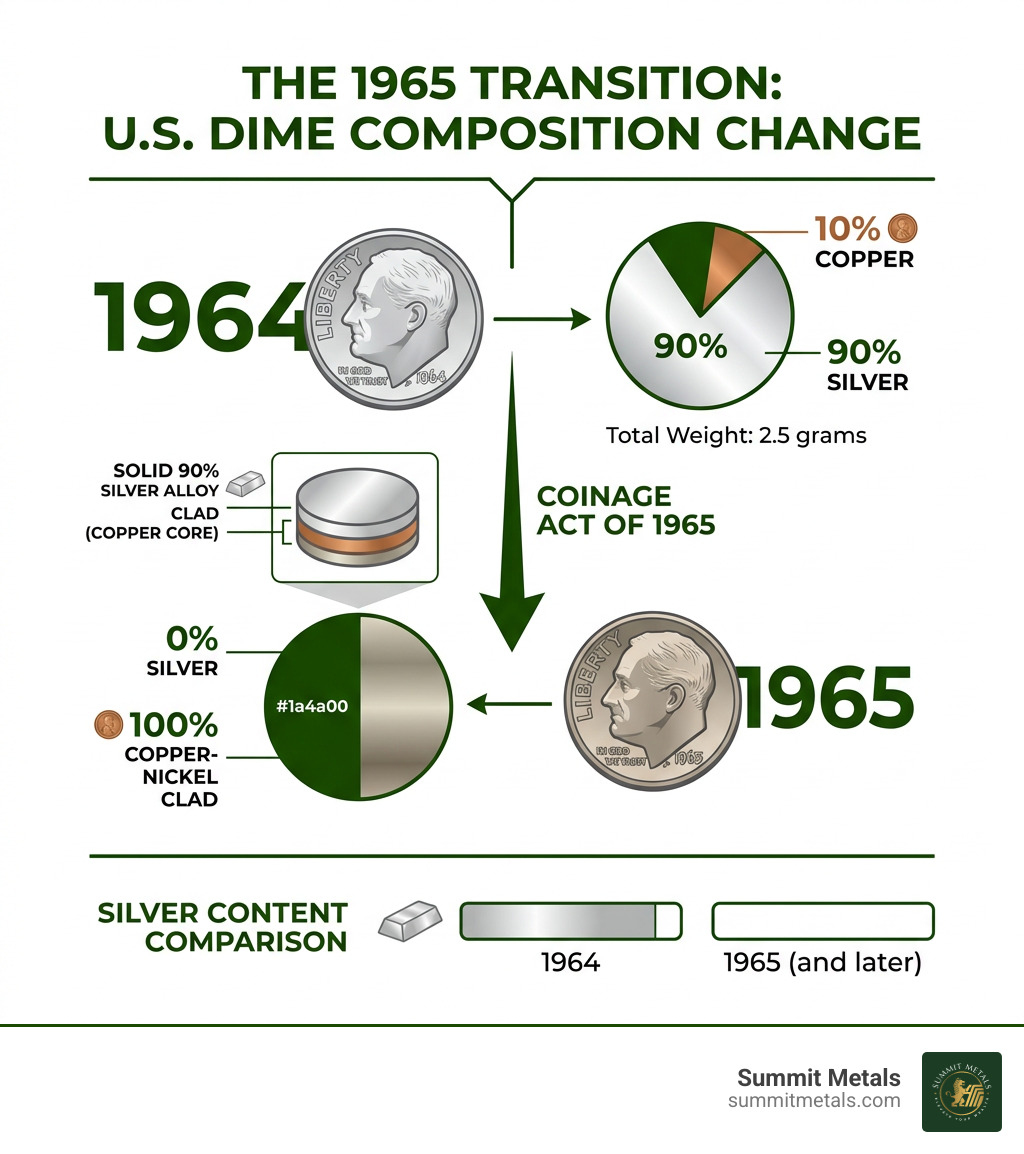
- Only dimes dated 1964 or earlier contain 90% silver
- Each coin is 90% silver and 10% copper, weighing 2.5 grams
- The three silver dime series are Barber (1892–1916), Mercury (1916–1945), and Roosevelt (1946–1964)
- Melt value is the floor — rare dates and high grades can push values much higher
- 1965 and later dimes contain zero silver (copper-nickel clad only)
These coins are commonly called "junk silver" — not because they're worthless, but because they're valued for metal content rather than collector rarity. In practice, they're one of the most trusted and liquid forms of physical silver you can own.
I'm Eric Roach, a former Wall Street investment banker and M&A advisor who now helps everyday investors build resilient portfolios using physical precious metals — including understanding 90 silver dimes value as part of a broader silver strategy. Let's break down everything you need to know to stack smart.
90 silver dimes value definitions:
Understanding the 90 Silver Dimes Value: Melt vs. Numismatic
When we talk about the 90 silver dimes value, we are really looking at two different worlds: the "melt" world and the "numismatic" world. For most of us stacking silver for a rainy day, the melt value is our bread and butter. It represents the intrinsic worth of the precious metal itself.
Every 90% silver dime was minted with a specific composition: 90% pure silver and 10% copper. When they were fresh from the mint, they contained exactly 0.07234 troy ounces of silver. However, because these coins circulated in pockets and cash registers for decades, they experienced a bit of wear. In the industry, we generally use a standard of 0.715 troy ounces of silver per $1 face value (10 dimes) to account for that slight loss of metal over time.

If you're looking for a deeper dive into how these calculations work across all types of coinage, check out An Essential Guide to Valuing Constitutional Silver.
Factors Influencing 90 Silver Dimes Value
While most dimes are sold based on their weight, some are "diamonds in the rough." Numismatic value comes into play when a coin is rare due to its low mintage, its condition, or a specific mint mark.
- Mint Marks: These tiny letters tell you where the coin was born. "D" stands for Denver, "S" for San Francisco, and "O" for New Orleans. If there is no mark, it usually came from Philadelphia.
- Key Dates: Some years saw very few dimes produced. The king of all silver dimes is the 1916-D Mercury Dime. Even in "Good" condition, one of these can fetch several hundred dollars. In "Uncirculated" condition? You're looking at thousands.
- Condition: A dime that looks like it was minted yesterday (Brilliant Uncirculated) will always command a higher premium than one worn smooth by years of use.
Interestingly, even modern-looking coins can have unique stories. For example, while the 1990 S Dime Coin Value (Price Chart) shows that 1990 dimes are typically clad (non-silver), proof versions were still produced for collectors. However, for the purpose of "stacking," we focus on the pre-1965 era where silver was the standard.
Tracking the 90 Silver Dimes Value in Real-Time
The price of silver isn't static; it breathes with the market. To know your 90 silver dimes value today, you have to look at the "spot price"—the current market price for one troy ounce of pure silver.
When you buy from a dealer, you'll pay a "premium over spot." This covers the dealer's costs, shipping, and a small profit. Because silver dimes are no longer being made, their supply is fixed. During times of high demand, these premiums can spike. You can stay ahead of these trends by reading Junk Silver - A Deep Dive into Current Values and Melt Prices.
At Summit Metals, we pride ourselves on transparent, real-time pricing. We believe you should know exactly what you’re paying for the metal content without hidden fees or "salesy" gimmicks.
The Three Pillars of Silver Dimes: Barber, Mercury, and Roosevelt
If you open a bag of junk silver, you’re likely to see three distinct faces staring back at you. Each represents a different era of American history and carries its own unique charm.
Barber Dimes (1892–1916)
Named after their designer, Charles E. Barber, these coins have a classic, almost "masculine" depiction of Liberty wearing a Phrygian cap and a laurel wreath. Because these are the oldest of the 90% silver dimes, they are often the most worn. However, because they generally have lower mintage numbers—peaking at around 34 million in a single year—they often carry a slightly higher collector premium than their younger cousins. For more on how these fit into the broader market, see A Comprehensive Guide to Junk Silver Value.
Mercury Dimes (1916–1945)
Widely considered the most beautiful U.S. coin ever minted, the "Mercury" dime actually depicts Lady Liberty in a winged cap (representing freedom of thought). People mistook her for the Roman god Mercury, and the name stuck. These coins are 0.900 fine silver and are highly sought after by both investors and collectors. Rare varieties like the 1921-D or the 1942/1 overdate are the prizes of the series. You can learn more about their place in a portfolio at Junk Silver.
Roosevelt Dimes (1946–1964)
Following the death of Franklin D. Roosevelt, the U.S. Mint moved quickly to honor him on the dime, largely because of his association with the March of Dimes. These are the most common silver dimes you will find. In 1964 alone, the mint pumped out over 2.2 billion of them! Because they are so plentiful, they are the perfect "workhorse" for silver stackers. If you're wondering how many of these you need to reach a certain weight, check out How Much Junk Silver Equals an Ounce.
Strategic Stacking: Bulk Bags and Autoinvesting
While buying a single silver dime is fun, serious investors usually look at "face value" (FV) quantities. We typically sell these in rolls ($5 FV) or bags ($100, $250, or even $1000 FV).
A $100 face value bag is a standard unit in the industry. It contains 1,000 dimes and provides approximately 71.5 troy ounces of pure silver. These bags are the ultimate "fractional" silver. If you ever needed to trade silver for groceries or fuel in an emergency, a dime is much easier to spend than a 100-ounce bar.
| Feature | 90% Silver Dimes | 10 oz Silver Bar |
|---|---|---|
| Liquidity | Extremely High (Small units) | High (Standard unit) |
| Face Value Protection | Yes ($0.10 legal tender) | No (Value is purely metal) |
| Divisibility | High (Can sell 1 or 1,000) | Low (Must sell the whole bar) |
| Counterfeit Risk | Low (Hard to fake wear/ring) | Moderate (Requires testing) |
For those looking to go big, 100 Face Value Junk Silver is a great place to start your research.
Dollar Cost Averaging with Autoinvest
One of the biggest mistakes investors make is trying to "time the market." They wait for silver to drop, and then it shoots up, leaving them on the sidelines. We recommend a "stacking" approach—similar to how you might contribute to a 401k.
Through our Autoinvest program, you can set a monthly budget to buy silver. Whether the price is up or down, you keep building your "mountain." Over time, this dollar-cost averaging lowers your average cost per ounce and removes the emotional stress of watching daily tickers. It's budget-friendly and builds long-term wealth without you having to think about it. Learn more about making smart moves in Junk Silver Coins: Your Go-To Guide for Smart Purchases.
Storage and Preservation for Long-Term Wealth
Once you've started stacking, you need to protect your investment. While silver is durable, it can tarnish when exposed to air and moisture.
- Tubes: Plastic coin tubes are great for organizing rolls. They keep the coins from rattling and limit air exposure.
- Canvas Bags: For bulk storage, heavy-duty canvas bags are the traditional choice.
- Environment: Keep your silver in a cool, dry place. If you're in a humid area like parts of the South, a few silica gel packets in your safe can work wonders.
For a guide on the weight and value of larger collections, see our Pound Junk Silver Worth Guide.
The Exit Strategy: Liquidity and Selling Your Silver
A good investment isn't just about how you buy; it's about how you sell. This is where 90% silver dimes truly shine. Because they are official U.S. coinage, they are recognized by every coin shop and precious metals dealer in the country.
At Summit Metals, we don't just want to sell you silver; we want to be your partner for the entire lifecycle of your investment. We offer private vault storage for those who don't want the risk of keeping metal at home. And when you're ready to cash out, our "Sell to us" program ensures you have instant liquidity. You can send your silver back to us, and we will pay you competitive market rates, often much higher than a local pawn shop would offer.
You can explore the different types of constitutional silver we buy and sell at Constitutional Silver / Junk Silver.
Why Dimes Beat Bars in Economic Uncertainty
In a "worst-case scenario" or a period of extreme economic instability, "barterability" becomes the most important feature of your silver.
- Denominations: A silver dime is currently worth about $6. That’s roughly the price of a gallon of milk or a loaf of bread.
- Legal Tender: These are still legal tender. While you'd be crazy to spend them for 10 cents, that status provides a layer of legal protection and recognition that private bars don't have.
For more on the math of silver by weight, check out 1 Troy Pound of Junk Silver.
Frequently Asked Questions about Silver Dimes
How can I tell if my dime is 90% silver?
The easiest way is the Date Test: if it’s 1964 or older, it’s silver. You can also do the Edge Test: look at the rim of the coin. If you see a solid silver-colored stripe, it’s likely silver. If you see a copper-colored "sandwich" layer, it’s a modern clad coin. Finally, try the Ping Test: gently tap the dime or drop it on a hard surface. Silver has a distinct, high-pitched "ring" that lasts, whereas clad coins have a dull "thud."
What is a "Junk Silver" bag?
It is a bag of circulated 90% silver coins (dimes, quarters, or half dollars) sold purely for their metal content. These coins are usually well-worn and have no special collector value, which makes them the most affordable way to buy physical silver. They are typically sold in $100, $500, or $1,000 face value increments.
Are 1965 dimes silver?
No. 1965 was the first year the U.S. Mint switched to "clad" coinage. These are made of a core of pure copper with an outer layer of 75% copper and 25% nickel. They contain zero silver. If you find a 1965 dime, it’s worth exactly ten cents.
Conclusion
Understanding the 90 silver dimes value is the first step toward building a tangible, resilient wealth strategy. Whether you're drawn to the history of the Barber dime, the beauty of the Mercury, or the utility of the Roosevelt, these coins offer a unique blend of silver content, legal tender status, and historical significance.
At Summit Metals, based in Wyoming, we are dedicated to helping you navigate the precious metals market with confidence. We offer authenticated gold and silver with transparent, real-time pricing. By purchasing in bulk, we’re able to pass those savings on to you, ensuring you get the most metal for your dollar.
Whether you're in Salt Lake City, Utah, or anywhere else across the country, we are here to help you start stacking. Start your silver subscription today and take control of your financial future, one dime at a time.