Your Grandad's Old Coins Could Be Sitting on a Silver Fortune
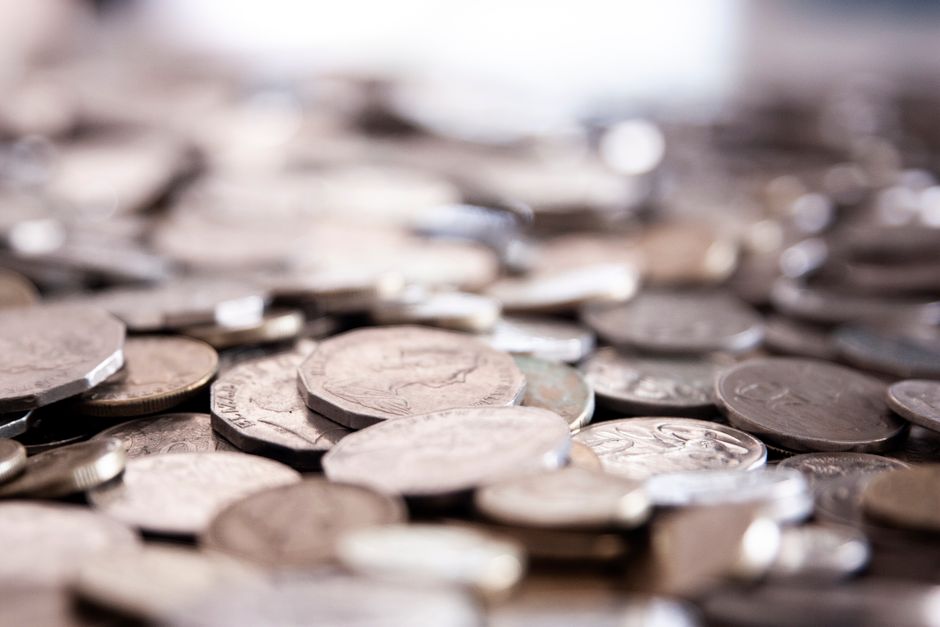
Australian junk silver refers to pre-decimal coins minted between 1910 and 1966 that contain real silver — and are traded primarily for their metal content rather than any collector premium.
Here's a quick breakdown of what qualifies:
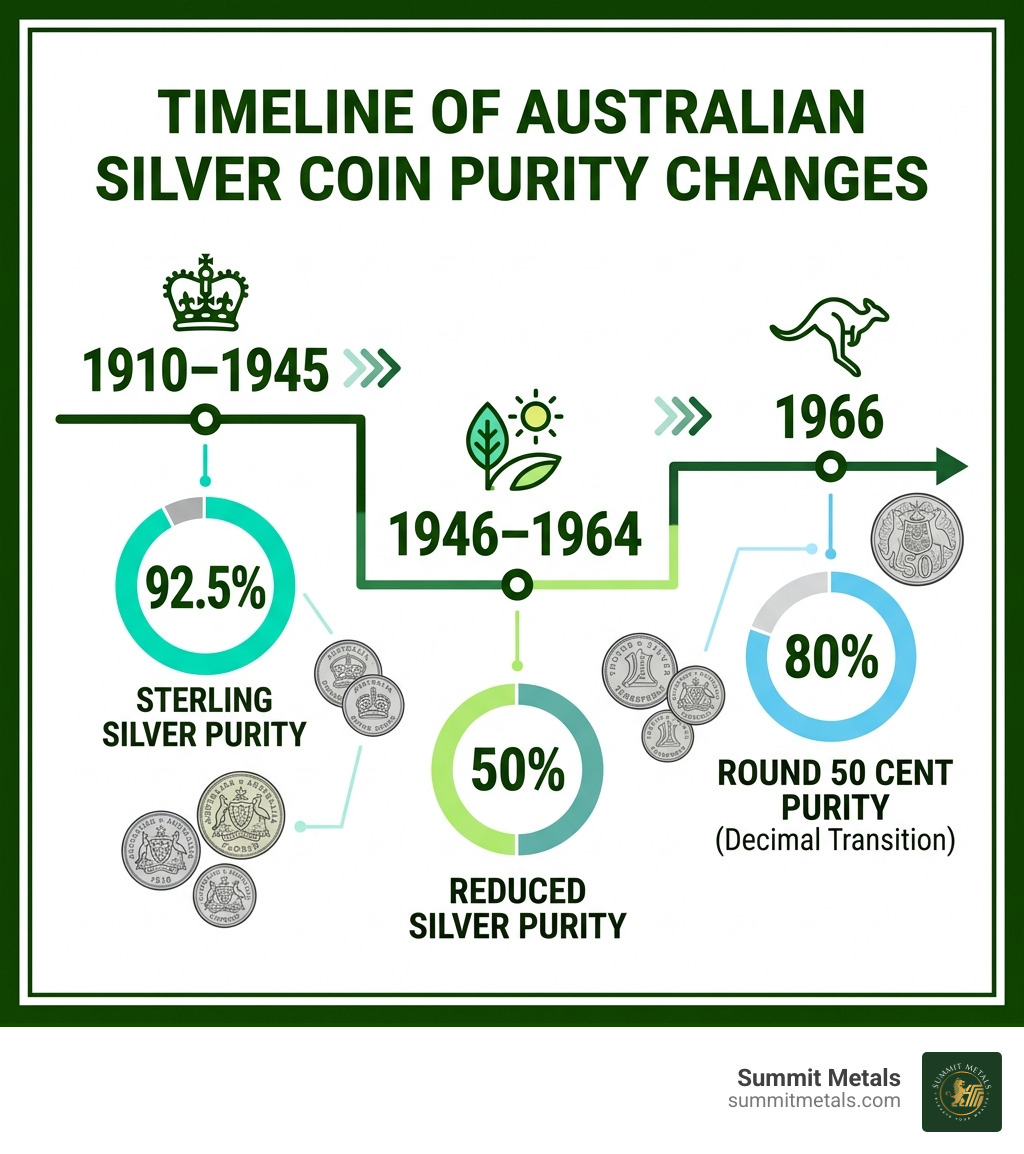
| Coin Era | Silver Purity | Denominations |
|---|---|---|
| 1910–1945 | 92.5% (sterling) | Threepence, Sixpence, Shilling, Florin, Crown |
| 1946–1964 | 50% | Threepence, Sixpence, Shilling, Florin |
| 1966 | 80% | 50 Cent Round (decimal transition coin) |
These aren't rare collector pieces. They're everyday coins that circulated in Australian pockets for decades — and they happen to contain genuine silver bullion.
When Australia switched to decimal currency in 1966, the government melted down millions of pre-decimal coins turned in by citizens. But many Australians quietly held onto theirs. Today, those hoarded coins trade hands as affordable, fractional silver — a tangible hedge against economic uncertainty that you can hold in your hand.
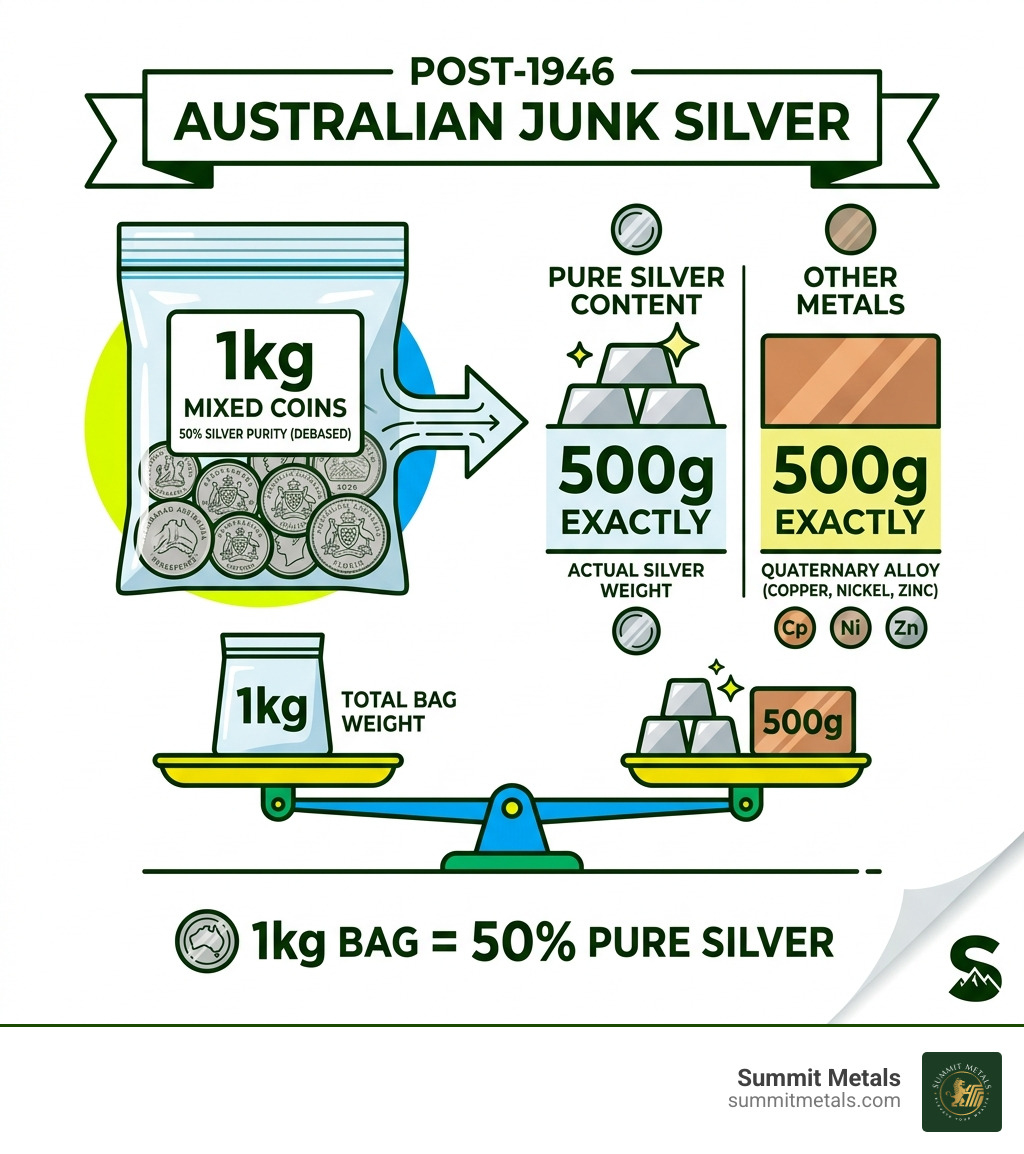
The appeal is simple. Unlike a silver bar, these coins come in small denominations, carry government-backed legal tender status, and are notoriously difficult to counterfeit. A 1kg bag of post-1946 coins, for example, contains exactly 500g (16.075 troy oz) of pure silver — a meaningful position that doesn't require a large upfront investment.
Whether you've inherited a biscuit tin full of old shillings or you're actively stacking fractional silver, understanding what these coins are actually worth — and why — is the first step.
I'm Eric Roach, a former Wall Street investment banker and M&A advisor who now helps everyday investors build resilient portfolios through physical precious metals, including Australian junk silver — and I'll walk you through everything you need to know.
Common australian junk silver vocab:
Defining Australian Junk Silver: History and Purity
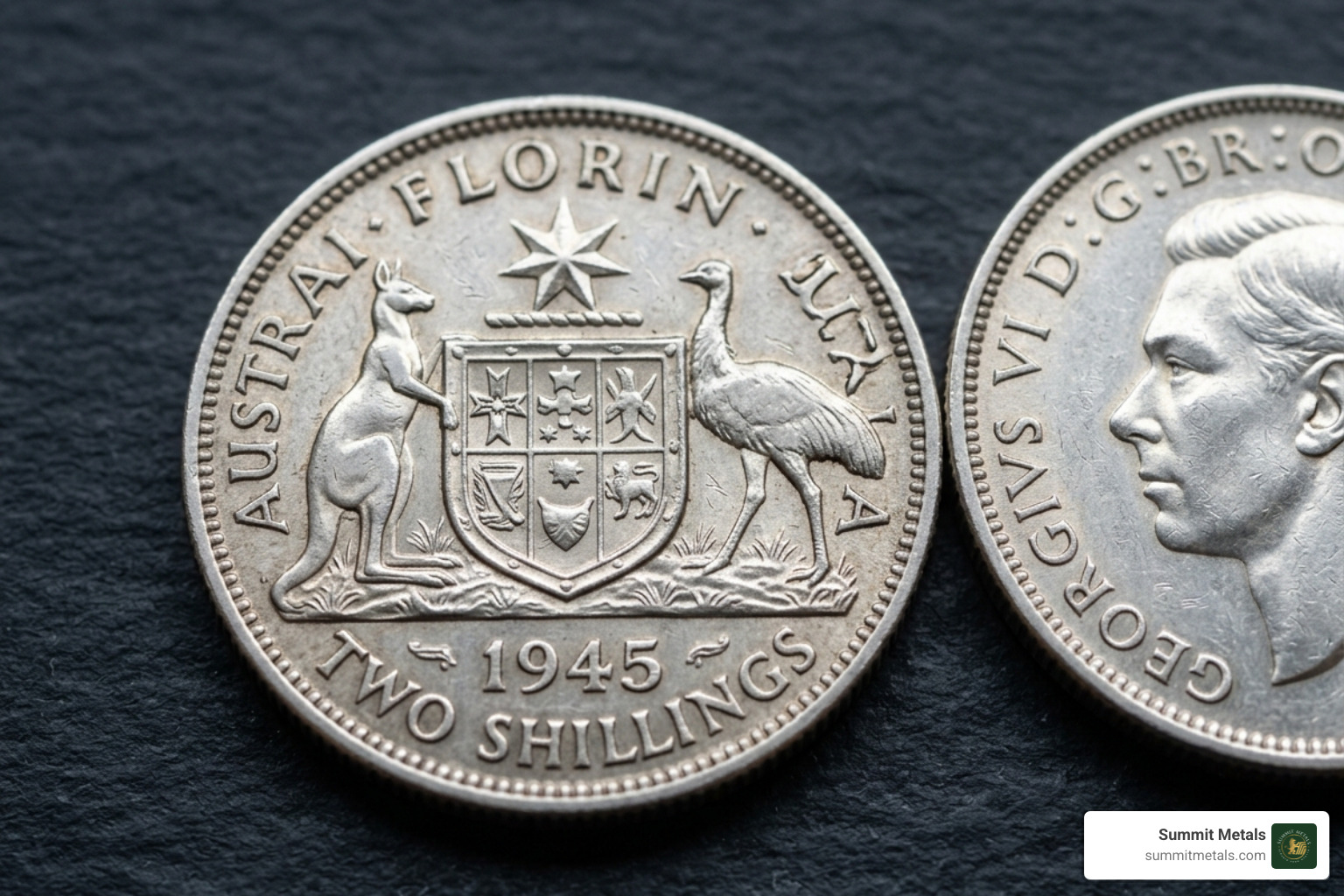
To understand australian junk silver, we have to look back at the history of the Australian Pound. Before the country switched to the decimal system we use today (dollars and cents), the currency was based on the British Pound Sterling. This meant the coins in people's pockets—specifically the threepence, sixpence, shilling, and florin—were actually made of silver.
The term "junk" is a bit of a misnomer. These coins aren't trash; in fact, they are highly sought after by investors. We call them Constitutional Silver Junk Silver because their value is derived from their "intrinsic" metal content rather than their rarity as a collectible. Most of these coins are worn, scratched, or "circulated," which means they don't carry the high premiums of a pristine uncirculated silver dollar.
Historically, the era of Australian Silver Coins spans from 1910 to 1964 for pre-decimal denominations, with a final "hurrah" in 1966. During this time, the silver content wasn't just a suggestion—it was the standard. However, as we'll see, global events eventually forced the government to thin out the silver.
Pre-1946 vs. Post-1946: The Great Silver Debasement
If you are sorting through a bag of old coins, the date is the most important factor. In 1946, Australia followed the lead of other Commonwealth nations and reduced the silver content of its coinage. This was largely due to the massive debts incurred during World War II and the rising cost of silver.
Pre-1946 coins are often called "Sterling" because they are 92.5% pure silver. These are the "heavy hitters" of the junk silver world. A 500g bag of mixed pre-1946 coins yields approximately 462.5g of pure silver.
Post-1946 coins (minted from 1946 to 1964) were debased to 50% silver. The remaining 50% is a "quaternary alloy" consisting of copper, nickel, and zinc. While they contain less silver per coin, they are often more affordable for those looking to start Bagging A Bargain.
| Denomination | Pre-1946 (92.5%) ASW | Post-1946 (50%) ASW |
|---|---|---|
| Threepence | 0.0418 troy oz | 0.0226 troy oz |
| Sixpence | 0.0836 troy oz | 0.0452 troy oz |
| Shilling | 0.1672 troy oz | 0.0904 troy oz |
| Florin | 0.3363 troy oz | 0.1808 troy oz |
Note: ASW stands for Actual Silver Weight.
Calculating the Melt Value of Your Collection
When we talk about Junk Silver A Deep Dive Into Current Values And Melt Prices, we are focusing on "melt value." This is the value of the silver if you were to melt the coin down into a bar.
To calculate this, you need two things: the current spot price of silver and the Actual Silver Weight (ASW) of your coins. Because silver is traded in troy ounces (which are slightly heavier than standard ounces), we always convert the gram weight of the coin to troy ounces.
For example, a pre-1945 Australian florin weighs 10.46 grams. Since it is 92.5% silver, it contains 0.3363 troy oz of pure silver. At a theoretical spot price, you can quickly determine the Pound Junk Silver Worth Guide by multiplying the total ASW of your bag by the current market rate. At April 2026 prices, a single pre-1945 florin has a melt value of approximately $31.85 AUD.
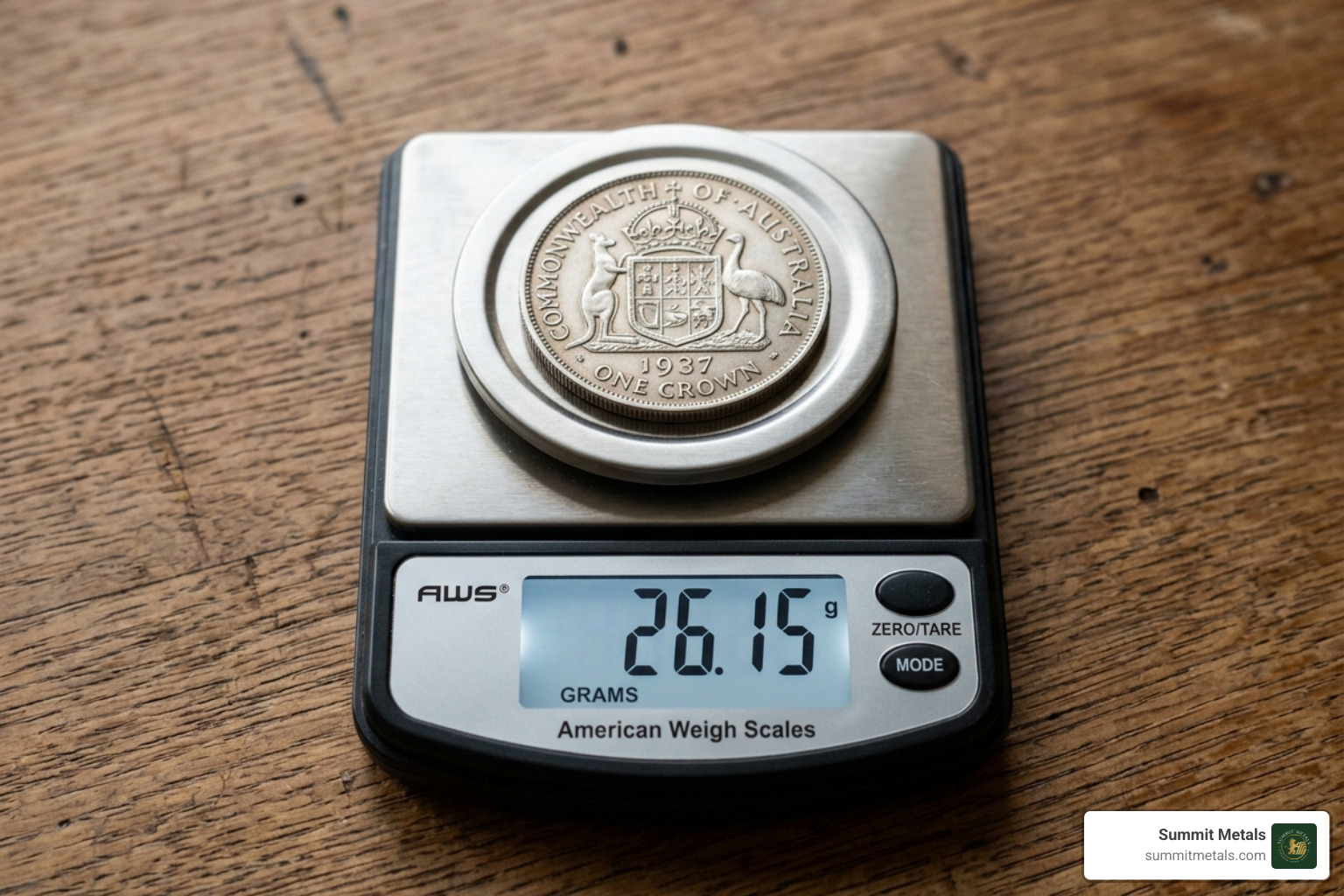
Don't forget the "Crown." The 1937-1938 Australian Crown is a massive coin weighing 26.15g. At 92.5% purity, it contains 0.8407 troy oz of silver, giving it a melt value of roughly $79.61 AUD. These are the "silver dollars" of the Australian world and are highly prized. You can find similar large-format coins like the Ike Silver Dollar in U.S. collections, though the silver content differs.
The 1966 50 Cent Piece: A Legend in Australian Junk Silver
In 1966, Australia officially switched to decimal currency. To mark the occasion, the government released a beautiful, round 50-cent coin. Unlike the 50-cent coins we use today (which are dodecagonal and made of base metal), the original 1966 version was 80% silver.
It didn't take long for the public to realize that the silver in the coin was worth more than its 50-cent face value. As silver prices rose in late 1966, people began hoarding them. The government quickly stopped production and switched to the non-silver shape we recognize now.
Each 1966 silver round weighs 10.62g and contains 0.3414 troy oz of pure silver. Because 36 million were struck, they remain one of the most liquid and recognizable forms of australian junk silver available today. For many, they are the "gold standard" of silver stacking because of their consistent weight and purity. Understanding these specifics is part of An Essential Guide To Valuing Constitutional Silver.
Why Investors Stack Australian Silver Coins
At Summit Metals, we often see investors moving toward australian junk silver for a few very practical reasons. While purchasing silver rounds or 1kg bars is popular, junk silver offers unique advantages that bars simply can't match.
- Fractional Portability: If you own a 1kg bar and need to buy $50 worth of groceries in a crisis, you can't exactly saw off a corner of the bar. Junk silver is "pre-divided." You can trade a few sixpences or a florin easily.
- Trust and Recognition: These coins were minted by the Royal Australian Mint (or the Perth/Melbourne branches of the Royal Mint). They are recognizable "legal tender," which makes them much harder to counterfeit than a generic silver bar from an unknown private mint.
- Low Premiums: Because these are "circulated" coins, you aren't paying for the "art" or the "rarity." You are buying silver at a price very close to the actual melt value.
- Numismatic "Upside": While we buy them for their silver, occasionally a "junk" bag contains a rare date or a mint mark that makes the coin worth much more to a collector. It’s like a treasure hunt where you can't lose, because even the "common" coins are still silver!
Fractional Benefits and Legal Tender Status of Australian Junk Silver
One of the most overlooked aspects of australian junk silver is its status as legal tender. Even though you'd be crazy to spend a 1966 50-cent piece at its face value today, the fact that it is a government-issued coin provides a layer of security.
In precious metals, "barterability" is a key concept. In a hyper-inflationary scenario, smaller denominations like the threepence or shilling become invaluable. We discuss this in depth in our Comprehensive Guide To Junk Silver Value. Having a mix of 90% silver dimes (if you collect U.S. coins) or Australian florins ensures you have a liquid asset that anyone can recognize and value.
Building Your Portfolio with Summit Metals
Building a silver portfolio doesn't have to happen all at once. In fact, we recommend a "set it and forget it" approach. At Summit Metals, we promote Autoinvest, a way for you to dollar-cost average your way into a significant silver position. Just like you contribute to a 401k every month, you can schedule monthly purchases of silver.
Whether you are buying Australian Silver Coins or bulk bags of junk silver, buying regularly helps smooth out the volatility of the silver market. When prices are low, your monthly investment buys more silver; when prices are high, you buy less. Over time, this often results in a lower average cost per ounce than trying to "time the market."
| Feature | Silver Coins (Junk) | Silver Bars |
|---|---|---|
| Face Value | Yes (Government Backed) | No |
| Counterfeit Risk | Low (Hard to replicate wear/detail) | Moderate (Requires testing) |
| Premiums | Very Low | Lowest |
| Divisibility | Excellent (Fractional by nature) | Poor (Requires melting/cutting) |
| Storage | Easy (Bags/Tubes) | Easy (Stackable) |
Where to Buy and Sell Australian Junk Silver
If you're looking for Junk Silver Coins Your Go To Guide For Smart Purchases, you want a dealer you can trust. Summit Metals, based in Wyoming with locations in Salt Lake City, Utah, offers authenticated precious metals with real-time, transparent pricing.
But buying is only half the battle—you need an exit strategy. Many people buy silver and then realize they have nowhere to sell it without getting "fleeced" by a local pawn shop. At Summit Metals, we say: Sell to us. We offer competitive buy-back rates for the coins we sell.
Furthermore, we offer secure storage in a private vault. This keeps your investment liquid. If you decide to sell, you don't have to worry about shipping heavy bags of lead-heavy silver across the country; we can handle the liquidation right from the vault, putting cash back in your pocket instantly. It’s the ultimate way to ensure your 1 Troy Pound Of Junk Silver stays safe and accessible.
Frequently Asked Questions about Australian Junk Silver
What is the difference between "Pre" and "Post" silver?
"Pre" refers to coins minted before 1946, which are 92.5% (Sterling) silver. "Post" refers to coins minted from 1946 to 1964, which are 50% silver. You can usually tell the difference by the date, but post-1946 coins also have a slightly different "ring" when dropped and may show a copper-colored line on the edge if they are heavily worn.
Is the 1966 50 cent coin still legal tender?
Yes, technically the 1966 round 50-cent piece remains legal tender for its face value of 50 cents. However, with its silver melt value currently hovering around $30-$40 AUD (depending on spot prices), you would never want to spend it at a grocery store!
How much pure silver is in a 1kg bag of post-1946 coins?
A 1kg bag of post-1946 Australian silver coins (threepence, sixpence, shilling, florin) contains exactly 500g of pure silver. This is equivalent to 16.075 troy ounces. This makes them very easy to value—just take the current price of 1/2 kilo of silver!
Conclusion
Whether you are a seasoned "stacker" or just discovered a jar of your grandad's old coins, australian junk silver is a fantastic asset class. It combines the history of the Australian Pound with the timeless security of physical silver.
At Summit Metals, we believe in making precious metals accessible to everyone. Through our transparent pricing, Autoinvest options, and secure vaulting, we provide the tools you need to build a legacy. Don't let those old coins gather dust—understand their value, protect your wealth, and consider adding some Constitutional Silver Junk Silver to your portfolio today.
Ready to start your silver journey? Sell to us or explore our bulk options to see how easy it is to own a piece of Australian history.