What is a Self-Directed Gold IRA?

A self directed gold IRA is a specialized individual retirement account that gives you direct control over alternative investments—specifically physical gold, silver, platinum, and palladium—while maintaining the same tax advantages as traditional IRAs.
Quick Answer:
- What it is: A self-directed IRA that holds physical precious metals instead of paper assets
- How it works: You choose an IRS-approved custodian, fund the account, purchase eligible metals, and store them in an approved depository
- Key benefit: Tax-deferred or tax-free growth combined with tangible asset ownership
- Main requirement: Metals must meet IRS purity standards (gold 99.5%+, silver 99.9%+) and be stored at an approved facility—never at home
Unlike standard IRAs where your custodian limits you to stocks, bonds, and mutual funds, a self-directed IRA puts you in the driver's seat. You decide which alternative investments to hold. For precious metals investors, this means owning physical gold and silver coins or bars—not just paper certificates or mining stocks.
The appeal goes back centuries. Gold has served as a store of value since the California Gold Rush of 1849, and today's investors still turn to it during economic uncertainty. Between August 2019 and August 2021, gold climbed from $1,377 to $1,778.62. As of March 2025, it trades at $2,133.30—a clear signal that precious metals continue to hold their purchasing power when paper currencies falter.
Why consider a self directed gold IRA now?
Traditional retirement accounts leave you exposed to stock market swings and inflation. Physical precious metals offer:
- Diversification beyond paper assets
- Inflation protection as metal prices often rise when the dollar weakens
- Crisis insurance when markets tumble
- Tangible ownership of a finite resource
The catch? You can't just buy gold and stash it in your safe. IRS rules require an approved custodian to hold your metals in a secure depository. You'll also face contribution limits ($7,000 for 2024, or $8,000 if you're 50+) and specific purity requirements for each metal.
Setting up a self directed gold IRA involves three key steps: selecting a custodian who specializes in precious metals, funding your account through contributions or rollovers, and purchasing IRS-eligible coins or bars. From there, you can build your position over time—just like contributing to a 401(k).
Dollar-cost averaging with Autoinvest: Summit Metals makes it simple to grow your holdings steadily. Set up recurring monthly purchases to smooth out price volatility and build your precious metals position consistently—no guesswork, no market timing.
Planning your exit matters, too. When you're ready to liquidate, you need a clear path to cash. Summit Metals offers private vault storage and a "Sell to us" program, giving you a seamless way to turn your metals into dollars when retirement arrives or life demands it.
I'm Eric Roach, and I spent over a decade advising Fortune 500 companies on M&A and hedging strategies in New York before channeling that Wall Street expertise into helping everyday investors protect wealth through physical gold and silver, including self directed gold IRA strategies that mirror the defensive tactics used by institutional treasuries. In one memorable case, a 59-year-old executive allocated 12% of her $3.2 million 401(k) rollover to a self directed gold IRA—gold and silver gains added $141k in excess returns, letting her retire eight months early.
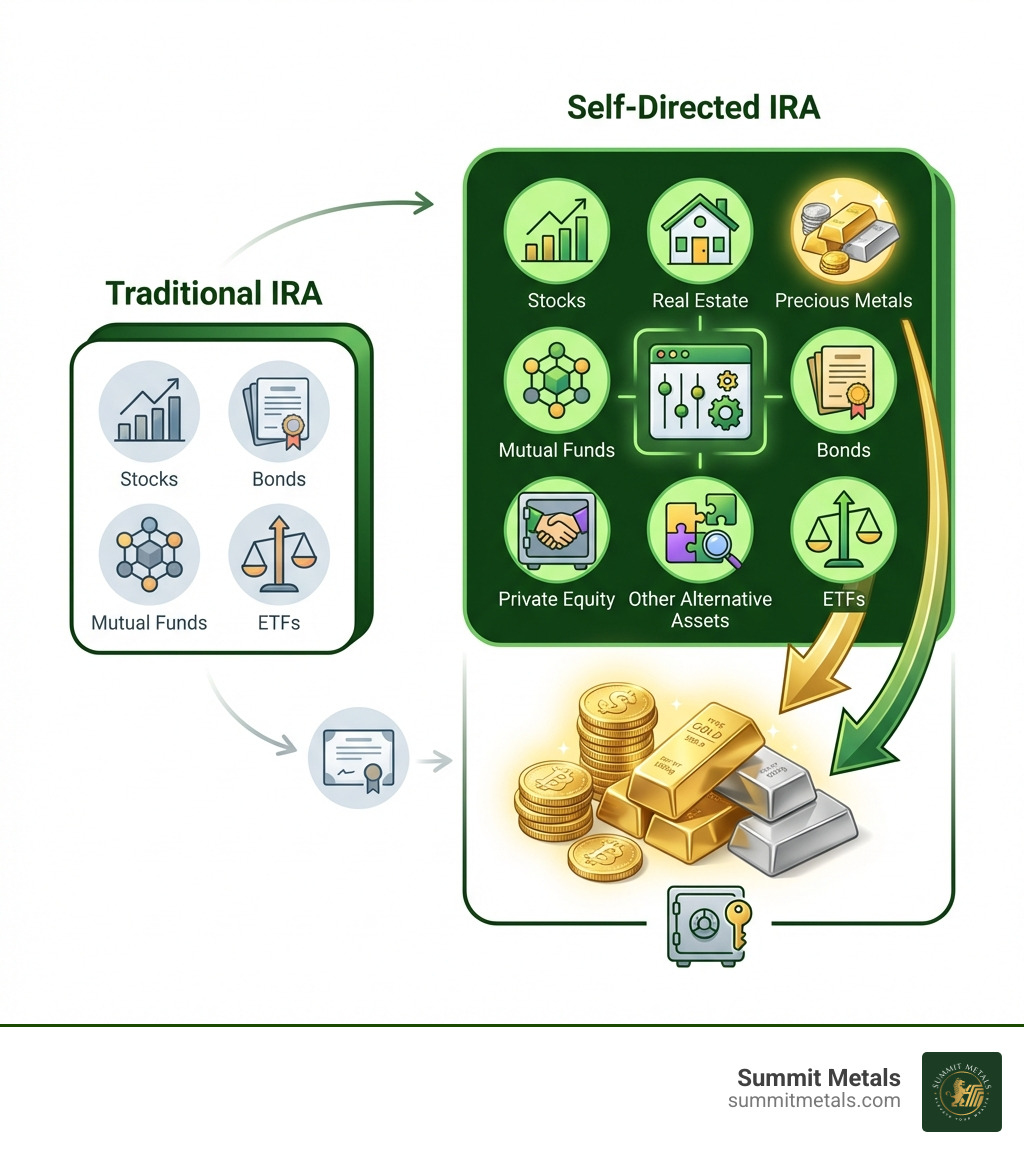
Self directed gold IRA terms simplified:
The "Why": Benefits and Comparisons of a Precious Metals IRA

Investing in a self directed gold IRA isn't just about owning shiny objects; it's a strategic move to fortify your retirement against the unpredictable tides of the global economy. For us, it's about providing a tangible anchor in a sea of abstract financial instruments.
Understanding the Benefits of a Self-Directed Gold IRA
The primary benefits of investing in gold and other precious metals through an SDIRA are compelling for any prudent investor:
- Portfolio Diversification: Traditional IRAs often confine you to stocks, bonds, and mutual funds—all "paper assets" that tend to move in correlation with the broader market. A self directed gold IRA allows you to diversify into physical, tangible assets. This means your entire retirement portfolio isn't beholden to the whims of the stock market. As the research indicates, self-directed IRAs allow for a wide range of alternative investments beyond traditional stocks and bonds, including real estate, private equity, and, of course, precious metals.
- Hedge Against Inflation: When the purchasing power of fiat currencies erodes, precious metals historically shine. The U.S. dollar has lost approximately 97% of its purchasing power since 1913, while gold prices have increased substantially over the same period. Gold's price surge from $1,377 in 2019 to over $2,133 in 2025 further demonstrates its ability to maintain value during inflationary periods and economic uncertainty. Gold has been a reliable store of wealth for millennia.
- Protection from Economic Downturns: Often referred to as a "safe haven asset," gold tends to perform well when other investments falter. During times of economic crisis, market volatility, or geopolitical instability, investors frequently flock to gold, driving its price up. This can provide a crucial buffer for your retirement savings when traditional markets are in decline.
- Tangible Asset Ownership: Unlike paper assets, physical gold and silver are tangible. You own a physical asset that cannot be printed or devalued by government policy. This direct ownership eliminates counterparty risk that comes with many financial instruments.
- Tax-Deferred or Tax-Free Growth: Just like traditional IRAs, a self directed gold IRA offers significant tax advantages. Contributions to a Traditional SDIRA are often tax-deductible, and your investments grow tax-deferred until retirement. With a Roth SDIRA, contributions are made with after-tax dollars, but qualified withdrawals in retirement are completely tax-free. This tax efficiency, combined with the stability of precious metals, can significantly fortify your financial future.
For more on fortifying your future, check out our guide on Retirement Riches: How Gold IRAs Can Fortify Your Financial Future.
Physical Gold: Coins vs. Bars
When you decide to invest in physical gold within your SDIRA, you'll typically choose between gold coins and gold bars. Both offer the benefits of direct ownership and a hedge against inflation, but they have distinct characteristics.
The key difference from investing in gold-related paper assets (like ETFs or mining stocks) within a traditional IRA is the direct ownership of the physical metal. With an ETF, you own shares in a fund that holds gold, not the gold itself. With mining stocks, you're investing in a company's operations, which carries operational risks beyond the price of gold. A self directed gold IRA lets you truly own the physical asset, removing that layer of counterparty risk. This tangible nature is a core appeal for many investors.
For a deeper dive into securing your future with physical metals, read our article on Maximizing Retirement Security: Using a Precious Metals IRA to Invest in Gold and Silver with SummitMetals.com.
[COMPARISON CHART] Gold Coins vs. Gold Bars
| Feature | Gold Coins (e.g., American Eagle) | Gold Bars |
|---|---|---|
| Purity | 91.67%–99.99% (varies by coin) | 99.5%+ |
| Divisibility | High (smaller denominations) | Lower (larger sizes) |
| Premiums | Slightly higher | Lower per ounce |
| Fraud Protection | Legal tender, face value, recognized by governments | No face value, requires assay |
| IRA Eligibility | Yes (select coins) | Yes (approved bars) |
Highlight: Gold coins offer added fraud protection due to their legal tender status and face value.
Gold coins, such as the American Gold Eagle or Canadian Gold Maple Leaf, are popular choices for IRAs. They offer excellent divisibility, meaning you can sell smaller portions of your holdings if needed, and often command a slightly higher premium due to their intricate designs and government backing. Crucially, their status as legal tender, even if nominal, provides an added layer of fraud protection and recognition. Gold bars, on the other hand, typically have lower premiums per ounce and are often preferred for larger investments, though they offer less divisibility. Both, however, must meet strict IRS purity standards to be eligible for your SDIRA.
The "How-To": A Guide to Your Self-Directed Gold IRA

Getting started with a self directed gold IRA might seem daunting, but we've streamlined the process to make it as straightforward as possible. Think of us as your co-pilot, guiding you through every turn.
Step-by-Step: Opening Your Self-Directed Gold IRA
Opening your SDIRA is a crucial first step toward diversifying your retirement. Here’s how we guide you through it:
- Choose a Summit Metals-approved Custodian: This is the most critical decision. Unlike traditional IRAs, SDIRAs require a specialized custodian capable of holding alternative assets like precious metals. They handle all the paperwork, ensure IRS compliance, and facilitate the purchase and storage of your metals. We partner with reputable custodians who understand the nuances of precious metals IRAs, ensuring your account is in expert hands.
- Fund Your Account: Once your custodian is selected, you'll need to fund your SDIRA. This can be done through direct contributions, or more commonly, through a rollover or transfer from an existing retirement account (like a 401(k), 403(b), or another IRA).
- Select Summit Metals as Your Dealer: After funding, your custodian will work with us to facilitate your precious metals purchase. We pride ourselves on transparent, real-time pricing and competitive rates, ensuring you get the best value for your investment.
- Purchase Metals: With your funds ready, you'll direct your custodian to purchase your chosen IRS-approved gold, silver, platinum, or palladium from Summit Metals. We'll handle the transaction and ensure your metals are sent directly to an IRS-approved depository.
For a detailed walkthrough on moving funds, explore our guide on Unlock Your Retirement's Potential: A Guide to Gold IRA Transfers.
Funding Your Account and Building Your Position
Funding your self directed gold IRA can happen in a few ways, each with its own advantages:
- Direct Contributions: For 2024, you can contribute up to $7,000 to an IRA. If you're 50 or older, you benefit from a catch-up contribution of an additional $1,000, bringing your total to $8,000. These limits apply across all your IRAs, not per account.
-
Rollovers vs. Transfers: This is often where confusion arises.
- A transfer is typically the safest and most common method. Your existing IRA custodian sends funds directly to your new SDIRA custodian. The money never touches your hands, eliminating the risk of accidental tax penalties. It's a direct, trustee-to-trustee transaction.
- A rollover involves your existing custodian sending you a check. You then have 60 days to deposit that check into your new SDIRA. If you miss the 60-day window, the distribution becomes taxable and may incur penalties. We generally recommend transfers for their simplicity and reduced risk.
- SEP IRA Limits: If you're self-employed or a small business owner, a SEP IRA offers higher contribution limits. For 2024, you can set aside up to 25% of your compensation or $69,000, whichever is less. These larger contributions can be a powerful way to build a substantial precious metals position.
Autoinvest with Summit Metals: Building wealth is often a marathon, not a sprint. That's why we champion dollar-cost averaging (DCA). With our Autoinvest program, you can set up recurring monthly purchases of precious metals for your SDIRA, just like contributing to a 401(k). This consistent buying strategy helps smooth out market fluctuations, allowing you to buy more when prices are low and less when they're high, all without needing to time the market. It's a disciplined, hands-off approach to consistent portfolio growth.
Planning Your Exit: Storage and Liquidity
The journey with your self directed gold IRA doesn't end with the purchase; it extends through storage and, eventually, your exit strategy.
- Private Vault Storage with Summit Metals: The IRS mandates that precious metals held within an SDIRA must be stored in an approved third-party depository. You cannot store them at home. Our partners provide IRS-approved private vault storage options, ensuring your assets are secure and compliant.
-
Segregated vs. Commingled Storage:
- Segregated storage means your specific metals (serial numbers on bars, unique coin tubes) are kept separate from other investors' holdings. You know exactly which items belong to you.
- Commingled storage means your metals are stored with identical items from other investors. You own a proportionate share of the total metals, but not specific, identifiable pieces. Both are IRS-compliant, but segregated storage offers an extra layer of peace of mind for some investors.
- Importance of an Exit Strategy: While we hope your metals appreciate beautifully, it's wise to have a plan for when you're ready to liquidate. This includes understanding the process of selling your metals and how distributions will be handled.
- "Sell to us" program: When retirement arrives or life calls for liquidity, Summit Metals offers a streamlined "Sell to us" program. We provide a transparent, efficient process to liquidate your precious metals holdings for cash, ensuring you can access your investment when you need it, without hassle. This focus on not just buying, but also a clear exit strategy, is part of our commitment to your financial well-being.
For a comprehensive look at storage options and fees, refer to our Depository Deep Dive: Understanding Precious Metals Storage Options and Fees.
The "Rules": IRS Regulations and Compliance for Precious Metals IRAs
Navigating the IRS rules for a self directed gold IRA can feel like walking a tightrope, but it's essential for maintaining the tax-advantaged status of your retirement account. We're here to help you understand these crucial regulations.
IRS-Approved Metals and Purity Requirements
The IRS is quite specific about what types of precious metals can be held in an SDIRA. This is outlined in Internal Revenue Code Section 408(m), which generally prohibits "collectibles" but makes key exceptions for certain precious metals.
Here are the purity requirements and common IRA-eligible metals:
- Gold: Must be a minimum of 99.5% pure (.995 fine). The notable exception is the American Gold Eagle coin, which is 91.67% pure but is specifically approved by the IRS due to its government backing.
- Silver: Must be a minimum of 99.9% pure (.999 fine).
- Platinum & Palladium: Both must be a minimum of 99.95% pure (.9995 fine).
Common IRA-Eligible Coins and Bars:
- Gold: American Gold Eagles, Canadian Gold Maple Leafs, Austrian Philharmonics, Australian Kangaroos, and various 99.95%+ pure gold bars from accredited refiners like Credit Suisse.
- Silver: American Silver Eagles, Canadian Silver Maple Leafs, Austrian Philharmonics, and 99.9%+ pure silver bars and rounds. For specific eligibility details on silver, check out Unlock Your IRA: The Definitive Guide to American Silver Eagle Eligibility.
- Platinum: American Platinum Eagles, Canadian Platinum Maple Leafs, and 99.95%+ pure platinum bars.
- Palladium: Canadian Palladium Maple Leafs and 99.95%+ pure palladium bars.
It's crucial that any metals you purchase for your SDIRA meet these standards and are produced by an approved refinery, typically in their original packaging. Collectible coins or other numismatic items are generally not allowed.
Storage, Prohibited Transactions, and Fees
Compliance with IRS regulations is paramount to protect the tax-advantaged status of your self directed gold IRA.
- IRS-Approved Depositories: This is non-negotiable. Your precious metals must be stored in an IRS-approved, third-party depository. These facilities are secure, audited, and bonded, providing the safety and regulatory compliance required. Popular depositories include Delaware Depository and Texas Precious Metals Depository.
- The Home Storage Myth Debunked: We understand the appeal of having your treasure close, but storing precious metals purchased for your IRA at home is strictly prohibited by the IRS. Doing so would be considered an early distribution, making the entire value of your metals taxable and potentially subject to a 10% penalty if you're under 59 ½. As the IRS states, "Gold and other bullion are collectibles... An exception is provided for certain coins and for bullion if it is held by an IRA trustee." The key is "held by an IRA trustee," not by you.
-
Prohibited Transactions (Self-Dealing): The IRS has strict rules against "prohibited transactions," which are any dealings where the IRA owner or a "disqualified person" benefits personally from the IRA's assets. This includes:
- Selling property to your IRA or buying property from it.
- Loaning money to your IRA or borrowing from it.
- Using IRA assets for personal gain, even indirectly.
- Disqualified Persons: This term refers to the IRA owner, their spouse, ascendants (parents, grandparents), descendants (children, grandchildren), and any entities (like a business) where the IRA owner or other disqualified persons own 50% or more. Engaging in transactions with these individuals or entities using your SDIRA funds is prohibited.
-
Common Fees: While the benefits of a self directed gold IRA are significant, it's important to be aware of the associated fees, which are generally higher than for traditional paper asset IRAs due to the specialized nature of the investment and storage. These typically include:
- Setup Fees: A one-time charge to establish your account, which can often be around $50.
- Annual Administrative Fees: For the custodian's services in managing your account.
- Storage/Insurance Fees: For the secure storage of your physical metals at an approved depository. These annual fees can range from $100 to $300, and can vary based on whether you choose segregated or commingled storage, and the total value of your holdings. It's crucial to compare these costs across providers to understand the full picture.
For a deeper dive into these regulations, consult our article on Precious Metals IRA Regulations 101.
Understanding Valuation, Reporting, and Taxes
Transparency in valuation and reporting is key to managing your self directed gold IRA.
- Role of the Custodian in Reporting: Your SDIRA custodian is responsible for providing annual reporting to the IRS (Form 5498) detailing the fair market value of your account. They also handle any necessary tax forms for contributions or distributions.
- Fair Market Value (FMV): The value of your precious metals in your SDIRA is typically reported based on its Fair Market Value. For precious metals, this is usually determined by the current spot price multiplied by the ounces of fine metal you hold. This "spot value" is what you'll see reflected in your quarterly statements.
-
Tax Implications of Distributions:
- Traditional SDIRA: When you take distributions in retirement (typically after age 59 ½), they are taxed as ordinary income. Early withdrawals (before 59 ½) are subject to a 10% penalty in addition to regular income tax.
- Roth SDIRA: Qualified distributions in retirement are completely tax-free, as you contributed after-tax dollars.
- Required Minimum Distributions (RMDs): For Traditional SDIRAs, you must begin taking RMDs starting at age 73 (this age changed from 72 to 73 in 2023). Your custodian will help calculate and facilitate these distributions. You can choose to take your RMDs in cash (selling some metals) or "in kind" (taking physical possession of the metals themselves, which would then be removed from the SDIRA and become taxable).
Understanding these rules is crucial for long-term success. Our The Ultimate Rulebook for Precious Metals IRA Investors offers even more comprehensive guidance.
Frequently Asked Questions about Self-Directed Gold IRAs
Can I store the precious metals for my IRA at home?
No, IRS regulations strictly prohibit this. The metals must be held in the physical possession of a trustee at an IRS-approved depository to maintain the account's tax-advantaged status. Taking personal possession is considered a taxable distribution and could result in significant penalties if you're under 59 ½. This rule is in place to prevent self-dealing and ensure the assets are truly for retirement purposes, not personal use.
What is the difference between a Gold IRA rollover and a transfer?
A transfer moves funds directly from one IRA custodian to another, with the money never touching your hands. This is generally the preferred method because it's simpler and carries less risk of accidental tax penalties. Your existing custodian sends the funds directly to your new self directed gold IRA custodian.
A rollover involves receiving a check from your old custodian, which you then have 60 days to deposit into your new IRA. If you miss this 60-day window, the IRS considers the distribution taxable, and you could face income taxes and a 10% early withdrawal penalty if you're under 59 ½. Transfers are almost always recommended to avoid these pitfalls.
How much of my portfolio should I allocate to a Gold IRA?
While there's no single answer that fits everyone, many financial advisors suggest an allocation of 5-10% of your total retirement portfolio to precious metals. This amount is often considered sufficient to provide diversification and a hedge against economic uncertainty without overexposing you to the volatility of a single asset class. The right percentage for you will depend on your individual risk tolerance, investment goals, and overall financial situation. It's always wise to consult with a financial advisor to determine the optimal allocation for your unique circumstances.
Conclusion: Take Control of Your Retirement Future
The world of retirement planning is constantly evolving, but the enduring value of tangible assets like precious metals remains a constant. A self directed gold IRA offers a powerful way to bring that stability and diversification to your retirement portfolio, moving beyond the traditional confines of stocks and bonds.
We've explored the myriad benefits—from hedging against inflation and economic downturns to the peace of mind that comes with owning physical assets. We've also guided you through the practical steps of opening and funding your account, and digd into the crucial IRS regulations that ensure your investments remain compliant and tax-advantaged.
At Summit Metals, serving investors in Salt Lake City, Utah, we believe in empowering you to take control of your financial future. Our commitment to transparent, real-time pricing and competitive rates, coupled with our Autoinvest program for disciplined growth and our "Sell to us" program for seamless liquidity, means you have a trusted partner every step of the way.
Don't let market volatility dictate your retirement dreams. Take the next step to secure your future with a self directed gold IRA. For a comprehensive guide to securing your future, refer to IRA Gold Investment: A Comprehensive Guide to Securing Your Future.