What Every Investor Needs to Know About Gold IRA Eligibility

Gold IRA eligibility comes down to a few key rules set by the IRS. Here is a quick summary before we dive deeper:
Gold IRA Eligibility at a Glance
| Requirement | Details |
|---|---|
| Who can open one? | Anyone with earned (taxable) income |
| Minimum age | None |
| Maximum age | No limit for contributions |
| 2025 contribution limit | $7,000/year (under 50); $8,000/year (50+) |
| Income limit | No maximum income restriction |
| Gold purity standard | 99.5% minimum (.995 fineness) |
| Exception | American Gold Eagle coins (.9167 fineness) |
| Storage | IRS-approved depository only — not at home |
| Funding methods | New contributions, rollovers, or direct transfers |
Physical gold has played a role in protecting wealth for thousands of years. Today, the IRS allows certain investors to hold it inside a tax-advantaged retirement account — but the rules are specific, and getting them wrong can cost you.
A Gold IRA is a self-directed IRA that holds physical precious metals instead of stocks or bonds. It offers the same tax benefits as a traditional or Roth IRA, but adds a layer of tangible asset protection that paper investments simply cannot match.
The challenge is that eligibility is not just about you — it is also about the metals themselves, how they are stored, and how the account is funded. Miss one rule, and the IRS can treat your investment as a taxable distribution.
Gold has outperformed the S&P 500 in both 2024 and 2025 (with gold already hitting an all-time high of $3,500 per ounce as of summer 2025). More investors than ever are looking at gold IRAs as a serious retirement strategy — not just a hedge, but a core position.
I'm Eric Roach — former investment banker who advised Fortune 500 companies on multi-billion-dollar deals, and the founder of the first flat-fee stock trading company later acquired by Morgan Stanley. I now focus on helping everyday investors navigate gold IRA eligibility and precious metals strategy with the same disciplined approach Wall Street uses to protect institutional capital.
In this guide, we'll walk through everything: who qualifies, which metals are approved, how to fund the account, and how to plan your exit strategy so your gold stays liquid when you need it.
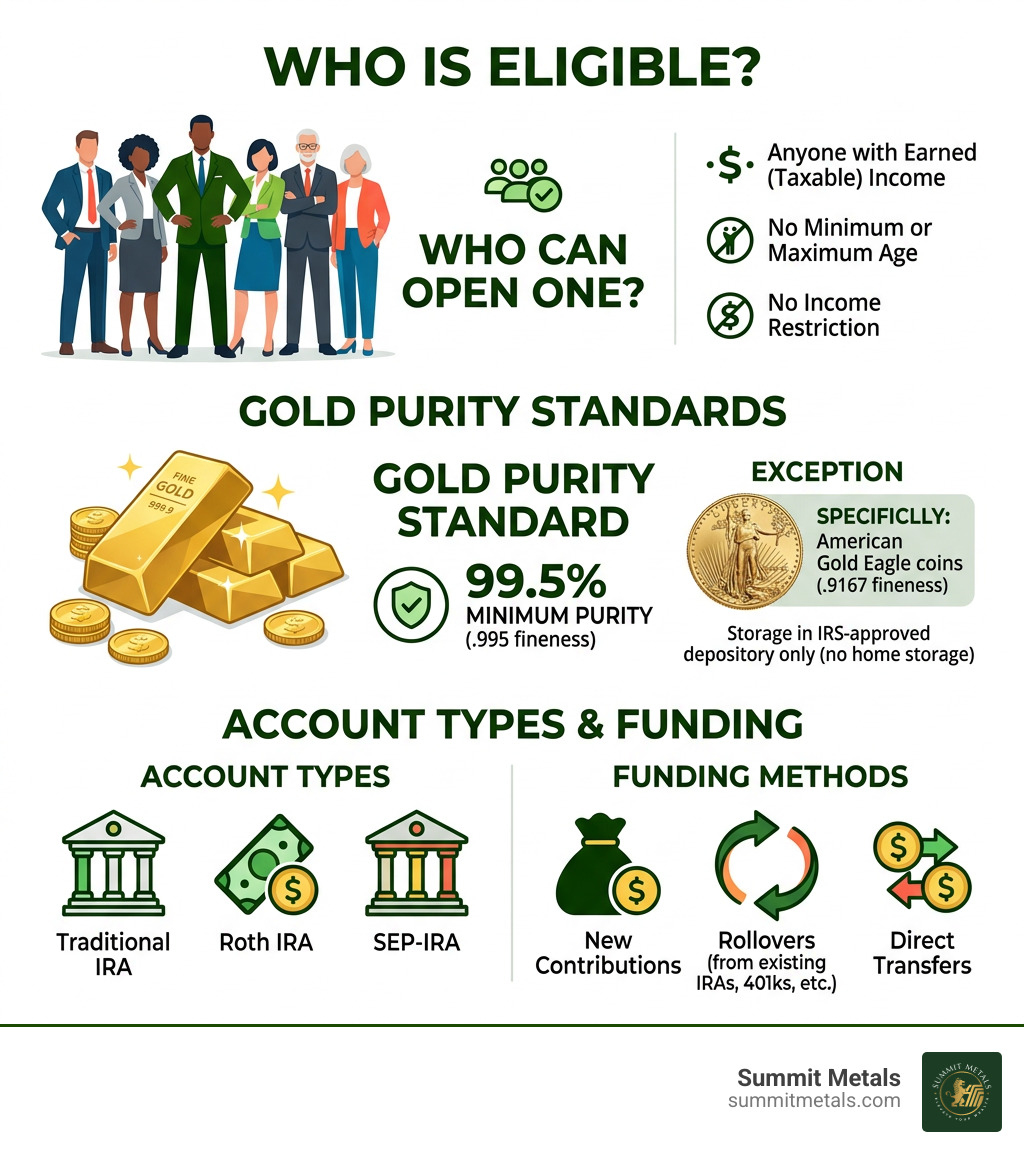
Gold ira eligibility word list:
Who Qualifies? Personal Gold IRA Eligibility Requirements
Opening a precious metals account isn't reserved for the "ultra-wealthy" or institutional giants. In fact, the IRS is surprisingly inclusive when it comes to who can participate. At its core, the primary hurdle for gold ira eligibility is having "earned income."

If you work for an employer, run your own business, or even have a side hustle where you receive taxable compensation, you likely qualify. According to IRS regulations on IRA contributions, compensation includes wages, salaries, tips, professional fees, and bonuses. It does not include passive income like rental earnings, interest, or dividends.
One of the best pieces of news for high earners is that there is no maximum income limit for opening a Gold IRA. Unlike certain Roth IRA contribution rules that phase out as your paycheck grows, anyone with earned income can establish a Self-Directed IRA (SDIRA) to hold physical metals. However, it’s vital to stay within the lines of the Gold IRA Rules to ensure your account remains compliant and tax-advantaged.
Thanks to recent legislative updates like the SECURE Act, the barriers to entry have dropped even further. For instance, the old rule that prevented you from contributing to a traditional IRA after age 70½ has been repealed. As long as you are still working, you can keep adding gold to your "treasure chest."
Income and Age Factors for Gold IRA Eligibility
We often get asked, "Am I too old to start?" or "Can I open one for my child?" The answer is simpler than you might think. There is no minimum age to open a Gold IRA. If a teenager has a summer job with documented earnings, they can technically start a precious metals retirement fund.
Similarly, there is no maximum age for making contributions. If you’re 85 and still consulting or earning a salary, you can continue to contribute. This inclusivity makes gold an excellent tool for legacy planning and long-term wealth preservation.
When planning your contributions, you need to keep the annual limits in mind. For 2025, the IRS has set the following limits:
- Under Age 50: You can contribute up to $7,000 annually.
- Age 50 and Older: You qualify for a "catch-up" contribution, bringing your total limit to $8,000.
These limits apply across all your traditional and Roth IRAs combined. If you are managing multiple accounts, we recommend using an Ultimate Checklist for Gold IRA Services Comparison to ensure you aren't over-contributing and triggering unnecessary tax penalties.
Account Types and Gold IRA Eligibility
A "Gold IRA" isn't actually a separate category of IRA; it’s a description of what’s inside the account. You can apply gold ira eligibility standards to several different tax structures:
- Traditional Gold IRA: Contributions are typically made with pre-tax dollars. You may get a tax deduction now, and you pay taxes later when you take distributions in retirement.
- Roth Gold IRA: You contribute after-tax dollars. There’s no immediate tax break, but your gold grows tax-free, and qualified withdrawals in retirement are also tax-free.
- SEP Gold IRA: Designed for small business owners and the self-employed. These have much higher contribution limits—up to 25% of compensation or $70,000 (for 2025).
- SIMPLE Gold IRA: For small businesses with 100 or fewer employees.
Many of our clients choose to unlock their retirement potential with transfers from existing accounts. This includes rolling over funds from a 401(k), 403(b), or even a Thrift Savings Plan (TSP). If you have a dormant 401(k) from a previous employer, it is often a prime candidate for a rollover into a physical gold holding.
Metal Standards: What Makes Gold IRA Eligible?
Just because it’s shiny doesn't mean it’s IRA-eligible. The IRS is extremely picky about the quality of the metals allowed in your account. If you accidentally buy the wrong type of coin, the IRS views it as a "collectible," which triggers an immediate tax bill and potential penalties.
To meet gold ira eligibility standards, gold must have a minimum fineness of .995 (99.5% purity). Furthermore, the metals must be produced by a national government mint or an accredited refiner, assayer, or manufacturer approved by NYMEX, COMEX, or the LBMA.
When deciding between coins and bars, there are distinct advantages to each. We generally lean toward coins for most individual investors due to their added layers of security.
| Feature | Gold Coins (Bullion) | Gold Bars |
|---|---|---|
| Purity | Must meet .995 standard | Must meet .995 standard |
| Legal Tender | Yes (has face value) | No |
| Counterfeit Resistance | High (intricate mint designs) | Moderate |
| Portability | High (standardized sizes) | Variable |
| Face Value Protection | Yes—protected by federal law | No |
Coins like the American Buffalo or the Canadian Maple Leaf are popular because they are legal tender. This status provides an extra layer of protection against fraud, as counterfeiting legal tender is a much more serious federal crime than faking a generic bar.
Approved Precious Metals and Gold IRA Eligibility Purity
While gold is the headline act, a "Precious Metals IRA" can also hold silver, platinum, and palladium. Each has its own "VIP list" for purity:
- Silver: Must be 99.9% pure (.999 fineness).
- Platinum: Must be 99.95% pure (.9995 fineness).
- Palladium: Must be 99.95% pure (.9995 fineness).
There is one famous exception to the purity rule: the American Gold Eagle. Even though it is only 22-karat (.9167 fine), the IRS specifically allows it in Gold IRAs because it is a primary U.S. Mint bullion coin. However, for silver, you’ll want to consult our Guide to American Silver Eagle eligibility to ensure you’re getting the right versions (bullion vs. certain proofs).
What to Avoid:
- Collectibles: Most "rare" or numismatic coins are banned.
- Graded Coins: Coins graded by services like PCGS or NGC are often treated as collectibles by the IRS.
- Specific Foreign Coins: The South African Krugerrand and pre-2013 British Britannias do not meet the purity requirements and are ineligible.
Funding and Storage: The Compliance Rules
You cannot simply buy gold and stick it under your mattress or in a home safe. The IRS is very clear on this: physical possession by the account owner is strictly prohibited. The IRS warns taxpayers to be wary of anyone claiming that precious metals held in your IRA can be stored at home. Doing so is considered a "distribution," meaning you'll owe taxes on the entire value plus a 10% penalty if you're under 59½.
To maintain gold ira eligibility, your metals must be held by an IRS-approved custodian (usually a bank or a non-bank trust company) and stored in an IRS-approved depository. These facilities are like Fort Knox for private investors, offering 24/7 armed security and massive insurance policies.
When choosing a depository, you’ll encounter two main storage types:
- Commingled (Allocated) Storage: Your metals are stored in a large vault with metals from other investors. You don't get the exact same coin back that you bought, but you are guaranteed the same type and weight of metal.
- Segregated Storage: Your metals are kept in a separate, private locker or "drawer" within the vault. You get back the exact physical items you deposited.
We provide a detailed Guide to IRS-approved depositories to help you decide which facility fits your needs, whether you prefer storage in Salt Lake City, Utah, or other major financial hubs.
Rollovers and Transfers for Gold IRA Eligibility
Funding your account is the final step in the eligibility puzzle. You have three main paths:
- Direct Transfer: This is the "cleanest" method. Your current IRA custodian sends the funds directly to your new Gold IRA custodian. No taxes are withheld, and the money never touches your personal bank account.
- Trustee-to-Trustee: Similar to a transfer, but usually involves moving funds between different types of plans (like a 401k to an IRA).
- Indirect Rollover: You receive a check from your current retirement plan. You then have exactly 60 days to deposit those funds into your Gold IRA. If you miss the deadline by even one day, the IRS considers it a taxable withdrawal.
By maximizing retirement security through these official channels, you preserve the tax-deferred growth of your assets, allowing your gold to appreciate without the "tax man" taking a cut every year.
Strategic Investing: Autoinvest and Exit Strategies
At Summit Metals, we believe that investing in gold shouldn't be a one-time event. Most financial planners recommend a 5% to 10% allocation to precious metals. The best way to achieve this without stressing over daily price fluctuations is through Dollar Cost Averaging.
We heavily promote our Autoinvest feature. It allows you to shop with us and set up a monthly subscription, much like you contribute to a 401(k). By buying a set dollar amount every month, you buy more gold when prices are low and less when prices are high, smoothing out your average cost over time. This "set it and forget it" approach is a cornerstone of our Self-Directed Gold IRA guide.
Planning Your Exit: Liquidity and "Sell to Us"
A great investment strategy is useless without an exit strategy. Eventually, you will want to take distributions from your IRA. You have two choices:
- Liquidation: The custodian sells the gold and sends you the cash.
- Distribution in Kind: The depository ships the physical gold directly to your front door.
We encourage our clients to think about liquidity from day one. When you store your metals in a private, approved vault, they remain in a "liquid" state within the chain of integrity. This makes it incredibly easy to Sell to Us. Because we know the provenance of the metal and where it has been stored, we can offer competitive, real-time buyback prices, ensuring you can turn your gold into cash quickly when the time comes.
Frequently Asked Questions about Gold IRA Eligibility
Can I store my IRA gold at home or in a safe deposit box?
Absolutely not. As mentioned earlier, the IRS warns taxpayers to be wary of home storage claims. Storing IRA assets in a personal safe or a local bank's safe deposit box (which you have access to) is a violation of IRS rules. It will result in the disqualification of the IRA, immediate taxation, and heavy penalties. All metals must stay in the physical possession of a qualified third-party custodian.
Can I move gold I already own into a Gold IRA?
No. This is a common misconception. You cannot "contribute" gold that you already have sitting in a home safe into an IRA. IRS rules require that all funding for a Gold IRA must be done via cash (which the custodian then uses to buy new metal) or through a rollover/transfer of existing retirement funds. The metals must be purchased by the custodian from an authorized dealer to ensure the "chain of custody" is never broken.
What are the 2025 contribution limits for a Gold IRA?
For 2025, the annual limit is $7,000 for those under age 50. If you are 50 or older, you get a $1,000 catch-up contribution, making your total $8,000. These are aggregate limits—if you put $4,000 into a traditional stock IRA, you only have $3,000 left for your Gold IRA that year.
Conclusion
Navigating gold ira eligibility doesn't have to be a headache. By focusing on high-purity metals, using approved custodians, and avoiding the "home storage" trap, you can build a retirement portfolio that is truly resilient.
At Summit Metals, we are proud to be based in Wyoming, a state known for its pro-investor environment. We focus on providing authenticated gold and silver with total transparency. Because we purchase in bulk, we are able to pass those competitive rates on to you, with real-time pricing that ensures you always know exactly what you’re paying.
Whether you are looking to do a one-time rollover or want to start your gold subscription today through our Autoinvest program, we are here to help you secure your financial future with the ultimate tangible asset. If you’re in the Salt Lake City area, reach out—we’re ready to help you turn those "paper" gains into "golden" security.