Why Understanding Silver IRA Eligibility Matters for Your Retirement
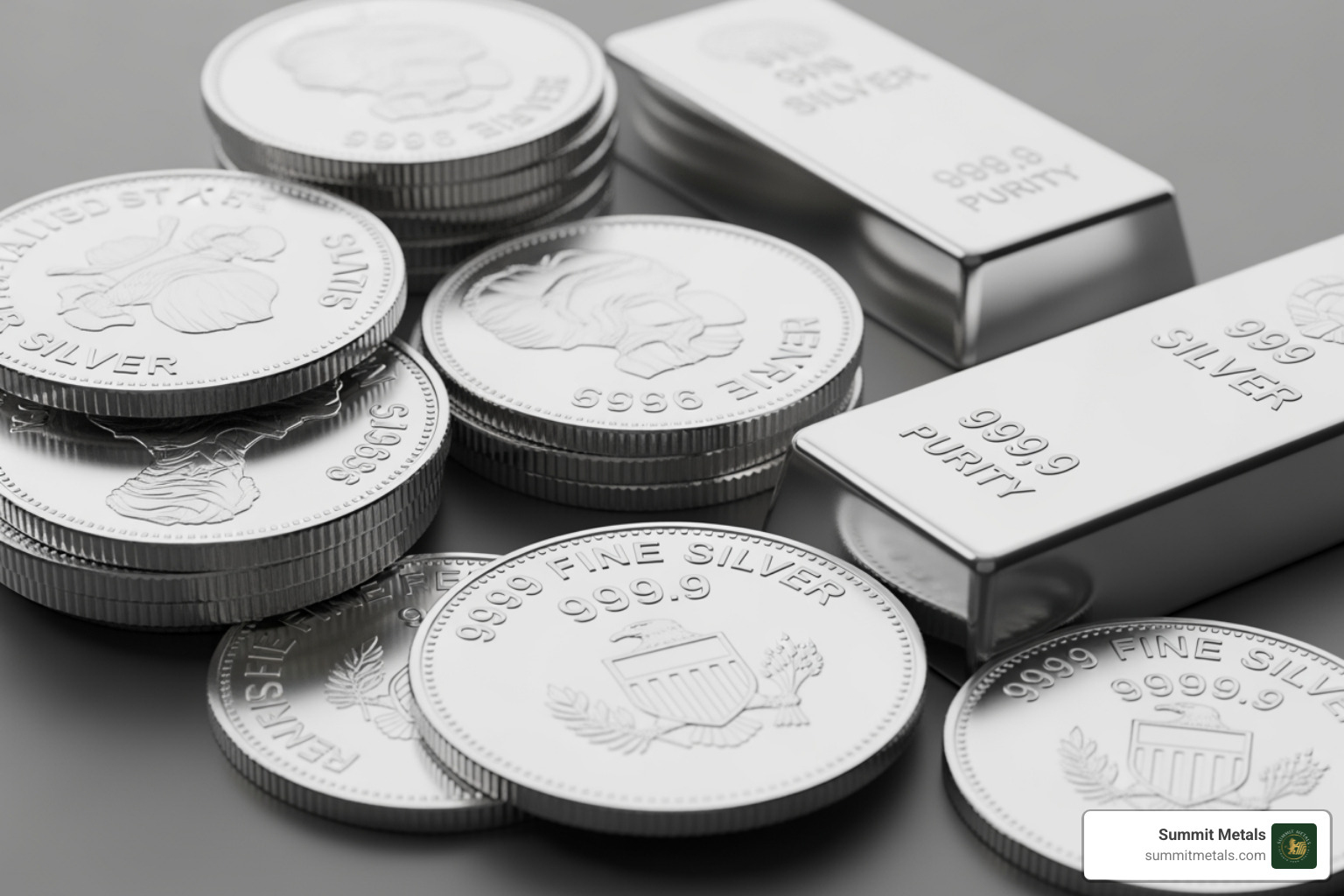
Silver IRA eligible products are physical silver items that meet strict IRS requirements for inclusion in a self-directed IRA. To qualify, silver must be at least 99.9% pure and produced by a government mint or an accredited refiner.
Quick Answer: What Makes Silver IRA Eligible?
- Minimum purity of .999 fine silver (99.9% pure)
- Approved forms: Bullion coins, bars, or rounds
- Recognized producers: U.S. Mint, Royal Canadian Mint, Perth Mint, and COMEX/NYMEX-approved refiners
- IRS-approved storage in a qualified depository (no home storage allowed)
Not all silver qualifies. Pre-1965 "junk silver" coins, silver jewelry, and certain foreign coins are not eligible. The products must meet specific exchange standards and come from certified sources.
The stakes are real. Since 2000, silver has gained over 400% while the dollar has lost nearly half its purchasing power. Many investors don't realize they can hold physical silver in a tax-advantaged retirement account.
I'm Eric Roach, a former Wall Street strategist. I spent a decade helping Fortune 500 clients use precious metals to protect their assets. Now, I bring those institutional tactics to everyday investors navigating silver IRA eligible products. This guide will help you understand which silver products qualify, why IRS rules exist, and how to build a resilient retirement portfolio with tangible assets.
Silver IRA eligible terminology:
- silver bullion
- silver coin investments
- Canadian Silver Maple
Understanding the Silver IRA Framework
A "Silver IRA" is a specialized Self-Directed IRA (SDIRA) that allows you to invest in alternative assets like physical precious metals. Unlike traditional IRAs holding stocks and bonds, an SDIRA gives you control to include tangible silver IRA eligible bullion in your retirement portfolio. This lets you diversify beyond paper assets and safeguard your wealth against economic uncertainty.
Precious metals IRAs follow the same rules as other IRAs for contributions, distributions, and taxes. The key difference is the asset itself—you're investing in physical silver, not a stock that tracks its price. This distinction is crucial for investors seeking the security of tangible assets.
For a deeper dive, explore our guide on Maximizing Retirement Security: Using a Precious Metals IRA to Invest in Gold and Silver with Summitmetals.com.
Traditional vs. Roth Silver IRAs
The choice between a Traditional and Roth IRA applies to your silver investments, with different tax implications based on your financial situation and future tax rate expectations.
A Traditional Silver IRA uses pre-tax contributions, which may be tax-deductible, lowering your current taxable income. Your investments grow tax-deferred, and you pay taxes on withdrawals in retirement. This is ideal if you expect to be in a lower tax bracket during retirement.
A Roth Silver IRA uses after-tax contributions. While not tax-deductible, your silver IRA eligible assets grow tax-free, and qualified withdrawals in retirement are also tax-free. This is appealing if you anticipate being in a higher tax bracket in retirement.
Understanding these differences is key for retirement tax planning. For more details, check out Precious Metals IRA Regulations 101.
Annual Contribution Limits and Rollovers
The IRS sets annual contribution limits for all IRAs, including Silver IRAs. For 2024 and 2025, the limit is $7,000. If you're 50 or older, you can make an additional "catch-up" contribution, bringing your total to $8,000.
You can also fund your Silver IRA through rollovers or transfers from existing retirement accounts like a 401(k), 403(b), or another IRA. A rollover involves receiving the funds and depositing them into the new IRA within 60 days. A direct transfer moves funds between custodians without you handling the money, which is simpler and less risky. Rollovers are not subject to annual contribution limits, making them a great way to diversify your retirement savings into silver IRA eligible assets.
To learn more about transferring funds, read our guide on Unlock Your Retirement's Potential: A Guide to Gold IRA Transfers.
IRS Rules for Silver IRA Eligible Products
The IRS has strict rules for alternative investments in IRAs. The Taxpayer Relief Act of 1997 allowed precious metals like silver in IRAs, but with guidelines to ensure they are investment-grade bullion, not collectibles.
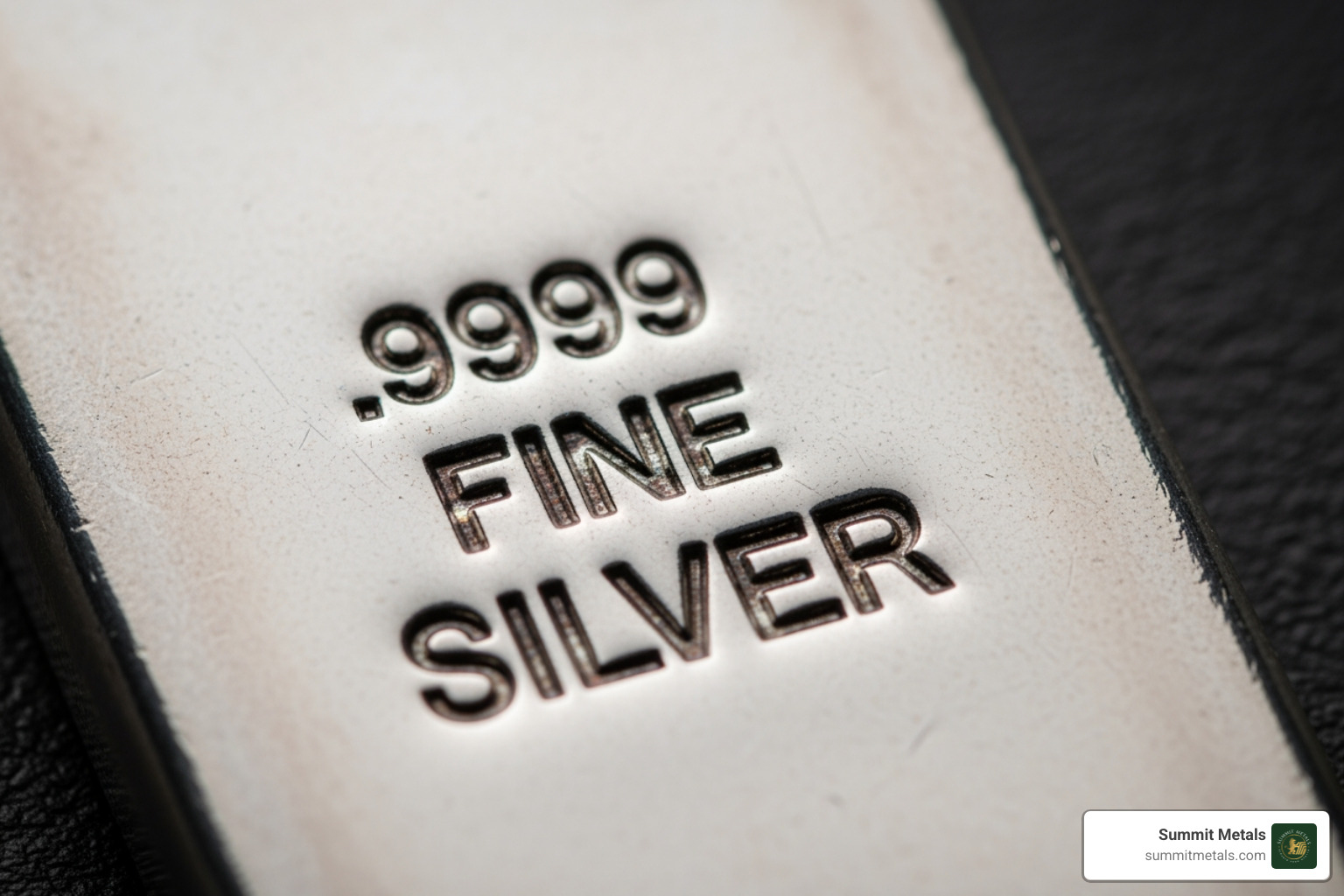
The most critical factor for silver IRA eligible products is their fineness, or purity. This standard is non-negotiable. Without meeting this requirement, silver bullion won't qualify for your IRA.
For all the specifics, our dedicated page on Silver IRA Rules provides a detailed overview.
The Purity Standard: What is .999 Fine Silver?
The IRS requires that silver must be at least .999 fine, meaning it is 99.9% pure. This is a mandatory requirement that ensures the silver is investment-grade bullion.
It's vital to distinguish between bullion and numismatic (collectible) coins. Most collectible coins are not silver IRA eligible because the IRS considers them "collectibles," and investing in them within an IRA can trigger penalties. It's best to stick to recognized bullion.
Items explicitly prohibited from IRAs include silver jewelry, silverware, and any silver that doesn't meet the .999 purity standard. This also means pre-1965 "junk silver" coins (90% silver) are not eligible because they don't meet the purity threshold.
For more detailed information on what products qualify, dive into More on IRA-Eligible Products.
Manufacturer and Mint Requirements for Silver IRA Eligible Items
It's not just about purity; the producer matters too. For silver to be silver IRA eligible, it must come from a recognized government mint or an accredited private refiner. This ensures the quality, authenticity, and weight of the bullion.
Government mints like the United States Mint, the Royal Canadian Mint, and the Perth Mint are generally recognized. You can Learn about the U.S. Mint's production on their official site.
For private refiners, the IRS requires their products to come from facilities on the NYMEX or COMEX approved list. These institutions have rigorous standards. Reputable refiners will also have an assayer hallmark and ISO 9000 certification, signifying adherence to international quality standards.
Approved Silver Products for Your IRA
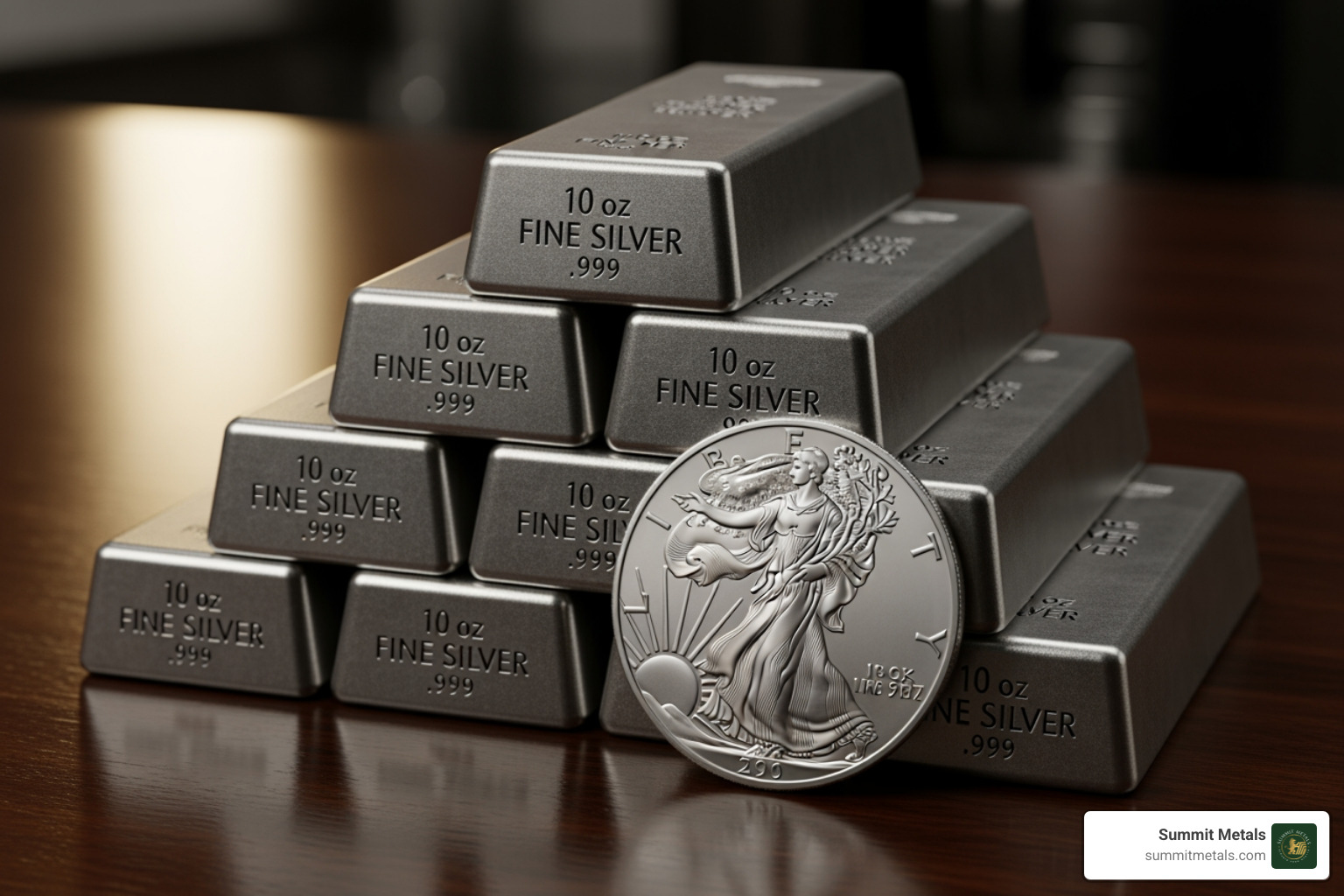
So, what can you actually put in your Silver IRA? Silver IRA eligible products fall into three main categories: bullion coins, bullion bars, and certain silver rounds. Each has unique characteristics that appeal to different investors.
Bullion coins are popular due to their government backing, which adds trust and recognizability. Silver bars, especially larger ones, can offer lower premiums over the spot price, meaning more silver for your money. Silver rounds from private mints can also be IRA-approved if they meet all standards, sometimes offering unique designs at a lower cost.
Popular IRA-Approved Silver Coins
When it comes to silver IRA eligible coins, some stand out as perennial favorites. These coins combine high purity with global recognition, making them excellent choices for retirement accounts.
Here is a list of popular IRA-approved silver coins:
- American Silver Eagle: Struck by the U.S. Mint, this 1 oz, .999 fine silver coin is one of the most trusted bullion coins worldwide. For more details, see Unlock Your IRA: The Definitive Guide to American Silver Eagle Eligibility.
- Canadian Silver Maple Leaf: Produced by the Royal Canadian Mint, this coin is renowned for its exceptional .9999 purity.
- Austrian Silver Philharmonic: Issued by the Austrian Mint, this .999 fine silver coin celebrates the Vienna Philharmonic Orchestra.
- Australian Kangaroo: The Perth Mint's first .9999 pure silver bullion coin, joining its popular Kookaburra and Koala series.
- British Britannia (2013 and newer): The Royal Mint's Britannia coins are .999 fine silver. Earlier versions are not IRA-eligible.
- Mexican Libertad: Produced by the Mexican Mint, these .999 fine silver coins are known for their beautiful design and often have lower mintage figures.
These coins are a fantastic way to include tangible silver in your IRA.
Silver Coins vs. Silver Bars: Which is Right for You?
Choosing between silver IRA eligible coins and bars depends on your investment goals. Let's break down the key differences to help you make an informed choice.
| Feature | Silver Coins | Silver Bars |
|---|---|---|
| Premium | Generally higher over spot price due to minting costs, intricate designs, and legal tender status. | Typically lower premiums over spot price, especially for larger bars, meaning more silver for your dollar. |
| Liquidity | Highly liquid and easily recognizable globally. Often preferred by individual buyers for smaller transactions. | Very liquid, especially from recognized refiners. Preferred by institutional buyers and for larger transactions. May be slightly less flexible for partial sales. |
| Government Guarantee | Issued by sovereign mints, they carry a face value (even if nominal) and are backed by the issuing government. This offers protection against counterfeiting. | Produced by private refiners (though some government mints also make bars). Authenticity relies on the refiner's reputation and assayer hallmark. |
| Divisibility | Excellent for divisibility, as each coin is a standard unit (e.g., 1 oz). Easier to sell smaller portions of your holdings. | Less divisible. Selling a 100 oz bar means selling all 100 oz at once. Can be a drawback if you need to liquidate only a small amount. |
| Recognizability | Widely recognized designs like the American Silver Eagle or Canadian Maple Leaf make them easy to identify and verify. | Recognizability depends on the refiner's hallmark. Less familiar to the general public compared to popular coins. |
| Storage Efficiency | Can take up more space per ounce compared to bars, especially in their protective capsules. | More compact and efficient for storing larger quantities of silver. |
Highlight: Silver coins offer added protection against counterfeiting due to their government-issued face value, making them a secure choice for IRA investors. While the face value is far below the melt value, its existence as legal tender provides a layer of sovereign backing that bars do not. This legal tender status, combined with intricate designs, makes them harder to counterfeit successfully.
The choice depends on your priorities. If you want lower premiums and efficient storage, bars might be your go-to. If you value government backing, high recognizability, and easier divisibility, coins could be a better fit. Many investors choose a blend of both!
Setting Up and Managing Your Silver IRA
Starting a silver IRA eligible investment journey is a straightforward process involving specialized financial partners. Think of it as assembling a dream team for your retirement.
Our ultimate rulebook for precious metals investors can be found here: The Ultimate Rulebook for Precious Metals IRA Investors.
Step 1: Choosing a Self-Directed IRA Custodian
The first and most crucial step is selecting a reputable Self-Directed IRA custodian. The IRS requires that all physical precious metals in an IRA be managed by an IRS-approved custodian; you cannot personally take possession of the metals. The custodian administers your account and ensures compliance.
A good custodian will:
- Set up your SDIRA account.
- Handle administrative duties like IRS reporting.
- Facilitate metal purchases with your chosen dealer (like Summit Metals).
- Manage storage arrangements in an IRS-approved facility.
When choosing a custodian, carefully review their fee structures, which typically include setup, annual, and transaction fees. These can vary significantly, so do your homework.
For guidance, our article Don't Get Custody-Napped: Finding the Right Gold IRA Service offers advice that also applies to silver IRAs.
Step 2: Funding Your Account and Buying Silver
Once your custodian is in place, it's time to fund your account. You have a few options:
- Cash Contribution: Add new funds, adhering to annual contribution limits.
- IRA Transfer: Initiate a direct, non-taxable transfer from an existing IRA.
- 401(k) Rollover: Roll over funds from a previous employer's 401(k) to gain control and diversify into silver IRA eligible products.
After funding, you instruct your custodian to purchase silver from a reputable dealer. This is where Summit Metals comes in. We offer transparent, real-time pricing and competitive rates, ensuring trust and value.
Promote Autoinvest: At Summit Metals, we promote dollar-cost averaging (DCA) through our Autoinvest program. You can set up recurring monthly purchases of silver IRA eligible assets, similar to a 401(k) contribution. This strategy helps smooth out market fluctuations and builds your holdings consistently over time. Learn more with our IRA Investing in Gold guide.
Step 3: IRS-Approved Storage and Your Exit Strategy
The IRS mandates that all physical precious metals in an IRA be stored in an approved, third-party depository. You cannot store your IRA silver at home. These depositories are highly secure facilities with comprehensive insurance.
You'll typically have two storage options:
- Segregated Storage: Your specific silver items are kept separate from others.
- Commingled Storage: Your silver is stored with other investors' silver of the same type.
Both are secure, but segregated storage may have higher fees. The custodian arranges shipping from Summit Metals to the depository.
Promote "Sell to Us": It's smart to plan your exit strategy. When you're ready to liquidate, Summit Metals offers a streamlined "Sell to Us" program. If your silver IRA eligible assets are in a private vault, we make it easy to sell them back to us, ensuring a smooth process and fast access to cash. For more on storage, see The Ultimate Guide to Gold and Other Precious Metals Storage.
Weighing the Pros and Cons of a Silver IRA
Investing in silver IRA eligible assets is a significant decision with its own set of advantages and disadvantages. It's important to consider these carefully as part of your overall investment strategy and risk management.
Potential Benefits of Investing in Silver IRA Eligible Assets
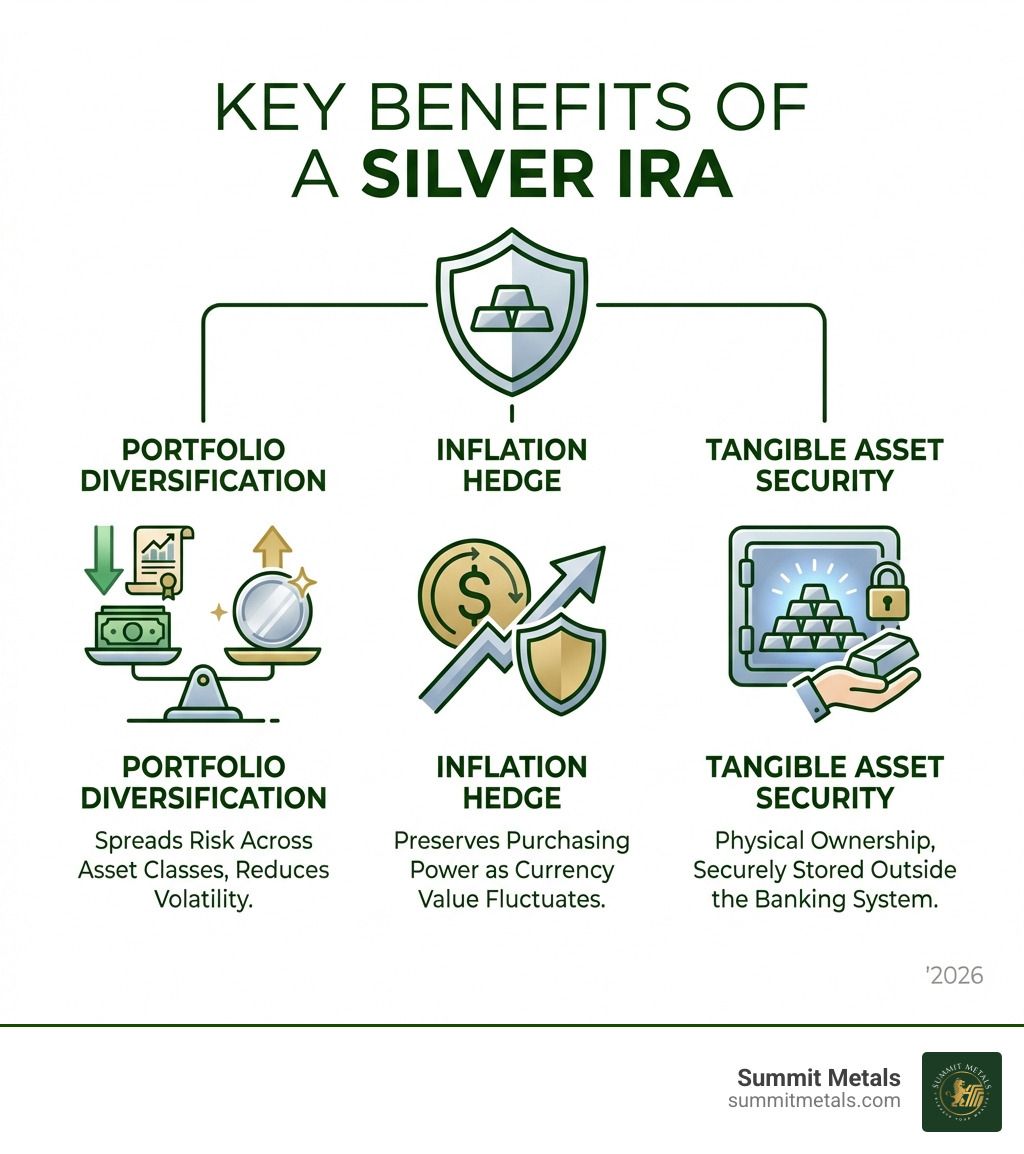
The benefits of a Silver IRA are compelling, particularly in today's economic climate:
- Portfolio Diversification: Silver often moves independently of stocks and bonds, which can reduce overall portfolio risk and improve returns during market downturns.
- Inflation Hedge: As fiat currencies lose purchasing power, tangible assets like silver tend to retain or increase in value. Since 2000, silver has seen significant gains while the U.S. dollar has weakened.
- Currency Debasement Protection: As a finite physical commodity, silver offers protection against the erosion of currency value when governments print more money.
- Tangible Asset Security: Owning physical silver provides a sense of security. It's a real asset that isn't subject to the same risks as digital assets, like cyberattacks or corporate failures.
- Rising Industrial Demand: Unlike gold, silver has significant industrial applications (electronics, solar panels, medical devices), creating consistent demand that can support its price.
These benefits highlight why silver IRA eligible investments are a crucial component of a balanced retirement plan. For more on this, check out Retirement Riches: How Gold IRAs Can Fortify Your Financial Future.
Potential Risks and Drawbacks to Consider
Of course, no investment is without its downsides. Be aware of the potential risks associated with a Silver IRA:
- Price Volatility: Silver's price can be more volatile than gold's due to its dual role as an industrial metal. Economic slowdowns can impact industrial use, leading to price fluctuations.
- Storage and Administrative Costs: Holding physical silver in an IRA incurs ongoing fees for custodian services and depository storage, which can impact returns.
- Higher Fees than ETFs: A physical Silver IRA generally has higher fees than silver ETFs, which is the cost of owning the actual metal versus a paper derivative.
- Lack of Dividends or Interest: Silver does not pay dividends or interest. Returns are solely derived from price appreciation.
- Liquidity is Not Instantaneous: Selling physical silver from an IRA is not as quick as selling a stock. The process involves your custodian and a dealer, and it takes time for funds to settle.
Understanding these factors helps you make a balanced, long-term decision.
Frequently Asked Questions about Silver IRAs
We often get questions about how Silver IRAs work. Here are answers to some of the most common ones.
Can I store my IRA silver at home?
No. The IRS strictly prohibits personal possession of IRA metals. To maintain the IRA's tax-advantaged status, all silver IRA eligible assets must be held by a third-party custodian in an IRS-approved, insured depository. Storing it yourself is considered a taxable distribution and can incur penalties.
What are the typical fees for a Silver IRA?
Expect a few types of fees:
- Setup Fee: A one-time fee from the custodian to open your account.
- Annual Administrative Fees: Paid to the custodian for account management and IRS compliance (typically $50-$300+ per year).
- Annual Storage Fees: Charged by the depository for secure storage (often $100-$250+ annually).
It's crucial to get a clear breakdown of all costs from your custodian and depository before committing.
How do I sell the silver in my IRA?
To sell, you instruct your IRA custodian to liquidate a portion or all of your silver. The custodian works with a precious metals dealer (like Summit Metals) to execute the sale at the current market price.
The cash proceeds return to your IRA account, where you can reinvest them or take a distribution. Distributions may have tax implications depending on your IRA type and age.
Promote "Sell to Us": For a hassle-free liquidation, Summit Metals offers a simple "Sell to Us" program. We ensure a smooth process for converting your silver IRA eligible assets into cash, providing a clear exit strategy.
Conclusion
Understanding what makes silver silver IRA eligible is the first step toward diversifying your retirement with tangible assets. The IRS requires silver to be at least .999 pure, produced by a recognized mint or refiner, and stored in an approved depository through a custodian.
Setting up a Silver IRA involves choosing a custodian, funding the account, and purchasing approved products. At Summit Metals, we make this process transparent, offering authenticated silver with real-time pricing. We also encourage disciplined investing through our Autoinvest program and provide a clear exit strategy with our "Sell to Us" service.
A Silver IRA offers diversification, an inflation hedge, and the security of a tangible asset. While there are risks like volatility and costs, the long-term advantages can be significant for protecting your wealth.
Ready to secure your retirement with physical silver? Explore our IRA-approved silver options and fortify your financial future.