Why IRA Investing in Gold Deserves Your Attention Now
IRA investing in gold allows you to hold physical precious metals within a tax-advantaged retirement account, offering a tangible hedge against inflation and market volatility. Unlike traditional IRAs limited to paper assets, a Gold IRA—a type of self-directed IRA (SDIRA)—lets you own IRS-approved gold coins and bars while enjoying the same tax benefits.
Quick answers for evaluating gold IRA options:
- What it is: A self-directed retirement account holding physical gold, silver, platinum, or palladium.
- Key benefit: Portfolio diversification and a hedge against currency devaluation.
- Contribution limits (2025): $7,000 annually ($8,000 if age 50+); SEP IRAs up to $70,000.
- Purity requirements: Gold must be 99.5% pure (with the American Gold Eagle being a notable exception).
- Storage rule: Must use an IRS-approved depository—no home storage allowed.
- Typical fees: Setup ($50-$100), annual admin ($80-$160), storage ($100-$150).
- Minimum investment: Generally $2,000-$25,000, depending on the company.
Why this matters now: Gold's value isn't just its price—it's its stability. During 2022's inflation spike, gold rose 6% while equities sank 18%. A small allocation to physical gold and silver can significantly improve returns, as some investors have found it helped them retire months ahead of schedule.
The challenge: The industry is plagued by hidden costs and high-pressure sales tactics. Some investors have lost over a third of their savings to inflated markups. This guide cuts through the noise to help you understand IRS rules and build a gold position transparently.
I'm Eric Roach, and I've spent over a decade translating my Wall Street hedging expertise into clear, risk-managed strategies for everyday investors looking to protect their wealth through IRA investing in gold.
Basic ira investing in gold terms:
Understanding the Fundamentals of a Gold IRA
When we talk about IRA investing in gold, we're stepping into a specialized corner of retirement planning. This section explains what a Gold IRA is, its pros and cons, and the different types available.
What is a Gold IRA and How Does it Differ from a Traditional IRA?
A Gold IRA is a type of Self-Directed Individual Retirement Account (SDIRA). While traditional IRAs limit you to paper assets like stocks and bonds, an SDIRA allows for alternative investments, including physical precious metals. The IRS makes a specific exception to its "collectibles" rule for certain high-purity gold, silver, platinum, and palladium bullion, enabling you to hold tangible assets in your retirement account.
Functionally, a Gold IRA offers the same tax advantages as a traditional one. A Traditional Gold IRA provides tax-deferred growth, while a Roth Gold IRA allows for tax-free withdrawals in retirement. The key difference is the underlying asset: you're investing in the historical stability and tangible nature of physical metal, not just its price potential.
To truly understand how a Gold IRA can fortify your financial future, we invite you to read our detailed guide: Retirement Riches: How Gold IRAs Can Fortify Your Financial Future.
The Pros and Cons of IRA Investing in Gold
Like any investment, IRA investing in gold has clear benefits and drawbacks.
Advantages:
- Portfolio Diversification: Gold often moves independently of stocks and bonds, helping to smooth out portfolio volatility during market downturns.
- Inflation Hedge: When the purchasing power of currencies like the dollar falls, gold has historically retained its value, protecting your savings.
- Store of Value: Gold is a universally recognized store of value and a tangible asset that cannot be created by central banks.
- Tangible Asset: Owning a physical asset provides a sense of security that paper investments cannot replicate.
Disadvantages:
- Higher Fees: Gold IRAs have setup, annual administration, and secure storage fees that are typically higher than those for traditional IRAs.
- No Yield: Gold does not pay dividends or interest. Returns come only from price appreciation.
- Lower Liquidity: Selling physical metal can be a slightly slower process than trading stocks or ETFs.
- Complex Regulations: The IRS has strict rules on the types of metal allowed and how they must be stored, requiring careful compliance.
Types of Gold IRAs: Traditional, Roth, and SEP
Gold IRAs mirror the tax structures of standard IRAs.
- Traditional Gold IRA: Funded with pre-tax dollars, contributions may be tax-deductible. Growth is tax-deferred, and you pay taxes on withdrawals in retirement.
- Roth Gold IRA: Funded with after-tax dollars, so contributions are not deductible. However, growth and qualified withdrawals in retirement are completely tax-free.
- SEP Gold IRA: Designed for self-employed individuals and small business owners, this allows for much higher contribution limits. Contributions are tax-deductible, and growth is tax-deferred.
Contribution Limits:
- For 2024 and 2025, the IRA contribution limit is $7,000, with an additional $1,000 "catch-up" for those age 50 or older.
- For 2024, SEP IRA contributions are limited to the lesser of 25% of compensation or $69,000 (increasing to $70,000 in 2025).
Navigating the Rules and Regulations for Physical Gold
The IRS has strict rules for IRA investing in gold. Adhering to them is critical to avoid taxes and penalties that could undermine the benefits of your account. Let's cover the essentials of compliance.

IRS-Approved Metals: Purity and Type Requirements
Not all precious metals are eligible for an IRA. The IRS mandates specific purity standards to ensure you are holding investment-grade bullion, not collectibles.
Here are the minimum purity requirements:
- Gold: 99.5% pure
- Silver: 99.9% pure
- Platinum: 99.95% pure
- Palladium: 99.95% pure
An important exception is the American Gold Eagle coin. Though it is 91.67% pure gold (alloyed for durability), Congress specifically authorized it for IRA inclusion. Only bullion coins and bars produced by a government mint or an accredited refiner that meet these standards are allowed. Working with a knowledgeable dealer like Summit Metals is invaluable for navigating these requirements.
To help you decide, here's a comparison of two popular forms of IRA-eligible gold:
| Feature | IRA-Approved Gold Coins (e.g., American Gold Eagle) | IRA-Approved Gold Bars (e.g., PAMP Suisse) |
|---|---|---|
| Government Backing | Yes, often with a legal tender face value | No, from private refiners |
| Fraud Protection | Strong, due to mint marks and anti-counterfeit features | Good, relies on assay from reputable refiners |
| Premiums (over spot) | Generally higher | Generally lower, especially for larger sizes |
| Liquidity | Very high, widely recognized | High, but may vary by brand |
| Denominations | Typically 1 oz and fractional sizes | Wide range, from 1 gram to 1 kilo |
| Ideal for | Divisible investments and quick resale | Larger, lower-premium investments |
Gold coins from sovereign mints often provide extra confidence due to their government backing and anti-fraud measures, a comforting feature for a significant retirement investment.
The Critical Rules of Storage, Contributions, and Withdrawals
When engaging in IRA investing in gold, the rules for storage, contributions, and withdrawals are non-negotiable.
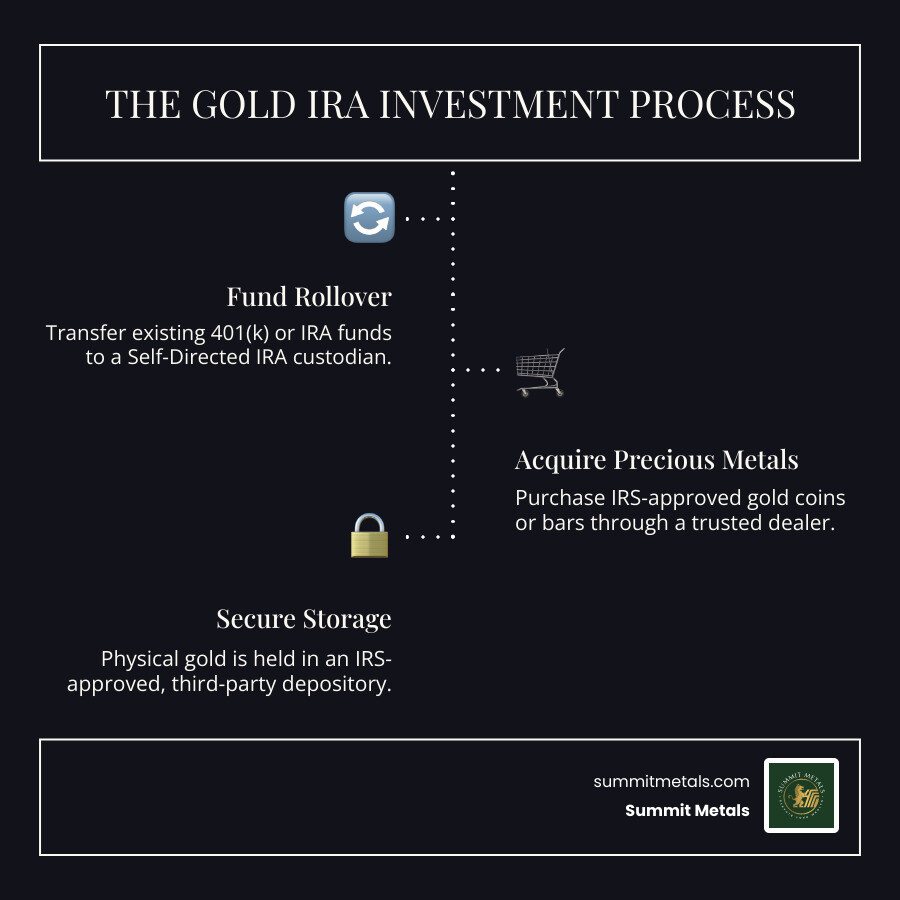
First, you cannot store your IRA gold at home. The IRS considers home storage a taxable distribution, which would trigger income taxes and a potential 10% penalty if you're under 59 ½. Your precious metals must be held in the physical possession of an IRS-approved third-party depository. These facilities are secure, insured, and regularly audited.
For more on compliant storage, read our guide: Storing Your Shine: A Guide to IRS-Approved Precious Metals Depositories.
Contributions follow standard IRA limits ($7,000 for 2024/2025, or $8,000 if 50+), while SEP IRAs allow up to $70,000. You can fund your account via direct contributions, transfers, or rollovers from plans like a 401(k).
Withdrawals are penalty-free after age 59 ½. Before that, you'll likely face a 10% penalty plus income tax. Once you reach age 73, Required Minimum Distributions (RMDs) begin for Traditional and SEP Gold IRAs. You can take these as cash (by selling metal) or as an "in-kind" distribution of the physical metal itself.
A Step-by-Step Guide to IRA Investing in Gold
Ready to start your journey into IRA investing in gold? This section walks you through the essential steps, from selecting the right partners to smart investment strategies, so you can invest confidently.
Step 1: Evaluating Gold IRA Companies and Avoiding Red Flags
This is the most critical step. Due diligence is key to finding trustworthy partners who prioritize your financial well-being.
First, understand the roles:
- Custodian: The IRS-approved financial institution that holds your IRA account and ensures compliance (e.g., Equity Trust Company).
- Dealer: The company where you buy your IRA-approved metals, which are then shipped to the depository. Summit Metals acts as your trusted dealer, offering transparent pricing and authenticated metals.
When evaluating companies, look for:
- Transparent Fee Structures: Get a written breakdown of all fees: setup, annual admin, storage, and transaction costs.
- Clear Buyback Policies: A reputable dealer should have a clear policy for repurchasing your metal. Summit Metals prides itself on competitive buyback rates.
- Reasonable Minimum Investments: These vary widely, from $2,000 to $25,000 or more. Find one that fits your budget.
- Strong Reputation: Check ratings from the Better Business Bureau (BBB) and read customer reviews.
Now, for the red flags to avoid:
- High-Pressure Sales Tactics: Rushed, fear-based selling is a classic warning sign.
- Vague or Hidden Pricing: Avoid any company that isn't upfront about costs and commissions. Fraudulent dealers can charge spreads of over 300%.
- "Free Gold" or Gimmicky Offers: If it sounds too good to be true, it is.
- Pushing "Semi-Numismatic" Coins: This is a made-up term used to justify inflated prices on non-bullion coins. Stick to IRA-approved bullion.
- Unsolicited Contact: Never respond to cold calls or unsolicited offers.
Use our Ultimate Checklist for Gold IRA Services Comparison and the FINRA Investor Bulletin to guide your research.
Step 2: Setting Up and Funding Your Account
Once you've chosen a reputable custodian and dealer, setting up your Gold IRA is straightforward.
- Choose a Custodian: Select an IRS-approved SDIRA custodian that handles precious metals.
- Open the SDIRA Account: Complete the custodian's application forms, which can often be done online.

-
Fund the Account: You can fund your account via:
- Direct Contribution: Add new funds up to the annual IRS limit.
- Transfer: Move funds directly from an existing IRA to your new Gold IRA custodian.
- Rollover: Move funds from an employer-sponsored plan like a 401(k). A direct rollover is the simplest, non-taxable method. Learn more in our Guide to Gold IRA Transfers.
- Purchase Approved Metals: Work with your dealer (like Summit Metals) to select IRA-approved products. You direct your custodian to purchase the metals, and the dealer ships them directly to the secure depository. You never take physical possession, ensuring compliance.
Step 3: Smart Investing with Dollar-Cost Averaging
Once your Gold IRA is funded, a smart strategy for IRA investing in gold is dollar-cost averaging.
Dollar-cost averaging means investing a fixed amount of money at regular intervals, regardless of the price. Instead of a $12,000 lump-sum purchase, you might invest $1,000 every month for a year.
Why is this smart for gold?
- Mitigates Volatility: By investing consistently, you avoid the risk of buying all your gold at a market peak. You buy more ounces when prices are low and fewer when they are high, averaging out your cost over time.
- Builds Discipline: This strategy removes emotion from investing and encourages a consistent, long-term approach, much like contributing to a 401(k).
- Automate Your Investment: This is where Summit Metals simplifies IRA investing in gold. Our Autoinvest program lets you set up recurring monthly purchases of IRA-approved gold and silver. It puts your precious metals savings on autopilot, ensuring you consistently build your holdings without trying to time the market. This disciplined approach is perfect for long-term retirement planning.
Frequently Asked Questions about Gold IRAs
We understand that IRA investing in gold can spark many questions. Here are concise answers to the most common ones.
Can I store the gold from my IRA at home?
No. IRS regulations strictly prohibit home storage of IRA-held assets. Taking physical possession is considered a taxable distribution and would subject you to income taxes and a potential 10% early withdrawal penalty. Your metals must be held by an IRS-approved trustee in a secure, third-party depository.
How much of my portfolio should I allocate to a Gold IRA?
While there's no single answer, many financial advisors suggest an allocation of 5-10% of a total portfolio to precious metals. This is often considered enough to provide diversification and a hedge against economic turmoil without overexposing your retirement to a single asset class. Gold is primarily an asset for stability and wealth preservation.
What happens when I want to take a distribution from my Gold IRA?
Once you reach age 59 ½, you can take penalty-free distributions. You have two main options:
- Receive Cash: Instruct your custodian to sell the metal and disburse the cash proceeds to you.
- Receive the Metal: Take an "in-kind" distribution of the physical gold bars or coins, which are then shipped to you from the depository.
For a Traditional Gold IRA, both options are taxable as income. For a Roth Gold IRA, qualified distributions are tax-free. Once you take an in-kind distribution, the metals are no longer part of your IRA.
Conclusion: Making a Golden Decision for Your Retirement
IRA investing in gold offers a powerful way to diversify your retirement portfolio, hedge against inflation, and hold a tangible store of value. Gold's historical performance during market turbulence highlights its unique role in a balanced, long-term investment strategy.
Success, however, requires understanding the rules and avoiding pitfalls. The regulations are strict: you cannot store IRA gold at home, and only specific, high-purity bullion is permitted. The higher fees and lack of dividends associated with physical gold mean it should be considered a strategic component of a larger plan.
Most importantly, your success hinges on choosing a transparent and trustworthy dealer. At Summit Metals, based in Wyoming, USA, and serving clients from locations like Salt Lake City, Utah, we are committed to this transparency. We provide real-time pricing and competitive rates, leveraging our bulk purchasing power to deliver value and trust. We believe in empowering you to make your IRA investing in gold journey smooth and secure.
By understanding the process, adhering to IRS rules, and selecting the right partners, you can confidently integrate precious metals into your retirement plan. Take control of your financial future and explore your options for a more secure retirement.
For a deeper dive, read our comprehensive guide: IRA Gold Investment: A Comprehensive Guide to Securing Your Future.
Ready to move from research to holdings? Browse our IRA-eligible gold and silver — IRS-fineness-verified listings you can purchase through your custodian, with Summit Metals handling the metal side from order to approved depository.