Understanding the 1879 Double Eagle: Rarity, History, and Value
The 1879 double eagle is one of the most fascinating gold coins in American numismatics, especially the ultra-rare New Orleans issue. If you're trying to understand what your coin is worth, here's what matters most:
Quick Value Guide for 1879 Double Eagles:
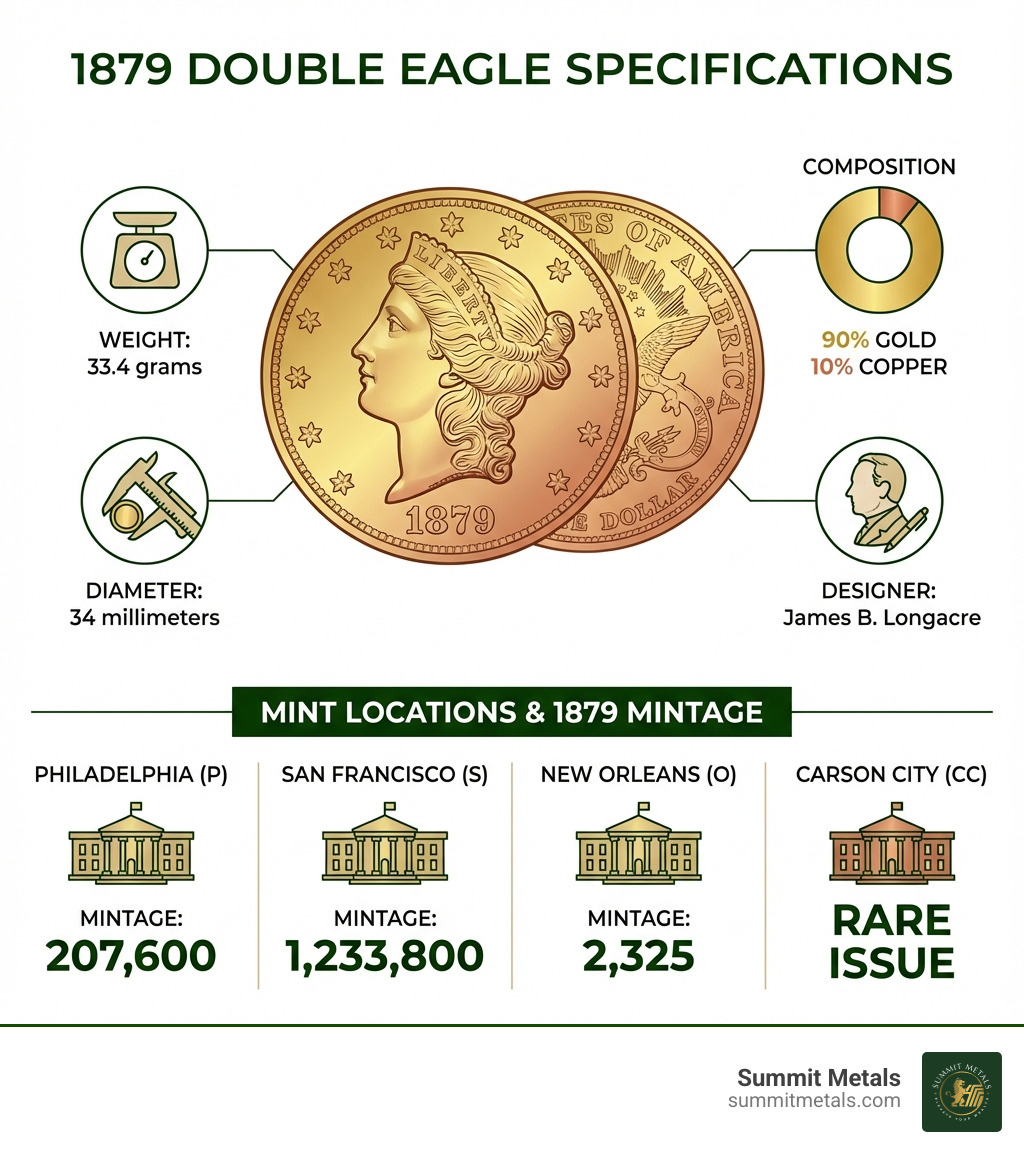
- 1879-O (New Orleans): $70,000–$138,000+ depending on grade (only 2,325 minted, 100–150 survive)
- 1879-CC (Carson City): Rare, highly collectible (mintage data limited)
- 1879-S (San Francisco): $3,300–$80,000+ (1,233,800 minted, more available)
- 1879-P (Philadelphia): $3,300–$75,000+ (207,600 minted, readily available)
The 1879-O is the only Type 3 Liberty Head Double Eagle ever struck at the New Orleans Mint, making it a key date that commands a significant premium over its gold content alone.
These $20 gold coins emerged during a pivotal moment in American history. When the New Orleans Mint reopened in 1879 after being shuttered during the Civil War, it struck just 2,325 double eagles—a tiny symbolic run compared to the million-plus Morgan silver dollars it produced that year. Most surviving examples show heavy wear from international banking use, and fewer than a dozen are known in mint-state condition.
The 1879 double eagle contains .9675 troy ounces of pure gold, giving it a melt value around $2,500 (as of November 2023) at current gold prices. But for collectors, the real story is rarity. While the Philadelphia and San Francisco issues trade near bullion value in lower grades, the 1879-O regularly sells for $70,000 or more—even in circulated condition—because so few escaped the melting pots of foreign banks and President Roosevelt's 1933 gold recall.
Whether you're holding a common-date piece or one of the legendary New Orleans rarities, understanding the history and grading nuances can mean the difference between a few thousand dollars and a six-figure windfall. I'm Eric Roach, and after a decade structuring billion-dollar deals on Wall Street, I now help investors understand how historic gold coins like the 1879 double eagle fit into a diversified wealth-protection strategy.
At Summit Metals, we also see coins like these as a gateway into disciplined, long-term precious metals ownership. Many clients use our Autoinvest approach—buying gold and silver every month, similar to how they contribute regularly to a 401k—to steadily build a position over time.
Explore more about 1879 double eagle:
- Why the 1849 Coronet Head Gold $20 Double Eagle is a Unique Smithsonian Collection Piece
- A Quick Start Guide to Gold Eagle Coins
- Beyond the Mint: What Makes Indian $10 Gold Coins So Special
The Story Behind the Coin: Why Was the 1879 Double Eagle Minted?
The year 1879 was a fascinating time for U.S. coinage, especially with the reopening of the New Orleans Mint. To truly appreciate the 1879 double eagle, particularly the 'O' mint mark issue, we need to dive into the historical currents that shaped its creation.
A Nation Rebuilds: The New Orleans Mint's Symbolic Return
The American Civil War brought a halt to coining operations at the Southern mints, including New Orleans, in 1861. For nearly two decades, the machines lay silent. But by 1879, the nation was deep into post-Civil War Reconstruction, and the federal government sought to restore economic stability and confidence.
The reopening of the New Orleans Mint that year was driven by two key legislative acts: the Bland-Allison Act of 1878 and the Specie Payment Resumption Act of 1875. The Bland-Allison Act mandated the production of millions of silver Morgan Dollars, aiming to increase the money supply and alleviate the post-war economic depression. Indeed, the primary purpose of the New Orleans Mint's reopening was to churn out these silver dollars.
However, alongside the silver, a small, almost symbolic mintage of gold coins was also produced. This included the 1879-O double eagle, marking the first $20 gold coin issued by the New Orleans Mint since 1861. Its exact purpose for coinage remains somewhat of a numismatic mystery; it may have been struck simply to commemorate the historic resumption of coining in New Orleans. Whatever the reason, this small production run immediately set the 1879-O apart from its counterparts.
Gold's Role in 19th Century America
In the late 19th century, gold coins like the 1879 double eagle played a crucial role in the U.S. and global economy, albeit not for everyday transactions. With a face value of $20, equivalent to roughly $500 in today's purchasing power, these magnificent coins were far too valuable for the average American's daily use. After all, $20 was often more than an average weekly wage!
Instead, these large gold coins served as the backbone of international trade payments, acting as bank reserves, and facilitating large-scale financial transactions between institutions. Many 1879 double eagles, particularly those from the New Orleans and San Francisco mints, were exported to foreign banks as payment for imported goods or to settle international debts. This explains why many surviving examples show significant wear and tear from their travels and storage in foreign bank hoards.
The importance of these coins was underscored by their eventual fate. Many pre-1933 gold coins, including the 1879 double eagle, survived Executive Order 6102, which in 1933 required U.S. citizens to surrender their gold coins, bullion, and certificates to the government. Millions were melted down, making the surviving examples of this era, especially rare dates like the 1879-O, even more precious today.
A Tale of Four Mints: Comparing the 1879 Double Eagle Issues
The year 1879 saw the production of double eagles at four different U.S. Mint facilities: Philadelphia (no mint mark), San Francisco ('S'), Carson City ('CC'), and New Orleans ('O'). Each mint's output tells a unique story about availability and rarity, profoundly impacting a coin's value.
The Common Dates: Philadelphia (P) and San Francisco (S)
For collectors interested in the 1879 double eagle, the Philadelphia and San Francisco issues are generally the most accessible.
The Philadelphia Mint, as the nation's primary mint, produced a substantial 207,600 pieces of the 1879 double eagle. While not as massive as some other years, this mintage ensures a reasonable supply for collectors today.
The San Francisco Mint, strategically located near the gold fields, was a prolific producer of gold coinage. In 1879, it struck an impressive 1,233,800 double eagles. This large mintage means that the 1879-S is relatively available, even in higher circulated grades. Many examples found today were repatriated from foreign bank hoards, often displaying the characteristic abrasions from being stored together in canvas bags.
These issues are typically encountered in Very Fine (VF) to About Uncirculated (AU) conditions, with Mint State (MS) examples becoming scarcer and commanding higher premiums. However, compared to their 'CC' and 'O' counterparts, they are far more common and represent a more approachable entry point for collectors.
The Legendary Rarities: Carson City (CC) and New Orleans (O)
Now, let's talk about the true gems for the 1879 double eagle series: the Carson City and New Orleans issues.
The Carson City Mint, known for its distinctive 'CC' mint mark, produced some of the most sought-after U.S. gold coins. While specific mintage figures for the 1879-CC double eagle are somewhat elusive, it is unequivocally considered a major rarity. Collectors often pay substantial premiums for any Carson City gold, and the 1879-CC is no exception. Its scarcity places it firmly in the field of advanced collectors.
Then there's the star of our show: the 1879-O double eagle. As we discussed, the New Orleans Mint reopened in 1879, and its mintage of double eagles was a paltry 2,325 pieces. This minuscule mintage figure immediately positions the 1879-O as a significant rarity.
Survival estimates for the 1879-O are remarkably low, with only about 100 to 150 examples believed to be extant in all conditions. This translates to an R-7.4 numismatic rarity rating for all grades, and an astounding R-9.8 for grades MS60 or better, with zero known in MS65 or higher. The 1879-O Liberty Head Double Eagle is not just rare; it's prohibitively rare in full mint state and seldom found even in AU58.
What makes the 1879-O even more special is its unique place in numismatic history: it is the only Type 3 Liberty Head Double Eagle struck at the New Orleans Mint. This makes it a true key date and a leading rarity within the entire Southern gold series.

1879 Double Eagle Mintage and Rarity Comparison
To put the rarity of the 1879 issues into perspective, let's look at a direct comparison:
| Mint Mark | Mintage Figure | Estimated Survivors (All Grades) | Rarity Level | Desirability |
|---|---|---|---|---|
| P | 207,600 | 4,000 - 6,000 | Common | High (Type 3) |
| S | 1,233,800 | 10,000 - 15,000 | Common | High (Type 3) |
| CC | (Very Low) | < 100 | Extremely Rare | Elite |
| O | 2,325 | 100 - 150 | Ultra Rare | Elite (Key Date) |
The contrast is stark. While the Philadelphia and San Francisco issues offer a chance to own a piece of history, the Carson City and especially the New Orleans 1879 double eagle represent some of the most challenging and rewarding acquisitions for serious collectors.
How to Identify and Value Your 1879 Double Eagle
Identifying and valuing your 1879 double eagle goes beyond simply checking the date and mint mark. It requires an understanding of its design, the nuances of its condition, and the dynamics of the numismatic market.
Decoding the Type 3 "Coronet Head" Design
The 1879 double eagle belongs to the Type 3 design of the Liberty Head $20 series, which was in production from 1877 to 1907. This iconic design was created by James B. Longacre, the Chief Engraver of the U.S. Mint.
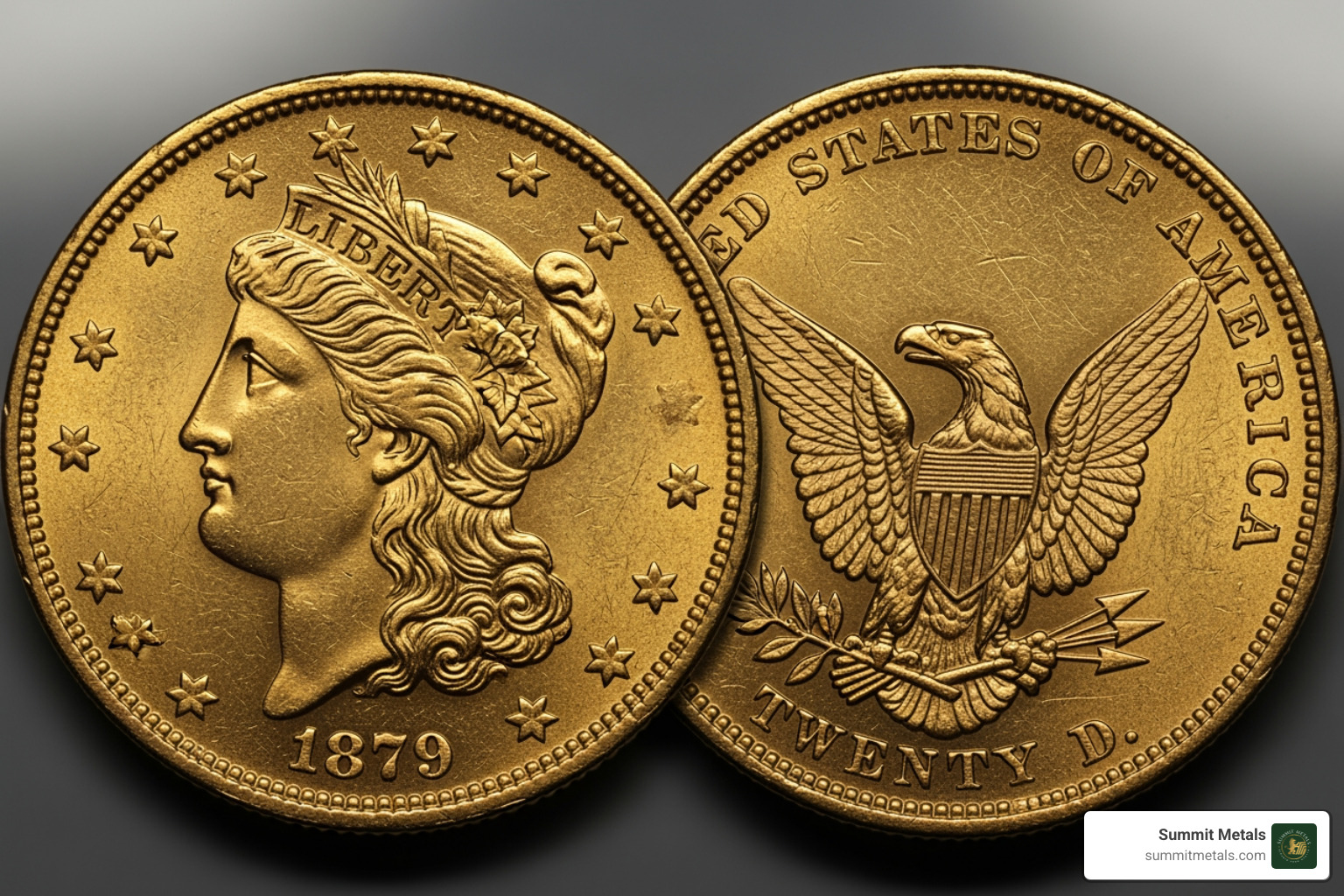
Obverse (Front): The obverse features a left-facing depiction of Lady Liberty, her hair pulled back and adorned with a coronet inscribed with the word "LIBERTY." Surrounding her portrait are 13 stars, representing the original colonies, and the date "1879" at the bottom. The Type 3 design is characterized by its refined details, particularly in Liberty's hair, which often shows better definition than earlier types.
Reverse (Back): The reverse showcases a majestic heraldic eagle, wings outstretched, clutching an olive branch (symbolizing peace) and arrows (representing strength) in its talons. A shield is emblazoned on its breast. Above the eagle, a scroll bears the motto "E PLURIBUS UNUM," and a halo of 13 stars surrounds its head. The inscription "UNITED STATES OF AMERICA" arches above, and the denomination "TWENTY DOLLARS" is boldly displayed below. This "TWENTY DOLLARS" inscription, rather than "TWENTY D." found on Type 2, is a key identifier of the Type 3 design. The motto "IN GOD WE TRUST" is also prominently featured above the eagle.
For the 1879-O specifically, collectors often note unique die characteristics. For instance, the borders of the obverse and reverse can appear mismatched to the naked eye. The obverse border tends to be wider with longer denticles (the tooth-like projections around the rim), while the reverse border is often narrower with stubbier denticles. Light repunching can also sometimes be observed on some of the obverse stars. The 'O' mint mark itself is small and centered, placed between the 'Y' in TWENTY and the 'D' in DOLLARS. These subtle details are crucial for authenticating and appreciating the specifics of your coin.
Grading Your Coin: Strike, Luster, and Surfaces
The condition, or grade, of your 1879 double eagle is the single most important factor determining its value beyond its inherent rarity. Professional grading services like PCGS and NGC evaluate coins based on three primary characteristics: strike, luster, and surfaces.
- Strike Quality: This refers to how sharply the coin's design elements were impressed from the die onto the planchet during minting. A strong strike means Liberty's hair details are clear, the stars are well-defined, and the eagle's feathers are distinct. The 1879-O is generally considered among the best-struck New Orleans double eagles, often showing good detail. However, the reverse can sometimes be less boldly impressed, with lightness on the lettering.
- Luster: Luster describes the coin's original mint brilliance. It can range from frosty (a satiny, crystalline appearance) to prooflike (a highly reflective, mirror-like surface). The luster on the 1879-O, for example, can be either frosty or prooflike with a soft, almost fuzzy texture. Original, vibrant luster is highly prized by collectors.
-
Surfaces: The surfaces of the coin are examined for imperfections. For many 19th-century gold coins, especially those used in international commerce, common imperfections include:
- Abrasions and Bag Marks: These are nicks, scratches, and scrapes caused by contact with other coins during handling, transport, and storage in canvas bags. Virtually every known 1879-O double eagle has numerous deep abrasions due to indifferent handling.
- Cleaning: Many older gold coins were cleaned over the years by previous owners, often resulting in a dull, unnatural surface or fine hairlines. A significant percentage of surviving 1879-O coins have been cleaned, which significantly reduces their numismatic value.
- Mint-Made Spots or Discoloration: These are inherent to the planchet or minting process and can appear as copper spots or areas of discoloration. They are common on the 1879-O.
The grading scale typically ranges from Good (G) for heavily worn coins to Mint State (MS) for uncirculated examples, with intermediate grades like Very Fine (VF), Extra Fine (EF), and About Uncirculated (AU). An accurately graded AU 1879-O is rare, and finding a choice example with good eye appeal can be a long hunt. The finest certified 1879-O examples are MS62 (PCGS) and MS63 (NGC), underscoring their extreme rarity in top condition.
What is an 1879 Double Eagle Worth Today?
The value of an 1879 double eagle varies dramatically based on its mint mark, grade, and overall eye appeal. While all 1879 double eagles share a melt value of approximately $2,500 (as of November 2023) due to their gold content, their numismatic premium—the value beyond the gold—can range from a few hundred dollars to well over six figures.
- Philadelphia (P) and San Francisco (S) Issues: In lower circulated grades (VF-EF), these coins often trade for a relatively small premium over their melt value. As you move into AU grades, the premium increases, with MS60-MS62 examples commanding several thousand dollars. High-end Mint State coins (MS63 and above) can reach into the tens of thousands. For example, an 1879-S in MS64 was recently valued at $80,750, while an MS63 was $32,300.
- Carson City (CC) Issue: Any 1879-CC double eagle will carry a significant numismatic premium due to its extreme rarity. Even in lower circulated grades, these coins are highly sought after and command five-figure prices.
- New Orleans (O) Issue: This is where the values truly skyrocket. The 1879-O is a "trophy coin" for many collectors. Even in lower circulated grades (VF-EF), the 1879-O double eagle can fetch $50,000 to $70,000. In AU58, a condition where coins show slight wear but retain much of their original luster, prices can easily exceed $70,000. We've seen examples like a PCGS AU58 sell for $114,000 in the Fairmont Collection – Hendricks Set in April 2022. Another NGC MS61 example sold for $138,000 in April 2021, and an NGC MS61 for $135,125 in January 2014. These figures demonstrate the immense demand for this particular rarity.
The market for such rare coins is dynamic, and prices can fluctuate. However, the consistent high auction results for the 1879-O reflect its enduring status as a numismatic icon. For investors using a long-term approach, pairing a key-date rarity like this (when available) with a steady, monthly purchase plan in more common-date gold through Summit Metals’ Autoinvest strategy can balance trophy pieces with reliable, incremental accumulation. Prices shown are at the time of this publication.
Investing in Historic Gold: A Smart Strategy
Beyond the thrill of collecting, historic gold coins like the 1879 double eagle offer a compelling investment opportunity. They combine the intrinsic value of precious metal with a numismatic premium that can appreciate independently of the spot price of gold.
Gold Coins vs. Gold Bars: Which is Better?
When considering an investment in physical gold, many people weigh the pros and cons of gold coins versus gold bars. Both have their merits, but for the discerning investor, gold coins, especially historic ones, often present a more diversified and robust option.
| Feature | Gold Coins (e.g., 1879 Double Eagle) | Gold Bars / Bullion |
|---|---|---|
| Numismatic Premium | Significant, can appreciate independently of spot price | Minimal, trades very close to spot price |
| Legal Tender Status | Yes, U.S. coins hold face value (e.g., $20) | No, purely based on metal content |
| Counterfeit Protection | Complex designs, mint marks, and grading by third-party services make fraud easier to detect; legal-tender status and detailed design features provide extra layers of verification | Simpler appearance; relies heavily on assay marks and refiner reputation, making careful sourcing essential |
| Historical Value | Rich history, cultural significance, finite supply | Primarily commodity value, no historical premium |
| Portability | Excellent for smaller, divisible units | Efficient for large, single purchases but less divisible |
| Liquidity | High among coin dealers and collectors familiar with key dates and types | Very high in broad bullion markets worldwide |
| Premiums Over Melt | Higher premiums over melt value | Lower premiums over melt value |
For clients at Summit Metals, we often highlight the unique advantages of owning gold coins. Their legal tender status means they carry a face value backed by the U.S. government, and their detailed, historically significant designs make them harder to counterfeit convincingly than simple rectangular bars. While a gold bar's value is almost purely tied to the fluctuating spot price of gold, a rare gold coin like an 1879 double eagle offers the potential for appreciation based on both its gold content and its numismatic rarity. This dual value proposition provides a hedge against market volatility and a unique asset for wealth preservation.
Build Your Holdings with Dollar-Cost Averaging
For those looking to build a substantial holding in precious metals, whether coins or bars, a disciplined approach works best: dollar-cost averaging. This strategy involves investing a fixed amount of money at regular intervals, regardless of market fluctuations.
It is similar to how many people invest in a 401k or IRA: you contribute a set amount each month, instead of trying to time your buys perfectly. With Summit Metals’ Autoinvest-style approach, you can structure regular monthly purchases of gold and silver through our transparent, real-time pricing, taking advantage of our competitive rates from bulk purchasing.
When prices are high, your fixed dollar amount buys fewer ounces; when prices are low, it buys more. Over time, this averages out your purchase price, often resulting in a lower average cost per ounce and a more stable investment experience.
This long-term strategy is particularly effective for assets like gold, which tend to hold value over extended periods. By consistently adding to your holdings—month after month—you build wealth steadily and protect yourself against inflation and economic uncertainty.
Ready to start building your gold and silver holdings with a disciplined approach and monthly purchases? You can Set up your gold savings plan with Summit Metals and put your Autoinvest strategy on autopilot, just like your 401k contributions.
Conclusion: The Enduring Legacy of the 1879 Double Eagle
The 1879 double eagle stands as a testament to a pivotal era in American history, embodying the nation's post-Civil War reconstruction and the critical role gold played in its economy. From its magnificent Type 3 Liberty Head design by James B. Longacre to its varied mintages across Philadelphia, San Francisco, Carson City, and New Orleans, each coin tells a part of this compelling story.
The extreme rarity of the 1879-O, with its minuscule mintage of 2,325 pieces and estimated survival of only 100-150 examples, cements its status as a numismatic legend. As the only Type 3 Liberty Head Double Eagle ever struck at the New Orleans Mint, it commands extraordinary premiums, making it a highly coveted piece for serious collectors and investors alike. The Carson City issue also remains a formidable rarity, while the Philadelphia and San Francisco issues offer more accessible entry points to this historic series.
Whether valued for its intrinsic gold content or its significant numismatic premium, the 1879 double eagle represents a tangible link to the past. For us at Summit Metals, based in Wyoming and serving clients in Salt Lake City, Utah, we understand the profound appeal of these historic gold coins. They are not merely commodities; they are pieces of history, safeguarded assets, and potent symbols of enduring wealth.
Understanding the drivers of their value—grade, rarity, and historical context—is key to appreciating these treasures. As you consider diversifying your portfolio, coins like the 1879 double eagle offer a unique blend of investment and legacy.
If you want to build your own position in gold and silver methodically, you can treat it much like a retirement contribution: set a fixed monthly amount and let time do the work. Summit Metals’ Autoinvest-style monthly purchase approach, backed by transparent, real-time pricing and competitive bulk rates, makes it straightforward to accumulate precious metals alongside standout numismatic pieces.
To dig deeper into U.S. gold coinage and explore how these magnificent pieces fit into a modern investment strategy, you can Learn more about American Eagle coins.