Is Low-Cost Gold Investment Actually Within Reach in 2026?

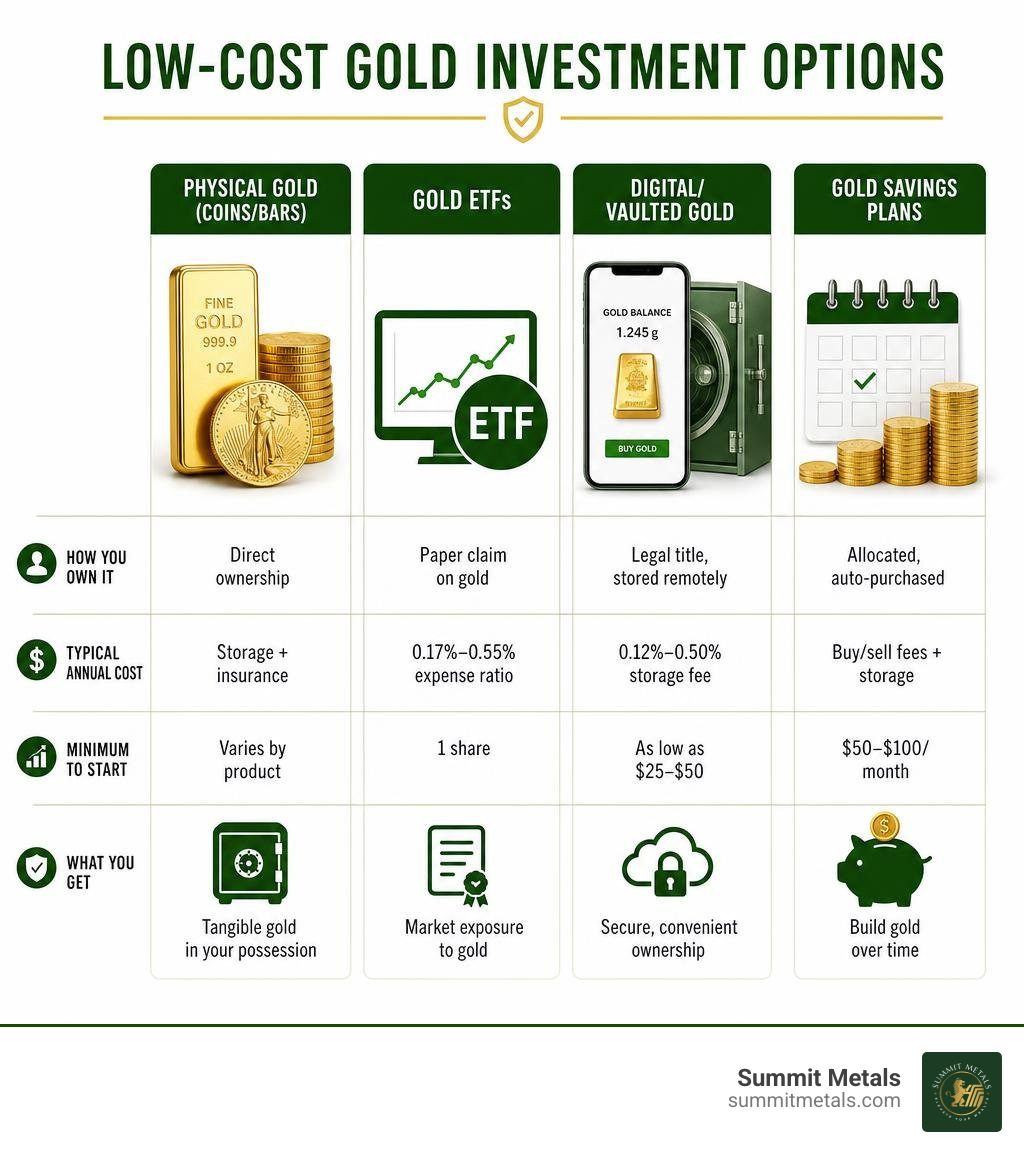
Gold investment low cost options are more accessible today than most people realize. Here is a quick breakdown of the main routes and what they typically cost:
| Investment Type | How You Own It | Typical Annual Cost | Minimum to Start |
|---|---|---|---|
| Physical gold (coins/bars) | Direct ownership | Storage + insurance | Varies by product |
| Gold ETFs | Paper claim on gold | 0.17%–0.55% expense ratio | 1 share |
| Digital/vaulted gold | Legal title, stored remotely | 0.12%–0.50% storage fee | As low as $25–$50 |
| Gold savings plans | Allocated, auto-purchased | Buy/sell fees + storage | $50–$100/month |
Each option carries a different mix of upfront costs, ongoing fees, and ownership rights. The "cheapest" option depends on how long you hold, how much you invest, and whether you want to actually own the metal.
Gold has served as a store of value for thousands of years, and that hasn't changed. What has changed is how many ways there are to buy it — and how dramatically the costs vary between them.
In July 2026, with gold prices having already reached significant all-time highs and investor interest surging, the gap between a smart gold purchase and an expensive one has never been wider. Dealer premiums, ETF expense ratios, storage fees, and hidden spreads can quietly erode your returns before gold moves a single dollar.
Whether you are considering your first ounce or looking to build a systematic position the way you would a 401(k), understanding the true cost of each approach is the only way to protect your purchasing power — not just from inflation, but from unnecessary fees.
I'm Eric Roach, an investment banker and precious metals advisor who has helped clients ranging from retiring executives to physicians structure gold allocations that actually work — making gold investment low cost a practical reality, not just a marketing phrase. In the sections below, I'll walk you through every major option, side by side, so you can make a confident, informed decision.
Related content about gold investment low cost:
Choosing a Gold Investment Low Cost Strategy
When we look at the landscape of precious metals today, we see three primary routes for building your position: physical bullion, exchange-traded funds (ETFs), and automated savings plans. Deciding which route is right for you requires looking past the initial price tag and understanding how each vehicle functions over the long term.
To build a solid foundation on why we allocate to this asset class in the first place, you can explore our resources on The Strategic Role of Gold in Long-Term Portfolio Management and Gold Investment 101: Turning Your Savings into Solid Gold. For those completely new to the space, we also highly recommend The Ultimate Beginner’s Guide to Investing in Precious Metals.
Physical Bullion vs. ETFs: A Cost Comparison
The debate between physical gold and ETFs usually boils down to convenience versus absolute control.
With gold ETFs, the transaction is as simple as buying a stock. You pay a small commission to your broker (often free these days) and an ongoing annual management fee, known as the expense ratio. There are no shipping fees, no security installations at your house, and no vault storage bills to pay out of pocket.
Physical gold, on the other hand, requires an upfront premium over the spot price. You also have to think about secure shipping, insurance, and long-term storage. However, physical ownership eliminates the ongoing "management fee drag" of paper assets. Once you buy physical gold and secure it, you can hold it for decades without a third party taking a fraction of your metal every single year.
Automatic Gold Savings Plans and Accumulation Programs
For many modern investors, the easiest way to build a position is to automate it. Automated gold savings plans allow you to set aside a fixed amount of money every week or month to purchase gold. This is the exact same dollar-cost averaging (DCA) strategy that millions of people use in their employer-sponsored 401(k) plans.
By investing a fixed dollar amount regularly, you automatically buy more gold when prices are lower and less gold when prices are higher. This takes the emotional guesswork out of timing the market.
To help our clients build wealth systematically, we offer the Summit Metals AutoInvest program. Instead of waiting until you have saved up enough for a large purchase, you can dollar-cost average by shopping regularly with us. It is a seamless, disciplined approach to turning paper currency into real, tangible wealth over time.
Analyzing the Lowest-Cost Gold ETFs and Expense Ratios
If you decide that paper exposure fits your liquid trading needs, the exchange-traded fund market is incredibly massive. Globally, gold-backed ETFs hold roughly 3,893 tonnes of gold, representing total assets of approximately US $503 billion.
However, not all gold funds are built the same. According to the Fact Sheet:SPDR® Gold Shares, Jun2025 , the average gross expense ratio for gold ETFs sits around 0.55%, which is still significantly lower than the 0.89% average gross expense ratio found in active gold mutual funds. For long-term investors, finding a fund that minimizes this annual drag is crucial.
Top Gold Investment Low Cost ETFs for Savvy Investors
To achieve a true gold investment low cost strategy using paper assets, you should look at the lowest-cost funds on the market:
- iShares Gold Trust Micro (IAUM): Specifically designed for retail investors looking for low-cost exposure, boasting an ultra-low expense ratio of 0.15% to 0.17%.
- SPDR Gold MiniShares Trust (GLDM): Offers a highly competitive expense ratio of 0.18%. As of July 2026, GLDM delivered an impressive one-year return of 21.30%, tracking the upward surge in spot gold prices.
- Aberdeen Standard Physical Gold Shares ETF (SGOL): Another excellent low-cost institutional trust with an expense ratio of 0.17%.
- GraniteShares Gold Trust (BAR): A highly liquid trust holding physical gold in secure vaults with an expense ratio of 0.175%.
By choosing one of these mini-trusts over the traditional, larger funds (which often charge 0.40% or more), you save a substantial amount of money over a multi-year holding period.
Understanding ETF Tracking Error and Liquidity
Low expense ratios are great, but they do not tell the whole story. You also have to look at tracking error and liquidity.
Tracking error measures how closely the ETF's net asset value (NAV) follows the actual spot price of gold. For example, the massive SPDR Gold Shares (GLD) has a historic tracking error of 0.000393, while its lower-cost sibling, GLDM, maintains a tight tracking error of 0.000116.
Additionally, you must consider the bid-ask spread. Highly liquid, massive funds like GLD have incredibly tight spreads (often as low as 0.01%), meaning it costs virtually nothing to enter and exit a position. Smaller, ultra-low-cost ETFs might save you on the annual expense ratio but could cost you slightly more in wider spreads if you trade in and out frequently.
The Hidden and Ongoing Costs of Physical Gold Ownership
While paper gold has its place for short-term traders, physical gold remains the ultimate form of wealth preservation. To buy physical metal safely without overpaying, we advise checking out our guides on How to Buy Gold and Silver Online Safely and learning how to Unlock the Secret: Buying Gold and Silver Without the Premium.
To ensure you make smart decisions, read Don’t Get Fooled: The Smart Way to Buy Gold and Silver and review our tips on Smart Shopping: How to Purchase Precious Metals Safely.
Dealer Premiums, Spreads, and Minimum Purchase Sizes
Physical gold is never sold exactly at the "spot price." The spot price is the wholesale price for massive, industrial-sized 400-ounce bars traded in professional markets. When that gold is refined, melted down, minted into coins or smaller bars, insured, and shipped to a dealer, those fabrication and distribution costs are added to the price. This markup is called the dealer premium.
When you sell your gold back to a dealer, they will typically buy it at a slight discount to the spot price or right at spot, creating a "buy-sell spread."
To understand how different physical formats affect your total cost, let us look at a comparison between gold coins and gold bars:
| Feature | Gold Coins | Gold Bars |
|---|---|---|
| Typical Premium | Slightly higher due to minting complexity | Lower, closer to spot price |
| Legal Tender Status | Yes, carries a government-backed face value | No, valued purely by weight and purity |
| Counterfeit Protection | High (government security features & legal penalties) | Moderate (depends on assay card and brand) |
| Fraud Protection | Excellent (face value provides legal protections) | Standard |
| Liquidity | Extremely high worldwide | High, but requires purity verification |
We often recommend gold coins to investors who value the built-in security of government minting. Because coins carry a legal tender face value, counterfeiting them is considered counterfeiting national currency—a major federal crime that deters fraudsters. This added layer of protection makes coins incredibly easy to authenticate and trade globally.
Storage, Insurance, and Security Risks
Once you take physical delivery, you must decide how to store it. There are three primary options:
- Home Storage: Utilizing a high-quality, bolted-down home safe. This gives you 24/7 access and zero ongoing fees, but you bear the security risk and must ensure your homeowner's insurance policy covers high-value precious metals (which often requires a separate rider).
- Bank Safe Deposit Boxes: Relatively inexpensive, but bank boxes are not insured by the FDIC. If the bank suffers a catastrophic event or is closed during a holiday, you cannot access your metal.
- Professional Private Vaults: The gold standard of security. Private vaults offer fully allocated storage, meaning your exact physical coins or bars are held separately under your legal title. These facilities utilize world-class transport partners like Brinks or Loomis and secure comprehensive insurance policies through Lloyd's of London to protect against theft, damage, or loss.
Total Cost of Ownership: Physical Gold vs. ETFs
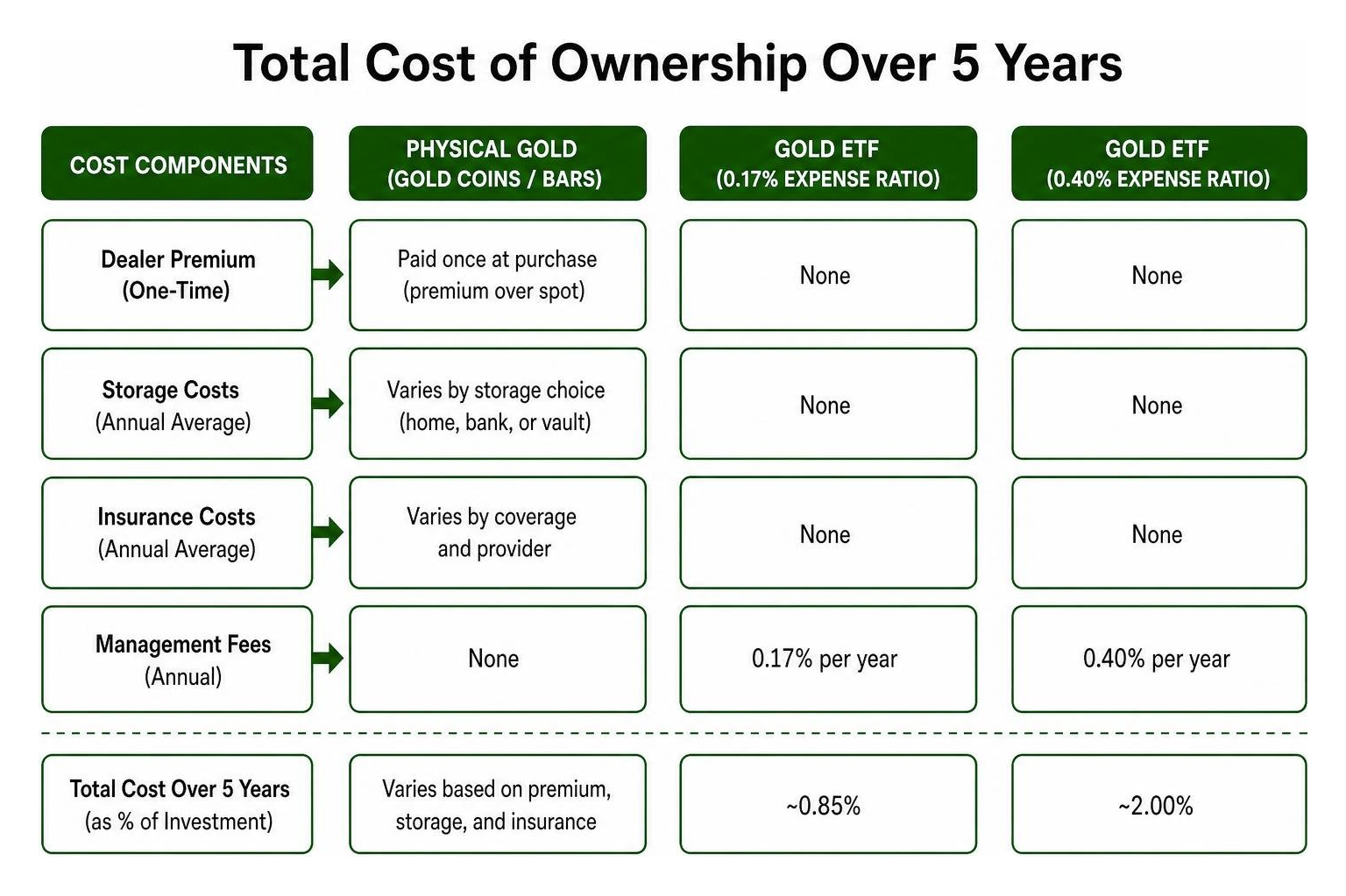
To determine which strategy represents a true gold investment low cost path for your specific goals, we have to look at the total cost of ownership (TCO) over time.
Multi-Year Cost Comparison: Physical vs. Paper Gold
Let us look at a hypothetical five-year holding period.
If you buy a low-cost gold ETF with an expense ratio of 0.17%, you will lose about 0.85% of your total investment over five years to management fees. If you buy a larger, more liquid ETF with a 0.40% expense ratio, that loss increases to 2.0% of your capital over five years.
With physical gold, your primary costs are paid upfront in the dealer premium. If you buy a physical coin with a premium of 4% to 5%, your initial cost is higher than the ETF. However, if you store that gold securely at home, your ongoing annual cost is 0%. By year ten, the compounding fee drag of a higher-cost ETF can easily surpass the one-time premium you paid for physical ownership.
For investors working with a tighter budget who still want to diversify, we highly recommend looking at our silver collections. Silver has a lower cost per ounce, allowing you to build a substantial physical metal position without a massive upfront capital commitment.
Fractional Gold: A Gold Investment Low Cost Entry Point
If you want to own physical gold but do not want to wait until you can afford a full one-ounce coin, fractional gold is an exceptional alternative. To understand the mechanics of this strategy, read our expert guides:
- The Benefits of Buying Fractional Gold: Why Smaller Is Often Better Than Waiting for a 1oz Gold Coin
- Fractional Gold Bars: An Affordable Entry Point for Gold Investors
- The Case for Fractional Gold: Why It’s More Important Than Ever
You can browse our extensive fractional gold collections to see how easy it is to start.
While it is true that smaller fractional pieces carry slightly higher percentage premiums (for example, a 1/10th ounce coin might carry a 7% to 10% premium compared to 3% to 4% on a one-ounce coin), they provide invaluable budget flexibility. Fractional gold allows you to build your holdings incrementally, paycheck by paycheck, rather than waiting months to buy a larger piece.
Key Factors for Choosing Your Low-Cost Gold Strategy

When deciding which low-cost route to take, you must weigh the convenience of financial assets against the security of physical ownership. For a real-world perspective on how the physical market operates during periods of high demand, watch this insightful local news segment: Surge in gold prices prompt wave of buying, selling at local coin shops .
Ownership Rights: Real Gold vs. Paper Claims
It is vital to understand what you actually own when you buy paper gold. When you purchase shares in a gold ETF, you do not own physical gold. You own shares in a trust that holds gold.
The physical gold in the trust is held by a custodian (typically a massive global bank like HSBC or JPMorgan Chase). You cannot show up at the bank vault and ask to withdraw your three ounces of gold. The trust agreement only allows physical redemption for institutional "Authorized Participants" who can transact in massive "baskets" of 100,000 shares (representing millions of dollars). For the average retail investor, an ETF is simply a cash-settled paper claim.
Liquidity, Exit Strategies, and Selling Your Gold
A smart investor always plans their exit strategy before making an investment. If you own physical gold, how quickly can you convert it back to cash when you need it?
If you store your physical gold at home, you have to pack it up, drive to a local coin shop, or ship it securely back to an online dealer to liquidate it. This process can take a few days.
However, if you utilize secure private vault storage, many facilities offer immediate liquidation. Because the gold is already authenticated and securely held within the vaulting system, you can sell your position instantly at highly competitive rates without shipping a single coin.
When you are ready to sell, we make the process incredibly straightforward. Our Sell to us exit strategy provides a transparent, secure, and competitive buyback process, ensuring you can liquidate your precious metals quickly and with complete peace of mind.
Frequently Asked Questions About Low-Cost Gold Investments
Is it more affordable to buy physical gold or ETFs?
For short-term traders or those looking to rebalance their portfolios frequently, gold ETFs are generally more affordable because they feature ultra-low transaction fees and no immediate shipping or physical storage costs. However, for long-term buy-and-hold investors, physical gold can be more cost-effective. Physical gold has no annual management fee drag, meaning that over a 10-to-20-year period, the upfront premium of physical metal can be cheaper than the compounding expense ratios of an ETF.
Do you actually own physical gold when you buy ETFs?
No. When you buy shares in a gold ETF, you own a financial security that represents a fractional interest in the trust's gold holdings. You do not hold legal title to any specific physical bar, and you cannot redeem your shares for physical metal unless you are an institutional player trading in multi-million dollar blocks. If you want true, uncompromised ownership without counterparty risk, physical bullion is the only way to achieve it.
How do premiums and spreads affect the real cost of physical gold?
Premiums and buy-sell spreads represent the transactional friction of physical gold. The premium is the markup over the spot price to cover manufacturing and distribution, while the spread is the difference between what a dealer sells gold for and what they will buy it back for. You can minimize these costs by purchasing larger bars or choosing government-minted gold coins, which carry slightly higher premiums but enjoy much higher buyback demand and legal tender fraud protections.
Conclusion
At Summit Metals, based in Salt Lake City, Utah, we are dedicated to helping our clients navigate the precious metals market with clarity and integrity. We offer a curated selection of authenticated gold and silver bullion products designed to help you preserve your hard-earned wealth.
By leveraging our bulk purchasing power, we are able to secure competitive rates and pass those savings directly on to you through real-time, transparent pricing. Once your payment is verified through our rigorous anti-fraud protocols, we ship your physical metals securely via FedEx Express, ensuring your investment arrives safely and promptly at your door.
We believe that an educated investor is a successful investor. That is why we maintain an active educational YouTube channel filled with guides, market analysis, and practical tips to help you master the fundamentals of precious metals. When you are ready to take control of your financial future with a trusted partner, we are here to help you every step of the way.