What Is the Daily Gold Gram Price Right Now?
The daily gold gram price is approximately $161–$166 USD per gram for 24K gold at the time of this publication, depending on the source and whether you're looking at the spot, bid, or ask price.
Here's a quick snapshot of current gold gram prices by purity:
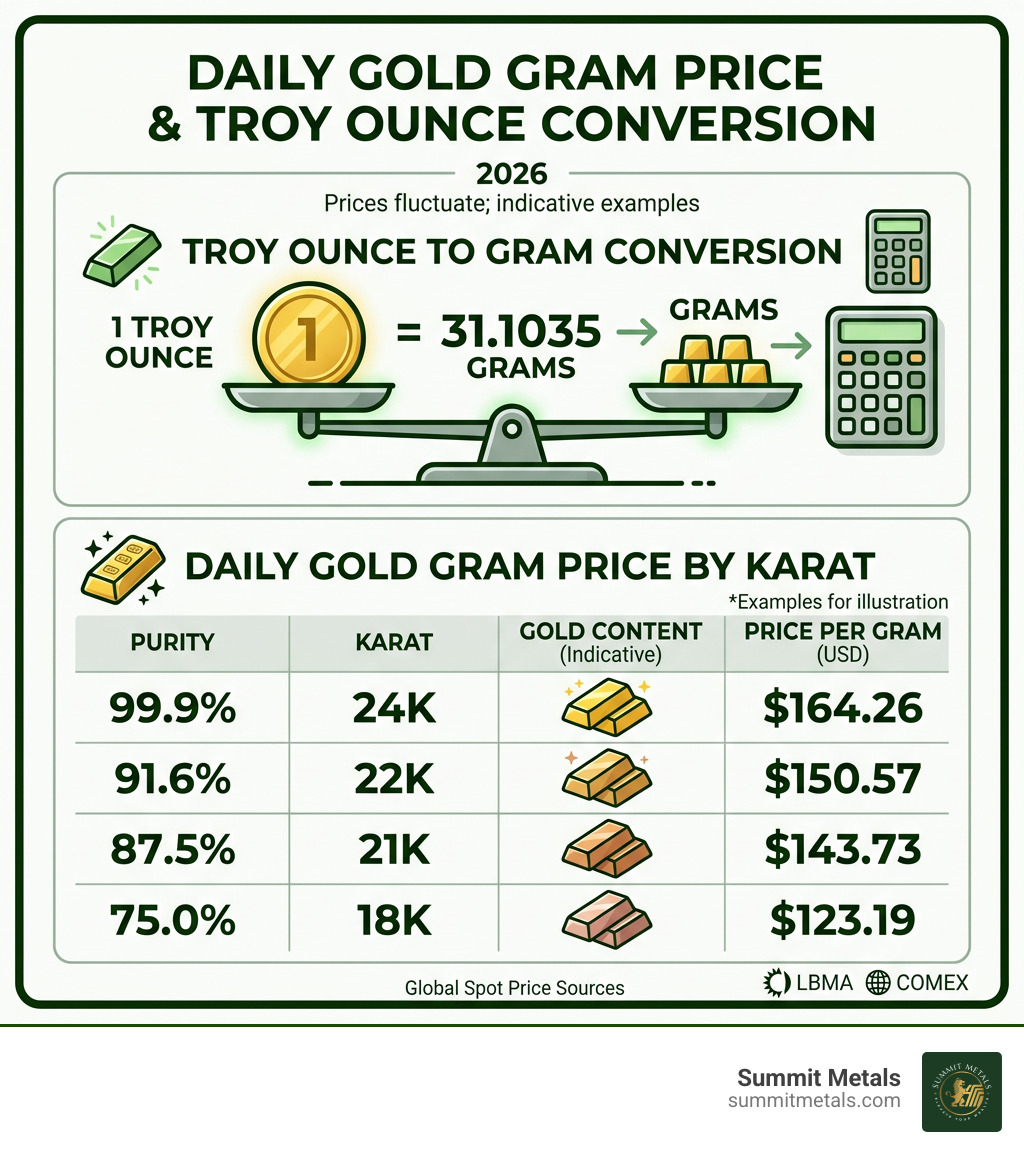
| Purity | Karat | Price Per Gram (USD) |
|---|---|---|
| 99.9% | 24K | ~$164.26 |
| 91.6% | 22K | ~$150.57 |
| 87.5% | 21K | ~$143.73 |
| 75.0% | 18K | ~$123.19 |
Prices shown are at the time of this publication and fluctuate throughout each trading day.
Gold prices move constantly. And if you've ever gone looking for a simple, honest number, you know how fast confusion sets in. One site shows $161. Another shows $165. A dealer quotes you something different entirely. What's real?
Here's the short answer: the global spot price is set by major exchanges like the LBMA (London Bullion Market Association) and COMEX. The gram price is simply that spot price divided by 31.1035 — the number of grams in a troy ounce. Any price you see above that baseline includes a dealer premium. Any price below it should raise a red flag immediately.
The gap between the spot price and what you actually pay matters — especially now, with gold hitting a record high of $5,602.22 per troy ounce (roughly $180.24 per gram) in January 2026. At these levels, even small pricing errors or deceptive markups can cost you hundreds of dollars.
I'm Eric Roach, a former investment banker who spent over a decade advising Fortune 500 companies on multi-billion-dollar transactions, and I now help everyday investors use physical gold and silver to protect and grow their wealth — including tracking the daily gold gram price to find the right entry points. This guide will show you exactly how to read gold gram pricing, avoid common traps, and invest with confidence.
Understanding the Daily Gold Gram Price and Spot Market Dynamics
To understand why the daily gold gram price fluctuates, we have to look at the "engine room" of the global gold market. The price you see on your screen isn't just a random number; it's the result of massive, high-speed trading across global exchanges.
The two biggest players are the London Bullion Market Association (LBMA) and the COMEX (part of the CME Group in Chicago). The LBMA is essentially the world's "gold hub," where major international banks trade physical gold. They conduct electronic auctions twice daily to set the "LBMA Gold Price," which serves as the global benchmark. Meanwhile, the COMEX is where gold futures are traded- contracts to buy or sell gold at a specific price in the future.
These exchanges provide "price discovery." When you see a live chart, you are seeing real-time market data reflecting the equilibrium between global supply and demand. For investors, this transparency is vital. It ensures that whether you are in Salt Lake City or London, the base value of your gold is recognized worldwide. You can explore more about these market benchmarks in our guide on the Spot Price Gold Oz. For broader background on how the global benchmark works, see the London Bullion Market Association.
How to Calculate the Daily Gold Gram Price from Spot
Most major financial news outlets report gold in "troy ounces," but many physical products- especially smaller bars and jewelry- are sold by the gram. This can make price comparisons tricky if you don't know the math.
A troy ounce is not the same as a standard "grocery store" ounce (avoirdupois). One troy ounce equals exactly 31.1034768 grams. To find the daily gold gram price, simply take the current spot price per ounce and divide it by 31.1035.
- Example: If the spot price is $5,151.80, then $5,151.80 / 31.1035 = $165.63 per gram.
Alternatively, you can multiply the spot price by 0.03215. Both methods get you to the same destination. Keeping this conversion in mind helps you verify if a dealer's "per gram" price is fair or if they’ve padded the premium. For a deeper dive into these calculations, check out our 24k Gold Value Per Gram Complete Guide.
Why Purity Levels Change the Daily Gold Gram Price
Not all gold is created equal. When we talk about the daily gold gram price in a financial context, we are almost always referring to 24K gold (99.9% pure). However, if you are looking at jewelry or certain coins, the purity- and therefore the price- will be lower.
- 24K (99.9%): Pure investment-grade gold.
- 22K (91.6%): Common in sovereign coins like the American Gold Eagle or Krugerrand. It’s mixed with copper or silver for durability.
- 18K (75.0%): Standard for high-end jewelry.
The market value of 18K gold is exactly 75% of the 24K spot price. Industrial demand and jewelry scrap markets rely heavily on these gram-based calculations. If you're holding older items, our 18kt Gold Price Per Gram Complete Guide explains how to value lower-purity metals accurately.
Economic Factors That Drive Daily Fluctuations
Why did the daily gold gram price go up $2 yesterday and down $3 today? It usually comes down to the US Dollar. Because gold is priced in USD globally, there is a strong inverse relationship: when the dollar gets stronger, gold often becomes more expensive for international investors, which can dampen demand and lower the price. Conversely, a weak dollar usually sends gold higher.
Inflation is another massive driver. Gold is the ultimate "inflation hedge." When the cost of living rises and the purchasing power of the dollar drops, investors flock to gold because its supply cannot be "printed" by a government. Interest rates also play a role; when rates are low, the "opportunity cost" of holding gold (which pays no interest) is lower, making it more attractive. You can learn more about these complex shifts in our article on Why Gold and Silver Prices Fluctuate.
The Role of Central Bank Policies
Central banks are the "whales" of the gold market. When institutions like the Federal Reserve or the People's Bank of China decide to increase their gold reserves, they buy in massive quantities, which can significantly drive up the daily gold gram price.
In recent years, we’ve seen record-breaking central bank acquisitions as nations seek to diversify away from the US dollar and protect themselves against geopolitical instability. This "safe-haven" demand is a primary reason why Gold Surges Past 2,700 and continues to reach new highs. When the world feels uncertain, gold is the asset everyone wants to hold.
Monitoring the Gold-to-Silver Ratio
If you want to play the precious metals market like a pro, you have to watch the gold-to-silver ratio. This ratio tells you how many ounces of silver it takes to buy one ounce of gold.
Historically, when the ratio is high (e.g., over 80:1), silver is considered "cheap" or undervalued relative to gold. Many savvy investors will sell some gold to buy silver when the ratio is high, then swap back to gold when the ratio drops. It’s a classic way to increase your total metal holdings without adding new capital. We discuss this strategy in detail in The Midas Touch: Gold and Silver Prices Today.
Physical Gold vs. Paper Derivatives: Calculating Real Value
There is a huge difference between "owning gold" on a brokerage app and holding a gold coin in your hand. Paper derivatives—like Gold ETFs (Exchange Traded Funds) or Futures contracts—are financial instruments that track the gold price, but they come with "counterparty risk." This means if the institution managing the fund fails, your "gold" might just be a worthless piece of paper.
Physical gold, on the other hand, is a tangible asset with no counterparty risk. It cannot be hacked, deleted, or devalued by a bank’s bankruptcy. While ETFs might have lower upfront costs, they charge annual management fees that eat into your gains over decades. Physical gold has a one-time premium but costs nothing to hold. Understanding the Spot Price vs Premium is the first step in realizing the true value of what you own.
Why You Should Never Buy Below the Daily Gold Gram Price
We’ve all seen the ads: "Gold at 10% below spot!" Our advice? Run.
The daily gold gram price is the raw material cost. By the time that gold is refined, minted into a coin, insured, and shipped to a dealer, costs have been added. No legitimate business sells an asset for less than its global melt value. If an offer is below spot, it is almost certainly a scam involving counterfeit bars or "gold-plated" tungsten. Protecting yourself means understanding the costs of the supply chain, as detailed in our guide on 14k Gold Price Per Gram.
Choosing Your Investment: Gold Coins vs. Gold Bars
When you're ready to buy, you'll face the age-old debate: coins or bars? Both have their place in a diversified portfolio, but they serve different purposes.
| Feature | Gold Coins (Sovereign) | Gold Bars |
|---|---|---|
| Issuer | Government Mints (US, Canada, etc.) | Private Mints |
| Legal Tender | Yes (Face Value) | No |
| Fraud Protection | High (Counterfeiting is a federal crime) | Moderate (Requires testing) |
| Premiums | Higher | Lower |
| Liquidity | Extremely High | High |
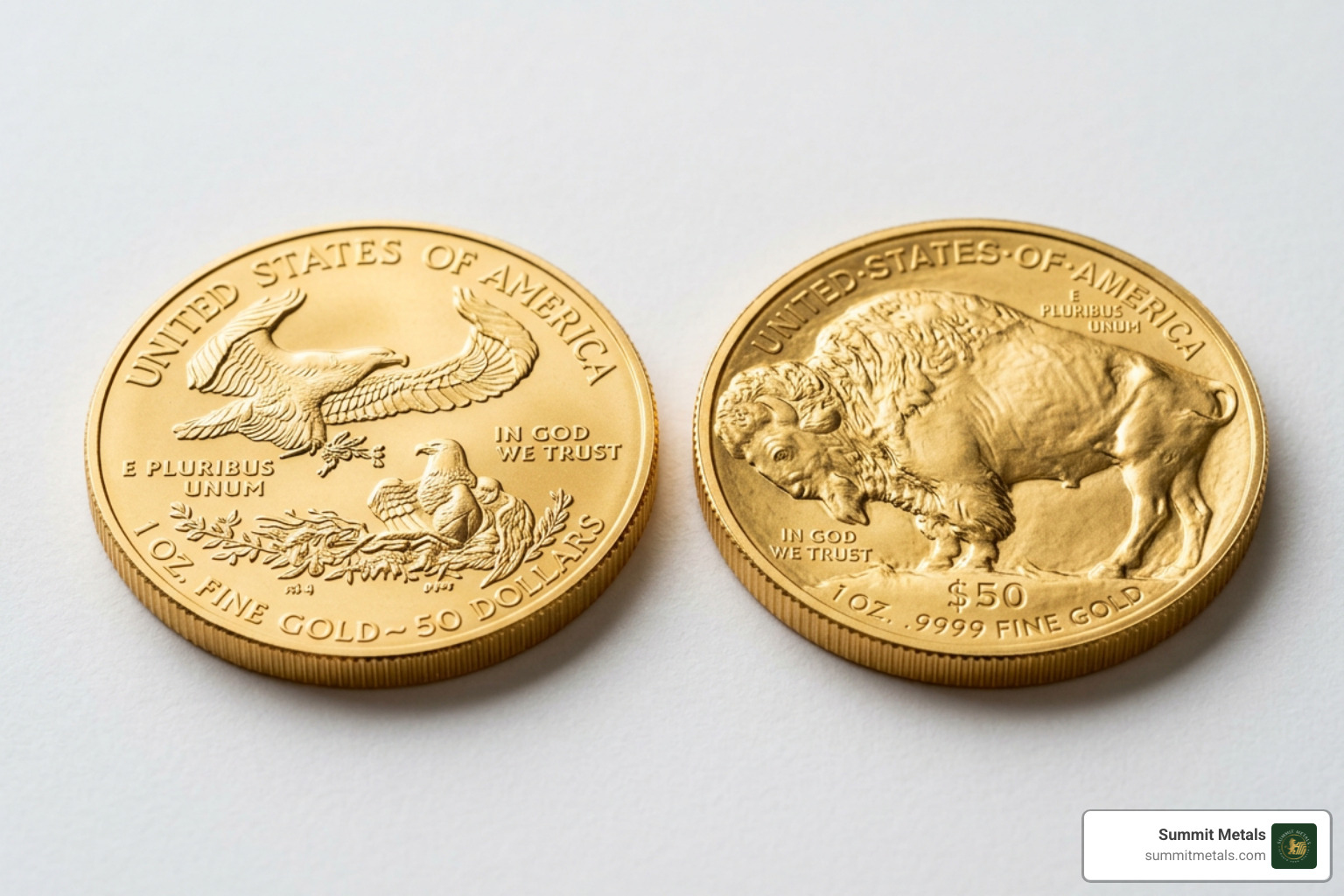
Gold coins like the American Gold Eagle or the Canadian Maple Leaf are legal tender. This provides an extra layer of security because tampering with government currency carries much harsher penalties than faking a private bar. However, bars usually offer a lower price per gram because they are simpler to manufacture.
Check out the Gold Price Today in USA Per Gram to see which option fits your current budget.
Fractional Gold and Small Gram Bars
You don't need $5,000 to start investing. Fractional gold—units like 1-gram, 5-gram, or 10-gram bars—allows you to "stack" gold over time. While the percentage premium is higher on a 1-gram bar than a 1-kilo bar, the total dollar amount is accessible for almost anyone.
Small bars are highly liquid and easy to trade or sell in small increments if you need quick cash. For those looking at larger entry points, we analyze the Golden Opportunity: Price of 250 Gram Gold to show how premiums drop as you buy in bulk.
Building Wealth with Autoinvest and Smart Exit Strategies
At Summit Metals, we believe the best way to build wealth isn't by "timing the market," but by "time in the market." That’s why we promote our Autoinvest program.
Just like a 401k, Autoinvest allows you to set up monthly purchases of gold or silver. This utilizes Dollar Cost Averaging (DCA). When the daily gold gram price is low, your monthly payment buys more gold. When the price is high, it buys less. Over time, this smooths out volatility and lowers your average cost basis. It’s the ultimate "set it and forget it" strategy for wealth preservation. You can find More info about Autopays services on our dedicated page.
Understanding your Asset Allocation is key to long-term success. Gold shouldn't be your only investment, but it should be the foundation that protects the rest of your portfolio.
Planning Your Exit with Private Vaulting and Liquidity
An investment is only as good as your ability to sell it. Many people buy gold but forget to plan their "exit strategy." We recommend considering private storage solutions that keep your gold liquid.
When you're ready to sell, Summit Metals offers a transparent "Sell to Us" program. We don't just sell you the metal; we provide a guaranteed buy-back market. By storing your gold in a secure, private vault, you can often sell it back to us instantly without the hassle of shipping or local security risks.
Strategic market timing is great, but having a reliable partner ensures you get a fair price based on the actual daily gold gram price at the moment of sale. Learn how to master your history and future gains in Yesterdays Prices Tomorrows Gains and see our Sell to us for easy exit page for more details.
Frequently Asked Questions about Gold Gram Pricing
How is the daily gold gram price determined?
It is derived from the global spot price per troy ounce (set by LBMA and COMEX) divided by 31.1035. This base rate fluctuates second-by-second during market hours based on global economic news, currency shifts, and supply/demand.
Why is the price per gram higher than the spot price?
When you buy physical gold, you pay a "premium." This covers the cost of refining the raw gold, minting the bar or coin, insurance, shipping, and a small dealer margin. Smaller units (like 1-gram bars) have higher premiums because the manufacturing cost is nearly the same as a larger bar, but spread over less gold.
Is it better to buy gold in grams or ounces?
It depends on your budget. Ounces (or kilos) offer the lowest premium per gram, making them better for large-scale wealth preservation. Grams are better for accessibility, monthly investing (DCA), and "barter-ability" in extreme economic scenarios.
Conclusion
Navigating the daily gold gram price doesn't have to be a headache. Whether you are looking to buy a single gram to start your journey or a 100-gram bar to anchor your retirement, the key is transparency and trust.
Based in Wyoming with a presence in Salt Lake City, Utah, Summit Metals is dedicated to providing authenticated gold and silver with real-time, honest pricing. Our bulk purchasing power allows us to pass competitive rates directly to you, ensuring you get more gold for every dollar invested.
Don't let market volatility scare you—let it be your opportunity. Start buying gold today and take control of your financial future with a partner who values your wealth as much as you do.