Why the Daily Gold Price per Gram Matters for Every Investor

Tracking the daily gold price per gram is one of the smartest habits any investor can build — whether you're buying your first gram or managing a significant metals portfolio. At the time of this publication, gold is trading in the range of $144.99 to $148.98 per gram (24K), depending on the source and moment of measurement.
Quick Answer: What Is the Daily Gold Price per Gram Right Now?
| Unit | Approximate Price (USD) |
|---|---|
| 1 gram (24K spot) | ~$146 – $149 |
| 1 troy ounce (31.1g) | ~$4,531 – $4,630 |
| 1 kilogram | ~$144,988 – $148,342 |
| 22K per gram | ~$133 – $137 |
| 18K per gram | ~$102 – $112 |
Prices shown are at the time of this publication and update continuously during market hours.
Gold prices move every minute. They respond to inflation data, central bank decisions, geopolitical tensions, and shifts in the US dollar. If you're not watching the daily rate, you could be buying — or selling — at the wrong moment.
The good news? You don't need to be a Wall Street analyst to track gold prices intelligently. You just need to understand what moves the number and where to watch it.
I'm Eric Roach — former investment banker and M&A advisor who has guided clients through multi-billion-dollar deals before turning my focus to helping everyday investors use physical gold as a wealth-preservation tool. My background tracking macro market cycles and hedging strategies gives me a unique edge when it comes to explaining the daily gold price per gram in a way that's both accurate and actionable. Let's break down exactly what you need to know to stay ahead of the market.
Important daily gold price gram terms:
Understanding the Daily Gold Price per Gram and How It’s Calculated
If you’ve ever looked at a financial news ticker, you’ve likely seen gold quoted in "troy ounces." But for the modern investor — especially those of us looking at fractional bars or jewelry — the daily gold price per gram is a much more practical metric.
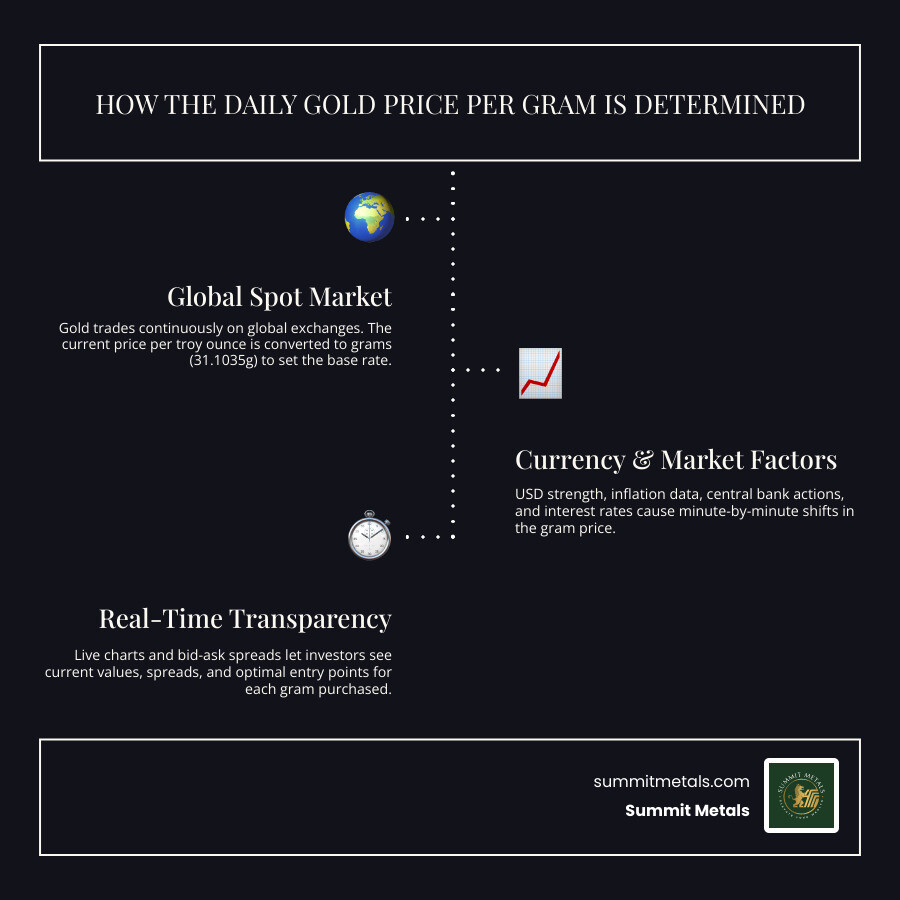
So, how do we get that number? The "spot price" of gold is the current market rate at which gold can be bought and sold for immediate delivery. This price is primarily driven by the COMEX (Commodity Exchange) in Chicago and the LBMA (London Bullion Market Association). Because the global standard for these exchanges is the troy ounce, we have to do a little math to find the gram rate.
A troy ounce is exactly 31.1035 grams. To find the live price per gram, you simply take the current spot price per ounce and divide it by 31.1035. For example, if the spot price is $4,552.70, the math looks like this:
- $4,552.70 / 31.1035 = $146.37 per gram.
At Summit Metals, we believe in total transparency. We use real-time data feeds to ensure that when you look at our Gold Price Calculator, you are seeing the most accurate reflection of the global market.
It is also vital to remember that gold is globally denominated in US Dollars (USD). When the dollar is strong, gold often appears cheaper to US investors but more expensive for those using Euros or Yen. Conversely, when the dollar weakens, the daily gold price per gram in USD often climbs as investors seek a "safe haven." You can check external benchmarks like Gold Price per Gram to see how these prices fluctuate across different currencies.
Tracking the daily gold price gram for Optimal Entry
Timing the market is a fool’s errand if you’re trying to catch the absolute bottom, but tracking the daily gold price per gram can help you identify "optimal entry points." This means looking for periods of consolidation or slight pullbacks before adding to your position.
When you look at Gold Price Today Live Gold Price Chart Historical Data, you’ll notice two specific prices: the Bid and the Ask.
- The Bid Price: This is the highest price a buyer (like a dealer) is willing to pay for your gold.
- The Ask Price: This is the lowest price a seller is willing to accept.
The difference between these two is the "spread." As an investor, you want to track these daily to understand the market's liquidity. If the spread is narrow, the market is highly active. If it widens, it might signal volatility. By watching live charts, you can see if gold is hitting "support" levels (prices where it historically stops falling) or "resistance" levels (prices where it struggles to climb higher).
Key Factors Influencing the daily gold price gram Fluctuations
Why did gold jump $2.00 per gram overnight? It’s rarely just one thing. Gold is the ultimate economic barometer. Here are the primary drivers we track at Summit Metals to keep our clients informed:
- Inflation and Interest Rates: Gold is a classic hedge against inflation. When the cost of living goes up, the purchasing power of the dollar goes down, often driving the daily gold price per gram higher. However, keep an eye on the Federal Reserve. If they raise interest rates, gold (which pays no interest) can sometimes face pressure as investors move toward bonds.
- Geopolitical Stability: Gold loves a crisis. Whether it's trade wars, elections, or international conflict, uncertainty drives people toward "hard assets." We saw this clearly in early 2026 when tariff uncertainties caused gold to spike toward record highs.
- Central Bank Demand: Central banks in China, India, and Turkey have been massive buyers of gold recently. When a central bank decides to diversify its reserves away from the dollar, they buy in such large quantities that it can shift the global spot price significantly.
- The US Dollar Index (DXY): There is an inverse relationship here. Because gold is priced in dollars, a "strong" dollar makes gold more expensive for international buyers, which can dampen demand and lower the price.
To stay updated on these macro shifts, we recommend following our guide on Gold Price Today in USA Per Gram. For those looking further ahead, our 2026 Gold Price Per Gram Forecast Guide provides expert insights into where the market might be headed by the end of the year.
Comparing Purity: Why Investment-Grade 24k Leads the Market
Not all gold is created equal. If you’re tracking the daily gold price per gram for investment purposes, you are almost always looking at 24k gold.
24k gold is 99.9% (or higher) pure. It is the "investment-grade" standard. Because it contains virtually no alloy metals (like copper or silver), its value is tied directly to the live spot price. When we talk about the "melt value" of a coin or bar, we are referring to the value of the raw gold content.
Jewelry, on the other hand, is usually 14k or 18k. While beautiful, jewelry carries a massive "retail markup" for craftsmanship and branding that has nothing to do with the gold’s weight. For a deeper dive into why purity matters, check out our 24k Gold Value Per Gram Complete Guide.
Investment-Grade Gold vs. Lower-Carat Jewelry
For wealth preservation, bullion (bars and coins) is vastly superior to jewelry. Here is why: when you buy a 14k gold ring, you are only getting about 58.3% gold. The rest is filler. When you go to sell that ring, a dealer will only pay you for the 58.3% gold content — and they’ll likely pay you below the spot price because they have to refine it.
| Karat | Gold Purity | Best Use | Resale Value |
|---|---|---|---|
| 24k | 99.9% | Investment/Bullion | High (linked to spot) |
| 22k | 91.7% | Investment Coins (e.g., Eagles) | High |
| 18k | 75.0% | High-end Jewelry | Moderate |
| 14k | 58.3% | Everyday Jewelry | Low (relative to purchase price) |
If you happen to hold 18k items, you can track their specific value using our 18kt Gold Price Per Gram Complete Guide. However, for those serious about stacking ounces, 24k is the only way to go.
Choosing Your Asset: Gold Coins vs. Gold Bars
Once you’ve mastered the daily gold price per gram, the next question is: What should I actually buy? The two main choices are coins and bars.

At Summit Metals, we often suggest that new investors consider the unique benefits of gold coins. While bars often have slightly lower premiums (the cost over spot), coins offer a layer of security that bars don't: Legal Tender Status.
| Feature | Gold Coins (Sovereign) | Gold Bars (Minted) |
|---|---|---|
| Premiums | Slightly Higher | Lower |
| Legal Tender | Yes (Face Value) | No |
| Fraud Protection | High (Government backed) | Moderate |
| Liquidity | Extremely High | High |
| Recognition | Global | Global (if recognized brand) |
Sovereign coins, like the American Gold Eagle or the Canadian Maple Leaf, are produced by government mints. They have a face value (e.g., $50), which means they are technically money. This provides enhanced protection against counterfeiting, as faking government currency carries much harsher penalties than faking a private bar. Furthermore, coins are often easier to sell in small quantities.
Whether you choose coins or bars, the underlying value will always be dictated by the Spot Price Gold Oz divided down to the gram.
Building Wealth with a daily gold price gram Strategy
Physical gold isn't just a "doomsday" asset; it’s a volatility dampener. Over the last 20 years, gold has seen a performance increase of over 590%. By keeping a portion of your wealth in gold, you ensure that even if the stock market takes a dive, your "hard assets" are there to hold the line.
The key to a successful gold strategy is consistency. Instead of trying to "all-in" when you think the price is low, savvy investors use the daily gold price per gram to scale into positions over time. This brings us to a powerful tool we offer at Summit Metals.
Using Autoinvest for Long-Term Stability
Most people are familiar with a 401k or a Roth IRA where they contribute a set amount of money every month regardless of what the market is doing. This is called Dollar Cost Averaging (DCA).
We’ve brought this same philosophy to the precious metals world with our Autoinvest program. Instead of stressing over whether the daily gold price per gram is up or down $0.50 today, you can set a monthly budget to shop for gold.
- How it works: You decide on a monthly amount (e.g., $200).
- The Benefit: When prices are lower, your $200 buys more grams. When prices are higher, it buys fewer. Over time, this lowers your average cost per gram and removes the emotional "fear of missing out."
It’s the ultimate "set it and forget it" strategy for building real, tangible wealth. You can Start your Autoinvest subscription today and begin building your private reserve. For more on how real-time pricing affects your purchases, see our guide on Real Time Precious Metals Prices.
Planning Your Exit: Liquidity and Private Vault Storage
Buying gold is only half the battle; you also need a plan for when it’s time to turn that gold back into cash. This is where many investors get stuck. If you store your gold in a shoebox under the bed, selling it might involve a trip to a local pawn shop where you’ll likely get "fleeced" on the price.
At Summit Metals, we offer a "Sell to Us" advantage. Because we maintain high-volume trading, we are always in the market to buy back authenticated metals at competitive rates.
Pro-Tip: Use Private Vault Storage To maximize your liquidity, consider using our private vault storage options. When your gold is held in a secure, insured, third-party vault:
- It stays "In Chain": The gold never leaves a professional environment, meaning it doesn't need to be re-assayed (tested) when you sell it.
- Instant Liquidity: You can sell your holdings back to us with a click or a phone call, and the funds can be wired to you immediately. No shipping, no insurance hassles, no waiting.
Understanding how to Unlock Today's Gold and Silver Value is essential for any long-term exit strategy.
Frequently Asked Questions about Gold Gram Prices
How is the spot price of gold determined?
The spot price is a "paper" price derived from the futures markets (COMEX). It represents the consensus of thousands of traders globally on what one troy ounce of gold is worth for immediate delivery. This price updates every few seconds from Sunday evening through Friday afternoon.
What is the difference between bid and ask prices?
The Ask is what you pay to buy gold from a dealer. The Bid is what the dealer will pay you to buy it back. The "spread" between them covers the dealer's operating costs and market risk.
Why are retail prices higher than the spot price per gram?
You cannot buy a "digital" gram of gold and hold it in your hand. Physical gold requires mining, refining, assaying, minting, packaging, insuring, and shipping. These "fabrication costs" create a premium over the raw spot price. Generally, larger items (like 100g bars) have lower premiums per gram than small items (like 1g bars).
Can I sell my gold back to Summit Metals?
Yes! We pride ourselves on being a two-way market. Whether you bought from us or elsewhere, we provide transparent buy-back rates based on the daily gold price per gram.
Conclusion
At Summit Metals, based in our Wyoming headquarters, we are dedicated to providing the most transparent, real-time pricing in the industry. Our bulk purchasing power allows us to pass competitive rates directly to you, ensuring you get the most "metal for your money."
Whether you are visiting us in Salt Lake City, Utah, or managing your portfolio online, our goal is to make gold investing accessible, simple, and secure. Don't leave your financial future to chance or the whims of a fluctuating dollar. By tracking the daily gold price per gram and utilizing tools like our DCA-focused Autoinvest, you can build a golden safety net that lasts for generations.
Ready to take control? Start your Autoinvest subscription today and stay golden.