What Is a Precious Metals Reserve Program — and Why It Matters for Your Wealth
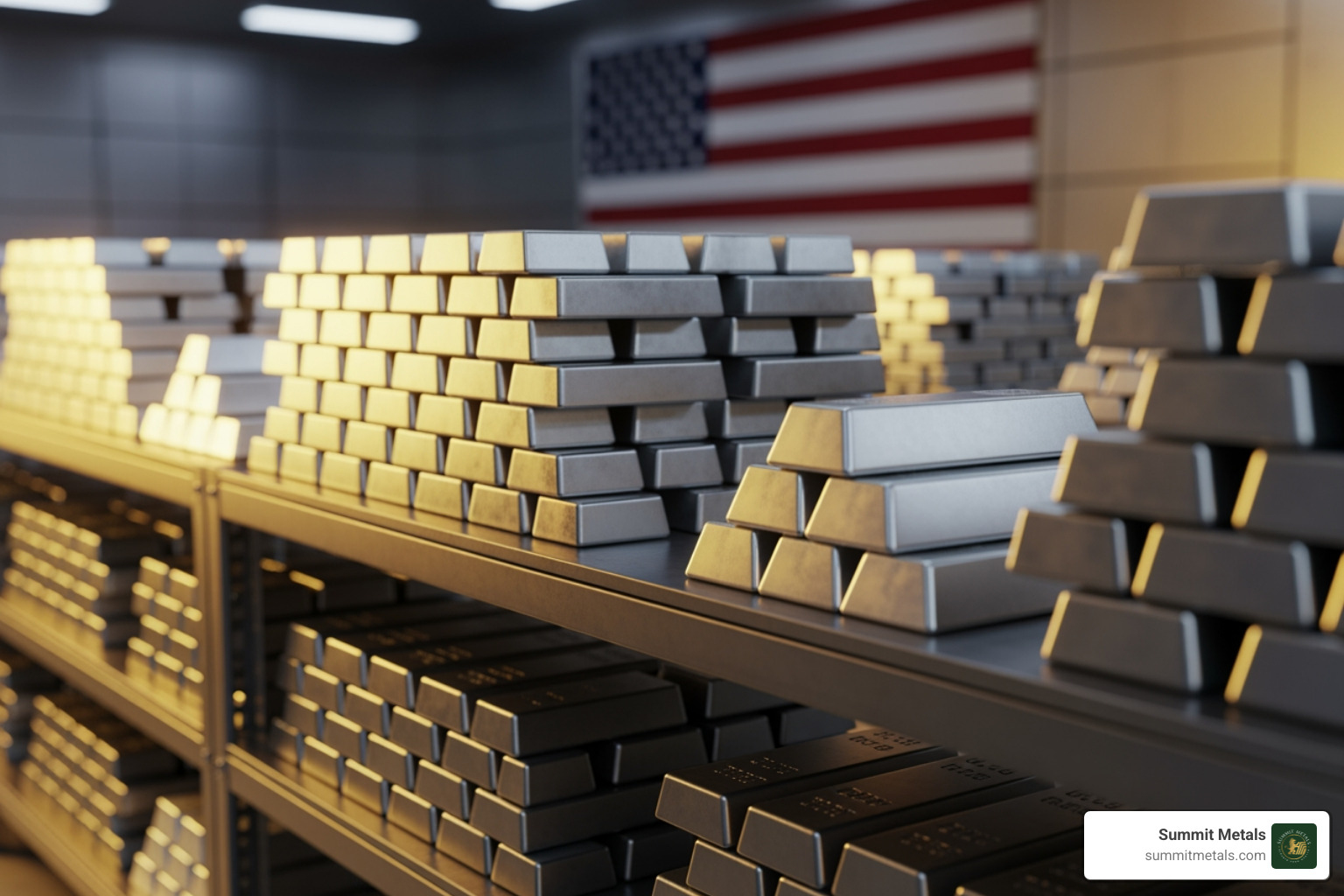
A precious metals reserve program is a structured system for acquiring, storing, and managing physical precious metals — like gold, silver, platinum, and palladium — to protect economic stability, national security, or personal wealth.
Here's a quick breakdown of who runs these programs and why:
| Type | Who Runs It | Primary Goal |
|---|---|---|
| National Reserve | U.S. Treasury / Federal Reserve | Monetary stability, international finance |
| Strategic/Defense Reserve | DoD, EXIM Bank (Project Vault) | Supply chain security, critical minerals |
| State-Level Depository | Texas Bullion Depository | Sovereign storage, public alternative to NYC vaults |
| Recovery Program | DoD PMRP via DLA | Reclaim metals from e-waste, reduce procurement costs |
| Personal Reserve | Individual investors | Wealth protection, inflation hedging, portfolio diversification |
These programs exist because precious metals hold value when paper currencies don't. The U.S. currently holds nearly 8,134 metric tons of gold — the largest national gold reserve in the world. Yet even at that scale, the official accounting value sits at just $42.22 per fine troy ounce, a figure frozen in time since the 1930s. The market tells a very different story.
Whether you're a government protecting a currency system or an individual protecting a retirement account, the core logic is the same: hard assets provide a floor when financial systems shake.
I'm Eric Roach, a former Wall Street investment banker and M&A advisor who has guided Fortune 500 clients through complex hedging programs — experience I now apply directly to helping everyday investors build their own precious metals reserve program through physical gold and silver. In the sections ahead, I'll walk you through how these programs work at every level, from federal policy to your personal portfolio.
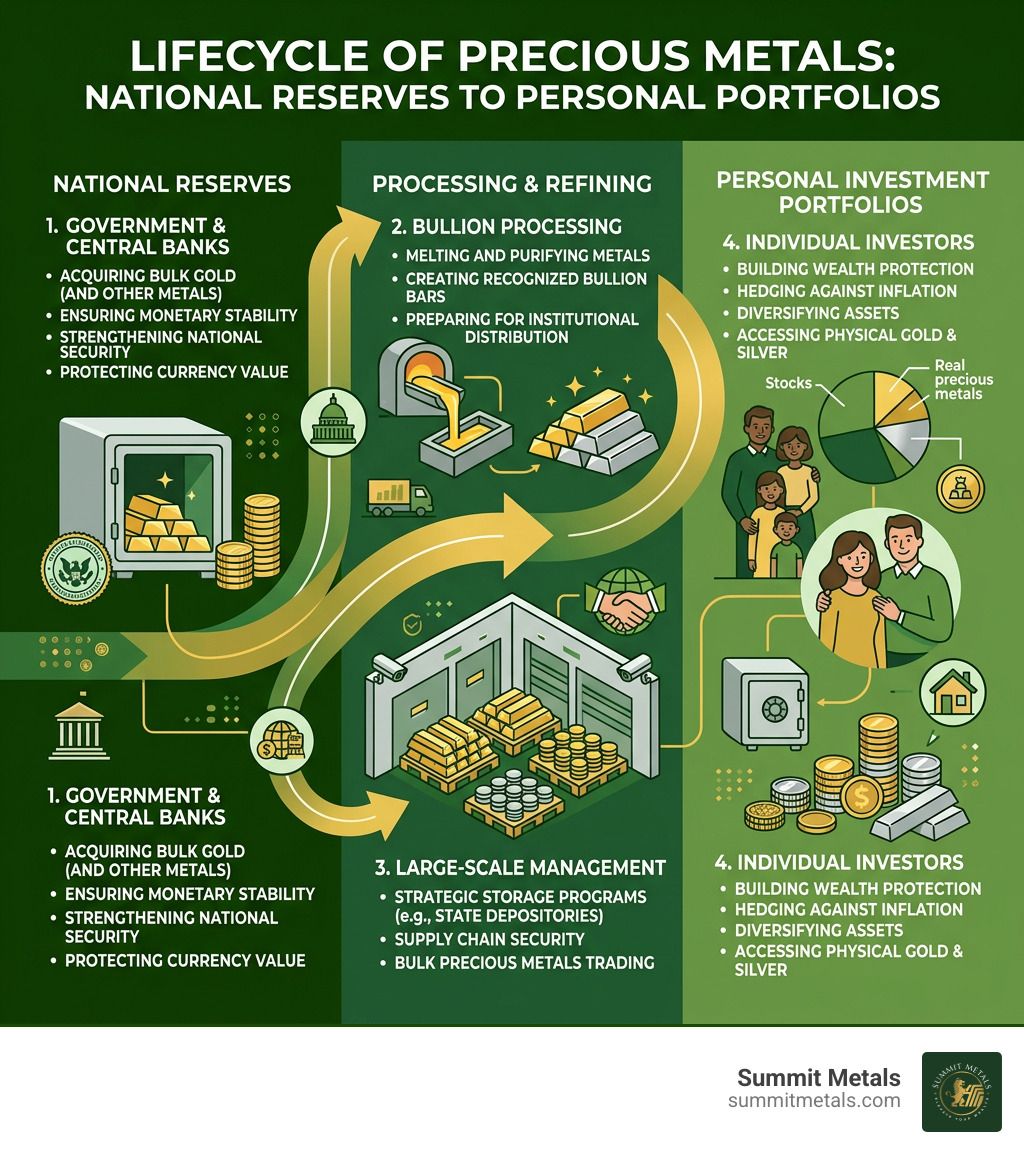
Precious metals reserve program terms you need:
Defining the Precious Metals Reserve Program: National and Strategic Objectives

At its heart, a precious metals reserve program isn't just a fancy vault filled with shiny objects; it’s a strategic insurance policy for a nation's economy. While we often think of gold as something for jewelry or individual investment, central banks view it as a pillar of the global monetary system.
According to The Fed - U.S. Reserve Assets, February 2026, the U.S. gold stock is valued for accounting purposes at $11,041 million. If that number sounds low, it’s because the government still values it at that historical $42.22 per ounce rate. If they used today's market prices, the value would be hundreds of billions higher. This massive reserve acts as a "backstop," providing confidence to international markets that the U.S. can meet its financial obligations even in extreme crises.
For those of us looking to mirror this stability in our own lives, our Precious Metals Investment Guide explains how these same principles apply to personal wealth. Just as a nation diversifies its reserves to include foreign currencies and Special Drawing Rights (SDRs), a smart investor diversifies to ensure they aren't overly exposed to a single asset class.
Strategic National Reserves vs. Recovery Initiatives
There is a major difference between holding a pile of gold and actively "recovering" it. National reserves are generally static—they sit in places like Fort Knox or West Point, serving as a long-term store of value. You can explore more about these global holdings in Beyond Fort Knox: A Look at Global Bullion Reserves.
Recovery initiatives, on the other hand, are proactive. They focus on "resource optimization"—the idea that we shouldn't just mine new metals, but reclaim what we already have. For example, the Department of Defense (DoD) doesn't want to pay full market price for the silver used in high-tech sensors if they can pull it out of old circuit boards. These recovery programs are about economic competitiveness and supply chain resilience, ensuring that even if foreign mines shut down, we have a domestic "mine" in the form of recycled materials.
The Role of Critical Minerals in Modern Defense
In the 21st century, the definition of a "strategic reserve" has expanded. It’s no longer just about gold and silver. We are now in a race for critical minerals like lithium, cobalt, and rare earth elements. These are the "new" precious metals because they power everything from AI and robotics to the batteries in our autonomous devices.
The 2026 Critical Minerals Ministerial highlighted how the U.S., along with 54 other partners, is reshaping the global market. One of the boldest moves is "Project Vault," an initiative by the Export-Import Bank of the United States (EXIM) to establish a domestic strategic reserve for critical minerals. With a $10 billion direct loan, Project Vault aims to ensure that the U.S. isn't held hostage by concentrated global markets that use minerals as tools of political coercion.
Historical Evolution of U.S. Precious Metals Control
To understand why a precious metals reserve program is so important today, we have to look back at the 1930s—a time when the government decided that private citizens holding too much gold was a threat to national stability.
The Gold Reserve Act 1934 was a watershed moment. It transferred ownership of all gold held by the Federal Reserve to the U.S. Treasury. This wasn't just a change in paperwork; it was a total centralization of the nation's "hard" wealth. You can read more about this transition in A Brief History of Gold as Currency and Store of Value.
The Nationalization of Gold and Silver in 1934
Most people have heard of Executive Order 6102, which effectively "confiscated" gold from American citizens in 1933. But fewer people realize that silver had its own "surrender mandate" just a year later.
Executive Order 6814 nationalized domestically mined silver and privately owned silver bullion. The government gave holders 90 days to deliver their silver to the Treasury. Within that window, 109 million ounces were turned in. Why? Because the government needed silver to strike coins and expand the money supply.
The difference between the two was fascinating:
- Gold: Holders were paid $20.67 an ounce, only to see the government revalue it to $35 shortly after. That’s a 70% devaluation of the dollar overnight.
- Silver: Holders were paid 50 cents an ounce. While still a forced sale, silver holders actually fared better over the long term because the devaluation of the silver dollar took nearly 17 years to catch up to the market price.
At Summit Metals, we believe The Real Deal: Demystifying Physical Precious Metals is understanding that these historical events prove one thing: when things get tough, governments value physical metal above all else.
From Stockpiles to Bullion: The Gold Bullion Coin Act of 1985
Fast forward to 1985, and the tide had turned. Instead of taking gold away, the government wanted to get back into the game of selling it. The Gold Bullion Coin Act of 1985 led to the creation of the American Gold Eagle, now the world's most popular gold bullion coin.
This Act was genius for two reasons:
- It required that all gold used for the coins be mined from natural deposits in the U.S. (supporting the domestic mining industry).
- It required that the "profit" (the difference between the cost of the gold and the sale price of the coin) be used to reduce the national debt.
This program proved so successful that when demand skyrocketed in 2009, the Mint actually had to cancel the proof versions of the coins because the law required them to prioritize the bullion version for public "reserve" needs. If you're looking at silver instead, check out Unlock Your IRA: The Definitive Guide to American Silver Eagle Eligibility.
Modern Federal Initiatives and the DoD Precious Metal Recovery Program (PMRP)
While the Treasury manages the gold bars, the Department of Defense (DoD) manages the "scrap." The DoD Precious Metal Recovery Program (PMRP) is a fascinating, self-funded initiative that saves taxpayers millions.
Managed by the Defense Logistics Agency (DLA), the PMRP identifies precious metals in everything from F-22 exterior paint and silver batteries to old X-ray film and dental scrap. Instead of throwing these items away, the DLA recovers the gold, silver, platinum, and palladium.
The benefit is massive: DoD components can order precious metals through the DLA at greater than half the cost of market prices. For a major defense contractor or a military branch, that’s an incredible "wholesale" deal. We discuss similar concepts of scale in Wholesale Wonders: How to Buy Precious Metals in Bulk.
Characteristics of an Effective Precious Metals Recovery Program
If you're looking to evaluate a recovery program—whether it's a government one or a commercial one—there are five key traits to look for, as outlined in the Strong PM Recovery Program documentation:
- Transparency: You should be able to witness the weighing and sampling.
- Reliability: The vendor should be established (publicly traded companies with independent auditors are often best).
- Certified Compliance: Look for R2, ISO 14001, and ITAR certifications.
- Flexibility: They should offer multiple settlement options (pool accounts, physical return, or cash).
- Efficiency: High-tech processing that can handle complex e-waste like printed circuit boards.
For more technical details on how the military manages these assets throughout an item's lifecycle, the Defense Acquisition University (DAU) ACQuipedia for PMRP is the go-to resource.
Securing the Future: Project Vault and the $10 Billion Strategic Reserve
As mentioned earlier, the U.S. is moving aggressively to secure "Project Vault." This isn't just about stockpiling; it's about reshaping the market. The Action Plan on Critical Minerals involves coordinating with Mexico, the EU, and Japan to mitigate supply chain vulnerabilities.
With over $30 billion in government support mobilized in just six months, the U.S. is signaling that "strategic reserves" are the cornerstone of future economic security.
State-Level Innovation and Private Storage Solutions
While the federal government is busy with global diplomacy, states are taking matters into their own hands. Texas and Utah are leading the charge in creating localized precious metals reserve program models.
The Texas Bullion Depository, established by HB 483, was the first state-administered bullion depository in the nation. Why did they do it? Because entities like the University of Texas/Texas A&M Investment Management Company (UTIMCO) were tired of paying $606,000 a year to store their $861 million in gold in New York City vaults. They wanted a secure, sovereign "Texas-sized" alternative.
For individual investors, these state-level initiatives provide a blueprint for Storing Your Shine: A Guide to IRS-Approved Precious Metals Depositories.
The Texas Bullion Depository and State Sovereignty
The Texas model is a public-private partnership. The state (via the Comptroller) provides oversight, while a private entity (Lone Star Tangible Assets) handles the day-to-day operations. This ensures that no taxpayer dollars are used, but customers get the security of government protection.
It’s a "non-bank" facility, meaning it’s not part of the traditional banking system that many investors are trying to avoid. You can learn more at the Texas Bullion Depository Website.
Utah and the Expansion of Legal Tender Laws
Our friends in Utah—where Summit Metals has a footprint in Salt Lake City—are even more progressive. Utah was the first state to approve gold and silver as legal tender for payments to state vendors.
According to the 2024 Precious Metals Study - Utah State Treasurer, the state is actively exploring how to integrate precious metals into its broader financial infrastructure. This makes a Gold IRA Approved Depository in a state like Utah or Wyoming particularly attractive for those looking for "safe haven" storage.
Establishing a Personal Precious Metals Reserve Program for Wealth Protection
You don't need a $10 billion loan from the EXIM bank to start your own precious metals reserve program. In fact, building a personal reserve is one of the most effective ways to protect your family's future.
The key is consistency. Many investors make the mistake of trying to "time the market." Instead, we recommend The Strategic Approaches to Investing in Gold and Silver, specifically Dollar-Cost Averaging (DCA).
Autoinvest: Building Your Reserve with Dollar-Cost Averaging
At Summit Metals, we’ve made this easy with our Autoinvest program. Think of it like a 401(k) for physical metal. You decide on a monthly amount, and we automatically shop for you at our competitive bulk rates.
- Set it and forget it: No more stressing over daily spot price fluctuations.
- Accumulate wealth: Over time, you build a significant reserve without feeling the "pinch" of a single large purchase.
- Discipline: It builds the habit of saving in "real money" rather than just letting fiat currency sit in a low-interest bank account.
Check out Automated Investing: Building Better Financial Habits for the Future to see how this can transform your portfolio.
Gold Coins vs. Gold Bars: Which Belongs in Your Reserve?
When building your reserve, you need to choose the right "format." Here is a quick comparison to help you decide:
| Feature | Gold Coins (e.g., American Eagle) | Gold Bars |
|---|---|---|
| Face Value | Yes (e.g., $50) | No |
| Fraud Protection | High (Federal counterfeiting laws apply) | Moderate |
| Liquidity | Extremely High (Recognized worldwide) | High |
| Premiums | Slightly Higher | Lower |
| Legal Tender | Yes | No |
Our Take: For a personal precious metals reserve program, we often recommend coins. The face value provides an extra layer of legal protection, and their instant recognizability makes them much easier to sell when you need cash quickly.
Exit Strategies and Liquidity: The "Sell to Us" Advantage
A reserve is only useful if you can access its value when you need it. That’s why your exit strategy is just as important as your acquisition strategy.
We promote a "Sell to Us" focus. When you store your metals in a private, IRS-approved vault through us, your assets remain highly liquid. You don't have to worry about shipping heavy boxes or finding a local buyer who might lowball you. With a simple phone call, you can sell your holdings back to us at current market rates, and the funds are often available immediately.
From the moment you make your Physical Gold Purchase, you should have a clear path to liquidity.
Frequently Asked Questions about Precious Metals Reserve Programs
What is the primary purpose of the DoD Precious Metal Recovery Program (PMRP)?
The PMRP’s primary goal is to save the government money by recovering precious metals from military scrap and e-waste. This reclaimed metal is then reused in defense manufacturing, allowing the DoD to acquire essential materials at significantly lower costs than market prices.
How does the Texas Bullion Depository differ from traditional bank storage?
Unlike a bank, which may use your deposits for lending (fractional reserve banking), the Texas Bullion Depository is a "bailment" facility. This means you own the specific physical bars or coins you deposit. It is also a state-overseen, non-bank entity, providing a layer of sovereign protection and distance from the traditional financial system.
Can individuals participate in a precious metals reserve program for retirement?
Absolutely. By using a Self-Directed IRA (SDIRA), you can hold physical gold and silver as part of your retirement "reserve." This allows you to gain the tax advantages of an IRA while holding the security of physical assets.
Conclusion
Whether it’s the U.S. government stockpiling gold to stabilize the dollar or the DoD recycling circuit boards to save on sensor costs, the message is clear: a precious metals reserve program is essential for long-term security.
At Summit Metals, we bring that same level of strategic thinking to your personal finances. Based in Wyoming with deep roots in Salt Lake City, Utah, we provide the transparent, real-time pricing and bulk-purchasing power you need to build a reserve that lasts.
Don't wait for the next economic crisis to start thinking about your "hard asset" floor. Explore Why Central Banks Buy Gold and Why You Should Too and start building your personal reserve with us today.