Why Buying and Selling Metals Belongs in Every Investor's Playbook

Buying and selling metals is one of the oldest and mostirable ways to protect and grow wealth — and it's more accessible today than ever before.
Here's a quick snapshot of what you need to know:
| Step | What It Means |
|---|---|
| Check the spot price | The live market price per troy ounce — your baseline for any baseline for any deal |
| Know your metal | Gold, silver, platinum, and palladium each have different price drivers |
| Choose your format | Coins, bars, or scrap — each affects your buy and sell price differently |
| Pick a trusted dealer | Look for transparent pricing, verified reviews, and clear buyback policies |
| Plan your exit | Before you buy, know how and where you'll sell when the time comes |
Gold and silver have held real value for thousands of years. Unlike cash, governments can't print more of them. And unlike stocks, you can hold them in your hand.
But here's what most guides skip: knowing how to buy is only half the equation. The other half — your exit strategy — determines whether you actually profit.
Whether you're a first-time buyer or looking to liquidate an existing position, this guide walks you through every step. From reading spot prices to choosing the right coins or bars, from storing your metals securely to selling them for maximum value.
I'm Eric Roach — a former Wall Street investment banker and M&A advisor who has spent over a decade helping everyday investors navigate buying and selling metals with the same disciplined strategies used by Fortune 500 companies. Let's make sure your metals work as hard as you do.
The Fundamentals of Buying and Selling Metals
Before you dive headfirst into bullion, we need to cover the "alphabet" of the industry. Understanding the language of buying and selling metals ensures you don't overpay when entering the market or get shortchanged when you leave it.
At the heart of every transaction is the spot price. This is the current market price at which a metal is bought or sold for immediate delivery. It fluctuates 24/7, driven by global exchanges. However, you rarely buy or sell exactly at spot. Dealers add a "premium" to the buy price to cover their costs and subtract a small margin when they buy it back from you.
Precious metals are measured in troy ounces, which are slightly heavier than the standard ounces you use at the grocery store (31.1 grams vs. 28.3 grams). Purity is equally vital; for investment-grade gold, you generally look for .999 or .9999 fineness.
One of the biggest decisions you'll face is choosing between coins and bars. While bars often have lower premiums, coins offer unique protections.
Gold Coins vs. Gold Bars: Which Is Right for You?
| Feature | Gold Coins (Government Minted) | Gold Bars (Private/LBMA Mints) |
|---|---|---|
| Premium | Usually higher due to intricate design | Usually lower; better for bulk weight |
| Legal Tender | Have a face value (e.g., $50) | No face value; valued only by weight |
| Fraud Protection | Counterfeiting a coin is a federal crime | Easier to replicate without legal teeth |
| Liquidity | Highly recognizable worldwide | Requires verification of the refiner |
| Best For | New investors and portability | Large-scale investors seeking low cost |
As we discuss in our guide on Spot Price vs. Premium: How Precious Metals Pricing Works, understanding these nuances is the difference between a "good deal" and a "great investment."

Understanding Market Drivers in Buying and Selling Metals
Why does the price of silver jump one day and gold dip the next? It isn't random. Several "gears" turn the market:
- Inflation: When the dollar loses purchasing power, metals historically retain theirs. They are the ultimate "anti-dollar."
- Geopolitical Events: In times of war or political instability, investors flock to "safe-haven" assets.
- Industrial Demand: This is huge for silver, platinum, and palladium. About 80% of global palladium is used in catalytic converters for cars. If the auto industry booms, palladium often follows.
- Central Bank Reserves: The United States holds the world's largest gold reserves (8,133.5 tons as of August 2024). When central banks buy more, it signals massive confidence in the metal.
Key Factors for Authenticity and Value
When buying and selling metals, "trust but verify" is the golden rule. Look for hallmarks—stamps on the metal that indicate the refiner, weight, and purity. For bars, the LBMA (London Bullion Market Association) standard is the "Good Delivery" seal of approval.
If you aren't sure what you have, assaying is the process of testing the metal to determine its ingredients and purity. We dive deeper into how to determine what your stash is worth in our article Unlocking Value: Understanding Gold and Silver's Current Worth.
Strategic Acquisition: How to Buy Smart
Smart buying isn't just about finding the lowest price; it's about finding the best value. While local shops in Salt Lake City offer the benefit of immediate possession, online platforms often provide better rates due to lower overhead and bulk purchasing power.
At Summit Metals, we leverage our Wyoming-based operations to offer transparent, real-time pricing. Because we buy in massive quantities, we pass those competitive rates directly to you.
To ensure you aren't walking into a trap, we recommend reading Smart Shopping: How to Purchase Precious Metals Safely.
Building Wealth with Summit Metals' AutoInvest and DCA
Most people think they need $10,000 to start buying and selling metals. We disagree. One of the most powerful tools in your arsenal is Dollar-Cost Averaging (DCA).
Through our AutoInvest program, you can set up a monthly subscription to buy gold or silver. It’s just like a 401k—you invest a set amount every month regardless of the price.
- When prices are low, your dollars buy more metal.
- When prices are high, you buy less, protecting you from "buying the top."
Over time, this smooths out market volatility and builds a massive "treasure chest" without the stress of timing the market. Learn more about this strategy in Buying & Selling Silver.
Choosing Between Bullion and Scrap Metal
Investment-grade bullion (coins and bars) is the cleanest way to invest, but don't overlook "hidden" gold. Scrap metal includes jewelry, dental gold, and silverware.
While bullion trades close to the spot price, scrap usually sells for a lower percentage because it must be melted and refined. However, if you have old rings or broken necklaces, you can Turn Trash to Treasure: How to Sell Your Scrap Gold and Silver to fund your next bullion purchase.
The Exit Strategy: Mastering the Process of Selling Metals
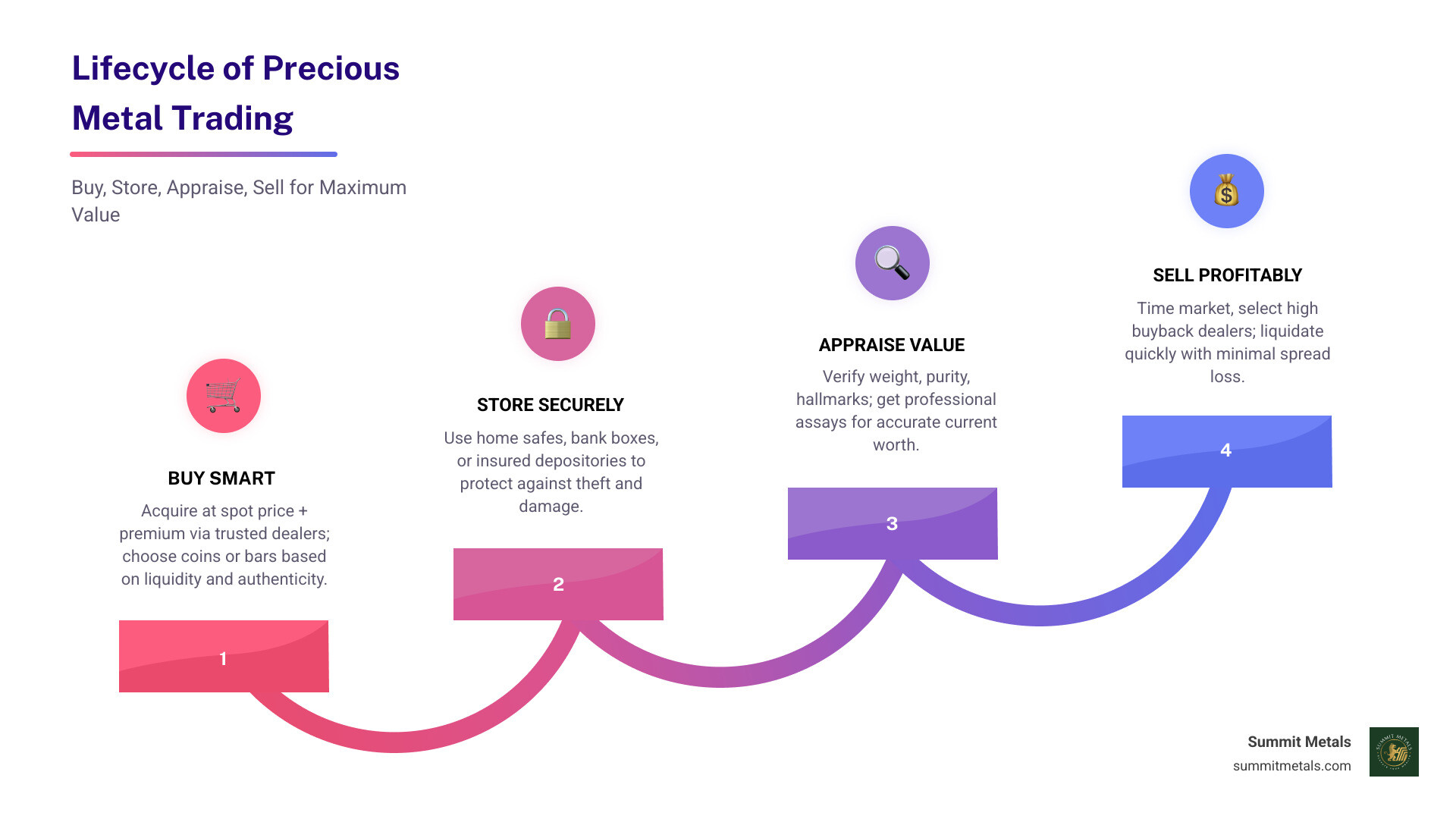
You haven't made a profit until you've sold. A common mistake is buying metal without knowing who will buy it back.
Maximizing Returns with Summit Metals' "Sell to Us" Programs
We don't just sell metals; we want to buy them back when you're ready to liquidate. Our "Sell to Us" program is designed for speed and security. Depending on the product and market conditions, buyback offers typically range from 90% to 107% of the spot price.
For example, 1 oz silver coins often command a premium above spot even when selling back to a dealer, whereas large bars might sell slightly below spot. We provide fully insured shipping and rapid payment—often within 24 hours of inspection. If you're asking, "Where Can I Sell My Gold Coins for Best Price?", the answer is usually a dealer who offers a transparent, guaranteed buyback.
Navigating Legal Limits and Anonymity in Buying and Selling Metals
Can you buy and sell anonymously? Yes, but there are rules. In the U.S., dealers are required to report certain large cash transactions (usually over $10,000) to the IRS via Form 8300 to comply with Anti-Money Laundering (AML) laws.
However, paying via bank wire or check for standard amounts is a routine, private process. Reputable dealers like us maintain strict privacy protocols to protect your data while staying fully compliant with federal law. For more on the "how-to" of the transaction, check out Mastering the Market: A Step-by-Step Guide to Gold and Silver Transactions.
Storage, Security, and Long-term Management
Once you own it, you have to protect it. You have three main options:
- Home Storage: A high-quality, bolted-down floor safe. Pros: Total control. Cons: Theft risk and insurance hurdles.
- Bank Safe Deposit Boxes: Pros: Secure. Cons: Not insured by the FDIC and only accessible during bank hours.
- Private Vault Storage: This is our recommended "pro" move. By storing your metals in a third-party depository, you get maximum security and insurance.
Pro Tip: If you store your metals in a private vault integrated with a dealer, selling becomes "one-click" easy. You don't have to ship the metal; you just sell the title, and the funds are wired to you. This is the ultimate liquidity strategy. Read more in our Decision Guide for Savvy Investors.
Professional Appraisals and Verification
If you inherit a collection or find scrap, you need a professional appraisal. This involves:
- Physical Examination: Checking for wear, tear, and mint marks.
- Weight Verification: Using "legal-for-trade" scales.
- Testing: Using XRF scanners or acid tests to verify purity without damaging the metal.
Frequently Asked Questions about Buying and Selling Metals
Why should I invest in precious metals instead of stocks?
Stocks represent a share in a company; precious metals represent an absolute store of value. Metals have no "counterparty risk"—they don't go bankrupt. They provide a low correlation to the stock market, a concept often discussed in Modern Portfolio Theory, meaning when stocks crash, metals often hold steady or rise.
What are the typical dealer minimums for transactions?
It varies wildly. Some large dealers have minimums of $5,000 to buy and $10,000 to sell. At Summit Metals, we focus on accessibility, though bulk purchasing always yields the best rates. (Prices shown are at the time of this publication.)
How do I safely ship metals for a sale?
Never use a box that rattles. Use "double-boxing"—place your metal in a small box, then place that box inside a larger one with plenty of padding. Use a shipping method that includes signature confirmation and high-value insurance.
Conclusion
Buying and selling metals doesn't have to be a "treasure hunt" filled with traps. By focusing on transparent pricing, understanding the difference between coins and bars, and utilizing modern tools like AutoInvest, you can build a portfolio that shines through any economic storm.
Whether you're looking to start a monthly silver habit or you're ready to liquidate a gold position for the best possible price, Summit Metals is here to help. Based in Wyoming with a presence in Salt Lake City, we bring Wall Street discipline to your personal vault.
Ready to see what your metals are worth? Sell to Us for Maximum Value and experience the Summit Metals difference.