The RBI Does Not Buy Your Old Coins - Here's What You Need to Know

The short answer for anyone searching for rbi old coin sell:
| Question | Answer |
|---|---|
| Does the RBI buy old coins from the public? | No. The RBI does not deal in buying or selling old coins or banknotes. |
| Has the RBI authorized any agent to do this? | No. No institution, firm, or person is authorized to collect fees on the RBI's behalf for such transactions. |
| Are offers claiming RBI involvement legitimate? | No. These are scams. The RBI has issued explicit public warnings against them. |
| Where can you actually sell old coins? | Certified dealers, reputable auction houses, and trusted precious metals buyers like Summit Metals. |
| What does the RBI actually do with old currency? | It manages the exchange of damaged or soiled legal tender - not collectible coins. |
Millions of people across India and the global diaspora have seen social media videos promising that a common Rs20 AKAM coin or a Mata Vaishno Devi commemorative piece is secretly worth lakhs of rupees. The viral content is convincing, but the supposed "RBI authorization" is fraudulent.
The Reserve Bank of India stated clearly in Press Release 2021-2022/634 that it does not deal in buying or selling old banknotes and coins. At Summit Metals, we help investors navigate precious metals markets from our secure base in the United States, with a focus on transparent pricing, safe transactions, and realistic valuation so you do not fall for "registration fee" traps.
I'm Eric Roach, a former Wall Street investment banker and M&A advisor. I've spent over a decade helping investors understand the critical importance of verified, transparent transactions. Whether you are looking at the rbi old coin sell landscape or planning a long-term metals strategy in Salt Lake City, this guide will show you how to do it safely.
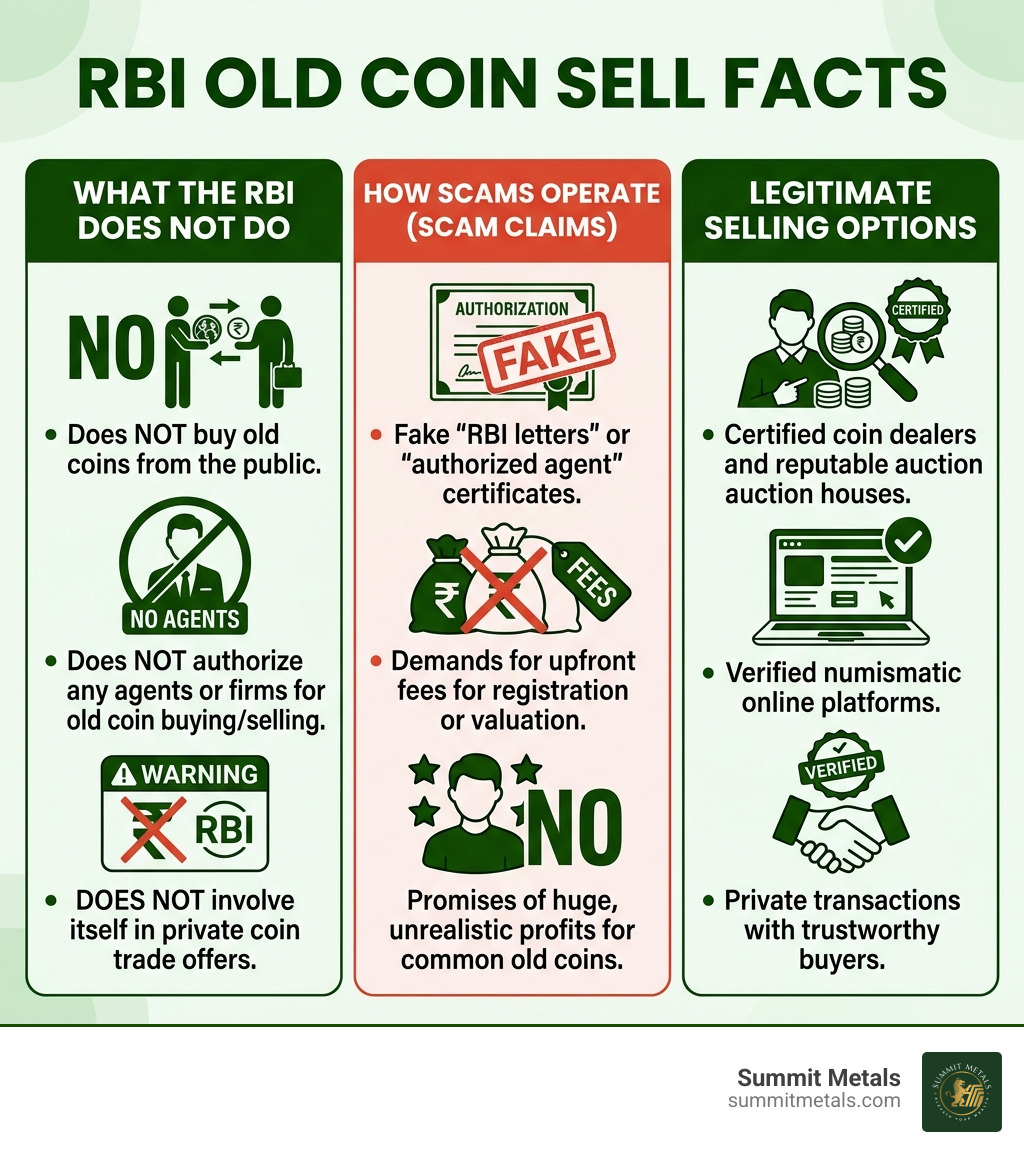
Rbi old coin sell word guide:
The Truth About the RBI Old Coin Sell Rumors
When we hear the term rbi old coin sell, it often conjures up images of a government counter where you can trade in a dusty jar of coins for a mountain of cash. Unfortunately, this is one of the most persistent myths in the Indian financial landscape. The Reserve Bank of India has been very vocal about this: they are not in the business of numismatics.
According to official Press Release 2021-2022/634, the RBI has explicitly stated that it does not deal in the buying or selling of old banknotes and coins. Furthermore, they have not authorized any institution, firm, or individual to collect charges or commissions on their behalf for such transactions. If you find a website or a "buyer" claiming they have an official tie-up with the central bank, they are simply not telling the truth. For genuine market insight, the safest approach is to compare offers only with established, transparent precious metals buyers and verified numismatic professionals.
Why you can't rbi old coin sell directly
The Reserve Bank of India is a central bank, not a commercial coin dealer. Its primary roles include managing inflation, issuing new currency, and regulating the banking sector. It operates as a non-commercial entity when it comes to the public.
The RBI's "customer service" regarding currency is strictly limited to maintaining the quality of cash in circulation. They issue public advisories to remind citizens that their role is to facilitate the economy, not to act as a marketplace for hobbyists. When you try to find a way to rbi old coin sell, you're looking for a service that doesn't exist within the government's framework.
Misuse of the RBI name and logo
Scammers are incredibly crafty. They often use high-quality replicas of the RBI logo on fraudulent letters, fake "approval certificates," and "tax clearance" documents. These documents are designed to intimidate you or make you feel like you are part of an elite, government-sanctioned deal.
We have seen reports of identity theft where victims are asked to provide their Aadhaar cards or bank details to "register" for a coin sale. Once the scammers have this information, they can drain bank accounts or commit further fraud in your name. Remember: the RBI never seeks charges, commissions, or taxes from the public for transactions related to old currency.
Identifying Common Scams and Fake RBI Certificates
The world of coin collecting should be about history and investment, but it is often clouded by "get rich quick" schemes. To protect yourself, you need to look at your collection through a critical lens.

One of the most common tactics used by fraudsters is the demand for "registration fees" or "processing charges." They might tell you that your coin is worth ₹10 lakh, but to "activate" the transfer from the RBI, you need to pay a small fee of ₹750 or ₹1,500. Once you pay that, they disappear—or worse, they ask for a larger "GST fee." This is a classic red flag we discuss in our guide on Don't Get Shortchanged Selling Your Silver Coins Wisely.
Red flags in an rbi old coin sell offer
If an offer seems too good to be true, it almost certainly is. Here are the warning signs we tell our clients to watch for:
- Upfront Payment: Any request for money before you receive your payment is a scam.
- Guaranteed Lakhs: No legitimate dealer can guarantee a price in the millions for a common coin without a professional appraisal.
- WhatsApp/Telegram Communication: Official government business is not conducted via private messaging apps with random "agents."
- Pressure Tactics: Scammers often threaten victims with "legal action" or "account freezing" if they don't pay the registration fee immediately.
The myth of the Mata Vaishno Devi and AKAM coins
Social media influencers are largely responsible for the hype surrounding the ₹5 and ₹10 Mata Vaishno Devi coins and the Azadi Ka Amrit Mahotsav (AKAM) series. While these are beautiful commemorative issues, they were minted in the millions.
In the numismatic world, value is driven by rarity. Because these coins are still in high circulation, their market value is usually just their face value—₹5 or ₹10. Some scammers claim these are worth ₹5 lakh, but as experts in the field note, these claims are "pure fantasy." Unless a coin has a specific, rare mint error, it isn't going to fund a retirement.
What the RBI Actually Does: Exchanging Damaged Currency
While you cannot rbi old coin sell for a profit, the RBI does provide a very important service: the exchange of "unfit" currency. This is part of their Clean Note Policy. If you have money that has been damaged by time or accident, the RBI and authorized bank branches are there to help you get the face value back.
For more details on how to handle precious metal transactions safely, check out our How To Sell Gold Silver Guide. In the meantime, here is how the RBI classifies damaged money:
- Soiled Notes: These are notes that have become dirty or slightly cut due to normal wear and tear. Even a note in two pieces is considered soiled if the cut doesn't pass through the number panels.
- Mutilated Notes: These are notes where a portion is missing or which are composed of more than two pieces.
- Defective Notes: Notes that are extremely brittle, burnt, or charred.
You can find more on the official rules in the Master Circular on the exchange of soiled/mutilated notes.
Legal tender status of coins and notes
It’s important to know what is still "money" and what isn't. According to the Gazette Notification No. 2529, coins of 25 paise and below ceased to be legal tender on June 30, 2011. You cannot spend them, and banks are no longer required to exchange them.
However, all coins in denominations of 50 paise, ₹1, ₹2, ₹5, ₹10, and ₹20 currently issued by the Government of India continue to be legal tender. Banks cannot refuse to accept these coins for deposit or exchange.
Procedures for rbi old coin sell and exchange at banks
If you have a small number of soiled notes (up to 20 pieces or a value of ₹5,000 per day), you can walk into any public sector bank and exchange them over the counter for free.
For larger amounts or severely damaged notes, the RBI provides "TLR" (Triple Lock Receptacle) covers. You place your notes in the cover, fill out your bank details, and drop it in a secure box at an RBI Issue Office. The value is then credited to your account after adjudication. If you are far from an office, you can even send mutilated notes via insured post directly to the RBI. If a bank refuses these services, you have the right to approach the Banking Ombudsman.
How to Determine the Real Value of Your Collection
If the RBI isn't buying, how do you know if that old silver coin in your drawer is actually worth something? We always tell our clients that numismatic value is different from "melt value."
When evaluating a coin, we look at four main factors:
- Rarity: How many were minted? (e.g., a 1939 Silver Rupee is rare; a 2010 Rs2 coin is not).
- Mint Marks: Small letters or symbols indicating where the coin was made (Mumbai, Kolkata, Hyderabad, or Noida).
- Condition: Is it "Uncirculated" (UNC) or heavily worn?
- Demand: Are there collectors actively looking for this specific year?
Professional grading and authentication
To get the best price, especially for items like Morgan Silver Dollars, you should look into professional grading. Organizations like PCGS (Professional Coin Grading Service) and NGC (Numismatic Guaranty Company) use the Sheldon Scale - a 70-point system - to give an objective grade to your coin. A coin graded MS-67 is worth significantly more than the same coin at MS-60.
[TABLE] comparing Gold Coins vs. Gold Bars
For those looking at coins as an investment rather than just a hobby, it's helpful to compare them to bullion bars.
| Feature | Gold Coins | Gold Bars |
|---|---|---|
| Face Value | Yes (Legal Tender) | No |
| Fraud Protection | High (Government Backed) | Moderate |
| Premiums | Higher (Collectibility) | Lower (Melt Value) |
| Best For | Small Investors/Collectors | Bulk Investors |
| Liquidity | Very High | High |
| Ease of Resale | Excellent for flexible selling | Efficient for larger-volume liquidation |
| Recognition | Strong retail recognition | Strong among bullion buyers |
Quick decision chart: Which may fit your goals?
| If your priority is... | Consider this first |
|---|---|
| Lower premium over spot | Gold bars |
| Government-backed legal tender | Gold coins |
| Easier small-lot selling later | Gold coins |
| Building larger positions efficiently | Gold bars |
| Added comfort from recognizable denomination and face value | Gold coins |
Gold coins can offer an extra layer of confidence for many buyers because they carry a face value as legal tender and are widely recognized, which can help with fraud awareness and resale confidence. Gold bars, on the other hand, often appeal to investors focused on maximizing ounces for the money.
Prices shown are at the time of this publication.
Legitimate Alternatives for Selling Rare Coins and Bullion
If you have verified that your coins are truly rare, stay away from social media "buyers." Instead, look for legitimate avenues. While the RBI does not buy coins, Summit Metals provides a secure, US-based alternative for investors looking to liquidate precious metals or rare pieces.
For those in the US, specifically near our locations in Salt Lake City, Utah, we recommend working with established buyers that offer transparent appraisals and clear pricing. You can learn more about finding the right fit in our guide on Where Can I Sell My Gold Coins For Best Price.
Building a secure exit strategy
Whether you are collecting for fun or investing for profit, you need an exit strategy. We always suggest thinking about not only what to buy, but how you may eventually sell. Keeping high-value items in private vault storage can help protect condition, improve security, and make holdings easier to liquidate when the time comes. When you're ready to move on from your collection, you can sell to us for maximum value.
Check our Sell Gold Silver Coins Guide to ensure you get the most value. We also have a dedicated guide on Selling Your Costco Gold Bar And Silver For Maximum Value for those who bought through retail giants.
Investing for the future with Summit Metals
At Summit Metals, we believe in making precious metals investing accessible and safe. We offer authenticated gold and silver with real-time, transparent pricing.
One of our favorite tools for long-term wealth building is Autoinvest. Just like contributing to a 401k, you can buy every month and dollar-cost average your way into a gold or silver position over time. That means less stress about trying to time the market and a more disciplined approach to building tangible holdings. Plus, when it's time to liquidate, you can simply sell coins for melt value or pursue numismatic premium through a trusted process designed around transparency and liquidity.
Comparison chart: selling route options
| Selling Option | Best For | Main Benefit | Main Caution |
|---|---|---|---|
| Summit Metals | Precious metals investors seeking transparent pricing | Clear buyback process and market-based pricing | Best fit for authenticated bullion and qualifying items |
| Auction houses | Rare, highly collectible numismatic pieces | Competitive bidding can lift rare coin prices | Fees and longer timelines |
| Local coin dealers | Fast in-person opinions | Convenience | Offers can vary widely |
| Social media buyers | None | None | Highest scam risk |
A strong investing plan includes both entry and exit. Buy with discipline, store securely, and choose a resale path before you need one.
Frequently Asked Questions about RBI Coin Sales
Are old 786 notes worth lakhs of rupees?
No. While many people consider the number "786" lucky, it is not a rare serial number. Millions of notes with this sequence exist. A collector might pay a small premium (perhaps ₹50 for a ₹10 note) if it is in perfect, "crisp" condition, but the claims of these being worth lakhs are entirely false.
Can I sell my old coins at a local bank branch?
No. Local bank branches are only mandated to exchange current legal tender that is soiled or mutilated for its face value. They do not buy coins for their "antique" or "collector" value.
How do I report a fraudulent coin buyer using the RBI logo?
If you encounter a suspicious offer, do not share any personal details. You can report the fraud to your local cybercrime cell or lodge a complaint via the official RBI website. The RBI will never ask you for a "registration fee" to sell a coin.
Conclusion
The dream of an rbi old coin sell windfall is, unfortunately, a fiction created by scammers. Financial literacy is your best defense. By understanding that the RBI is a regulator and not a dealer, you can protect your hard-earned money from "registration fee" traps.
If you are serious about building value through precious metals, stick to verified buyers and transparent platforms. Whether you are selling or looking to start a new investment journey via Autoinvest, we are here to help. Explore our Practical Guide to Selling Gold and Silver Tax-Free or, if you're ready to liquidate your current holdings, sell to us for maximum value.
Don't let your "trash" be stolen by scammers—turn it into real treasure by working with a trusted partner in Salt Lake City and across the US.