Why Selling Gold and Silver Tax-Free Matters for Your Wealth
How to sell gold and silver tax free is a question every precious metals investor faces. While you can't completely eliminate taxes on profits in the US, you can legally and significantly minimize them through strategic planning.
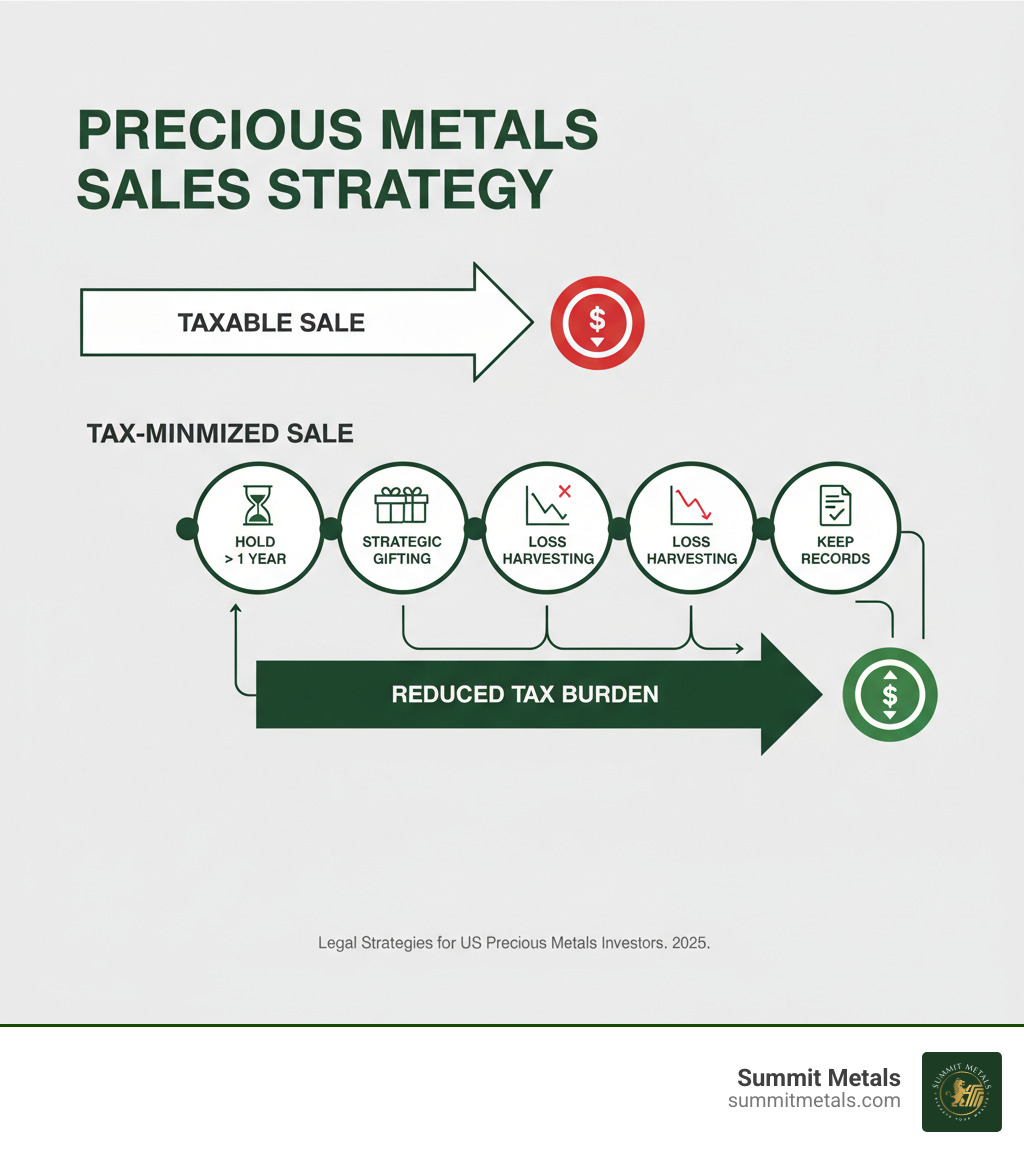
Here are the main ways to reduce your tax burden when selling precious metals:
- Hold for over one year to qualify for long-term capital gains rates.
- Use strategic gifting to transfer assets to family members.
- Harvest capital losses to offset gains from other investments.
- Keep perfect records to accurately track your cost basis.
- Choose coins over bars for potential reporting exemptions.
The key is understanding that the IRS classifies physical gold and silver as "collectibles." This means they face a maximum 28% tax rate on long-term gains—higher than stocks or bonds. But with proper planning, you can significantly reduce what you owe.
Strategic buying also helps. Dollar-cost averaging through programs like Summit Metals' Autoinvest simplifies tracking your cost basis. When you buy monthly, like a 401k, you create a clear paper trail that maximizes your tax efficiency when selling.
At Summit Metals, our team uses institutional-level tax strategies to help protect individual investors' portfolios. Our experience in how to sell gold and silver tax free comes from guiding clients through complex tax scenarios while they build wealth with physical precious metals.
Understanding the Tax Man: Capital Gains on Gold & Silver
When considering how to sell gold and silver tax free, your first step is understanding the IRS rules. The IRS classifies physical precious metals as "collectibles," not as stocks or bonds. This distinction has major consequences for your tax bill.

This collectibles status means your profits face different tax rates. How long you hold your metals is critical:
- Short-Term Capital Gains: If you sell assets held for one year or less, the profit is taxed at your ordinary income tax rate, which can be as high as 37%.
- Long-Term Capital Gains: If you sell assets held for more than one year, the profit is taxed at the collectibles rate, with a maximum of 28%. This is higher than the 15% or 20% long-term rates for stocks but is a significant saving over short-term rates.
Capital gains tax applies only to your profit, which is the sale price minus your cost basis. Your cost basis is what you originally paid plus associated costs like shipping, insurance, or storage fees. Meticulous record-keeping of your cost basis is essential to ensure you don't overpay taxes.
For more detailed information, see the IRS guidance on capital gains and our guide on profiting from precious metals.
Physical Bullion: What You Need to Know About Taxes
At Summit Metals, we specialize in authenticated physical gold and silver. Understanding the tax rules for these tangible assets is crucial. As collectibles, long-term gains (held over a year) are taxed at a maximum of 28%, while short-term gains are taxed at your ordinary income rate (up to 37%).
For example, if you buy 100 ounces of gold for $133,000 and sell it more than a year later for $230,000, your $97,000 gain is taxed at 28% ($27,160). If you sold within a year, that same gain could be taxed at your income rate, potentially costing over $35,000.
Remember to include costs like storage and appraisal fees in your cost basis to reduce your taxable profit. Additionally, inherited metals receive a "stepped-up" basis to the market value at the time of inheritance, which can eliminate capital gains for your heirs.
| Feature | Gold Coins (e.g., American Gold Eagle) | Gold Bars (e.g., 1 oz Gold Bar) |
|---|---|---|
| IRS Classification | Collectible | Collectible |
| Long-Term CGT | Max 28% | Max 28% |
| Short-Term CGT | Ordinary Income Rate (up to 37%) | Ordinary Income Rate (up to 37%) |
| 1099-B Reporting | Exempt from dealer reporting for certain coins (e.g., American Eagles) | Required for sales of 1 kilo (.995 fineness) or more |
| Legal Tender Status | Yes, typically has a face value | No |
Note: Summit Metals focuses exclusively on physical precious metals. Paper gold, stocks, or ETFs have different tax treatments not covered here.
Coins vs. Bars: Does Form Affect Your Taxes?
The form of your precious metals can significantly impact your tax strategy. While both coins and bars are taxed as collectibles, they have key differences in reporting requirements and other features.
Bullion coins like the American Gold Eagle are legal tender, which provides unique advantages. The most significant is that sales of American Gold and Silver Eagles do not require dealers to file Form 1099-B, regardless of the quantity. This adds a layer of privacy, though you are still legally required to report your gains.
Bullion bars face different thresholds. Dealers must file a 1099-B when you sell 1 kilogram of gold or 1,000 ounces of silver.
Here is a comparison to help you decide:
| Feature | Gold & Silver Coins (e.g., American Eagle) | Gold & Silver Bars |
|---|---|---|
| Reporting | Sales of American Eagles are exempt from dealer 1099-B reporting. | Sales of large quantities (e.g., 1kg gold, 1000oz silver) require 1099-B reporting. |
| Liquidity | Highly liquid and easy to sell in small increments (divisible). | Best for large transactions; less divisible. |
| Premiums | Typically have slightly higher premiums over spot price. | Lower premiums over spot, more cost-effective for bulk buys. |
| Security | Legal tender status offers government-backed authenticity and fraud protection. | Authenticity relies on refiner's brand and assay. |
| Storage | Easy to store in smaller quantities. | More compact for storing very large values. |
For investors prioritizing tax efficiency and flexibility, coins often have an edge. However, bars are excellent for cost-effective, large-volume investing. To learn more, read our guide on beginner selling mistakes to avoid.
Legal Strategies for How to Sell Gold and Silver Tax Free
Now that you understand the tax landscape, let's explore practical, IRS-compliant methods to legally reduce or defer the tax on your gold and silver profits. This isn't about tax evasion; it's about smart planning to protect your wealth.

Strategy 1: Dollar Cost Averaging with Autoinvest by Summit Metals
A powerful strategy for long-term investors is dollar cost averaging through Summit Metals' Autoinvest program. It works like a 401k for precious metals: you invest a set amount each month, regardless of price fluctuations. This disciplined approach builds a detailed paper trail of every purchase.
When it's time to sell, you have crystal-clear records of what you paid and when. This allows you to use the "specific identification" method to choose which ounces to sell. You can strategically sell assets held for over a year to get long-term rates or sell specific lots to harvest losses.
The Autoinvest program, exclusive to Summit Metals customers, brings an institutional-grade, disciplined approach to your physical precious metals investing and simplifies future tax planning.
Strategy 2: Strategic Gifting and Inheritance
Strategic gifting and inheritance planning are powerful tools for preserving wealth within your family. For 2024, the IRS allows an annual gift tax exclusion of $18,000 per person. You can gift up to $18,000 worth of gold or silver to any individual without filing a gift tax return. The recipient assumes your cost basis and will be responsible for capital gains upon selling, which can be advantageous if they are in a lower tax bracket.
Even more powerful is the stepped-up basis on inheritance. When an heir inherits your precious metals, their cost basis is "stepped up" to the market value on the date of death. This erases all taxable gains accumulated during your lifetime, allowing them to sell immediately with potentially zero capital gains tax. For more details, see the IRS guidance on gift tax exemption.
Strategy 3: Using Capital Losses to Your Advantage
When you sell an investment for less than you paid, you realize a capital loss. The IRS allows you to use these losses to your advantage through tax-loss harvesting.
Capital losses can offset capital gains dollar-for-dollar. You can use losses from stocks to offset gains from gold, and vice versa. If your losses exceed your gains in a given year, you can deduct up to $3,000 of excess losses against your ordinary income. Any remaining losses can be carried forward to offset gains in future years.
This makes timing your sales crucial. Sometimes the best time to sell is not when prices are highest but when the sale best fits your overall tax strategy. To maximize your return, it's important to know where to find the best price for your gold coins.
Note: While IRAs and 1031 exchanges are popular tax-deferral strategies, Summit Metals focuses on direct ownership of physical precious metals rather than these more complex structures.
Reporting, Records, and Regional Rules
The administrative side of selling precious metals is crucial for staying compliant and maximizing your returns. Without proper reporting knowledge and record-keeping, even the best tax strategies can fail.

IRS Reporting: When is a Sale Reported?
Dealers are required to file Form 1099-B for certain large transactions, meaning the IRS may know about your sale before you file. You are always responsible for reporting your capital gains, but it's important to know when a sale is automatically reported.
Reporting thresholds are specific:
- Gold Bars: 1 kilogram (32.15 ounces) or more.
- Silver Bars: 1,000 ounces or more.
- Specific Gold Coins: 25 or more 1-ounce coins (e.g., Krugerrands, Maple Leafs).
However, there is a notable American Eagle coin exemption. Dealers are not required to file a 1099-B for sales of American Gold or Silver Eagles, regardless of quantity. This provides a privacy advantage, but it does not eliminate your legal duty to report your profits.
Additionally, any cash transaction over $10,000 requires the buyer (if a business) to file Form 8300 for anti-money laundering purposes. For official details, see the Instructions for IRS Form 1099-B.
The Golden Rule: Meticulous Record-Keeping
If there's one piece of advice that trumps all others, it's this: keep meticulous records. Without accurate documentation, you cannot prove your cost basis and may pay more tax than necessary.
Your records should document the acquisition date, price, sale date, and sale price for every item. You should also track associated costs that can be added to your cost basis, such as shipping, insurance, storage, and appraisal fees. These costs reduce your taxable gain.
Summit Metals' transparent, real-time pricing and detailed transaction records make it easier to maintain the necessary paperwork. Our Autoinvest service is especially helpful, creating a clear monthly paper trail that simplifies tracking your cost basis over time. For more information, review the IRS guidance on basis of assets.
Essential Records to Keep for Tax Purposes:
- Purchase invoices showing date, item, quantity, price, and seller
- Sale invoices with date, item, quantity, price, and buyer
- Bank statements or payment confirmations for all transactions
- Records of associated costs like storage, insurance, and shipping fees
- Certificates of authenticity for high-value items
- Photographs of items, especially before shipping
- All correspondence with dealers or brokers
State and International Tax Law Differences
State laws can also impact your overall tax burden. While federal rules apply everywhere in the US, sales tax on purchases varies by state. Summit Metals is based in Wyoming, which does not charge sales tax on investment-grade bullion, reducing your initial acquisition cost.
Many other states have similar exemptions. State income tax on capital gains also varies. States like Wyoming, Florida, and Texas have no state income tax, which can substantially improve your after-tax returns. Our location in Salt Lake City, Utah, also benefits from rules that exempt certain gold and silver coins from sales tax.
Internationally, the rules can be even more favorable. In the United Kingdom, for example, certain legal tender coins like Gold Britannias are completely exempt from Capital Gains Tax for UK residents. These variations highlight the importance of understanding the specific laws that apply to your situation when deciding where to sell silver locally vs. online.
Frequently Asked Questions about How to Sell Gold and Silver Tax Free
Here are concise answers to common questions about precious metals taxation and how to approach how to sell gold and silver tax free.
1. Are some gold or silver coins completely tax-free to sell in the US?
No. In the United States, any profit from selling gold or silver is a capital gain that must be reported to the IRS. This differs from countries like the UK, where certain legal tender coins are exempt from Capital Gains Tax for residents.
However, American Gold and Silver Eagles offer a privacy advantage. Dealers are not required to file a Form 1099-B when you sell them. This does not remove your legal obligation to report the profit on your tax return, but the transaction is not automatically flagged to the IRS by the dealer.
2. How can I learn how to sell gold and silver tax free if I'm a beginner?
For beginners, focus on three key principles:
- Know Your Cost Basis: Track what you paid for each item, plus any related costs like shipping or storage.
- Be Patient: Hold your investments for more than one year to qualify for the lower long-term capital gains tax rate (max 28% for collectibles).
- Keep Excellent Records: Organize all purchase and sale documents.
To simplify this process, consider Summit Metals' Autoinvest service. It allows you to make disciplined, monthly purchases (like a 401k), which automatically creates a clear, documented history of your cost basis. This makes tax planning much easier when you decide to sell.
3. Does the IRS know if I sell a small amount of gold for cash?
The IRS may not be automatically notified of a small sale. Dealers are only required to file a Form 1099-B for transactions that exceed specific thresholds (e.g., 1 kg of gold or 1,000 oz of silver). A small, private sale would not trigger any business reporting.
However, your legal responsibility to report any capital gain is unchanged. Whether a 1099-B is filed or not, any profit you make is taxable income that you must report on your tax return. Failing to do so is tax evasion, which carries severe penalties. The smart and safe approach is to always remain compliant.
Conclusion: Building Your Tax-Efficient Precious Metals Strategy
Effectively selling gold and silver tax-free is not about finding a secret loophole but about implementing a strategic, legal plan. By understanding that the IRS treats precious metals as collectibles, you can use legitimate strategies to minimize your tax burden.
The foundation of this strategy is time. Holding your investments for over a year can cut your maximum tax rate from 37% to 28%. Beyond that, we've seen how strategic gifting, tax-loss harvesting, and inheritance rules can protect your wealth.
The form of your metal also matters, with coins like the American Gold Eagle offering privacy advantages. Perhaps most importantly, we've found how disciplined investing through dollar-cost averaging—like with Summit Metals' Autoinvest service—creates the clear paper trail needed for accurate tax planning.
A trusted partner is essential. Summit Metals provides transparent, real-time pricing on authenticated precious metals, ensuring you have the accurate documentation needed for future tax planning. Our competitive rates mean more of your investment dollars are put to work for you.
Smart investing is about buying right, selling smart, and keeping more of what you earn. With proper planning and meticulous records, you can protect your profits from unnecessary taxes while remaining fully compliant.

Ready to make your precious metals investment journey as tax-efficient as possible? Ready to sell your precious metals? Get a quote from us today!