Why 24 Hour Silver Prices Move Faster Than You Think
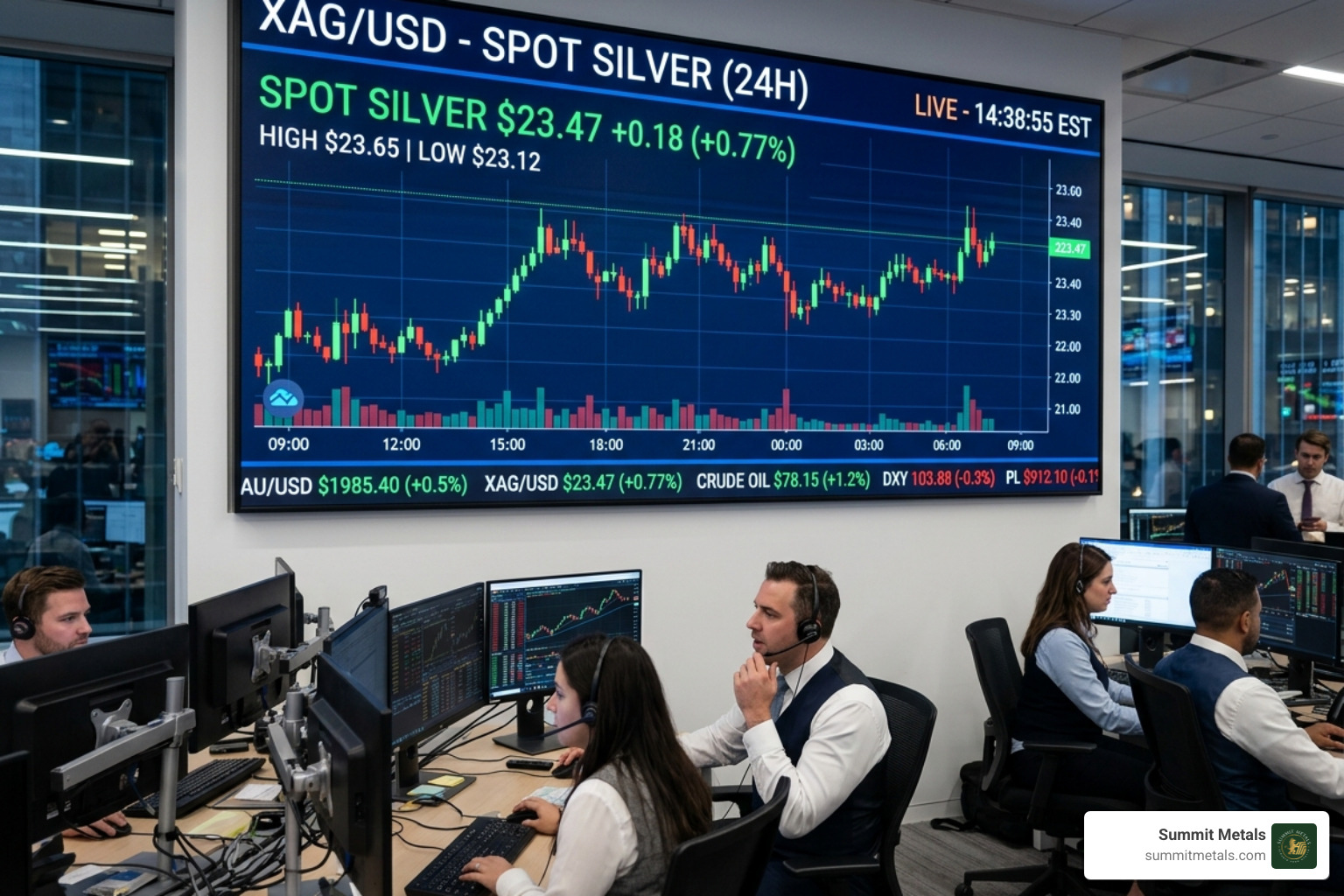
24 hour silver prices are constantly shifting — here's what you need to know right now:
| Metric | Recent Data (at time of publication) |
|---|---|
| Silver Spot Price (per oz) | ~$73.75 USD |
| 24-Hour Change | -$1.74 (-2.30%) |
| Silver per Gram | ~$2.37 |
| Silver per Kilogram | ~$2,371 |
| Typical Bid/Ask Spread | ~$0.25 per oz |
| Daily Trading Pause | 5:00–6:00 PM EST only |
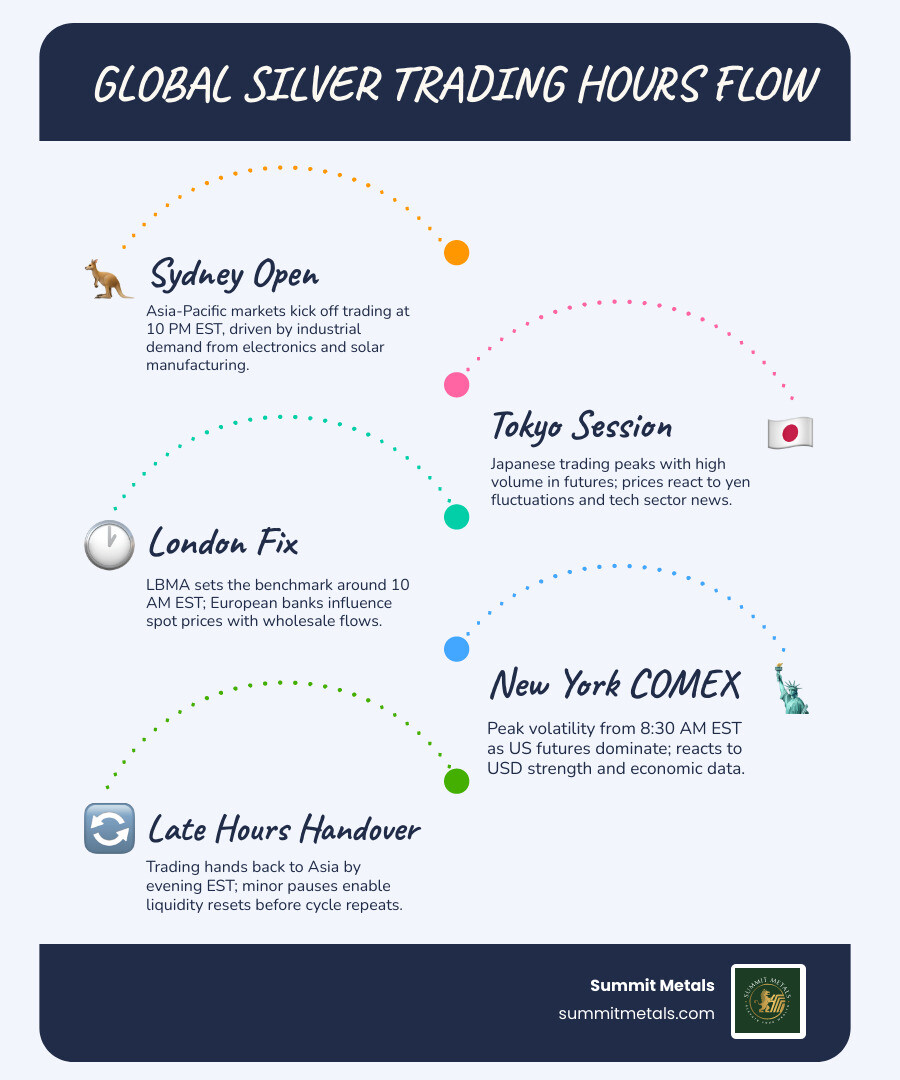
Silver trades nearly around the clock — from Sydney's open to New York's close — with prices updating every second based on global supply, demand, and market sentiment.
Here's the key takeaway: the silver market never really sleeps. A policy announcement in London or a solar panel factory order in Shanghai can move prices before your morning coffee.
I'm Eric Roach, a former Wall Street investment banker and M&A advisor who has helped clients structure precious metals strategies — including tracking 24 hour silver prices — as part of disciplined, inflation-resistant portfolios. That institutional background shapes everything I share here at Summit Metals, where we translate complex market mechanics into clear, actionable guidance for everyday investors.
24 hour silver prices word guide:
- Chandi and gold price today
- Current price of gold silver and platinum
- International gold silver price
Understanding the Mechanics of 24 Hour Silver Prices
If you’ve ever watched a live silver chart, you know it looks less like a steady climb and more like a heart monitor. This "rollercoaster" effect is driven by a sophisticated global infrastructure that ensures silver is being priced somewhere on Earth almost 24 hours a day.
At Summit Metals, we believe that understanding these mechanics is the first step toward becoming a confident investor. When you see 24 hour silver prices tick up or down, you aren't just looking at random numbers; you're seeing the result of millions of ounces being bid on and sold across several continents.
Global Exchanges and Live Spot Discovery
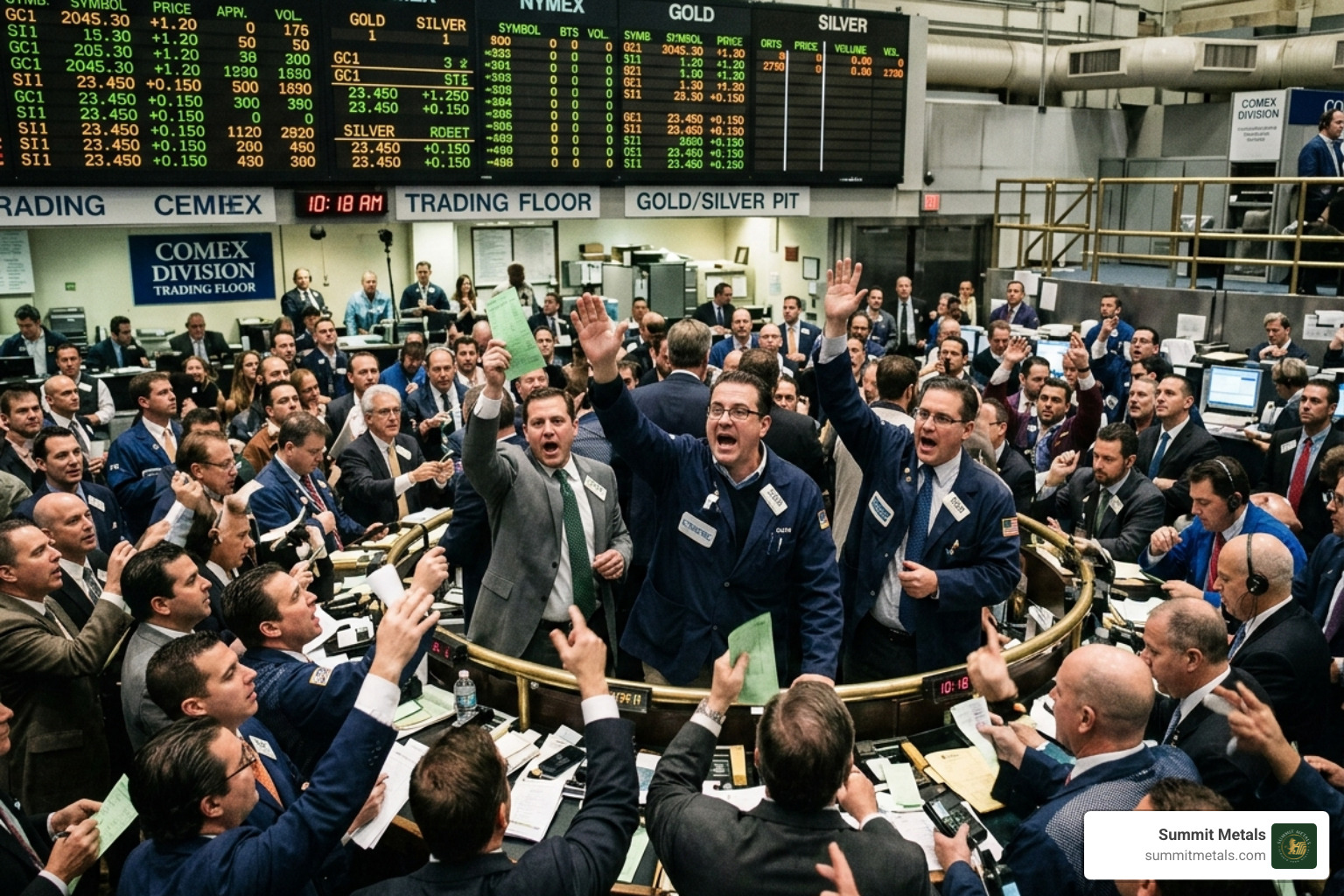
The "spot price" of silver is effectively the current market rate for one troy ounce of raw silver available for immediate delivery. However, this price isn't set by a single person in a room. Instead, it is "discovered" through the trading of futures contracts on major global exchanges.
- COMEX (Commodity Exchange): Based in New York, this is the primary driver of silver prices. Most Live Silver Price data you see is reflecting the activity on the COMEX.
- LBMA (London Bullion Market Association): London is the hub for physical "wholesale" silver. Twice a day, they set a benchmark price used by miners and industrial consumers.
- NYMEX and Others: Exchanges in Tokyo (TOCOM) and Shanghai (SHFE) also play massive roles in determining the Spot On Your Live Silver Price Per Ounce Guide.
Because these exchanges are linked electronically, the market remains highly liquid. When the sun sets in New York, trading shifts to Sydney and Hong Kong, ensuring that 24 hour silver prices stay current regardless of the time zone.
Bid vs. Ask: Navigating the 24 Hour Silver Prices Spread
When you look at a 24 Hour Silver | SilverSeek chart, you will often see two different prices: the Bid and the Ask. Understanding the difference is crucial for your bottom line.
- Bid Price: This is what a dealer is willing to pay you for your silver. Think of it as the "wholesale" purchase price.
- Ask Price: This is the price at which a dealer is willing to sell silver to you.
- The Spread: The difference between the two.
In the live market, the spread is usually very tight—often just a few cents. However, when you buy physical products like coins or bars, a "premium" is added to the ask price to cover fabrication, shipping, and dealer overhead. If you're looking for Silver Per Ounce Right Now, always check both numbers to see the true cost of entry.
Key Drivers of Intraday Volatility
Why does silver move $1.00 in an afternoon while other assets sit still? Silver is a "dual-purpose" metal. It is both a financial asset (like gold) and an essential industrial commodity. This double life makes 24 hour silver prices notoriously volatile.
The Gold-to-Silver Ratio and Market Timing
One of the most powerful tools in our arsenal is the Gold-to-Silver Ratio. This number tells you how many ounces of silver it takes to buy a single ounce of gold.
- High Ratio (e.g., 80:1 or 100:1): Historically, this suggests that silver is undervalued relative to gold. Many investors use this as a signal to buy silver.
- Low Ratio (e.g., 40:1 or 50:1): This may indicate that silver is becoming "expensive" compared to gold, and some traders might swap their silver for gold to lock in gains.
Tracking The Midas Touch What Are Gold And Silver Prices Per Ounce Today helps you understand if you're buying at a historical extreme or a balanced average.
How Global News Impacts 24 Hour Silver Prices
Because silver is priced in U.S. Dollars, any news affecting the greenback will immediately impact silver. But it goes deeper than that. The Silver Lining How To Track And Understand Silver Prices involves watching three main categories:
- Industrial Demand: Over 50% of silver demand comes from industry. The "Green Revolution" is a massive factor here. Solar panels use roughly 20 grams of silver each, and EVs use double the silver of a standard internal combustion engine.
- Geopolitical Tension: When things get rocky on the world stage, investors flee to "safe havens." While gold is the king of safe havens, silver often follows in its wake.
- Supply Deficits: For the last several years, global silver demand has actually outpaced mining production. When a major mine in Mexico or Peru faces a strike or a shutdown, 24 hour silver prices can spike instantly.
Physical Silver Strategy: Bars vs. Coins
When you're ready to move from watching charts to holding metal, you have a choice to make: bars or coins? Both have a place in a diversified portfolio, but they serve different purposes.
| Feature | Silver Sovereign Coins (e.g., Silver Eagle) | Silver Bullion Bars (e.g., 10 oz or 100 oz) |
|---|---|---|
| Purity | .999 or .9999 Fine Silver | .999 Fine Silver |
| Legal Tender | Yes (Face Value) | No |
| Premiums | Generally Higher | Generally Lower |
| Liquidity | Extremely High (Recognized Worldwide) | High (Best in bulk) |
| Fraud Protection | Sovereign backing & advanced security | Standard assay marks |
| Best For | New investors, survival/barter, portability | Large-scale wealth accumulation, lower cost-per-oz |
Benefits of Government-Minted Coins
At Summit Metals, we often recommend sovereign coins for those concerned about Real Time Precious Metals Prices and long-term security. Because these coins carry a face value (like $1 USD for an American Silver Eagle), they are protected by federal anti-counterfeiting laws. This provides an extra layer of fraud protection that private bars simply don't have. They are also incredibly easy to sell; any coin shop in the world recognizes a Silver Maple Leaf or a Silver Eagle.
Industrial Efficiency with Silver Bars
If your goal is to get as much silver as possible for every dollar spent, bars are the way to go. Because they are easier to manufacture than intricate coins, the premiums are much lower. A 100-ounce bar allows you to track the Silver Price Per Ounce Current more closely, as you aren't paying for "art" or "sovereign status." They are also perfectly stackable, making them ideal for home safes or private vaults.
Maximizing Returns with Autoinvest and Exit Strategies
Watching 24 hour silver prices can be stressful if you're trying to "time the bottom." Most successful investors use a different approach: consistency.
Building Long-Term Wealth via DCA
We are big fans of Autoinvest. This is a strategy known as Dollar Cost Averaging (DCA). Instead of trying to guess when silver is at its lowest point, you commit to buying a set dollar amount every month—just like you would with a 401k or an IRA.
When prices are low, your monthly investment buys more silver. When prices are high, it buys less. Over time, this mitigates the impact of volatility and builds a significant "stack" without the emotional stress of day-trading. You can Start your silver subscription today and let the math do the heavy lifting for you. For more insights, check out Live Metal Prices Your Daily Dose Of Market Insights.
Planning Your Exit: Sell to Us and Private Vaulting
An investment is only as good as your ability to turn it back into cash when you need it. This is your "exit strategy." At Summit Metals, we don't just sell you the metal; we want to be your partner for the entire lifecycle of your investment.
We recommend considering private vaulting. By storing your silver in a secure, third-party facility, you keep it "within the chain of integrity." This makes it much easier to sell later because the metal never left a professional secure environment. When you're ready to liquidate, you can simply Sell to Us. We offer competitive buyback rates, ensuring that your exit is as smooth as your entry. Don't forget to Dont Miss A Beat Real Time Precious Metal Charts For Savvy Investors to time your exit for maximum profit.
Frequently Asked Questions about 24 Hour Silver Prices
Why does the silver price change every minute?
Silver is traded globally on electronic exchanges that never truly close except for a brief 60-minute window. High-frequency trading algorithms, instant reactions to news (like a jobs report or a Fed announcement), and constant shifts in investment demand mean that the "equilibrium" price is always moving.
Is the spot price the same as the price I pay?
No. The spot price is the price for a 5,000-ounce futures contract of raw silver. When you buy a 1-ounce coin, you are paying for the silver plus the "premium." This premium covers the cost of minting the coin, the dealer's small profit, and the logistics of getting that metal to your door. For more on this, see the Current Price Of Gold Silver And Platinum.
What is the best time of day to buy silver?
While there is no "magic hour," volatility often peaks during the "New York Open" (around 8:20 AM EST) and during the London Fix. If you prefer a calmer market, the late afternoon (Eastern Time) can sometimes see more stable pricing before the Asian markets open for the next day.
Conclusion
The world of 24 hour silver prices is fast-moving, but it doesn't have to be overwhelming. By understanding how global exchanges discover the spot price, choosing the right physical products, and utilizing strategies like Autoinvest, you can turn market volatility into a long-term advantage.
At Summit Metals, we are proud to be a Wyoming-based company offering transparent, real-time pricing and competitive rates. Whether you are looking to buy your first silver coin in Salt Lake City or building a massive bullion position for your private vault, we have the expertise to help you succeed.
Ready to start your journey?