Why Finding the Best Way to Invest Matters More Than Ever
The best way to invest depends on your personal goals and risk tolerance. While there's no one-size-fits-all answer, proven strategies include building an emergency fund, maximizing retirement accounts, diversifying assets, keeping costs low, and automating contributions.
Saving money in a bank feels safe, but inflation silently erodes its value. If inflation is 3%, your money must earn at least 3% just to maintain its purchasing power.
Investing is different from saving. It involves putting money into assets that can outpace inflation. For example, the S&P 500 has historically averaged a 10% annual return, offering a real return of about 7% after inflation.
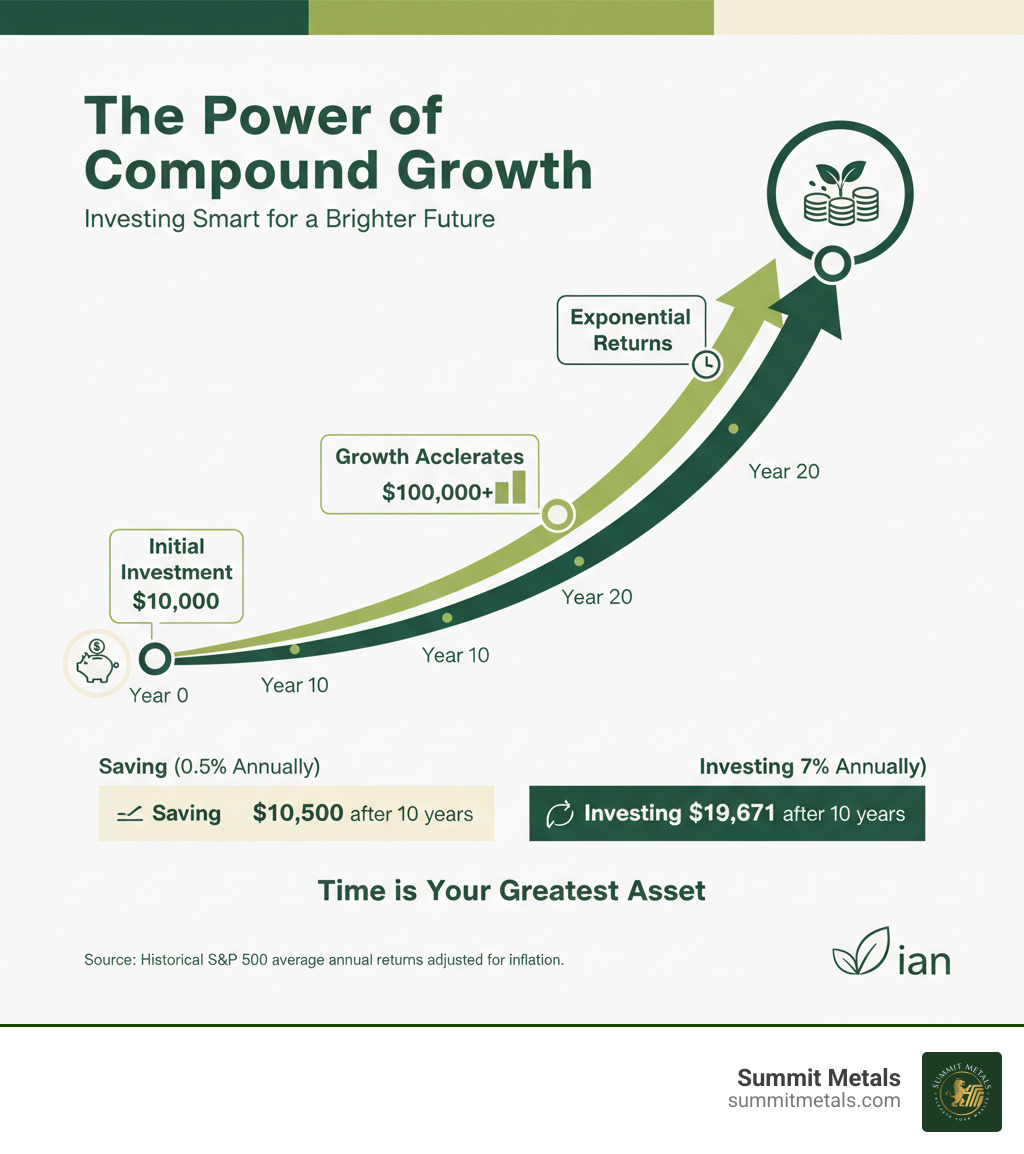
The secret to wealth creation is compound growth. When your investments earn returns, those returns begin earning their own returns. A $1,000 investment earning 7% annually can grow to nearly $7,600 in 30 years. The earlier you start, the more time your money has to compound.
But where should you invest? Stocks offer growth but are volatile. Bonds provide stability with lower returns. Precious metals like gold and silver can hedge against economic uncertainty. The winning strategy combines multiple asset classes based on your unique situation. A 30-year-old saving for retirement needs a different approach than a 60-year-old protecting their wealth.
I'm Eric Roach, and I've spent my career helping investors build and protect wealth with assets like physical gold and silver. I've learned that the best way to invest combines disciplined strategies with accessible options that work for everyone, not just the ultra-wealthy.
Laying the Foundation: What to Do Before You Invest
Before you think about stocks or gold, you need to get your financial house in order. A solid foundation is critical for long-term success.
First, build your emergency fund. This is three to six months of essential living expenses set aside in an accessible account, like a high-yield savings account. An emergency fund protects your investments from being sold at a bad time to cover an unexpected car repair or medical bill. It prevents life's curveballs from derailing your financial strategy.
Next, tackle high-interest debt. Credit card balances charging 15-25% interest make it nearly impossible for your investments to get ahead. Paying off this debt is like earning a guaranteed, risk-free return equal to the interest rate. It's one of the smartest financial moves you can make.
Once your emergency fund is set and high-interest debt is gone, look at your disposable income. This is the money left after all your monthly necessities are paid. To find this number, create a simple budget. A budget shows where your money goes and reveals how much you can comfortably invest without stress.
This foundation provides financial stability. It means you're investing from a position of strength, not desperation, and can stick to your plan through market ups and downs without panic.
Crafting Your Blueprint: How to Develop a Personal Investment Strategy

With a solid financial foundation, it's time to create your investment roadmap. This personalized strategy connects where you are today with your future financial goals.
Start by defining your financial goals. Are you saving for a comfortable retirement, a home ownership down payment, or your children's education? A 30-year retirement goal requires a different approach than a 3-year savings goal.
Your timeline is crucial. A younger investor has decades to recover from market downturns and can afford to be more aggressive. As you near your goal, your focus should shift toward protecting the wealth you've built.
Next, honestly assess your risk tolerance. How would you react to a 20% drop in your portfolio's value? Conservative strategies prioritize capital preservation with assets like bonds, while aggressive strategies seek higher growth through stocks and alternatives, accepting more volatility.
This is where diversification is essential. Spreading investments across different asset types helps cushion your portfolio. As this Beginner's Guide to Asset Classes explains, when stocks zig, bonds or tangible assets like gold might zag.
Your strategy is personal. By assessing your goals, timeline, and risk tolerance, you create a blueprint that guides your decisions and keeps you on the best way to invest for your unique future.
Exploring Your Options: A Guide to Different Investment Vehicles
With your strategy defined, let's explore where to put your money. The investment world offers a diverse menu of options, from traditional financial assets to tangible commodities.
Traditional Financial Assets
These are the instruments most people associate with investing.
- Stocks (Equities): Represent ownership in a company. If the company does well, your shares can increase in value, and you may earn dividends. The S&P 500 has historically returned about 10% annually, but stocks can be volatile and are best for long-term goals.
- Bonds: Essentially a loan you make to a government or corporation in exchange for interest payments. Government bonds are very safe but offer lower returns (typically 3-4%). Corporate bonds pay more to compensate for slightly higher risk.
- Mutual Funds & ETFs: Both pool investor money to buy a diversified basket of assets. Mutual funds are actively managed, while Exchange-Traded Funds (ETFs) trade like stocks and usually have lower fees, making them a cost-effective way to diversify.
- Target-Date Funds: A set-it-and-forget-it retirement option. These funds automatically become more conservative as your target retirement date approaches.
For more on these options, Investor.gov offers an excellent introduction.
Tangible Assets: Investing in Physical Commodities
Tangible assets are physical goods you can hold, offering a different kind of security.
Real estate is a familiar tangible asset, offering potential rental income and appreciation. However, it requires significant capital and is not easily sold.
Precious metals like gold and silver have been wealth preservation tools for millennia. At Summit Metals, this is our specialty.
- Gold: Revered as a store of value for thousands of years, gold serves as an inflation hedge and a safe-haven asset during economic uncertainty. When the dollar weakens, gold's value often rises. Its enduring role is why central banks worldwide hold it in reserve. Learn more in our guide on The Strategic Role of Gold in Long-Term Portfolio Management.
- Silver: Shares gold's monetary history but also has significant industrial demand. It's essential for solar panels, electronics, and medical devices. This dual role means its price is influenced by both investment demand and industrial growth. Many experts believe silver is currently undervalued. Explore its potential in our article, Is Silver a Good Investment?.
Comparing Gold Coins vs. Gold Bars
When buying physical gold, you'll choose between coins and bars. Both are excellent forms of ownership, but they serve different needs.
| Feature | Gold Coins | Gold Bars |
|---|---|---|
| Premium over Spot | Generally higher per ounce for smaller coins | Generally lower per ounce for larger bars |
| Liquidity | Excellent; easy to sell in small increments | Good, but larger bars are less divisible |
| Fraud Protection | Strong; legal tender with intricate, government-backed designs | Relies on the refiner's reputation; less intrinsic protection |
| Government Backing | Yes, issued by sovereign mints (e.g., U.S. Mint) | No, produced by private refiners |
| Divisibility | High; available in various fractional sizes | Low; harder to sell a portion of a large bar |
Gold coins like the American Gold Eagle are legal tender, which provides an inherent layer of fraud protection. Their government backing and global recognition make them easy to verify and sell. For most investors, coins offer superior flexibility and peace of mind.
Gold bars are ideal for larger investments where minimizing costs is the priority. A 10 oz or 1 kg bar has a lower premium per ounce than the equivalent weight in coins. Many investors use both: coins for liquidity and bars for cost-effective bulk accumulation.
Finding the best way to invest in precious metals
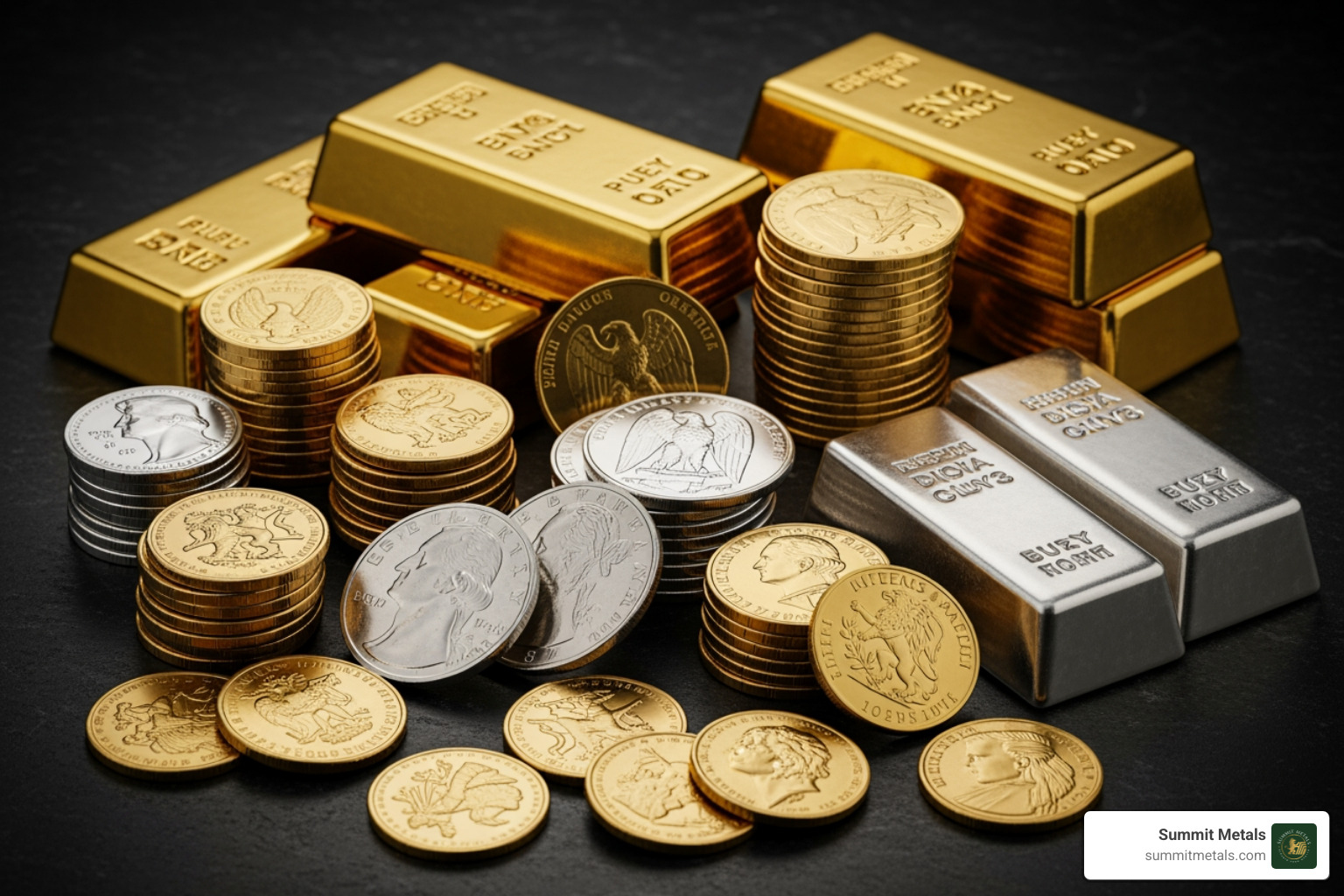
When investing in precious metals, physical ownership is the gold standard. Unlike paper assets (like ETFs or certificates), holding physical bullion eliminates counterparty risk. We cover this in our Bars vs. Coins: Your Ultimate Gold Investment Showdown.
Key factors to consider are:
- Liquidity: How easily can you sell? Widely recognized coins (American Eagles, Canadian Maples) and bars from reputable refiners offer the best liquidity.
- Purity: Investment-grade bullion is typically .999 or .9999 fine (99.9% or 99.99% pure).
- Authenticity: Buying from a trusted dealer is paramount to avoid counterfeits. At Summit Metals, we deal exclusively in authenticated gold and silver. Our transparent, real-time pricing ensures you get genuine products at fair value.
You don't need a fortune to start. With Summit Metals' Autoinvest program, you can use dollar-cost averaging to buy gold and silver monthly, just like a 401(k). This systematic approach is the best way to invest in precious metals for most people.
The Best Way to Invest: Choosing Your Approach
With a strategy and knowledge of investment vehicles, the next step is deciding how you want to invest. Your approach will depend on your starting capital and how hands-on you want to be.
How to Start Investing with Little Money
You no longer need thousands of dollars to start. Technology has made investing accessible to everyone.
- Micro-investing apps like Acorns let you invest spare change from everyday purchases. These small, automatic contributions add up over time.
- Fractional shares allow you to buy a piece of a stock for as little as a few dollars. This provides low-cost entry points to build a diversified portfolio even with limited funds.
The beauty of starting small is that it still harnesses the power of compound growth. This principle applies to tangible assets, too, as we've explored in The Case for Fractional Gold.
Finding the best way to invest for your style
Your personality influences your investment style.
- Robo-advisors: For a hands-off approach, platforms like Betterment use algorithms to build and manage a portfolio for you based on your goals and risk tolerance. They offer low fees and automated management.
- Self-directed investing: For those who want full control, online brokerages provide access to a wide range of investments. This requires a commitment to research and managing your own portfolio.
- Financial advisors: For complex situations, a professional can provide comprehensive planning. It's critical to vet professionals carefully. Ask about their fee structure (fee-only is often best) and check their background using FINRA's BrokerCheck tool.
The Power of Consistency: Automated Investing
Consistency is more important than trying to be clever. The most successful investors are those who invest regularly, month after month, through all market conditions.
This is the power of Dollar-Cost Averaging (DCA): investing a fixed amount at regular intervals. This strategy averages out your purchase price over time and removes the emotion-driven temptation to time the market.
401(k) contributions are a perfect example of DCA. If your job offers an employer match, contribute enough to get the full amount—it's an instant return on your investment.
The same principle is the best way to invest in precious metals. At Summit Metals, our Autoinvest program lets you buy physical gold and silver automatically each month, just like a 401(k). You set it up once, and you consistently accumulate real, tangible assets, smoothing out price swings. This systematic approach builds a robust precious metals portfolio over time. We detail this strategy in The Power of Dollar Cost Averaging in Gold and Silver Investments.
Frequently Asked Questions about Investing
Stepping into the investment world can bring up many questions. Here are answers to some of the most common ones.
What are some low-risk investment options for beginners?
For those just starting or needing a safe place for short-term funds, consider these stable options:
- High-yield savings accounts: FDIC-insured and offer better interest rates than traditional savings accounts. Perfect for an emergency fund.
- Certificates of Deposit (CDs): FDIC-insured accounts where you lock in a fixed interest rate for a set term (e.g., 1-5 years). Best for money you know you won't need immediately.
- Money market accounts: FDIC-insured accounts that blend features of savings and checking, offering competitive rates and limited check-writing.
- U.S. Treasury bonds: Loans to the U.S. government, considered one of the safest investments in the world. They provide stability and predictable income.
How much of my income should I invest?
A common guideline is the 10-15% rule: aim to invest 10-15% of your income toward long-term goals like retirement.
However, the right amount depends on your personal budget considerations and long-term goals. Always prioritize building an emergency fund and paying off high-interest debt first. If 10-15% is too much right now, don't worry. Start with what you can afford, even if it's just a small amount each week. The most important step is to build the habit. The best way to invest is to simply get started.
What are common red flags to watch out for?
Protecting your money is as important as growing it. Watch out for these warning signs of investment scams:
- Guaranteed high returns: Legitimate investments always carry risk. Promises of high, risk-free profits are a major red flag.
- High-pressure sales tactics: Scammers create false urgency. A good investment opportunity will still be there tomorrow.
- Unlicensed sellers: Always verify an advisor's credentials using tools like FINRA's BrokerCheck tool.
- Overly complex or secret strategies: If you can't understand it, or if someone won't explain it simply, walk away.
At Summit Metals, we believe education is your best defense. We detail how to protect yourself in our guide on How to Avoid Common Precious Metals Scams.
Conclusion

We've covered the essentials of investing, from building a financial foundation to exploring stocks, bonds, and physical precious metals. The key takeaway is that there is no single best way to invest for everyone. Your ideal path is unique to your goals, timeline, and risk tolerance.
What matters most is that you start. Remember these core principles:
- Build your foundation first: An emergency fund and zero high-interest debt are non-negotiable.
- Diversify your assets: Combine growth assets like stocks with stable ones like bonds and protective assets like physical gold and silver.
- Be consistent: Time is your greatest advantage. Automating your investments removes emotion and ensures you are always building wealth.
Whether it's through a 401(k) or dollar-cost averaging into precious metals, consistency is what builds real, lasting wealth. At Summit Metals, we make it easy to add the time-tested security of gold and silver to your portfolio. Our transparent pricing and authenticated products provide the trust you need to invest with confidence.
The journey to financial security is a marathon, not a sprint. You now have the knowledge to take the first step.
Start building your precious metals portfolio with our Autopay subscription and find how physical gold and silver can play a strategic role in your long-term wealth plan. Your future self will thank you.