What Is the kg Silver Rate Right Now?
The kg silver rate is $2,922.11 USD at the time of this publication — up $125.71 (+4.5%) in a single session. If you're in India, that same kilogram was trading at ₹323,000 (Ex-GST) in Delhi on January 23, 2026.
Here's a quick snapshot of what you need to know:
| Metric | Value |
|---|---|
| Silver spot price per kg (USD) | $2,922.11 |
| 1 kg silver bar ask price (USD) | $3,007.82 |
| Silver rate per kg in Delhi (INR) | ₹323,000 (Ex-GST) |
| Troy ounces in 1 kilogram | 32.1507 oz |
| Typical retail premium over spot | 2% – 15%+ |
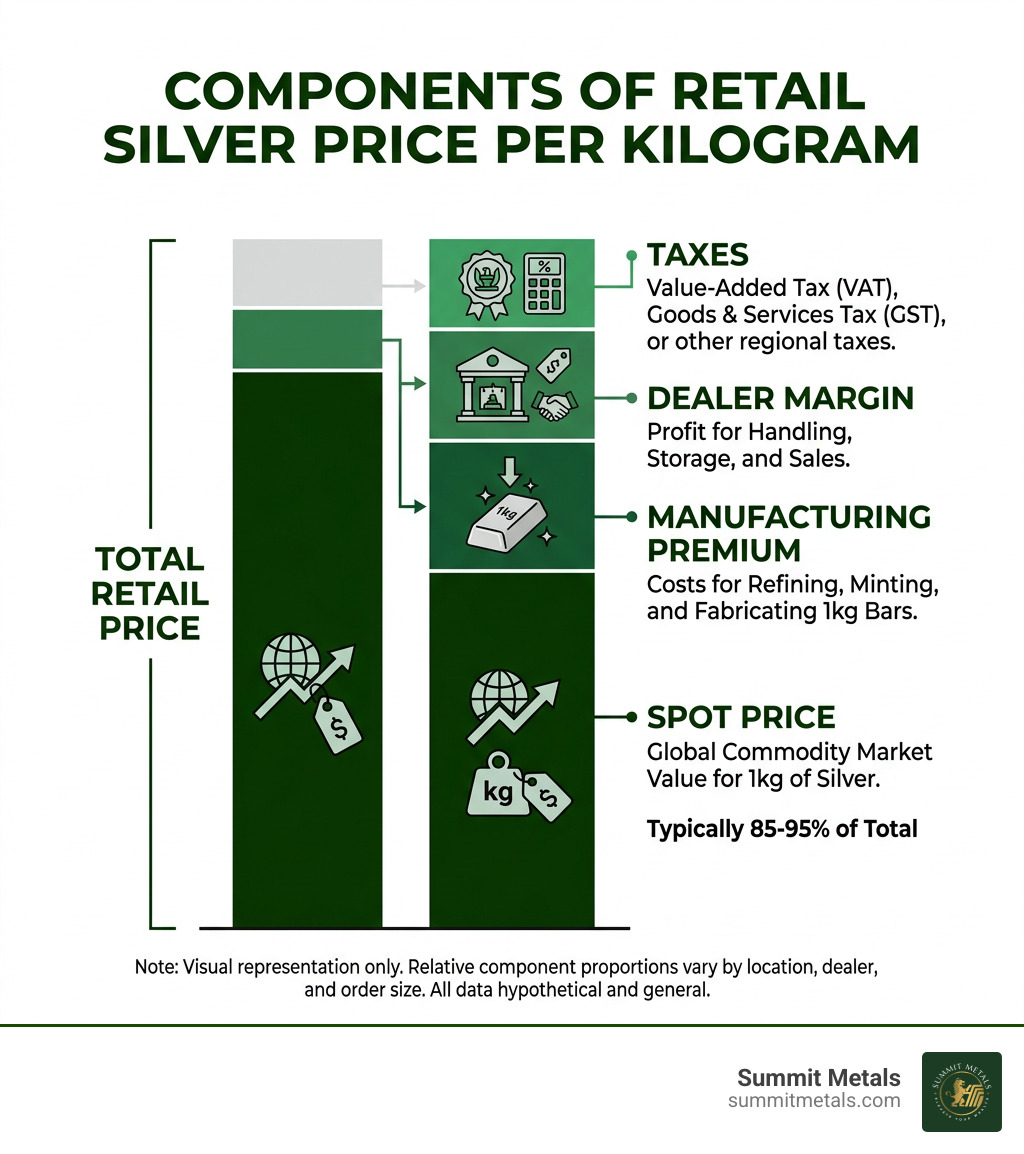
The bottom line: You can never buy physical silver at spot price. The retail rate will always be higher due to manufacturing, dealer margins, and distribution costs. A 1 kg bar is one of the most cost-efficient ways to minimize that gap.
Silver prices have been on a powerful run. From December 2025 to late January 2026, the Delhi kg rate surged over 86%. Globally, silver hit a nominal all-time high of $121.67 per troy ounce on January 29, 2026. Whether you're a first-time buyer or an experienced stacker, tracking the kg rate matters — because even small daily moves translate into significant dollar swings on larger holdings.
This guide walks you through everything: how to read and calculate the rate, what's driving prices right now, where to buy, and — just as importantly — how to sell.
I'm Eric Roach, a former Wall Street investment banker and M&A advisor who has helped clients navigate precious metals markets as part of a broader wealth strategy — including optimizing their kg silver rate exposure inside self-directed IRAs. My institutional background gives me a clear-eyed view of what drives silver pricing and how everyday investors can act on it with confidence.
Understanding the Current kg silver rate and Market Drivers
The kg silver rate isn't just a number on a screen; it’s a reflection of a massive, global tug-of-war between industrial necessity and investor fear. Unlike gold, which is primarily a monetary asset, silver lives a double life.
Industrial Demand: The Green Engine
Silver is the most electrically conductive metal on Earth. This "superpower" makes it indispensable for the green energy revolution.
- Solar Photovoltaics: In 2024, solar demand reached approximately 232 million ounces, a nearly 20% increase year-over-year.
- Electric Vehicles (EVs): A typical EV uses about 1 ounce of silver, roughly double what is found in an internal combustion engine (ICE) vehicle.

Supply Deficits and Market Mechanics
We are currently in a multi-year silver supply deficit. While demand from the solar and automotive sectors is skyrocketing, mining output has remained relatively stagnant or even declined in some regions. This imbalance puts immense upward pressure on the kg silver rate.
The benchmark for pricing is the LBMA silver price, but the day-to-day volatility is largely driven by the COMEX futures market. When investors see geopolitical tensions rise or inflation figures spike, they rush to silver as a hedge, often causing "backwardation"-a market state where the immediate spot price is higher than the future price, signaling a desperate need for physical delivery.
Calculating Your Holdings with the kg silver rate
If you are looking at a global ticker, you’ll likely see silver quoted in troy ounces. To find your value in kilograms, you need the magic number: 32.1507.
- Formula: Spot Price per Ounce x 32.1507 = Spot Price per Kilogram.
When you go to buy or sell, you will encounter the "bid-ask spread." The ask is what you pay to buy it; the bid is what the dealer pays you to buy it back. Understanding this gap is vital for valuing your silver bars accurately.
Factors Influencing the Daily kg silver rate
Several levers move the price daily:
- Geopolitical Tensions: Conflicts or trade tariffs (like those seen in early 2026) cause industrial users to stockpile, draining exchange vaults.
- Central Bank Policies: When the Fed signals a "dovish" stance (lower interest rates), the dollar often weakens, making silver more attractive.
- Mining Output: Labor strikes or regulatory changes in major producing nations like Mexico or Peru can tighten supply instantly.
- Currency Fluctuations: Since silver is priced in USD, a strong dollar can make silver more expensive for international buyers, potentially dampening demand.
Physical vs. Paper: Why 1kg Silver Bars Win
In investing, there is a saying: "If you can't hold it, you don't own it." This is the core argument for physical silver over "paper" silver like ETFs or futures.
Avoiding Counterparty Risk
When you buy a silver ETF, you own a piece of paper that tracks the price. You are relying on the fund manager, the custodian, and the financial system to remain solvent. In a true financial crisis—think back to the collapse of FTX or the 2008 banking crisis—physical silver in your possession (or a private vault) has zero counterparty risk. It is a tangible asset that cannot be "deleted" or devalued by a third party.
The Efficiency of the 1kg Bar
For those looking for cost-efficient wealth storage, the 1kg bar is the "sweet spot." It offers a significantly lower premium than 1oz coins because the manufacturing costs are spread over a larger weight.
However, coins have their own unique benefits, such as legal tender status and face value protection, which can provide an extra layer of security against fraud. Because coins carry a government-mandated face value, they offer a level of legal protection and authenticity that is harder to counterfeit.
| Feature | 1kg Silver Bar | 1oz Silver Coin |
|---|---|---|
| Premium over Spot | Low | High |
| Liquidity | High (in bulk) | Very High (individual) |
| Legal Tender | No | Yes (Face Value) |
| Fraud Protection | Standard | Enhanced (Govt Backed) |
| Storage Density | Excellent | Moderate |
| Best For | Pure weight accumulation | Portability & Legal protection |
Purity Standards for 1kg Silver Bullion
When you buy a 1kg bar, ensure it is ".999 Fine Silver." Look for reputable mint hallmarks and certified silver bars that come with assay certificates. This documentation proves the weight and purity, making it much easier to sell later at the full kg silver rate.
Global Pricing Dynamics: From COMEX to Regional Markets
The kg silver rate you see in Wyoming might differ from the rate in London or Delhi. Why? Because silver is a global commodity subject to local forces.
Regional Variations and Taxes
While the COMEX sets the global "paper" price, physical delivery involves transportation costs, insurance, and local taxes. In India, for example, prices are heavily influenced by import duties and the GST (Goods and Services Tax). During festival seasons like Diwali, local demand can skyrocket, causing regional premiums to jump even if the global spot price remains flat.
Historical Trends in the kg silver rate
Looking at history helps us understand the current bull run.
- 1980: The Hunt Brothers attempted to corner the market, driving prices to a then-record $49.45/oz (roughly $200 in today's inflation-adjusted dollars).
- 2011: The post-recession inflation fears pushed silver back toward $49/oz.
- 2026: We are currently seeing a massive bull run driven by industrial shortages and currency instability, with nominal prices hitting new all-time highs.
For those interested in the macro-trends of silver, our guide to buying big offers deeper insights into how to time these cycles.
Strategic Investing: Gold-to-Silver Ratio and Autoinvest
One of the most powerful tools for any silver investor is the gold-to-silver ratio. This ratio tells you how many ounces of silver it takes to buy one ounce of gold.
Understanding the Ratio
Historically, this ratio has fluctuated. When the ratio is high (e.g., 80:1 or 100:1), silver is considered "cheap" relative to gold. Many savvy investors will swap some of their gold for silver during these times. When the ratio drops (e.g., 40:1 or 50:1), they might swap back to gold, effectively increasing their total ounces of precious metals without adding new capital.
Autoinvest: The 401k for Silver
The biggest mistake investors make is trying to "time" the market perfectly. Instead, we recommend a "Dollar Cost Averaging" approach. Our Autoinvest and subscription buying program allows you to set a monthly budget to buy silver, regardless of the current kg silver rate.
By setting up Autopays with Summit Metals, you accumulate wealth steadily, much like a traditional 401k. When prices are low, your monthly investment buys more silver; when prices are high, it buys less. Over time, this mitigates the risk of buying at a "peak" and ensures your stack keeps growing consistently.
Your Exit Strategy: Storage and Selling Your Silver
Buying silver is only half the battle. You need a plan for how to store it and, eventually, how to turn it back into cash.
Private Vaulting vs. Home Storage
While "stacking" at home is popular, it carries risks of theft or fire. For larger holdings, we recommend private vaulting. Not only is it more secure, but it also makes your silver "liquid." If your silver is stored in a recognized vaulting system, you can often sell it back to us instantly without the need for re-testing or shipping.
How to Sell Your 1kg Silver Bars
When you are ready to harvest your gains, unlocking today's silver value requires a trusted partner. Avoid "we buy gold" shops that offer pennies on the dollar.
At Summit Metals, we pride ourselves on transparency. You can sell to us for competitive rates based on the real-time kg silver rate. We provide a straightforward process for testing purity and issuing payouts, ensuring you get the maximum value for your investment.
Frequently Asked Questions about Silver Rates
How many troy ounces are in a 1kg silver bar?
There are exactly 32.1507 troy ounces in a 1 kilogram bar. A "troy" ounce (31.1g) is heavier than a standard "grocery store" ounce (28.35g).
Why is the retail kg silver rate higher than the spot price?
The spot price is for "paper" silver on an exchange. To get a physical bar into your hands, it must be mined, refined, minted, insured, and shipped. Dealers also add a small margin to stay in business. This total "premium" is why the retail price is higher.
Is it better to buy one 1kg bar or thirty-two 1oz coins?
If your goal is the lowest price per ounce, the 1kg bar is usually better. If you want "barter-ability" or the ability to sell off small portions of your investment over time, the 1oz coins offer more flexibility.
Conclusion
The kg silver rate is a dynamic indicator of global economic health and industrial progress. With supply deficits growing and the "Green Revolution" demanding more silver every day, the long-term outlook for the metal remains compelling.
At Summit Metals, we are committed to helping you navigate this market with ease. Based in Wyoming, we provide authenticated silver with real-time, transparent pricing. Whether you are starting your stack with a single ounce or looking to secure your wealth with bulk 1kg bars, we are here to provide the value and trust you deserve.
Start your silver investment journey today and watch your stack grow with confidence.