Why the 1873 Quarter Eagle Matters to Collectors Today
The 1873 quarter eagle is a $2.50 gold coin that represents one of the most intriguing years in American numismatics. Here's what makes it special:
- Three distinct varieties: Philadelphia Mint 'Open 3' (122,800 minted), Philadelphia Mint 'Closed 3' (55,200 minted), and San Francisco 'S' mint (27,000 minted)
- Composition: 90% gold, 10% copper (0.1209 troy oz of pure gold)
- Rarity: Only about 800 examples survive in all grades; just 10 in MS-65 or better
- Current values: Range from $513 (Very Good-8) to $34,300 (MS-65) as of this publication
- Historical significance: Minted during the Panic of 1873, a major financial crisis
This Liberty Head gold coin was designed by Christian Gobrecht and produced during a turbulent year in American economic history. The coin's small 18mm diameter—about the size of a modern dime—belies its substantial value to collectors and investors alike.
Whether you're building a type set of Pre-1933 U.S. gold coins or seeking a tangible hedge against economic uncertainty, understanding the 1873 quarter eagle helps you make informed decisions. The coin's low survival rates and multiple varieties create unique opportunities for collectors at different price points.
I'm Eric Roach, and I've spent over a decade advising Fortune 500 clients on multi-billion-dollar hedging strategies before channeling that expertise into helping individual investors protect wealth through precious metals like the 1873 quarter eagle. My hands-on experience with rare gold coins shows that historical pieces like this offer both numismatic appeal and intrinsic gold value—a powerful combination for portfolio diversification.
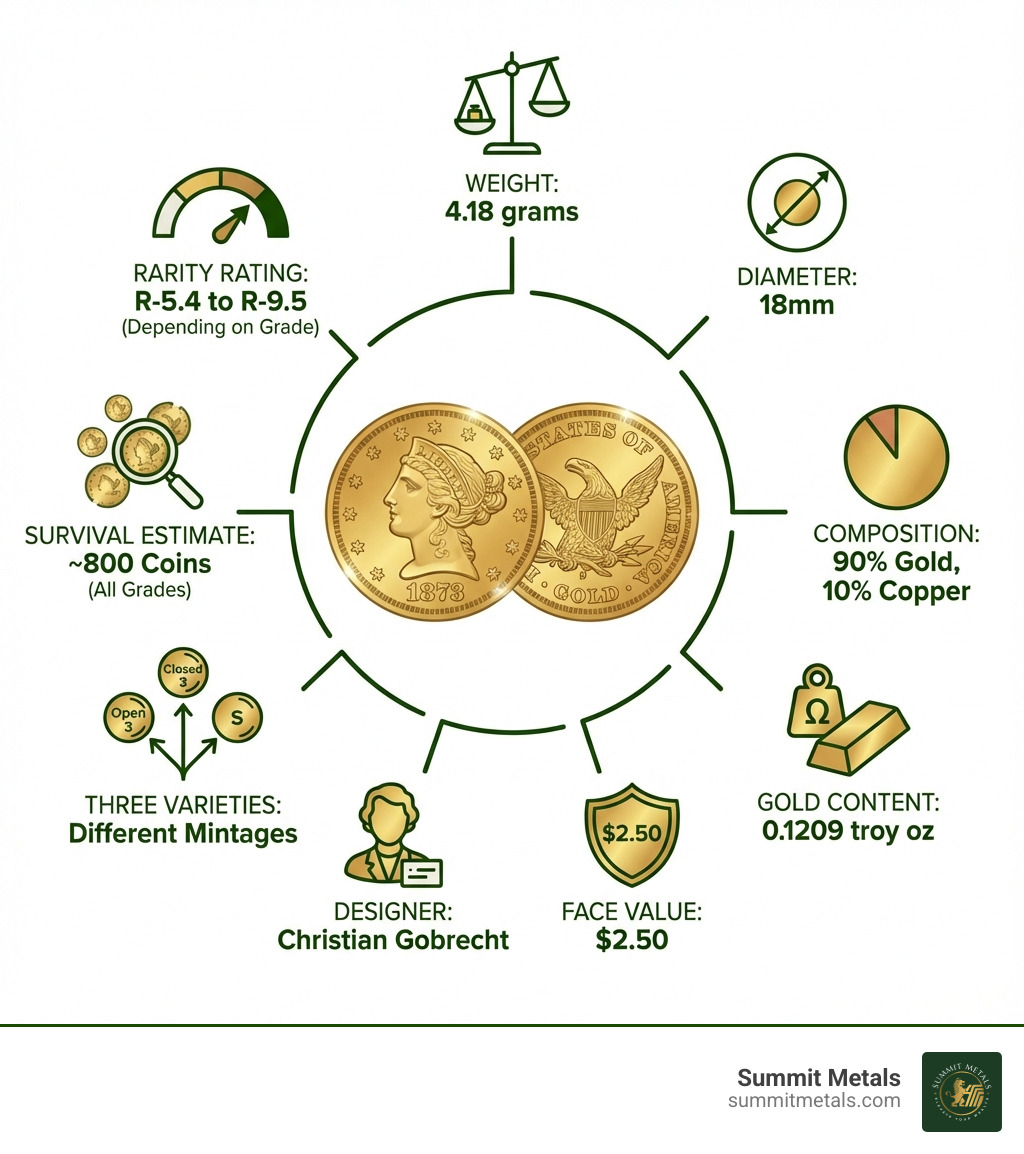
Basic 1873 quarter eagle terms:
Key Characteristics and Specifications
The 1873 quarter eagle coin, a beautiful relic of American coinage, embodies a fascinating blend of artistry, precious metal, and historical context. Understanding its core characteristics is the first step to appreciating its numismatic significance.
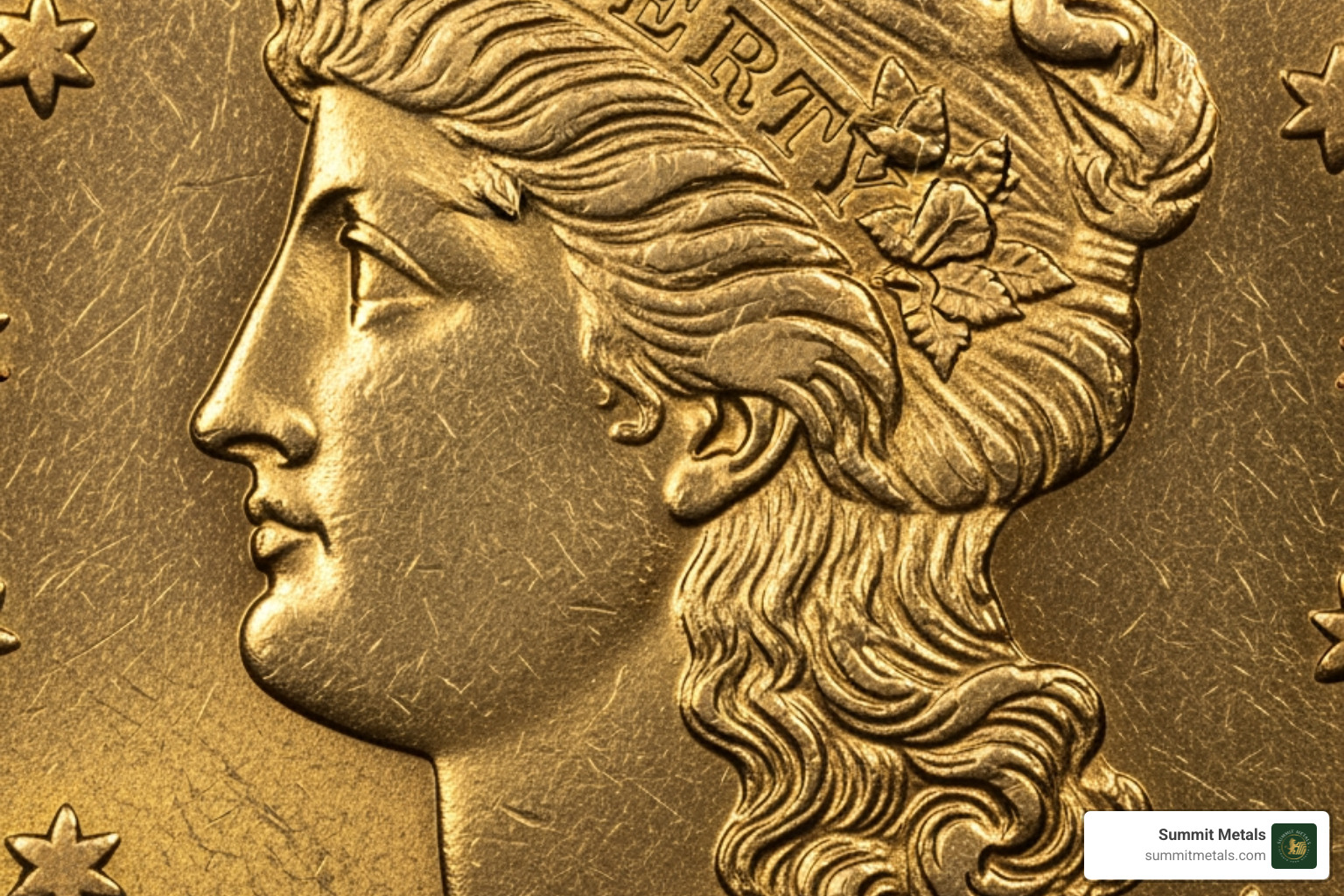
At its heart, the 1873 Liberty Head $2.50 Gold Quarter Eagle is a testament to the enduring vision of its designer, Christian Gobrecht. Gobrecht, renowned for his work on the Seated Liberty coinage, brought a classical aesthetic to this gold piece. The obverse prominently features a left-facing bust of Lady Liberty, her hair neatly tied back, adorned with a coronet inscribed with "LIBERTY." Thirteen stars encircle her portrait, representing the original thirteen colonies—a constant reminder of the nation's foundational principles.
The reverse side of the coin showcases a majestic Heraldic Eagle, its wings spread wide, clutching arrows (symbolizing strength and defense) and an olive branch (representing peace) in its talons. A shield is emblazoned on its breast. Inscriptions around the eagle proudly declare "UNITED STATES OF AMERICA" and the coin's face value, "2 1/2 D."
Beyond its striking visual appeal, the physical composition of the 1873 quarter eagle speaks to its intrinsic value. These coins were minted from "coin gold," a robust alloy comprising 90% gold and 10% copper. This composition ensured durability while maintaining a high precious metal content. Each coin weighs a precise 4.18 grams and measures 18 mm in diameter, making it a small but dense piece of history. The actual gold content in each quarter eagle is approximately 0.1209 troy ounces, giving it a significant melt value even today.
The Enduring Design of Christian Gobrecht
Christian Gobrecht's design for the Liberty Head Quarter Eagle series, which ran from 1840 through 1907, holds a unique place in U.S. numismatic history. It is, in fact, one of the longest-running coin designs produced without any changes—a remarkable 67 years! His Lady Liberty profile, with her serene expression and coronet inscribed "LIBERTY," became an iconic representation of American ideals. The surrounding thirteen stars were not merely decorative but carried the weight of the nation's origin story, linking the coin directly to the birth of the United States.
The Heraldic Eagle on the reverse is equally symbolic. This powerful bird, a national emblem, conveys messages of both readiness for defense and a desire for peace through the arrows and olive branch it holds. The meticulous detailing of the eagle, from its feathers to the national shield, reflects the high standards of U.S. Mint artistry during that era. This design's longevity and classic beauty have made the Liberty Head Quarter Eagle a favorite among collectors, and the 1873 quarter eagle stands as a particularly interesting example within this celebrated series.
Why Gold Coins Can Be a Secure Investment
When considering precious metals, many investors weigh the options between gold coins and gold bars. While both offer the inherent value of gold, gold coins, especially historical ones like the 1873 quarter eagle, present unique advantages that can improve their security and investment appeal.
| Feature | Gold Coins (e.g., 1873 Quarter Eagle) | Gold Bars |
|---|---|---|
| Face Value | Yes ($2.50 for Quarter Eagle) | No |
| Legal Tender | Yes | No (bullion only) |
| Government Guarantee | Backed by the U.S. government for face value and authenticity | Backed by manufacturer/refiner |
| Numismatic Premium | Significant potential for value beyond melt due to rarity, history, condition | Primarily tied to spot price of gold |
| Divisibility | Smaller units often more liquid | Larger units can be less liquid |
| Counterfeit Protection | Easier to authenticate with numismatic features, grading, and government marks | Can be susceptible to sophisticated counterfeiting; relies on assay reports |
As we can see, gold coins offer distinct benefits that gold bars typically do not. The presence of a face value, however small, means that the coin is legal tender, backed by the U.S. government. This provides a layer of security and official recognition that simple bullion bars lack. Furthermore, the numismatic value of a coin like the 1873 quarter eagle can far exceed its melt value, offering potential for greater appreciation. This historical and collectible aspect means that even if gold prices fluctuate, the coin's rarity and desirability can bolster its worth.
For investors in Salt Lake City, Utah, and across the nation, this dual appeal of intrinsic gold value and numismatic premium makes rare gold coins an attractive component of a diversified portfolio. They are not just metal; they are tangible pieces of history, protected by a government guarantee, and often easier to authenticate than generic bullion. This inherent fraud protection, stemming from their detailed designs and official minting, provides peace of mind.
At Summit Metals, we understand the long-term value of building a robust precious metals portfolio. That's why we encourage our clients to explore options like our Autoinvest program—dollar cost average by shopping monthly with Summit Metals, just like investing in a 401k. This strategy allows you to steadily accumulate valuable assets, including historical gold coins, smoothing out market fluctuations and leveraging the power of consistent investment.
Mintage and Varieties: The 1873 Quarter Eagle
The year 1873 was a pivotal one for U.S. coinage, marked by significant legislative changes and economic upheaval. For collectors of the 1873 quarter eagle, this year is particularly notable due to the distinct varieties produced and the relatively low mintage figures for certain issues. These coins were struck at two primary locations: the Philadelphia Mint (without a mint mark) and the San Francisco Mint (bearing an 'S' mint mark).
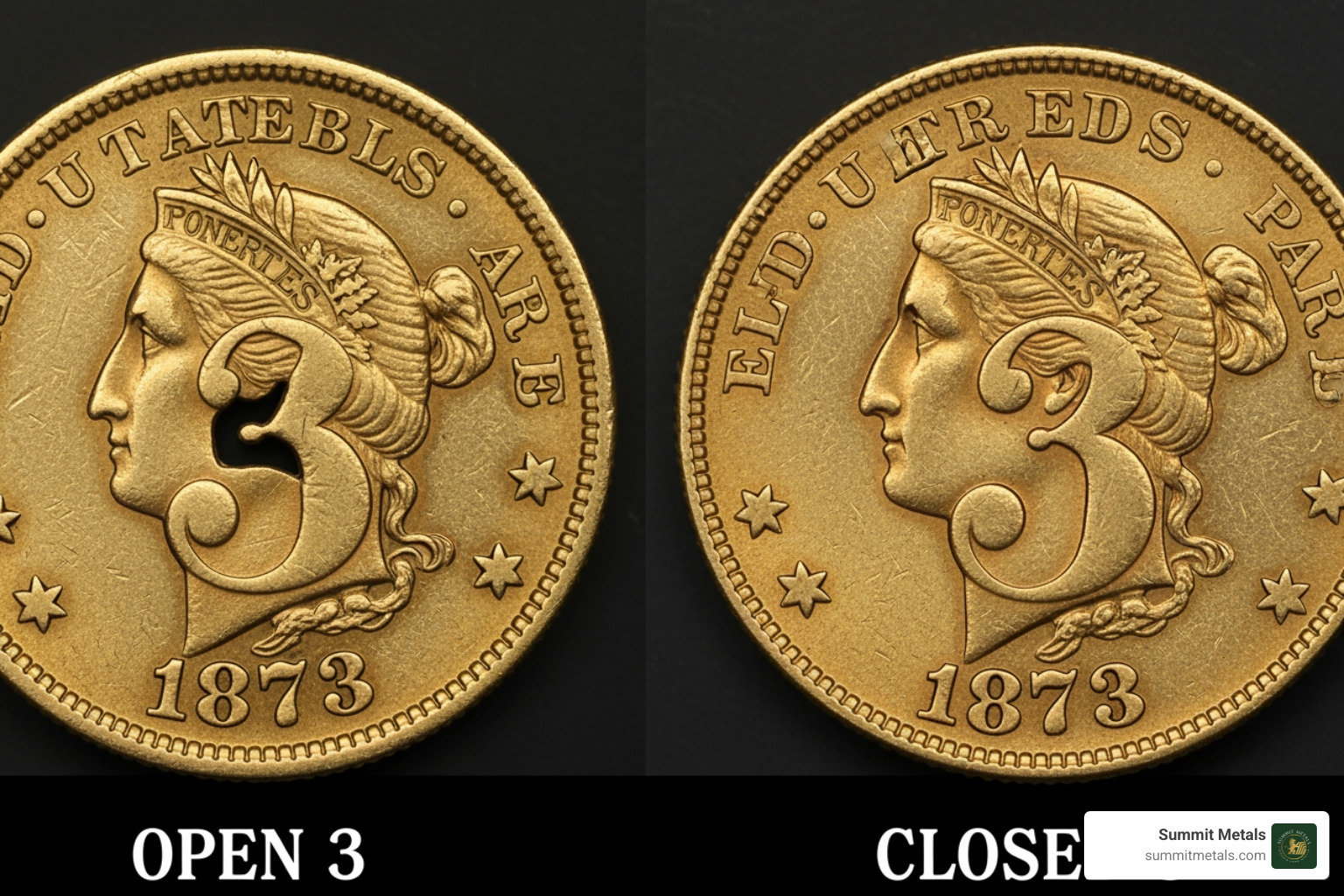
The Coinage Act of 1873 brought about substantial reforms to the U.S. monetary system, including the demonetization of silver dollars and a shift towards a gold standard. While this act primarily impacted silver coinage, it set a tone of change that permeated all mint operations. For the 1873 quarter eagle, this period of transition resulted in fascinating numismatic variations, particularly from the Philadelphia Mint, which produced both 'Open 3' and 'Closed 3' varieties of the coin.
The Philadelphia Mint: 'Open 3' vs. 'Closed 3'
The Philadelphia Mint's production of the 1873 quarter eagle is famous for its two distinct varieties, commonly referred to as the 'Open 3' and 'Closed 3'. These distinctions refer to the appearance of the last digit in the date "1873."
The 'Open 3' variety is characterized by a "3" where the top and bottom loops have small balls, and the opening between these loops is wide enough for them to pass through. This gives the "3" a more open, spacious appearance. The estimated mintage for the 'Open 3' variety was around 122,800 pieces, making it the more common of the two Philadelphia issues.
Conversely, the 'Closed 3' variety features a "3" with larger balls at the top and bottom loops, and the opening is so constricted that these balls appear to almost touch or merge, creating a much narrower, "closed" appearance. The mintage for the 'Closed 3' is significantly lower, estimated at 55,200 pieces.
Numismatic experts, such as David Akers and Gordon Wrubel, have extensively studied these varieties. Akers estimated the total mintage for the 1873 Open 3 Quarter Eagle to be around 125,000 pieces. Wrubel notes that the 'Open 3' is generally more common, both overall (about 30% more) and in Mint State (about 40% more common). However, interestingly, in the very highest grades (like MS-66), the rarity of 'Open 3' and 'Closed 3' tends to equalize. This subtle difference in the digit's design creates a captivating chase for collectors and significantly impacts the coin's value. You can dig deeper into these fascinating distinctions and their impact on rarity through NGC's analysis of the 1873 varieties.
The San Francisco Mint: The 1873-S
While the Philadelphia Mint captured attention with its 'Open 3' and 'Closed 3' variations, the San Francisco Mint produced a single, yet equally important, version of the 1873 quarter eagle – the 1873-S. Identifiable by the small 'S' mint mark located on the reverse, below the eagle, this coin stands out due to its remarkably low mintage figure. Only 27,000 pieces were struck at the San Francisco Mint in 1873.
This significantly lower mintage, especially compared to the combined Philadelphia output, automatically designates the 1873-S as a key date for the year. Its scarcity means that survival rates are even lower than its Philadelphia counterparts. While our overall estimate suggests about 800 surviving 1873 Quarter Eagles across all grades, the 1873-S contributes a smaller portion to this total. In higher grades, particularly Mint State examples, the 1873-S becomes exceptionally rare and highly sought after by collectors. This rarity translates directly into higher values, making it a prized acquisition for those looking to complete a comprehensive collection of Liberty Head Quarter Eagles. To explore more about this elusive coin, you can learn more about the 1873-S Quarter Eagle.
Historical Context: A Year of Financial Turmoil
The year 1873 was etched into American history not just by its coinage, but by a severe economic downturn known as the Panic of 1873. This financial crisis, triggered by a combination of factors including the post-Civil War economic boom, over-speculation in railroads, and a contraction of the money supply, led to a prolonged depression. For the 1873 quarter eagle, this period of turmoil had a profound impact on its circulation and subsequent survival.
During times of economic instability, gold coins often served as a safe haven, but they were also susceptible to melting. As confidence in paper currency wavered, some gold coins were hoarded, while others were melted down for their intrinsic metal value or exported. This phenomenon, coupled with subsequent large-scale melting of U.S. gold coins, particularly during the early 20th century, significantly reduced the number of surviving pieces from this era. The fact that only an estimated 800 1873 quarter eagle coins survive today, from an original combined mintage of over 200,000, underscores the destructive power of these historical events.
The U.S. adherence to the gold standard further intertwined the fate of these coins with economic cycles. The stability provided by a gold-backed currency was a double-edged sword: while it instilled confidence, it also meant that when the market value of gold fluctuated, coins could be profitably melted or exported, thus removing them from circulation. For collectors, understanding this historical context adds a layer of depth to each surviving 1873 quarter eagle, changing it from a mere coin into a tangible link to a turbulent chapter of American economic history.
Valuing and Collecting the 1873 Quarter Eagle
Collecting the 1873 quarter eagle is a rewarding pursuit, combining the thrill of history with the appreciation of numismatic art. However, understanding its value requires a grasp of coin grading, market trends, and the specific nuances of this particular year's issues.
Coin grading is paramount in determining value. The universally accepted Sheldon Scale, ranging from 1 (Poor) to 70 (Perfect Mint State), provides a standardized way to assess a coin's condition. For the 1873 quarter eagle, this scale is critical, as even slight differences in wear or preservation can dramatically alter its worth.
Circulated grades, such as Very Fine (VF) and Extra Fine (XF), indicate coins that saw some use but retain significant detail. Uncirculated grades, often denoted as Mint State (MS) followed by a number (e.g., MS-60, MS-65), represent coins that show no signs of wear from circulation. Proof issues, specially struck for collectors with highly polished dies and blanks, are extremely rare for this year and command premium prices.
Factors affecting the value of an 1873 quarter eagle include its specific variety ('Open 3', 'Closed 3', or 'S' mint), its condition (grade), overall rarity, and current market demand. Prices can fluctuate based on auction results, dealer inventories, and the general health of the precious metals market.
Approximate Values and Rarity
The 1873 quarter eagle is a coin of considerable rarity, particularly in higher grades. Our research indicates a numismatic rarity rating of R-5.4 for all grades, climbing to R-9.5 for coins graded MS-65 or better. This means that finding a top-tier example is an exceedingly difficult task.
To give you an idea of the current market, here are approximate values for the 1873 quarter eagle across different condition grades. Prices shown are at the time of this publication and are indicative, as actual market values can vary based on specific coin characteristics, market demand, and seller.
| Grade | 1873 (P) Open 3 (Approx. Value) | 1873 (P) Closed 3 (Approx. Value) | 1873-S (Approx. Value) |
|---|---|---|---|
| Very Good-8 (VG-8) | $513 | $513 | $513 |
| Fine-12 (F-12) | $542 | $542 | $542 |
| Very Fine-20 (VF-20) | $512 | $540 | $540 |
| Extra Fine-40 (XF-40) | $628 | $628 | $628 |
| Almost Uncirculated-50 (AU-50) | $780 | $780 | $780 |
| Uncirculated (UNC) | $1,798 | $1,798 | $1,798 |
| Mint State-63 (MS-63) | $6,125 | $6,125 | $6,125 |
| Mint State-64 (MS-64) | $14,800 | $14,800 | $14,800 |
| Mint State-65 (MS-65) | $34,300 | $34,300 | $34,300 |
| Mint State-66 (MS-66) | $6,462.50 (auction example for a similar year) | - | $34,300 (estimate) |
Note: The MS-66 value for the 1873 (P) Open 3 is based on an auction record for a similar Liberty Head Quarter Eagle from 1893, indicating the potential for high-grade pieces.
The survival estimates paint a stark picture of rarity: only about 800 1873 quarter eagle coins are believed to exist across all grades. Even more striking, merely 10 examples are estimated to survive in MS-65 or better condition. This extreme scarcity for high-grade pieces makes them highly sought after by collectors aiming for the condition census, which tracks the finest known examples of a particular coin. Notable auction records, such as an 1873 Open 3 PCGS MS66 CAC selling for a significant sum, highlight the intense competition for these numismatic treasures.
Where to Buy and Sell the 1873 Quarter Eagle
Acquiring an 1873 quarter eagle requires diligence and a keen eye, while selling one demands transparency and knowledge of the market. We always recommend dealing with reputable coin dealers and established auction houses, whether you're buying or selling. These professionals can provide expertise, authentication, and fair market pricing. Online marketplaces can also be a source, but always prioritize sellers who provide clear images and have coins professionally graded.
Authentication services like PCGS (Professional Coin Grading Service) and NGC (Numismatic Guaranty Corporation) are indispensable. A coin encapsulated in a "slab" from one of these services guarantees its authenticity and assigned grade, providing peace of mind for both buyers and sellers. Building a collection of such historical pieces means investing in verified quality.
Here are some tips for buying rare gold coins:
- Do your research: Understand the specific varieties, mintages, and historical context of the coins you're interested in.
- Set a budget: Rare coins can be expensive; know what you're willing to spend.
- Prioritize condition: Higher grades generally command higher prices and tend to appreciate more.
- Seek professional grading: Always opt for coins graded by PCGS or NGC.
- Buy from reputable sources: Work with dealers or auction houses with a proven track record.
At Summit Metals, we pride ourselves on transparent, real-time pricing and competitive rates for authenticated gold and silver precious metals. If you're looking to acquire or divest of historical gold coins, our team is here to assist you. Ready to sell your gold coins?. We ensure a smooth and secure process, offering fair value for your precious metals.
Frequently Asked Questions about the 1873 Quarter Eagle
We often encounter common questions from collectors and investors interested in the 1873 quarter eagle. Here are some of the most frequent inquiries:
How can I tell if my 1873 Quarter Eagle is an 'Open 3' or 'Closed 3'?
Distinguishing between the 'Open 3' and 'Closed 3' varieties of the 1873 Philadelphia Mint quarter eagle is crucial for collectors. The easiest way to tell them apart is by carefully examining the last digit of the date, "3," preferably with a coin loupe. The 'Open 3' has a wider gap between the two ends of the digit '3', with small balls at the top and bottom loops that appear distinct and separated. In contrast, the 'Closed 3' has a much narrower gap, with larger balls at the ends of the loops that are so constricted they almost touch or appear merged. Think of the 'Open 3' as having a more pronounced, airy space within the curve of the "3," while the 'Closed 3' looks more compact and condensed.
Is the 1873 Quarter Eagle a good investment?
Yes, the 1873 quarter eagle can be an excellent investment, offering a compelling blend of intrinsic and numismatic value. Due to its 90% gold content, it holds inherent value tied to the fluctuating price of gold. Beyond its metal content, its numismatic rarity, especially for the 1873-S mint mark and high-grade examples, gives it significant potential to appreciate in value over time. The historical context of its mintage during the Panic of 1873 also adds to its appeal. For those seeking both a tangible asset and a piece of history, it's a popular choice for both collectors and investors. To build your gold holdings steadily and leverage the benefits of dollar-cost averaging, consider using Summit Metals' Autoinvest program to acquire precious metals over time.
How many 1873 Quarter Eagles were made?
The total mintage for the 1873 quarter eagle was split between two mint locations and two varieties from Philadelphia:
- The Philadelphia Mint produced a combined total of approximately 178,000 coins. This was split into two varieties:
- The 'Open 3' variety had an estimated mintage of about 122,800 pieces.
- The 'Closed 3' variety had an estimated mintage of about 55,200 pieces.
- The San Francisco Mint (1873-S) produced a much smaller run of 27,000 coins. These figures highlight the relative scarcity of the 1873-S and the 'Closed 3' Philadelphia variety compared to the 'Open 3' from Philadelphia.
Conclusion: The Legacy of a Historic Coin
The 1873 quarter eagle stands as a compelling artifact, embodying a unique confluence of artistic design, precious metal composition, and turbulent American history. From Christian Gobrecht's enduring Liberty Head design to the distinct 'Open 3' and 'Closed 3' Philadelphia varieties, and the elusive 1873-S from San Francisco, each coin tells a story of a pivotal year. Its inherent gold content ensures a foundational value, while its numismatic rarity, especially in higher grades, offers significant investment potential.
For collectors and investors alike, the 1873 quarter eagle offers more than just a financial asset; it's a tangible piece of American history, a small but mighty witness to the economic shifts and artistic prowess of its era. At Summit Metals, we understand the allure of such historical treasures and are dedicated to providing authenticated precious metals that offer both security and a connection to the past. We believe that incorporating such storied pieces into your portfolio, perhaps through a consistent strategy like our Autoinvest program, can enrich your holdings both financially and historically.
As a tangible piece of American history, the 1873 Quarter Eagle offers a unique story of a pivotal year. We invite you to explore our collection of American Eagle coins and find more about the fascinating world of U.S. gold coinage.