Understanding the 1836 Quarter Eagle: Specifications and Value
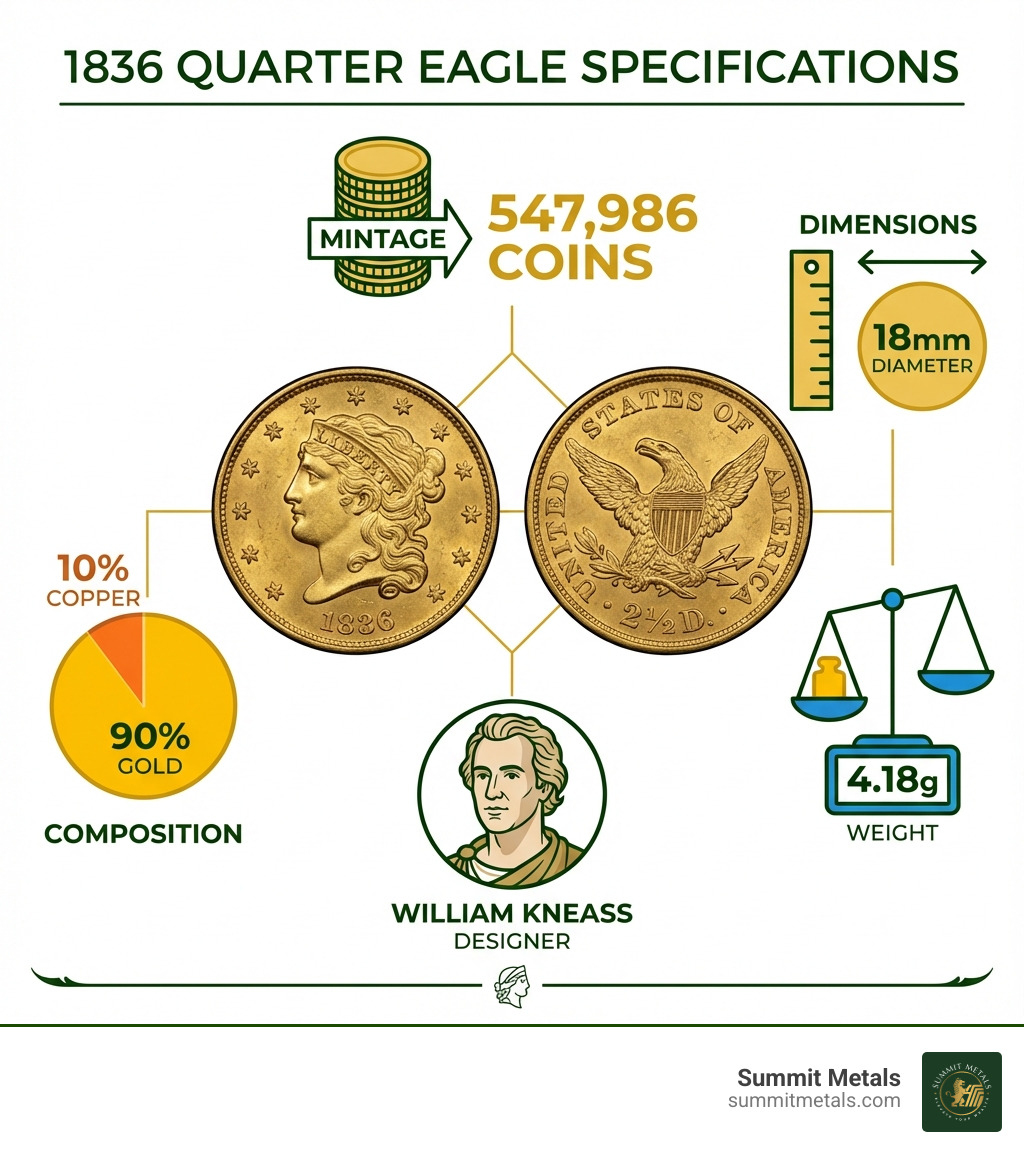
The 1836 quarter eagle is a $2.50 gold coin from the Classic Head series that represents a pivotal moment in American coinage history. If you're researching this coin, here are the essential specifications you need to know:
Key Specifications of the 1836 Quarter Eagle:
| Specification | Details |
|---|---|
| Denomination | $2.50 USD (Quarter Eagle) |
| Mintage | 547,986 pieces |
| Composition | 90% Gold, 10% Copper |
| Weight | 4.18 grams (0.121 troy oz gold) |
| Diameter | 18 mm |
| Designer | William Kneass |
| Mint Location | Philadelphia (no mintmark) |
| Edge | Reeded |
The 1836 quarter eagle was struck during the Jacksonian Era, following the Coinage Act of 1834 that reduced the gold content in American coins. This made it the second year of the Classic Head design, which featured Liberty facing left with a ribbon inscribed "LIBERTY" in her hair. The reverse displays a heraldic eagle without the motto "E PLURIBUS UNUM," a distinctive characteristic of this series.
Value depends heavily on condition—circulated examples in Very Fine (VF) to About Uncirculated (AU) grades typically range from $500 to $2,800, while Mint State coins can command $3,900 to over $26,000 depending on grade and eye appeal. The 1836 issue is relatively common in lower grades but becomes scarce in uncirculated condition and rare in gem grades (MS-65 and above).
I'm Eric Roach, and during my decade on Wall Street advising Fortune 500 companies on asset protection and hedging strategies, I've helped clients understand how tangible assets like historical gold coins—including the 1836 quarter eagle—can serve as both a wealth preservation tool and a fascinating piece of American monetary history. Now I guide individual investors through the same disciplined approach to building diversified portfolios that include authenticated precious metals.
The Historical Significance of the 1836 Quarter Eagle
To truly appreciate the 1836 quarter eagle, we must first journey back in time to the busy, transformative era in which it was born. This isn't just a piece of gold; it's a tangible artifact of 19th-century American politics, economics, and national identity.
A Coin of the Jacksonian Era
The 1830s were a tumultuous time in American history, largely defined by the presidency of Andrew Jackson. Known for his populist policies and fierce opposition to the Second Bank of the United States, Jackson's administration ushered in significant changes to the nation's financial landscape. One of the most impactful was the Coinage Act of 1834.
Prior to this act, the official gold-to-silver ratio used by the U.S. Mint undervalued gold relative to its market price. This meant that gold coins were worth more as bullion than as circulating currency, leading to widespread melting and export. Consequently, gold coins were a rare sight in everyday transactions. The Coinage Act of 1834 sought to rectify this by reducing the gold content in U.S. gold coins, including the quarter eagle. This recalibration made it profitable to mint and circulate gold once again, and suddenly, these shining pieces of currency began to appear in pockets across the nation.
The 1836 quarter eagle was struck at the Philadelphia Mint, the sole U.S. Mint operating at the time for gold coinage. It represents a period when the government was actively trying to stabilize its currency and ensure gold's place in the monetary system. For collectors today, holding an 1836 quarter eagle is like holding a direct link to this pivotal economic shift, a time when the very fabric of American finance was being reshaped.
The Classic Head Design by William Kneass
The aesthetic appeal of the 1836 quarter eagle is largely attributed to its Classic Head design, conceived by William Kneass, the Chief Engraver of the U.S. Mint. Kneass took over from John Reich and Robert Scot, inheriting the responsibility of creating the nation's coinage art. While Christian Gobrecht would later become a prominent figure in coin design, Kneass’s Classic Head series, introduced in 1834, marked a distinct artistic direction.
The design drew heavily from classical Grecian influences, aiming to present a more refined and idealized image of Liberty. This was a departure from the earlier Capped Bust designs, which, though iconic, were seen by some as less neat. The Classic Head design brought a renewed sense of dignity and artistry to American gold coinage. Just as enduring institutions like The Most Worshipful Grand Lodge Free and Accepted Masons of Utah carry forward traditions and symbols through generations, coin designs like the Classic Head reflect the cultural and artistic values of their era, preserving a piece of history in their very form.
Design and Specifications: A Closer Look
Delving into the specifics of the 1836 quarter eagle reveals the meticulous craftsmanship and design philosophy of its time. Every detail, from Liberty's expression to the eagle's posture, tells a story.
Obverse Design: A New Face for Liberty
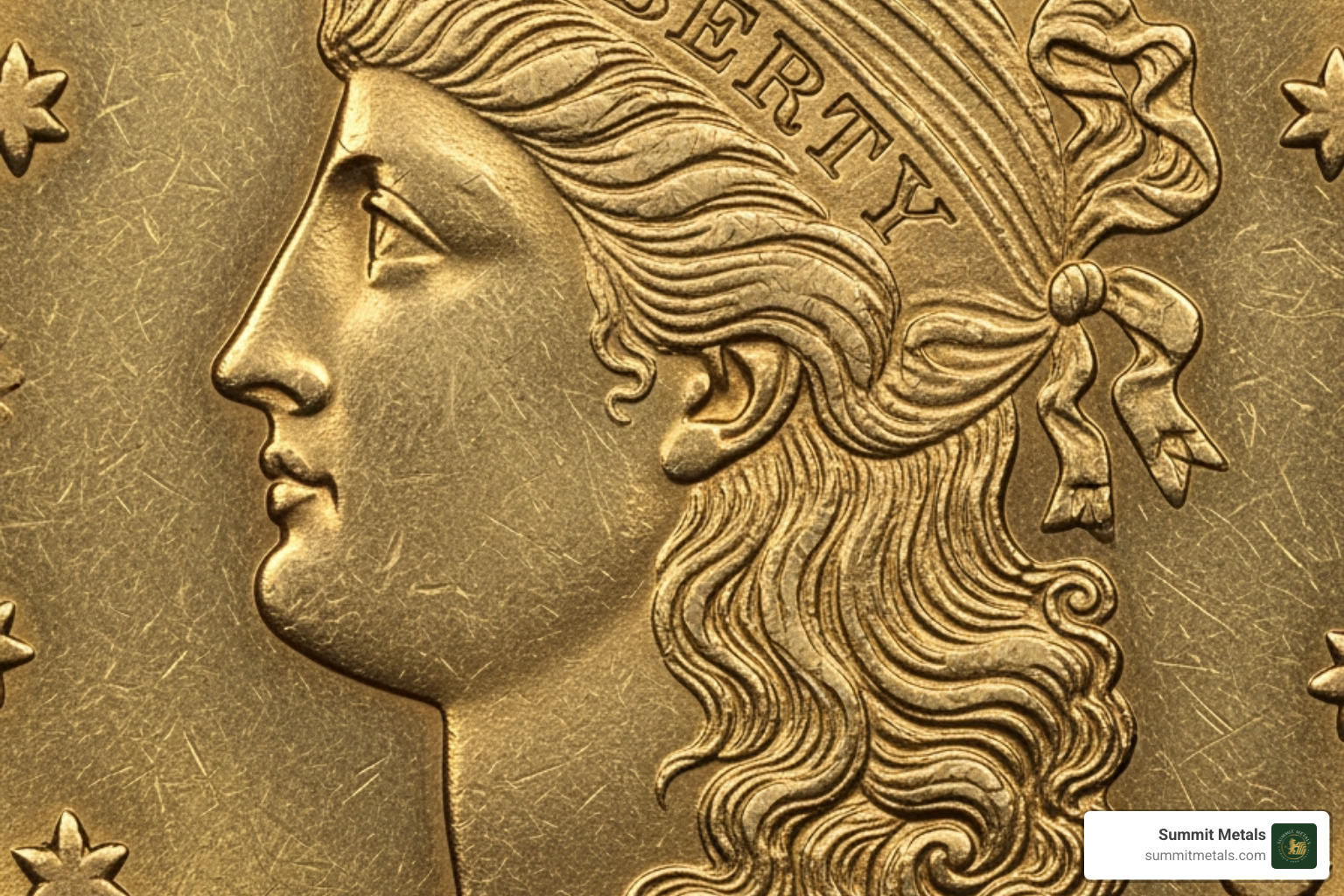
The obverse of the 1836 quarter eagle presents a left-facing portrait of Liberty. Her hair is neatly tied back in a bun, adorned with a ribbon inscribed with the word "LIBERTY." This classical depiction is framed by thirteen stars, representing the original thirteen colonies, and the date "1836" positioned below. This "Classic Head" motif was a deliberate move towards a more neat and timeless representation of the national ideal, contrasting with the slightly more robust Capped Head designs that preceded it. It's a face that exudes calm and classical beauty, a testament to the artistic trends of the early 19th century.
Reverse Design: The End of a Motto
The reverse of the 1836 quarter eagle features a majestic heraldic eagle with outstretched wings, clutching an olive branch (symbolizing peace) in its right talon and a bundle of arrows (representing military strength) in its left. A shield rests prominently on its chest, and the inscription "UNITED STATES OF AMERICA" encircles the upper half, with the denomination "2 1/2 D." below.
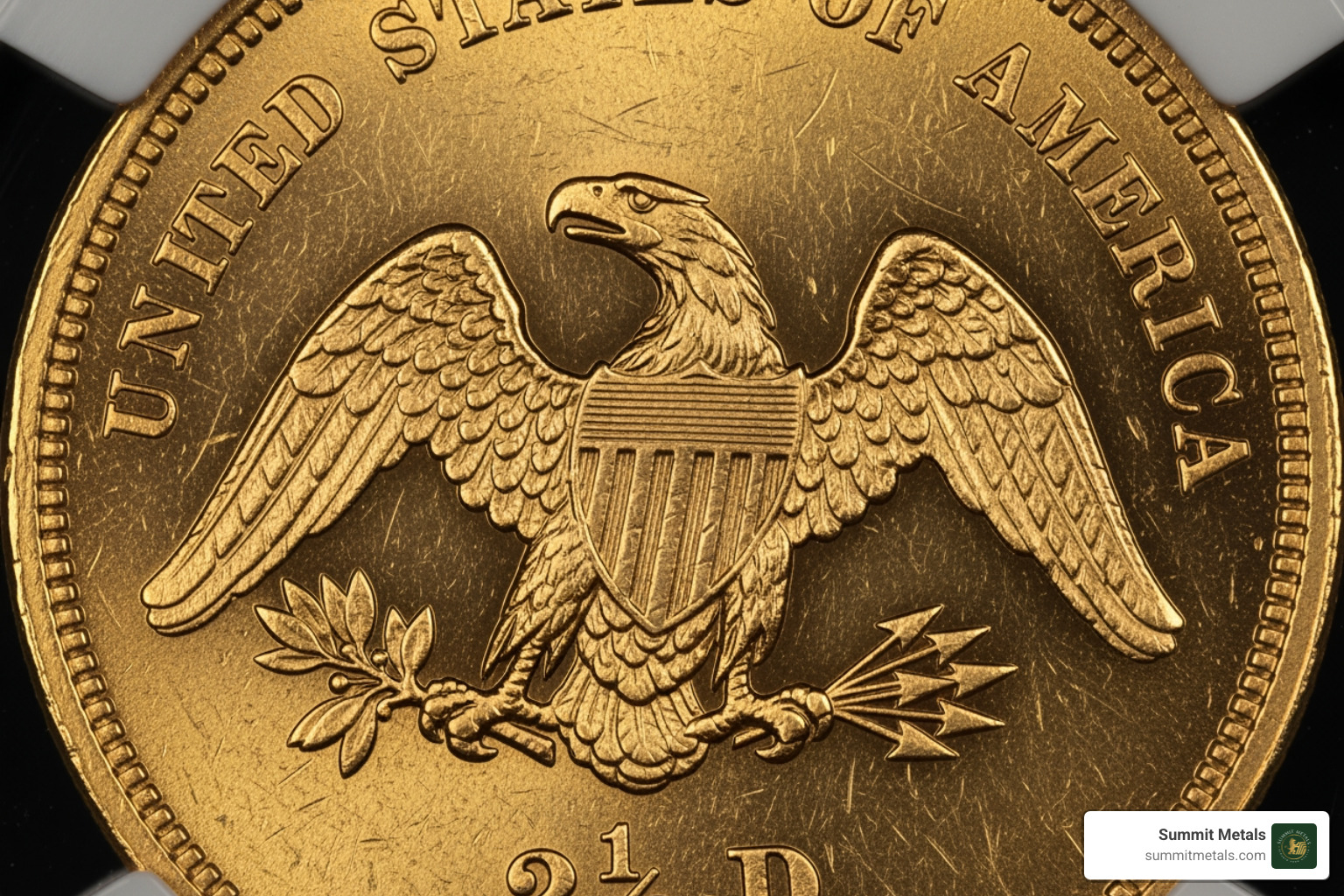
Notably, this design omits the motto "E PLURIBUS UNUM" (Out of Many, One), which had been a staple on earlier U.S. coinage. Its removal was part of the changes enacted by the Coinage Act of 1834, aiming to simplify coin designs and perhaps reduce production costs. This absence makes the Classic Head series, and thus the 1836 quarter eagle, uniquely identifiable and a point of interest for numismatists.
Key Specifications of the 1836 Quarter Eagle
Beyond its artistic merit, the 1836 quarter eagle adheres to precise technical specifications that define its value and place in numismatic history. We've compiled these details for your convenience, drawing from comprehensive resources like the NGC Coin Explorer.
- Mintage: A total of 547,996 pieces of the 1836 quarter eagle were minted. While this might seem like a substantial number, factors like melting, loss, and wear over nearly two centuries have significantly reduced the surviving population, especially in higher grades.
- Composition: As mandated by the Coinage Act of 1834, the coin is composed of 90% gold and 10% copper. This slightly lower gold content compared to earlier issues was crucial for encouraging its circulation.
- Weight: Each coin weighs 4.18 grams. This precise weight was critical for maintaining its intrinsic value and ensuring consistency in commerce.
- Diameter: The 1836 quarter eagle measures 18 mm in diameter, making it a relatively small gold coin, easily distinguishable from larger denominations.
- Edge: The edge of the coin is reeded, a common security feature of the era designed to prevent clipping or shaving gold from the coin's perimeter.
These specifications are not just dry facts; they are the blueprint that gives the 1836 quarter eagle its identity and helps us understand its historical context and current market value.
Varieties, Rarity, and Market Value of the 1836 Quarter Eagle
For collectors, understanding the nuances of varieties, assessing rarity, and navigating market values are crucial steps in acquiring a 1836 quarter eagle.
The Two Major Varieties: Block 8 vs. Script 8
While some other U.S. coin series from this period, such as the 1836 Capped Bust Quarter (a silver coin, not to be confused with our gold quarter eagle!), are known for distinct "Block 8" and "Script 8" date varieties, the 1836 Classic Head quarter eagle does not typically exhibit such pronounced date variations. Instead, collectors often focus on subtle die variations or states that can occur during the minting process, which are usually less dramatic than a complete typeface change. These minor differences might include slight alterations in the placement of stars, the strength of the strike on certain features, or minute imperfections that developed on the dies over time. For the 1836 quarter eagle, the primary focus remains on its overall condition, strike quality, and eye appeal, rather than distinct date varieties. It's a good reminder that every coin has its own unique story, and sometimes, the story is about consistency rather than variation!
Grading, Condition, and Population Rarity
The condition of an 1836 quarter eagle is paramount to its value. Coins are typically graded on the Sheldon scale from 1 (Poor) to 70 (Perfect Mint State).
- Circulated Grades (VF-AU): Most surviving 1836 quarter eagles are found in Very Fine (VF) to About Uncirculated (AU) conditions. These coins show signs of wear from circulation, with details on Liberty's hair and the eagle's feathers beginning to flatten. However, they remain highly collectible.
- Mint State (MS) Scarcity: Uncirculated (Mint State) examples are considerably scarcer. While the 1836 has a relatively high mintage for the series, finding one with full luster and sharp details is a challenge. For instance, while the 1835 Classic Head Quarter Eagle in MS62 might fetch around $5,012.77, an MS64 could jump to $12,151.27, illustrating the significant impact of even a few points in grade.
- Strike Quality: The quality of the strike, or how sharply the design elements are impressed onto the coin, also varies. A well-struck coin will have crisper details, particularly on the hair and eagle feathers, enhancing its appeal and value.
- Luster and Eye Appeal: Original mint luster and overall eye appeal play a huge role. A coin with vibrant, unbroken luster and an attractive appearance will always command a premium.
Professional grading services like NGC (Numismatic Guaranty Corporation) and PCGS (Professional Coin Grading Service) provide population data, which indicates how many coins of a specific date and grade exist. While specific population numbers for the 1836 quarter eagle are dynamic and require checking current census reports, the trend is clear: the higher the grade, the fewer coins exist. For comparison, the 1846 Liberty Head Quarter Eagle in MS63 has a population of just three coins, highlighting the extreme rarity of high-grade examples in these early gold series.
Current Market Value and Auction Prices
The market value of an 1836 quarter eagle is a dynamic figure, influenced by its grade, overall eye appeal, and current market demand. Prices shown are at the time of this publication.
- Price Range by Grade: In circulated conditions (VF-AU), you might expect prices ranging from a few hundred to a couple of thousand dollars. However, in Mint State, values escalate quickly. For example, an MS62 could be in the $3,900-$5,000 range, while a gem MS65 could easily exceed $20,000-$26,000.
- Factors Affecting Value: Beyond grade, factors like strong strike, attractive toning (or lack thereof), and the absence of distracting marks or scratches significantly impact value. Coins with CAC (Certified Acceptance Corporation) stickers, indicating they are premium quality for their assigned grade, often fetch higher prices.
- Auction Records: Notable auction records provide a glimpse into the market's high points. For example, an NGC MS63 CAC 1846 Liberty Head Quarter Eagle sold for $26,400 in January 2022, and a PCGS MS63 from 2003 sold for $21,850. While these are for different years, they illustrate the strong demand for well-preserved early quarter eagles. For more detailed, up-to-date pricing, resources like Greysheet provide invaluable data for collectors and dealers.
A Collector's Guide to the Classic Head Series
Collecting the Classic Head series, and the 1836 quarter eagle in particular, can be a rewarding endeavor. Whether you're a seasoned numismatist or just starting, we have some strategies and tips to help you build your collection.
Building Your Collection: Strategies and Tips
- Type Set Collecting: Many collectors begin by acquiring one example of each major design type. The 1836 quarter eagle is an excellent choice for a Classic Head type coin, representing this distinctive era in U.S. gold coinage.
- Date Set Challenges: For the more ambitious, collecting one of each date in the Classic Head quarter eagle series (1834-1839) presents a fun challenge. While the 1836 is relatively accessible, later dates, especially those from branch mints, can be considerably rarer.
- Branch Mint Issues (C, D, O): The Classic Head series also includes issues from the first branch mints: Charlotte (C), Dahlonega (D), and New Orleans (O). These coins, introduced later in the series (e.g., 1838-C), are typically much scarcer than their Philadelphia counterparts and are highly sought after.
- Dollar-Cost Averaging with Autoinvest: For our clients in Utah and Wyoming looking to build a gold coin collection systematically, considering a dollar-cost averaging strategy through Summit Metals' Autoinvest service can be a smart approach. By committing to regular purchases, you can smooth out market fluctuations and steadily grow your collection of authenticated precious metals, much like building a 401k. Learn more about our Autopay services here.
When investing in precious metals, especially historical coins, understanding the benefits of numismatic items over generic bullion is key.
| Feature | Gold Coin (e.g., 1836 Quarter Eagle) | Gold Bar (Generic Bullion) |
|---|---|---|
| Value Basis | Intrinsic gold value + numismatic (collector) value | Primarily intrinsic gold value |
| Face Value | Yes ($2.50 for 1836 Quarter Eagle), backed by government | No |
| Fraud Protection | Face value offers a layer of protection; less susceptible to counterfeit for circulating coins due to official minting. Graded coins offer authentication. | Relies heavily on third-party assay; more susceptible to sophisticated counterfeits without professional verification. |
| Liquidity | Can be sold to collectors, dealers, or bullion markets | Sold to bullion dealers or investors |
| Collectibility | High; historical significance, design, rarity, condition drive demand | Low; primarily for metal content |
| Premium | Higher premium over spot price due to numismatic value | Lower premium over spot price |
| Portability | Small, discrete | Varies by size |
Gold coins like the 1836 quarter eagle offer a dual appeal: the inherent value of gold combined with the historical and artistic value that appeals to collectors. The face value, even if symbolic today, provides a layer of government backing and historical authenticity that generic bullion simply cannot match. This makes them not just an investment in metal, but an investment in history and art, often providing a more stable and potentially appreciating asset over time.
How the 1836 Issue Compares
To place the 1836 quarter eagle in context, let's compare it to other significant issues within the series. The PCGS article on Quarter Eagles provides excellent background on the evolution of this denomination.
| Issue | Mintage | Key Features | Relative Rarity (in high grades) |
|---|---|---|---|
| 1834 Quarter Eagle (First Year Classic Head) | 163,000 | First year of the Classic Head design; reduced gold content; no motto. | Scarce |
| 1836 Quarter Eagle | 547,996 | Second year of Classic Head; higher mintage than 1834; no motto. | Available (circulated), Scarce (MS) |
| 1838-C Quarter Eagle (First Branch Mint) | 7,880 | First year for Charlotte Mint; Classic Head; very low mintage. | Rare |
As you can see, the 1836 quarter eagle, with its relatively high mintage for the series, is more accessible in circulated grades compared to the first-year 1834 issue or the very rare 1838-C from the Charlotte Mint. The Capped Head series that preceded it (ending in 1834) and the Liberty Head series that followed (starting in 1840) each have their own distinct characteristics and rarities, but the Classic Head series holds its unique place as a bridge between older and newer gold coinage standards.
Avoiding a Common Pitfall: Quarter Dollar vs. Quarter Eagle
It's easy to confuse the 1836 quarter eagle with the 1836 Capped Bust Quarter. Let's be clear: these are entirely different coins.
- Quarter Dollar: This is a silver coin, part of the Capped Bust series (1831-1838). The 1836 Capped Bust Quarter has a mintage of 472,000 and is made of 89% silver and 11% copper. It's a circulating silver coin with a face value of 25 cents.
- Quarter Eagle: This is a gold coin, our beloved 1836 quarter eagle, part of the Classic Head series (1834-1839). It's made of 90% gold and 10% copper, with a face value of $2.50.
The design differences are distinct (Liberty's cap vs. her classical head, the eagle's pose), as is their metal composition and, critically, their value disparity. While an 1836 Capped Bust Quarter in MS63 might sell for around $18,800, an 1836 quarter eagle in a comparable grade can easily be worth more. Always double-check which coin you're researching or holding!
Frequently Asked Questions about the 1836 Quarter Eagle
How much is an 1836 Quarter Eagle worth?
The value of an 1836 quarter eagle varies significantly based on its condition, strike quality, and overall eye appeal. In circulated grades (Very Fine to About Uncirculated), prices can range from approximately $500 to $2,800. For Mint State (uncirculated) examples, values can start around $3,900 for lower MS grades and climb to over $26,000 for gem-quality specimens (MS-65 and above). Prices shown are at the time of this publication.
What is the 1836 Quarter Eagle made of?
The 1836 quarter eagle is composed of 90% gold and 10% copper. This composition was established by the Coinage Act of 1834, which slightly reduced the gold content of U.S. gold coins to ensure they would circulate rather than be melted for their bullion value. It weighs 4.18 grams.
Is the 1836 Quarter Eagle a rare coin?
While the 1836 quarter eagle has a relatively high mintage for the Classic Head series (547,996 pieces), making it more accessible in lower, circulated grades, it is considered scarce in uncirculated (Mint State) condition. Finding examples in gem grades (MS-65 and above) is genuinely rare, with very few known to exist. Its rarity increases significantly with each step up in grade.
Conclusion: The Enduring Appeal of the 1836 Quarter Eagle
The 1836 quarter eagle is more than just a piece of gold; it's a tangible asset and a direct link to a pivotal moment in American history. Its classic design and relative accessibility in circulated grades make it a fascinating cornerstone for any U.S. gold coin collection. Its historical context, born from the economic shifts of the Jacksonian Era, adds layers of intrigue and significance.
For those looking to invest in authenticated historical gold, Summit Metals offers transparent pricing and expertise you can trust. Whether you're in Salt Lake City, Utah, or anywhere in Wyoming, we understand the importance of secure, valuable assets. We encourage you to explore our collections and start your numismatic journey today, perhaps even considering an 1836 quarter eagle as a distinguished addition to your portfolio.