Why Utah Leads the Nation in Gold-Backed Currency Innovation
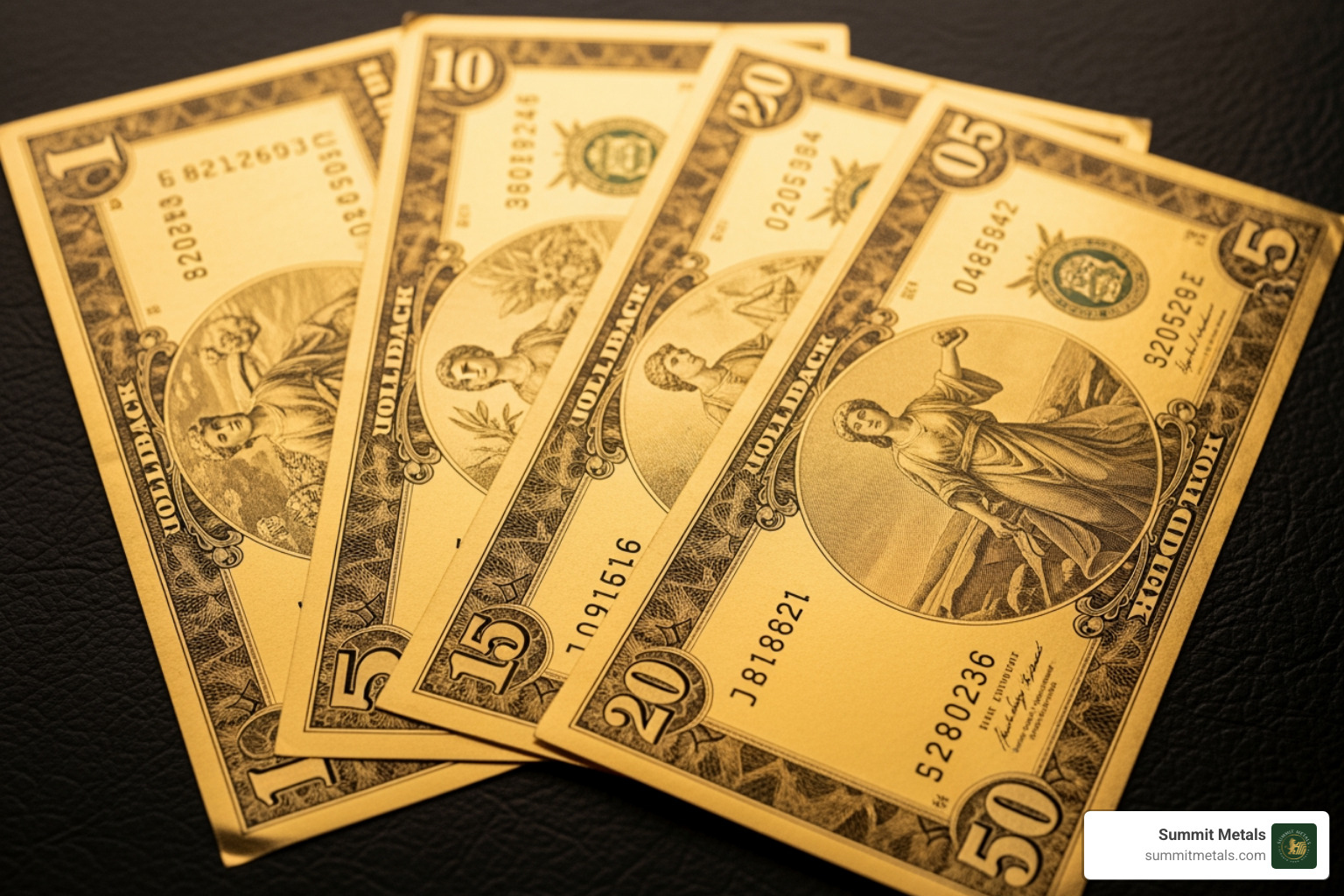
Utah gold currency represents a groundbreaking experiment in modern monetary systems. If you're looking to understand this unique form of money, here's what you need to know:
Quick Answer: Utah Gold Currency Essentials
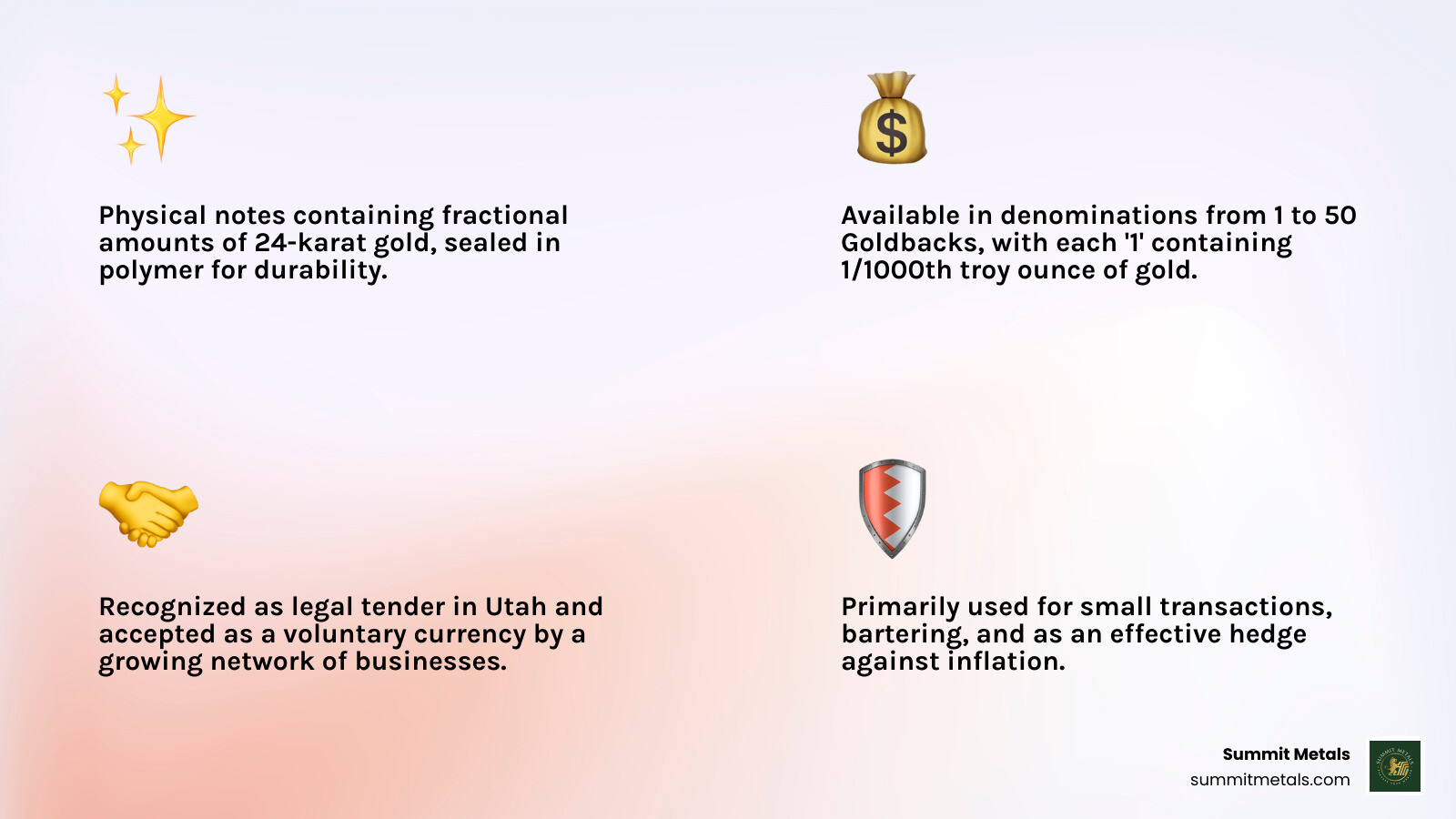
- What it is: Goldbacks—physical notes containing fractional amounts of 24-karat gold sealed in polymer
- Legal status: Recognized as legal tender in Utah since 2011, but not U.S. federal legal tender
- How it works: Privately issued voluntary currency accepted by businesses across Utah
- Denominations: 1, 5, 10, 25, and 50 Goldback notes (each "1" = 1/1000th troy ounce of gold)
- Primary use: Small transactions, bartering, and inflation protection
- Where accepted: Growing network of businesses in Utah and other states
Utah's pioneering stance on gold dates back to its earliest days. Mormon settlers established the Deseret Mint in 1848, coining their own gold pieces inscribed with "Holiness to the Lord" long before statehood. That legacy continues today—Utah became the first state to pass the Legal Tender Act in 2011, recognizing gold and silver coins as currency. In 2019, the Utah Goldback launched as the first practical way to spend gold in everyday transactions.
The timing couldn't be better. With gold hitting $3,500 in early 2025 and the U.S. national debt exceeding $36 trillion, more Americans are turning to tangible assets. The state has invested $60 million of taxpayer funds in physical gold reserves, and new legislation (HB306) allows state contractors to be paid in gold—a first in the nation.
Unlike traditional gold coins or bars, Goldbacks solve a critical problem: how do you spend a $3,000 gold coin on groceries? These notes contain as little as 1/1000th of an ounce, making gold practical for daily use. About 40-50% of cash-based businesses in Utah now accept them, and the concept has spread to Nevada, Wyoming, New Hampshire, South Dakota, and Florida.
I'm Eric Roach, and during my decade advising Fortune 500 companies on hedging strategies and portfolio protection in New York, I watched institutional clients turn to gold during every market crisis—the same stability I now help everyday investors access through utah gold currency and physical precious metals.
What is the Utah Goldback?
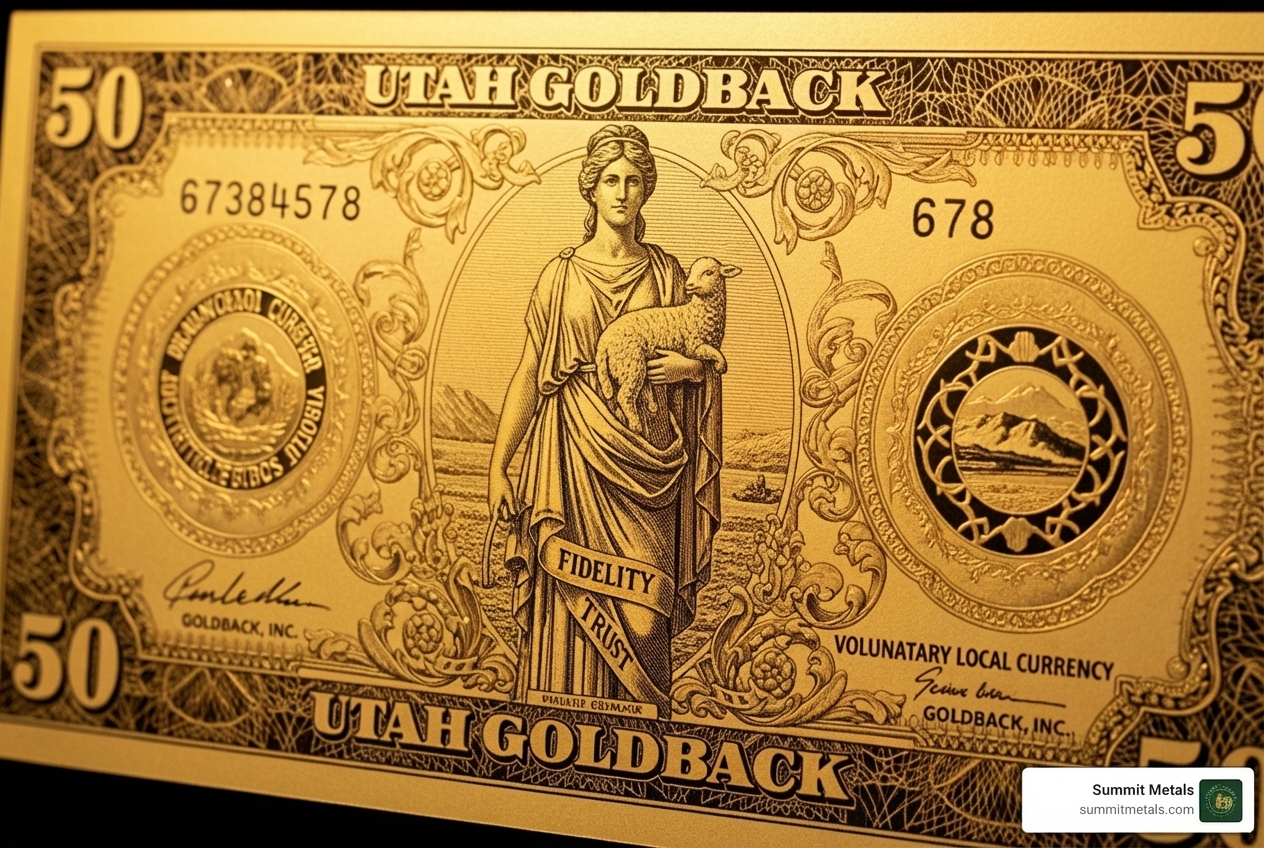
At its heart, the Utah Goldback is a step in making gold spendable again. Imagine carrying a banknote, but instead of paper, it contains actual, physical gold. That's essentially what a Goldback is: a fractional gold commercial product that functions as a local currency and commodity.
These unique notes are privately designed and minted, specifically crafted to be a "voluntary negotiable instrument." This means they are not official U.S. Dollar legal tender, but rather a form of currency that vendors and retailers can voluntarily agree to accept for goods and services.
The Utah Goldback series, first released in 2019, comes in several denominations: 1, 5, 10, 25, and 50 Goldbacks. Each "1 Goldback" note contains precisely 1/1000th of a troy ounce of 24-karat gold. Larger denominations hold proportionally more gold. For example, a 50 Goldback note contains 1/20th of a troy ounce of 24-karat gold.
The physical composition of Goldbacks is quite innovative. Each note is made using thin layers of 24-karat gold, combined together within durable polyester sheets. This cutting-edge manufacturing process is carried out by Valaurum, utilizing a vacuum deposition process to fuse the gold into these thin, spendable sheets. You can learn more about their mission and products at goldback.com.
To ensure authenticity and prevent counterfeiting, Goldbacks incorporate several sophisticated security features. These include unique serial numbers, intricate artwork, and a raised, reversed image on the back of each note. This careful design and manufacturing process ensures that while they are not government-issued, they are verifiable and secure.
How Goldbacks Work as a Currency
The core idea behind Goldbacks is to make gold practical for everyday transactions. Historically, gold coins were too valuable for small purchases, making them primarily an investment rather than a medium of exchange. Goldbacks solve this by offering gold in the smallest, most interchangeable increments. This allows for direct bartering for goods and services, bringing gold back into daily commerce.
We've seen reports, such as one from Local 'Goldback' currency gaining traction during pandemic, highlighting how Goldbacks gained attention as a stable alternative during economic uncertainty.
Across Utah, a growing network of businesses has chosen to accept Goldbacks as payment. In fact, roughly 40-50% of cash-based businesses in Utah now accept Goldback Gold Notes. This network empowers individuals to use their gold for everything from a cup of coffee to larger purchases, offering a real-world use for their precious metals beyond traditional investment. This stands in contrast to large gold coins or bars, which are difficult to use for small transactions. Goldbacks are designed to be a viable form of "emergency money" should traditional currencies face significant instability.
Understanding the Value of Utah Gold Currency
The value of Utah gold currency is rooted in its intrinsic gold content. Each Goldback note, particularly the "1 Goldback," represents a specific, verifiable amount of 24-karat gold—1/1000th of a troy ounce. This means its base value directly correlates with the current market price of gold. When the price of gold goes up, so does the intrinsic value of your Goldback.
However, it's important to understand that the market value of a Goldback is often higher than its pure metallic value. This is due to a "premium over spot price," which accounts for the intricate manufacturing process, the unique design, and the convenience of having gold in such a spendable, divisible form. This premium can fluctuate based on supply, demand, and collector interest.
We monitor the daily exchange rate of gold closely, as this directly influences the value of Goldbacks. Factors such as global gold market fluctuations, economic news, and even collector demand for specific series or denominations can impact their market value. While the gold content provides a stable foundation, the market price can vary, making them both a practical currency and, for some, a collectible item.
The Historical and Legal Roots of Gold in Utah
Utah's relationship with gold as a medium of exchange runs deep, predating the state itself. In the mid-19th century, before the establishment of a national currency in the United States, most coins in circulation were privately minted. The early Mormon settlers, arriving in 1847, faced the immediate challenge of establishing a stable economy without a reliable circulating medium.
This necessity spurred Brigham Young and his associates in the LDS Church to establish a church mint in 1848—the famous Deseret Mint. Gold dust brought back by members of the Mormon Battalion from California became the primary source for these early Utah gold coins. These coins, often inscribed with "Holiness to the Lord," served as a crucial form of currency for the burgeoning community. You can dig deeper into this fascinating history through the Utah History Encyclopedia.
However, the era of private coinage eventually came to an end. In 1864, the U.S. Congress passed acts that permanently forbade the private coinage of gold, centralizing monetary authority with the federal government. For over a century, gold largely receded from its role as a transactional currency in daily American life.
Fast forward to 2011, and Utah once again took a pioneering stance. It became the first state in the nation to pass the Utah Legal Tender Act, recognizing gold and silver coins minted by the federal government as legal tender within the state. This landmark legislation opened the door for Utahns to legally use physical gold in commercial and barter situations. Further supporting this, the Utah State Legislature later clarified that gold with a 'polymer holder' or 'coating' (like Goldbacks) would not be subject to state sales tax, removing a significant barrier to its practical use.
The Legal Status of Goldbacks Today
Understanding the legal status of Goldbacks is crucial. As we've discussed, Goldbacks are privately issued by a company, not by the U.S. government or even the state of Utah. This distinction is vital: they are not U.S. Dollar legal tender. Instead, they are a "voluntary local currency" or "voluntary negotiable instrument."
To avoid any issues with federal counterfeit laws, Goldbacks are explicitly printed with statements like "Privately Issued, Not U.S. Dollar Legal Tender" and include patent pending information. This transparent labeling ensures that while they are used as currency, they are not attempting to mimic or defraud the official U.S. dollar.
While our primary focus at Summit Metals is on the local Utah market, it's worth noting that the Goldback concept has proven so compelling that other states have followed suit. Goldback series have now been released for Nevada, New Hampshire, Wyoming, and South Dakota, with Florida also joining the movement. This expansion demonstrates a growing interest in state-level recognition of precious metals as a viable form of currency, though each state's legal framework will vary.
Goldbacks vs. Traditional Gold Investments: A Comparative Guide
When we consider investing in gold, we typically think of coins, bars, or perhaps even gold-backed ETFs. However, Utah gold currency in the form of Goldbacks offers a distinct alternative, particularly for those interested in the practicality of spending gold. Let's compare Goldbacks to more traditional gold investments to help you understand where they fit in your portfolio.
| Feature | Goldbacks | Gold Coins (e.g., American Eagle) | Gold Bars (e.g., 1 oz bar) |
|---|---|---|---|
| Divisibility | High (1/1000 oz increments) | Moderate (common fractional sizes like 1/10, 1/4 oz) | Low (typically 1 oz and larger) |
| Portability | High (thin, light, fits in wallet) | Moderate (heavier, bulkier than Goldbacks) | Low (heavy, requires secure storage) |
| Premium over Spot | Higher (due to manufacturing complexity for small units) | Moderate (includes minting, collector value) | Lowest (bulk gold, less intricate design) |
| Legal Tender Status | State-level voluntary currency (not federal) | Federal legal tender (face value protection) | Commodity (not legal tender) |
| Best Use Case | Small transactions, daily barter, emergency money | Investment, store of value, fraud protection | Bulk investment, wealth preservation |
As you can see, each form of gold serves a different purpose. Goldbacks excel in divisibility and portability, making them ideal for small transactions and daily bartering. They are designed to be spent. Gold coins, such as a U.S. Mint American Gold Eagle, offer the benefit of government backing and a face value, which provides a layer of protection against fraud and confirms their authenticity. This makes them a solid choice for investors seeking recognized bullion with a degree of legal tender status. For those looking to invest in larger quantities of gold with the lowest possible premium, gold bars are typically the most cost-effective option. They represent raw wealth preservation.
Building Your Portfolio with Gold
Regardless of the form, incorporating gold into your financial portfolio offers significant benefits, primarily as a diversification tool and a hedge against inflation. Gold prices tend to rise during bad economic times, making them a reliable asset when other investments might falter. This makes gold an excellent component of your rainy day funds.
At Summit Metals, we believe in empowering our clients to build wealth steadily over time. One of the most effective strategies for long-term gold investment is dollar-cost averaging. This involves making consistent, regular investments regardless of market fluctuations. By buying a fixed dollar amount of gold every month, you average out your purchase price over time, reducing the risk of buying high.
This is where our Summit Metals Autoinvest program shines. Just like investing in a 401k, you can set up consistent monthly investments in physical gold. Our program makes it easy to acquire high-quality, authenticated gold and silver precious metals without the hassle. We offer transparent, real-time pricing and competitive rates due to our bulk purchasing power, ensuring you get the best value for your investment. Consistent investment is key to building a robust and resilient portfolio.
We also offer a range of resources to help you steer the precious metals market, including guides on Utah's Top Spots to Buy Gold Bars and Bullion and From Bullion to Bling: Finding Your Perfect Gold and Silver Dealer in Utah.
The Future of Utah Gold Currency and State Legislation
Utah's proactive stance on precious metals positions it at the forefront of financial innovation. The state government has not only recognized gold as legal tender but has also taken significant steps to integrate it into its financial ecosystem. As of the end of the last legislative session, Utah's gold reserve has grown to $60 million, with the state treasurer having the authority to buy an additional $90 million. This substantial investment underscores the state's commitment to using gold as a hedge against economic downturns and a component of its fiscal strategy.
A major development in this arena is the recent passage of HB306. This groundbreaking legislation, passed with strong bipartisan support, authorizes the state treasurer to issue a competitive procurement for a precious metals-backed electronic payment platform. This is a first in the nation, allowing state vendors to opt for payment in physical gold and silver. We highlighted this significant move in First in the Nation: Utah Legislature passes bill paving the way for state vendors to be paid in gold and silver.
The Precious Metals Working Group, formed under previous legislation (HB 348), played a pivotal role in researching and recommending this path forward. This group heard from various companies, including Goldback, which is headquartered in Alpine, Utah, regarding platforms that could enable gold transactions. The goal is to create a seamless system for fractional gold transactions and real-time conversions, making it practical for state business.
The Practicality of Using Utah Gold Currency
The economic benefits of using Utah gold currency are compelling. It offers citizens and businesses a choice in how they conduct financial transactions, providing an alternative that can preserve purchasing power, especially during periods of inflation. By supporting local businesses that accept Goldbacks, we can help foster a more resilient and localized economy.
However, we must also acknowledge the potential economic risks. Like any commodity, the value of gold can be volatile, though historically it has shown stability over the long term. More importantly, while acceptance is growing, Goldbacks are not universally accepted, which can limit their immediate utility in all transactions.
Looking ahead, the future prospects for Goldbacks and transactional gold in Utah are promising. Increased adoption, driven by state initiatives like HB306, could normalize its use. Furthermore, if the Utah government officially uses gold for state business, it could open the door for a legal challenge to the IRS policy that classifies gold as a collectible, subject to high capital gains tax. If gold were treated as money rather than an asset for tax purposes, it would significantly reduce the friction in gold-backed transactions, potentially revolutionizing how we view and use precious metals.
Frequently Asked Questions about Utah Goldbacks
Are Goldbacks real money?
Goldbacks contain real, verifiable 24k gold, making them a tangible asset. While not official U.S. legal tender, they are recognized as a "voluntary local currency" in Utah and can be used for trade wherever accepted.
Where can I use Utah Goldbacks?
A growing network of small businesses in Utah and other states accept Goldbacks. The official Goldback website maintains a list of participating vendors, and they can be used in any private transaction where both parties agree on their value.
How is the value of a Goldback determined?
The value is based on the current market price of gold. A "1 Goldback" note contains 1/1000th of a troy ounce of gold, so its base value fluctuates with the spot price of gold, plus a small premium for manufacturing and distribution.
Conclusion
Utah's unique historical relationship with gold, coupled with its innovative legislative actions, positions it as a national leader in the movement to reintroduce precious metals into everyday commerce. Goldbacks stand out as an ingenious tool, bridging the gap between traditional gold investment and practical, spendable utah gold currency. They offer a tangible asset in a modern economy increasingly reliant on digital and fiat currencies, providing a hedge against inflation and a means for local, resilient trade.
At Summit Metals, we are proud to support Utahns in their journey toward financial security through precious metals. We provide transparent pricing and local expertise, ensuring you receive genuine value and trusted service. Whether you're exploring Goldbacks for daily transactions or building a diversified portfolio with gold and silver bullion, we're here to help.
Start your precious metals journey with Summit Metals' Utah resources and Autoinvest program. Visit our website to explore our offerings and learn how you can benefit from consistent, strategic investment in gold and silver.