Why Understanding the Gold Utah Quarter Matters
Gold utah quarter coins have caught the attention of many collectors and investors, but not all that glitters is actually valuable. Here's what you need to know:
Quick Answer: What is a Gold Utah Quarter?
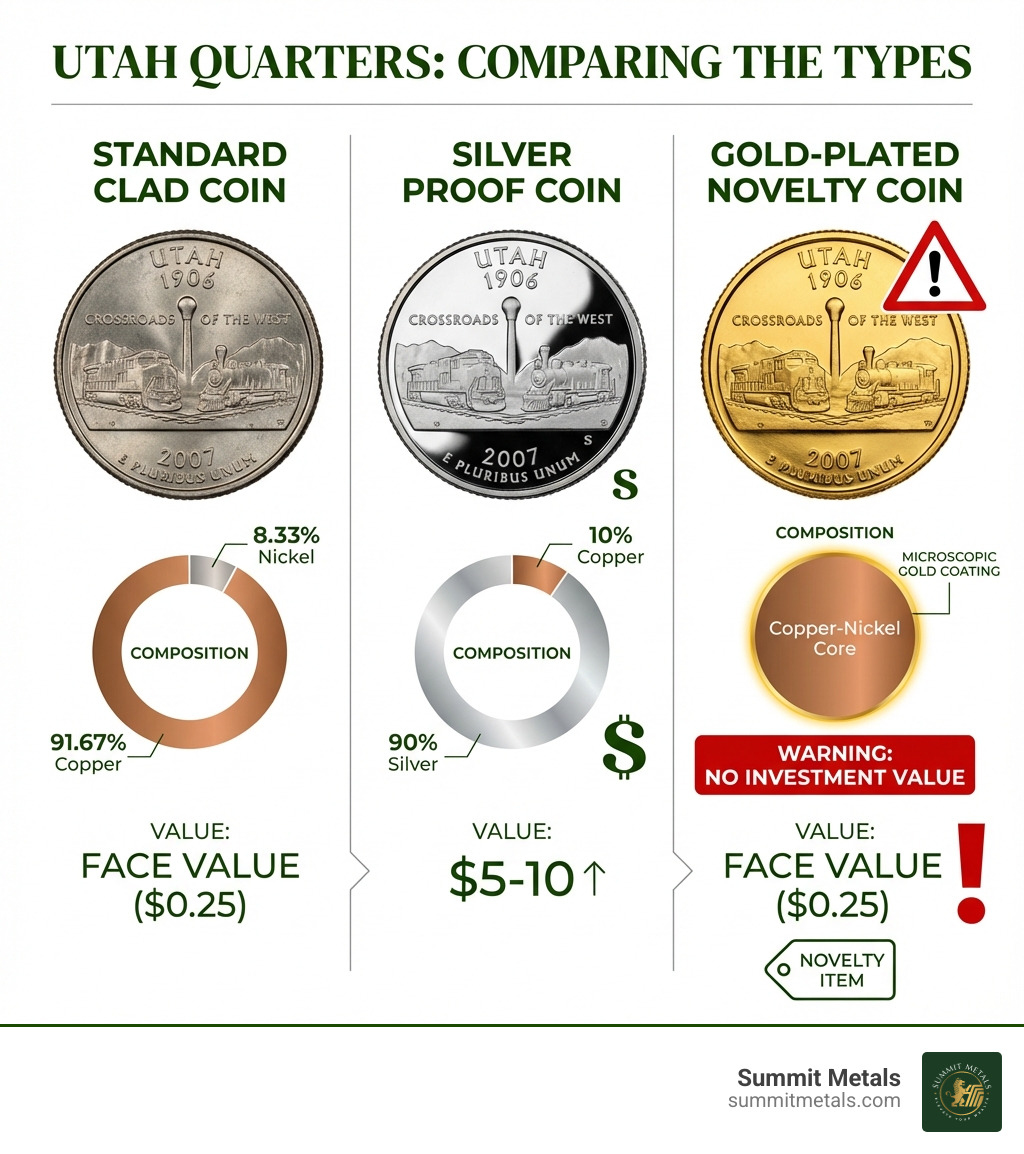
- Standard 2007 Utah Quarter: Worth face value ($0.25), made of copper-nickel clad
- Silver Proof Utah Quarter: Worth $5-$10, made of 90% silver with 'S' mint mark
- Gold-Plated Utah Quarter: Worth only face value ($0.25), novelty item with microscopically thin gold coating
- Real Gold Quarter: The 2016-W Standing Liberty is the only US Mint quarter containing actual investment-grade gold (0.25 troy oz, 24k)
Late-night TV commercials and online ads often promote "gold" state quarters as valuable collectibles. But here's the truth: these gold-plated Utah quarters are novelty items with zero investment value. The thin gold coating adds nothing to the coin's worth beyond its 25-cent face value.
The 2007 Utah State Quarter was the 45th coin released in the 50 State Quarters Program, featuring two locomotives meeting at Promontory Point—a beautiful tribute to Utah's "Crossroads of the West" legacy. While the standard clad version is common, and silver proof versions hold modest collector value, the gold-plated versions sold through aggressive marketing campaigns are essentially worthless to serious collectors and investors.
I'm Eric Roach, and during my decade on Wall Street advising Fortune-500 companies on billion-dollar hedging strategies, I learned how institutions protect wealth—lessons I now apply to help everyday investors steer the gold utah quarter market and identify genuine precious metals opportunities. My experience exposing deceptive marketing in the collectibles space has shown me how easily consumers can be misled by flashy advertisements that promise more than they deliver.
Gold utah quarter terms to know:
The Real Story of the 2007 Utah State Quarter
Before we dig into the misleading world of the gold-plated versions, let's appreciate the true history and design of the 2007 Utah State Quarter. This coin is a fascinating piece of American history, part of the wildly popular 50 State Quarters Program initiated by the U.S. Mint. It represents Utah's unique contribution to the nation's development and tells a story of innovation, connection, and westward expansion.
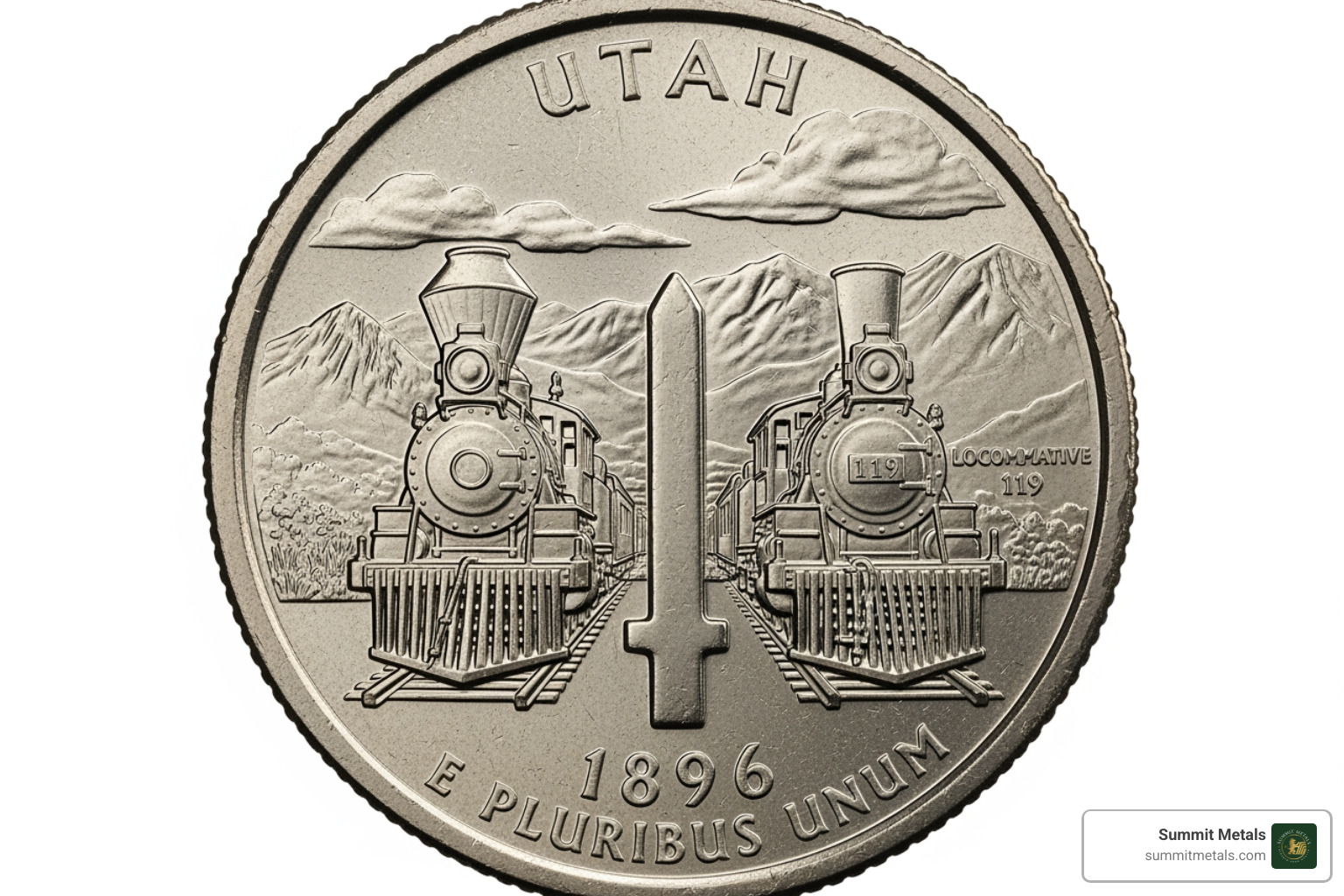
The 2007 Utah State Quarter holds a significant place in the 50 State Quarters Program as the 45th coin released in the series, and the fifth for that year. These coins weren't just pretty pictures; they were carefully designed to honor each state's distinct heritage. You can explore more about the U.S. Mint's extensive programs and archives on their official Coin and Medal Archive.
Design and Symbolism
The reverse side of the 2007 Utah State Quarter features a powerful and iconic image: two locomotives moving towards a golden spike, framed by a rugged mountain landscape. This imagery commemorates the historic joining of the Central Pacific and Union Pacific Railroads at Promontory Summit, Utah, on May 10, 1869. This event marked the completion of the First Transcontinental Railroad, a monumental achievement that dramatically reshaped the American landscape and economy.
The coin prominently displays Utah's state motto, "Crossroads of the West," which perfectly encapsulates its historical role. Utah truly became a vital hub for transportation and commerce, connecting the eastern and western halves of the burgeoning nation. The design also includes the date of Utah's statehood, "1896," and the national motto, "E Pluribus Unum."
The designer and engraver behind this meaningful artwork was Joseph Menna. The obverse of the quarter, as with all State Quarters, features a modified portrait of George Washington, originally by John Flanagan and adapted by William Cousins. This combination of historical reverence and state-specific symbolism makes the Utah quarter a cherished item for many collectors, even in its standard form.
Place in the 50 State Quarters Program
The 50 State Quarters Program was a groundbreaking 10-year initiative launched by the U.S. Mint in 1999. Its goal was to honor each of the nation's states in the order they ratified the Constitution or were admitted into the Union. This program captured the imagination of millions, becoming one of the most successful numismatic programs in U.S. history.
Each state quarter was produced for approximately 10 weeks and would not be reissued, creating a sense of urgency and collectibility. The Utah quarter, released in 2007, was part of this grand procession, celebrating the state's unique character and historical significance. Following the success of this program, the U.S. Mint continued with other commemorative series, such as the America the Beautiful Quarters program, which focused on national parks and sites.
Unpacking the Value: Clad, Silver, and the "Gold" Utah Quarter
Now, let's get down to the nitty-gritty of what a gold utah quarter actually is, and more importantly, what it isn't. When we talk about the "value" of a coin, we often consider its numismatic value (collector's worth), its face value, and its intrinsic metal value. For the 2007 Utah State Quarter, these categories diverge significantly depending on the coin's composition.
Standard Clad and Silver Proof Versions
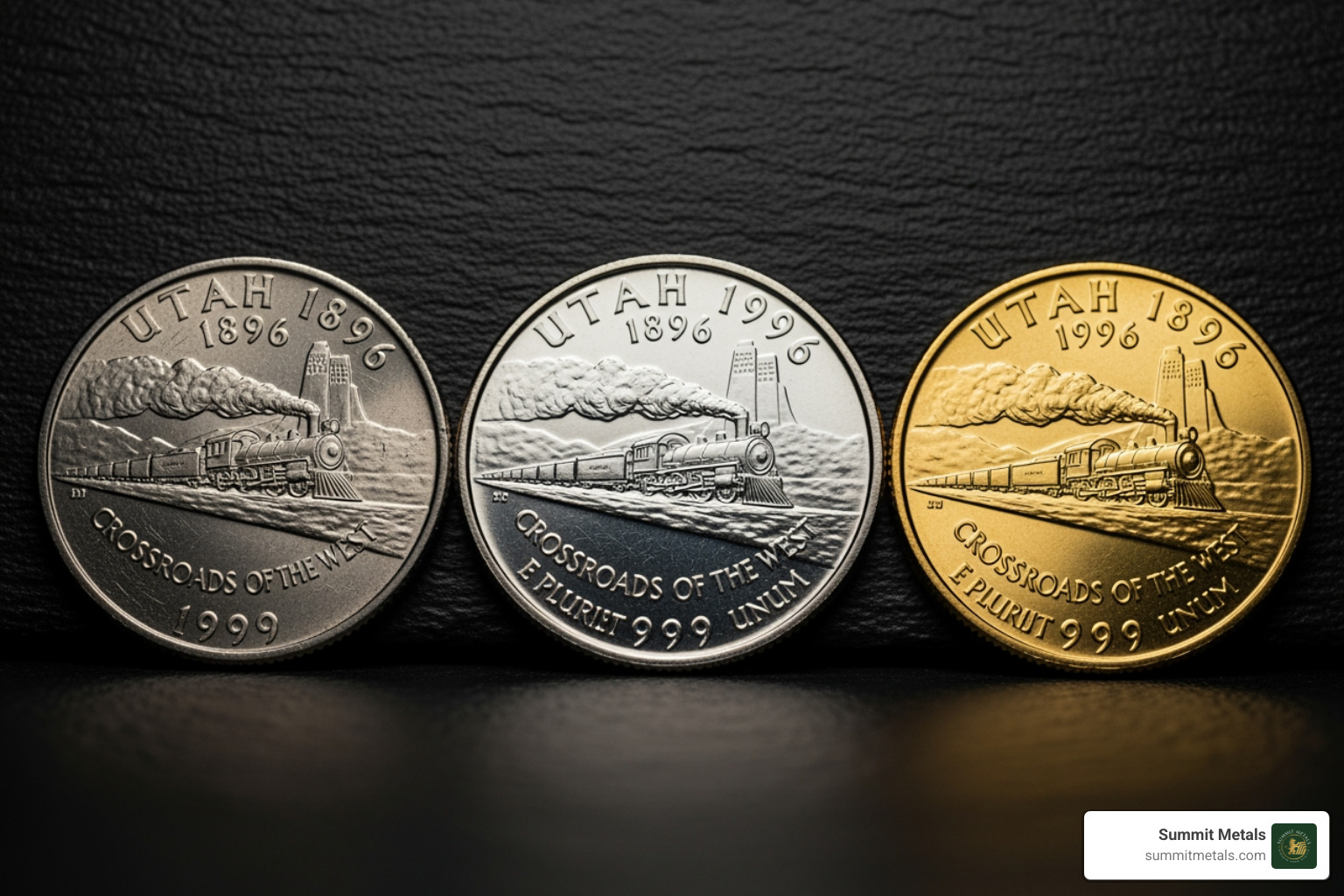
Most 2007 Utah State Quarters you'll encounter are "clad" coins. This means they are composed of a core of pure copper clad between two layers of a copper-nickel alloy. Specifically, they are 91.67% Copper and 8.33% Nickel. These coins have a diameter of 24.26 mm and weigh 5.67 grams. The U.S. Mint produced a staggering 508,200,000 of these circulating coins, alongside 2,374,778 proof versions. For more detailed specifications on circulating quarters, you can always check the Quarter specifications page from the U.S. Mint.
Due to their high mintage, a standard 2007 Utah State Quarter found in circulation is typically worth only its face value of $0.25. Even uncirculated versions, while slightly more appealing to some collectors, generally command only a small premium.
However, there's a special variety: the Silver Proof Utah State Quarter. These coins were produced for collectors as part of special Silver Proof Sets. Unlike the clad versions, these contain 90% silver and 10% copper. You can identify them by an "S" mint mark, indicating they were minted in San Francisco. A total of 1,313,481 silver coins were produced. These silver proof versions do have a collector value, typically ranging from $5 to $10, depending on their condition or "grade." While not a fortune, it's certainly more than their clad counterparts!
The Truth About the Gold-Plated Utah Quarter
And then there's the "gold-plated" version. This is where the term "gold utah quarter" becomes a bit of a misnomer, and frankly, a source of confusion and disappointment for many. These coins are standard 2007 Utah State Quarters that have been altered by a third party, not the U.S. Mint. A microscopically thin layer of gold, often advertised as 24k gold, is applied to the coin's surface.
Let's be crystal clear: these gold-plated coins are novelty items. They are not rare, not official U.S. Mint products in their plated form, and they carry no additional numismatic value in the collector community. In fact, serious coin collectors generally view altered coins, including gold-plated ones, with disdain. The amount of gold used in the plating is so minuscule that it has no recoverable melt value.
These items are often heavily marketed through aggressive advertising campaigns, sometimes on late-night television, preying on unsuspecting individuals who might believe they are acquiring a valuable piece of gold. Our expert opinion at Summit Metals, and the consensus among numismatists, is that these are essentially a "con." They look flashy, but their gleam is deceptive. If you have one, it's a fun souvenir, but don't mistake it for an investment.
Are There Any Real Gold Quarters?
This is a fantastic question, and the answer might surprise you! While the 2007 Utah State Quarter, even in its gold-plated form, does not contain investment-grade gold, there is one U.S. Mint quarter that truly contains gold: the 2016-W Standing Liberty Gold Quarter.
This exceptional coin was part of the U.S. Mint's Centennial Gold Coin Program, which also included a gold Mercury dime and a gold Walking Liberty half dollar. The 2016-W Standing Liberty Gold Quarter was struck in 24-karat (.9999 fine) gold and contains precisely 0.25 troy ounces of pure gold. It was produced at the West Point Mint, indicated by the "W" mint mark.
With a limited mintage of only 125,000, this coin was released with an initial price of $485. Its value today fluctuates with the spot price of gold, but also carries a numismatic premium due to its rarity and historical significance. At current gold spot prices (at the time of this publication), its melt value alone is approximately $665. Mint condition or uncirculated versions can sell for over $1,000, and recent auctions have seen prices between $600 and $800. This is a true example of a quarter that is both a collectible and a legitimate gold investment, a stark contrast to the gold-plated novelties.
Investing in Gold: Smarter Choices Than a Gold-Plated Utah Quarter
So, if a gold-plated Utah quarter isn't the way to invest in gold, what is? For those looking to genuinely diversify their portfolio with precious metals, there are far more reliable and valuable options. Gold has historically served as a hedge against inflation and a store of value, making it a tangible asset that can provide stability during economic uncertainties. At Summit Metals, we believe in empowering our clients with transparent, real-time pricing on authentic precious metals, ensuring trust and value for their investments.
When considering gold, think about government-minted bullion coins or bars. These are recognized globally for their purity and weight, offering liquidity and peace of mind. To learn more about finding reputable dealers and making wise choices, explore our guide: From Bullion to Bling: Finding Your Perfect Gold and Silver Dealer in Utah.
Comparing a Gold-Plated Utah Quarter vs. an American Gold Eagle
Let's lay it all out there. Here's a quick comparison to highlight why one is a keepsake and the other is a genuine investment:
| Feature | Gold-Plated 2007 Utah Quarter | 1/4 oz American Gold Eagle Coin (BU) |
|---|---|---|
| Gold Content | Microscopic, negligible layer | 0.25 troy oz (7.77 grams) of .9167 fine gold |
| Mint of Origin | U.S. Mint (core coin), Third-party (plating) | U.S. Mint (West Point) |
| Legal Tender Status | Yes ($0.25 face value) | Yes ($10 face value) |
| Investment Value | None (novelty item) | High (based on gold spot price + premium) |
| Resale Potential | Very low (only face value) | High (globally recognized bullion) |
As you can see, the difference is stark. While the gold-plated quarter might catch your eye, it's the American Gold Eagle (or other reputable bullion products) that truly offers the benefits of gold investment. The American Gold Eagle has been a preferred gold bullion coin since its introduction in 1986, available in various sizes, making it accessible to a wide range of investors. Its value is backed by its gold content and the U.S. government, providing a level of security and recognition that a novelty coin simply cannot match.
Building Your Gold Portfolio with Autoinvest
For many, the idea of investing in gold can seem daunting. But what if you could build your gold portfolio steadily, month after month, just like you might contribute to a 401k? That's where dollar-cost averaging comes in, and Summit Metals' Autoinvest program makes it incredibly easy.
Our Autoinvest feature allows you to set up small, regular purchases of authentic gold and silver bullion. This consistent investing strategy helps you acquire precious metals over time, smoothing out market fluctuations and making the process accessible and hassle-free. By automating your monthly investing, you can steadily build your wealth in tangible assets without having to constantly monitor market prices. It's a smart, disciplined approach to precious metals ownership, turning what might seem like a large undertaking into manageable, consistent steps toward financial security.
Utah's Rich Connection to Precious Metals
While the gold utah quarter itself might be a numismatic red herring, Utah has a truly rich and fascinating history deeply intertwined with precious metals. Often called "The Beehive State," Utah's industrious spirit has long been fueled by its mineral wealth. Our home state boasts a significant mining heritage, with gold playing a notable role.
Historically, areas like the Gold Hill mining district have been among the oldest mining sites in the state. The Utah Geological Survey (UGS) has extensive publications detailing gold occurrences, from placer deposits to lode mines and skarn occurrences. For example, some skarn occurrences in Utah contain more than 0.01 opt (ounces per ton) of gold, with significant deposits noted in the Bingham and Gold Hill mining districts. You can dive deeper into this history with resources like the POPULAR GEOLOGY of Utah Gold.
Beyond history, Utah plays a forward-thinking role in the modern precious metals market. Our state's mining sector generated an impressive $4.7 billion in non-fuel mineral production in 2022. More recently, Utah has been at the forefront of exploring innovative ways to integrate precious metals into its financial system. A 2024 Precious Metals Study highlighted Utah's potential to be a leader in this area, leveraging its mining leadership, existing legal tender laws for precious metals, and even exploring the possibility of state-backed transactional gold platforms. This study also noted the presence of secure vaulting facilities, such as Brink's Global Services in Salt Lake City, which further solidifies Utah's position in the precious metals landscape.
This deep connection makes Utah an ideal place for individuals and institutions to engage with precious metals. If you're in the area and looking to buy or sell, we've got you covered. Check out our guide to Utah's Golden Neighborhoods: Find Your Coin Dealer Near You.
Frequently Asked Questions about the Gold Utah Quarter
We've covered a lot, but let's quickly address some common questions about the gold utah quarter to ensure you're fully informed.
How much is a 2007 gold Utah quarter worth?
A standard 2007 Utah State Quarter (clad) is worth its face value, $0.25. While gold-plated versions might look appealing, the plating adds no significant numismatic or intrinsic value, meaning they are still only worth $0.25. If you happen to possess a 2007 Silver Proof Utah Quarter, identified by an "S" mint mark, its collector value can range from $5 to $10, depending on its condition or grade. Uncirculated clad coins might fetch a slight premium, but generally, their value remains very close to face value.
Are gold-plated state quarters a good investment?
Absolutely not. Gold-plated state quarters are unequivocally not a good investment. They are considered altered coins or novelty items by the numismatic community. The gold layer is microscopically thin, offering no recoverable precious metal value, and the alteration itself detracts from any potential collector value the original coin might have had. Serious collectors and investors actively avoid these items because they lack authenticity, intrinsic value, and future appreciation potential. You're paying a premium for a cosmetic alteration that has no real market worth.
Where can I buy real, investment-grade gold coins?
When you're ready to invest in authentic precious metals, it's crucial to turn to reputable dealers. You can purchase real, investment-grade gold coins from established precious metals dealers like us at Summit Metals. We specialize in government-minted bullion coins such as American Gold Eagles, Canadian Maple Leafs, and South African Krugerrands, all known for their purity and liquidity. We pride ourselves on transparent, real-time pricing and competitive rates, ensuring you get true value for your investment. For a local touch, you can find more information on SLC's Golden List: Finding Your Perfect Precious Metals Dealer.
Conclusion: Making a Wise Investment in Gold
The allure of a gold utah quarter is understandable – who wouldn't want a piece of gold history? However, as we've explored, the vast majority of these are simply novelty items with a deceptive gleam. They offer no real investment value and are not recognized as legitimate gold assets by serious collectors or investors.
Our key takeaway is clear: don't be fooled by the glitter of gold plating. If you're looking to truly invest in gold, focus on authentic, government-minted gold bullion products. These are the assets that offer intrinsic value, act as a genuine hedge against economic uncertainty, and hold their worth over time. At Summit Metals, we are committed to providing transparent pricing and competitive rates on real precious metals, helping you make informed decisions and build a robust portfolio.
Ready to make smarter choices for your precious metals investments? Learn more about investing in Utah Precious Metals with Summit Metals, your trusted partner in gold and silver.