Why Following Gold Price Charts Live Can Protect Your Wealth

Gold price charts live are the fastest way to see what one troy ounce of gold is worth right now — and to act on it before the market moves again.
Here is a quick snapshot of where gold stands as of the time of this publication:
| Metric | Value |
|---|---|
| Gold spot price (per oz) | ~$4,330–$4,493 USD |
| Gold price per gram | ~$139–$140 USD |
| Gold price per kilo | ~$139,000–$140,000 USD |
| All-time high (Jan 2026) | $5,608.35 USD/oz |
| 1-year price change | +30.78% |
| 12-month forecast | ~$4,942 USD/oz |
Prices shown are at the time of this publication and update continuously during market hours.
Gold hit an all-time high of $5,608 per ounce in January 2026, then pulled back sharply — dropping to around $4,331 by early June 2026, a swing of nearly 23% in just a few months. That kind of volatility is exactly why real-time tracking matters. Whether you are deciding when to buy, when to hold, or when to sell, a live chart gives you the clearest possible picture of where the market stands.
Gold does not sleep. It trades across global hubs — London, New York, Hong Kong, Zurich — almost 24 hours a day. Prices shift every few seconds based on economic data, currency moves, geopolitical events, and investor sentiment. Without a live chart, you are flying blind.
I'm Eric Roach, a former investment-banking and M&A advisor who has guided clients through multi-billion-dollar transactions on Wall Street — and today I help everyday investors use gold price charts live to build and protect real wealth through physical precious metals. That institutional background shapes every piece of guidance in this article, so you get the same disciplined, data-driven approach that Fortune 500 treasuries use — applied directly to your portfolio.
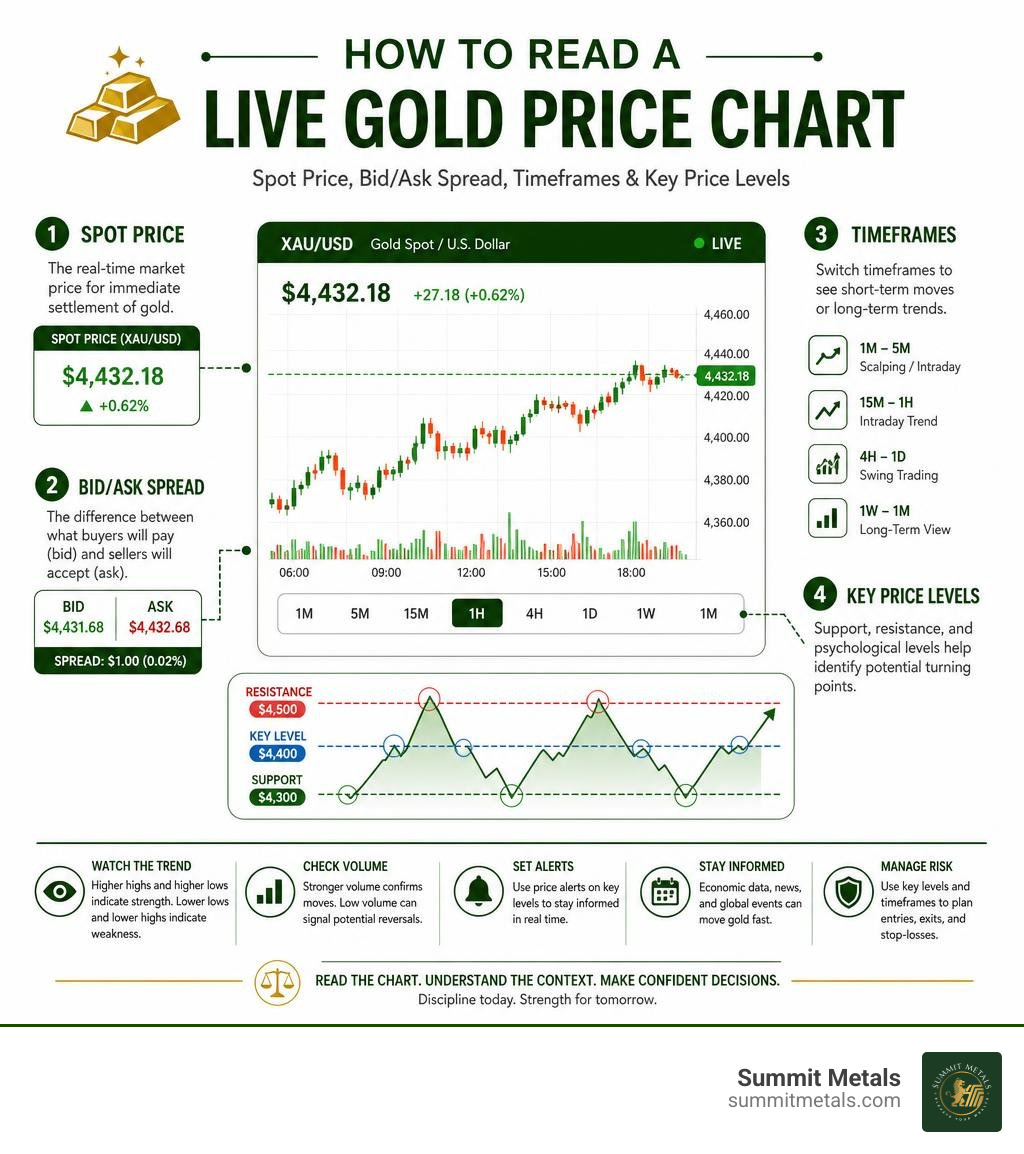
Easy gold price charts live glossary:
Understanding the Mechanics of Gold Price Charts Live
To understand why gold price charts live dance up and down all day, we have to look under the hood of the global precious metals market. The live "spot price" you see on your screen is not just a random number pulled out of thin air. It is the real-time equilibrium point of a massive, global tug-of-war between buyers and sellers trading across major international exchanges.
The two main heavyweights in this arena are the COMEX (Commodity Exchange) in New York and the LBMA (London Bullion Market Association). While London is the historic home of physical gold trading—where wholesale bullion is cleared—the COMEX is the absolute engine room for real-time price discovery. When you look at a live chart, the price updates you see every few seconds are primarily driven by highly active futures contracts trading on the COMEX.
To get a complete view of the market, institutional investors also monitor official daily benchmarks. You can track these official daily fixings directly via the LBMA Gold Price Data, which publishes twice-daily benchmarks used to settle institutional contracts worldwide.
How Live Spot Prices Are Determined
The live spot price is calculated using real-time data from the "front-month" (or nearest active) futures contract trading on the COMEX. Market makers—massive global banks and financial institutions—constantly provide liquidity by quoting buy and sell prices.
Because these futures contracts represent agreements to buy or sell gold at a specified date in the future, they are highly sensitive to new information. If a major economic report drops, algorithmic trading systems and human traders instantly adjust their bids. This constant recalibration is reflected immediately on your screen. You can observe this action in real time on the Gold Real-Time Quote | Real-Time Quote Gold | Markets Insider dashboard, which tracks these rapid ticks as they happen.
Navigating Bid, Ask, and Spreads on Gold Price Charts Live
When you look at a live chart, you will often see two different prices listed side-by-side: the Bid and the Ask. Understanding the relationship between these two numbers is crucial for any investor:
- The Bid Price: This is the maximum price a buyer (or dealer) is willing to pay to purchase gold from you at that exact second. If you want to sell your gold immediately, this is your reference price.
- The Ask Price: This is the minimum price a seller (or dealer) is willing to accept to sell gold to you. If you are looking to buy gold, this is the price you pay.
- The Spread: This is the difference between the Bid and the Ask price.
The spread is a direct indicator of market liquidity and trading volume. In highly active markets with heavy trading volume, the spread narrows to just a few cents, keeping transaction costs exceptionally low. During periods of extreme market stress or over the weekend when major exchanges are closed, the spread can widen significantly because there are fewer active market makers to absorb the risk.
Key Drivers of Real-Time Gold Price Fluctuations
Gold is often called the "ultimate insurance policy," but what exactly is it insuring against? The live price of gold reacts to a complex web of macroeconomic indicators, central bank policies, and geopolitical events.
To see how these forces interact over longer cycles, you can analyze decades of historical data on the Federal Reserve Economic Data (FRED) - Gold Price archive. In the short term, however, several key drivers dominate the daily ticks on your live chart.
The Inverse Relationship with the US Dollar and Global Currencies
Because gold is priced in U.S. Dollars (USD) on the global market, it shares a powerful, historically inverse relationship with the greenback. When the USD strengthens against other major currencies like the Euro (EUR), British Pound (GBP), or Canadian Dollar (CAD), gold typically falls. Why? A stronger dollar makes gold more expensive for international buyers holding other currencies, which dampens global demand.
Conversely, when the dollar weakens, gold becomes relatively cheaper for overseas investors, driving up purchasing power and pushing the spot price higher.
Macroeconomic Indicators and Central Bank Reserves
Central banks are some of the largest players in the gold market. When inflation rises, central banks often raise interest rates to cool the economy. Historically, higher interest rates can act as a headwind for gold because gold pays no yield or dividend. Investors might choose to chase yielding assets like government bonds instead.
However, we saw a classic example of how macroeconomic data impacts the market in June 2026. A stronger-than-expected U.S. nonfarm payrolls report revealed the economy added 172,000 jobs (far exceeding the forecasted 85,000). This strong economic data prompted investors to bet on a Federal Reserve interest rate hike, causing gold prices to drop below $4,370 per ounce on Friday, June 5, 2026, marking its lowest level of the year.
Despite these short-term dips, long-term support remains incredibly robust because global central banks continue to hold massive gold reserves as a safe-haven asset:
- United States: ~8,133 tonnes
- Germany: ~3,350 tonnes
- China: ~2,313 tonnes
Analyzing Historical Trends and the Gold-to-Silver Ratio
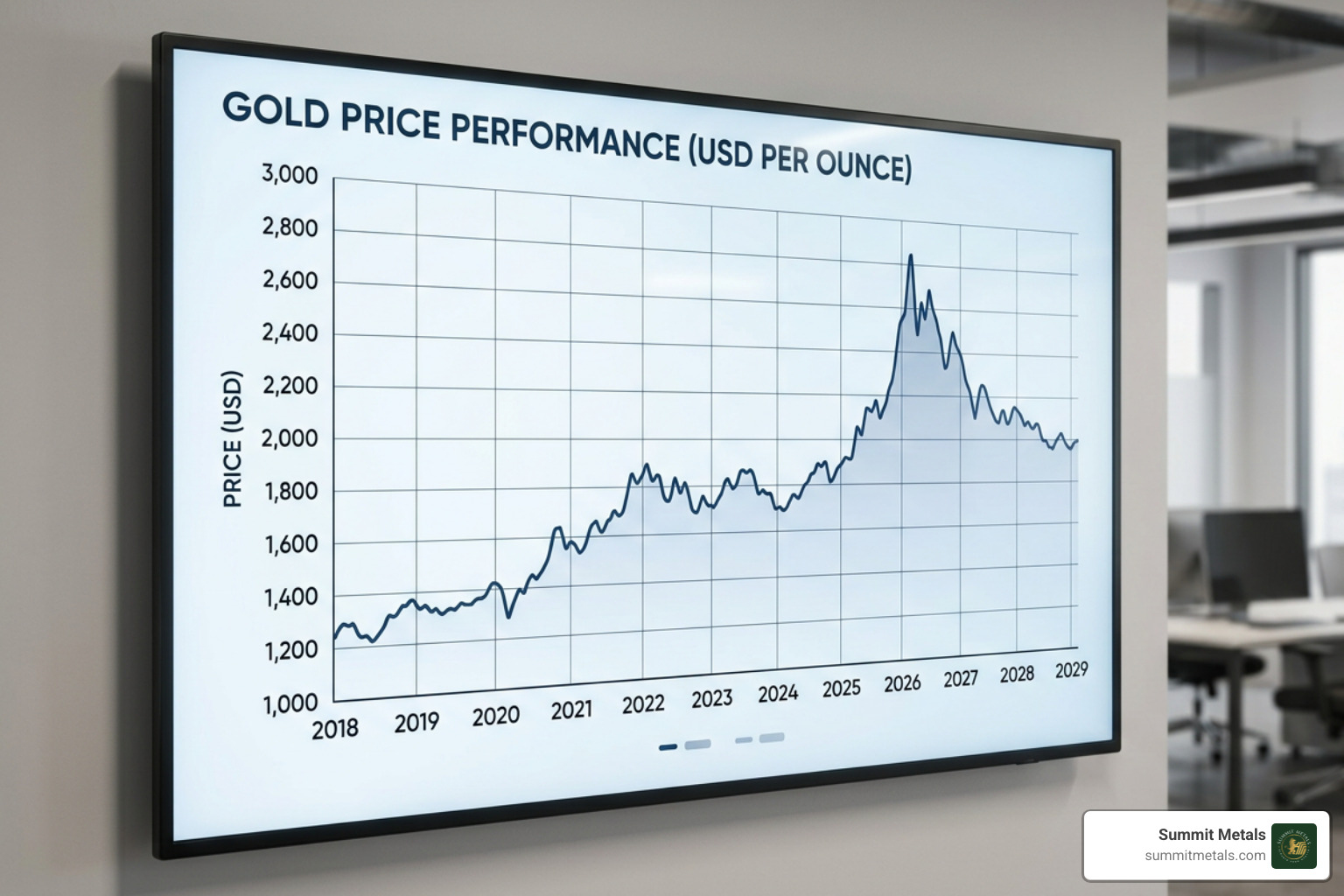
To make sense of the daily noise on gold price charts live, we have to zoom out and look at historical trends. Gold moves in long, multi-year market cycles. By examining where we are in a current cycle relative to historic highs, you can make far more informed decisions about when to accumulate or trim your positions. You can study these long-term macro cycles using the interactive Macrotrends Historical Gold Prices tool, which tracks gold's performance across various economic crises.
Tracking the 2026 All-Time Highs and Recent Corrections
The year 2026 has already carved its place into the financial history books. In January 2026, gold surged to an astonishing all-time high of $5,608.35 per troy ounce, driven by intense geopolitical tensions and persistent global inflation.
However, no asset moves upward in a straight line. By June 5, 2026, the market experienced a healthy correction, pulling back to $4,331 per troy ounce. While a monthly drop of 7.68% might startle short-term traders, experienced investors look at the broader picture: even with this correction, gold remains more than 30% higher than it was at this time last year. These pullbacks are a natural part of market cycles and often present excellent buying opportunities for long-term stackers.
How to Trade Using the Gold-to-Silver Ratio
Another powerful tool for precious metals investors is the gold-to-silver ratio. This ratio simply measures how many ounces of silver it takes to buy one single ounce of gold.
$$\text{Gold-to-Silver Ratio} = \frac{\text{Price of Gold per Ounce}}{\text{Price of Silver per Ounce}}$$
Historically, this ratio has served as an excellent indicator of relative value:
- High Ratio (e.g., above 80): Indicates that silver is historically cheap relative to gold. Many traders use this as a signal to accumulate silver.
- Low Ratio (e.g., below 60): Indicates that gold is relatively cheaper, or that silver has run up too fast. Traders may swap some of their silver holdings back into gold.
In 2026, with the ratio hovering in a tighter, highly liquid range between 60.01 and 63.43, precious metals are showing balanced strength. Watching this ratio alongside your live charts can help you determine which metal offers the best relative value for your next purchase.
Physical Gold Formats: Choosing Your Investment Vehicle
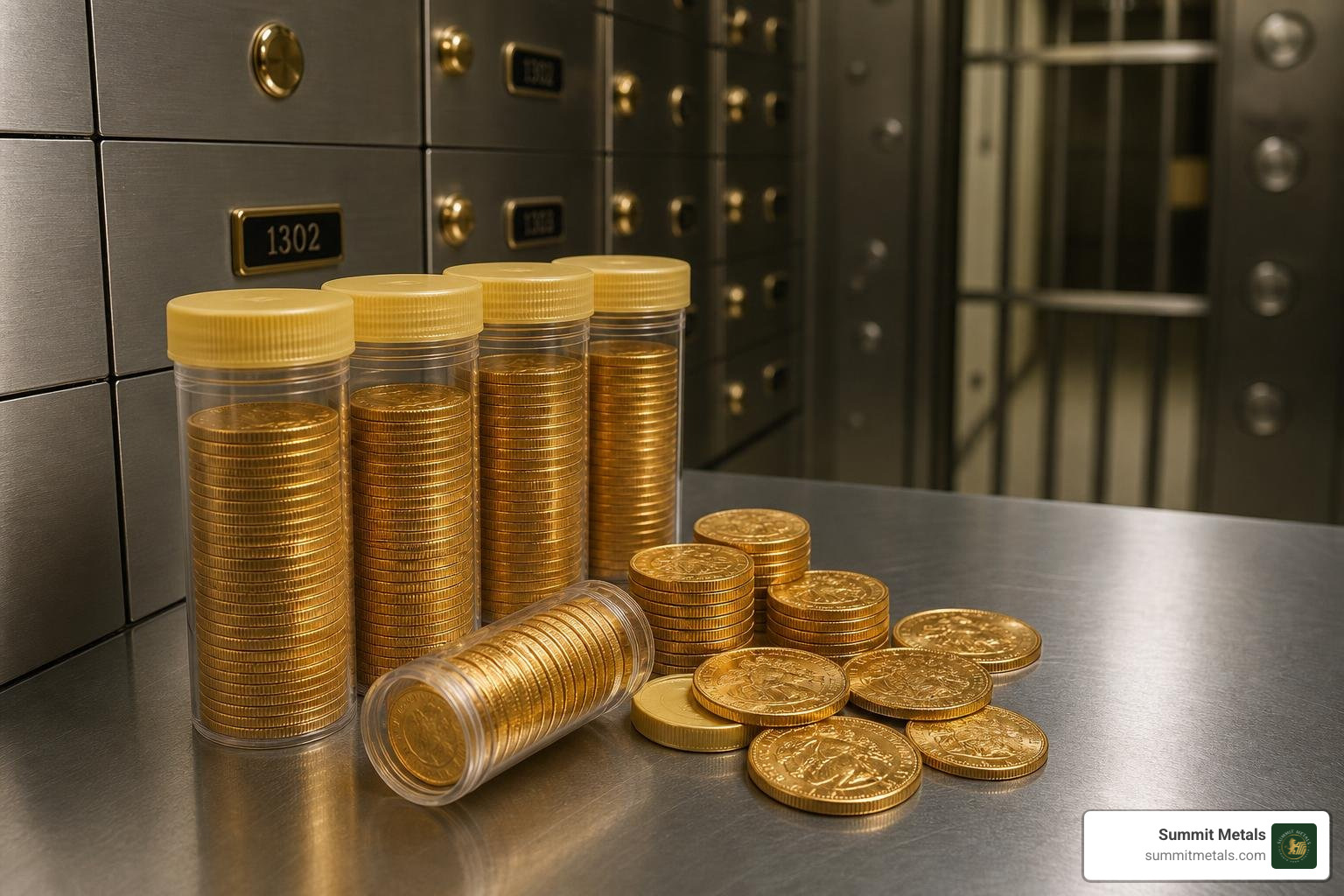
When you are ready to move from watching gold price charts live to actually owning the metal, you face a critical decision: what format should you buy? At Summit Metals, we specialize in physical, authenticated gold and silver because we believe in the unmatched security of direct ownership and tangible wealth preservation.
Comparing Gold Coins and Gold Bars: Maximizing Value and Protection
To help you decide which physical format fits your strategy, let us compare the two primary options: sovereign gold coins and minted gold bars.
| Feature | Sovereign Gold Coins | Minted Gold Bars |
|---|---|---|
| Fabrication Premium | Slightly higher due to intricate government minting | Lower; optimized for maximum ounces per dollar |
| Legal Tender Status | Yes (carries a nominal face value) | No |
| Fraud Protection | Extremely High (counterfeiting is a federal offense) | High (usually relies on serial numbers and assay cards) |
| Liquidity | Universally recognized and incredibly easy to trade | High, but large bars may require testing upon sale |
| Best For | Security, flexibility, and robust fraud protection | Maximizing total gold volume on a budget |
Why Sovereign Gold Coins Offer Unique Security
While gold bars are fantastic for putting a large amount of physical gold into your vault at the lowest possible cost over spot, sovereign gold coins (like the American Gold Eagle or the Canadian Gold Maple Leaf) offer a unique layer of safety.
Because sovereign coins are minted by official government mints, they carry a nominal face value and are classified as legal tender. This legal status is a massive deterrent to counterfeiters. Counterfeiting a sovereign gold coin is not just standard commercial fraud—it is a federal counterfeiting crime prosecuted by government agencies.
This government backing gives sovereign coins unmatched trust and liquidity. When you are ready to sell, any reputable dealer in Salt Lake City, Utah, or anywhere else in the world will recognize a sovereign coin instantly, making your exit strategy seamless.
Practical Strategies for Tracking and Buying Precious Metals
Watching live charts can be exciting, but the real magic happens when you turn that data into a disciplined, stress-free investment plan. Trying to perfectly "time the market" is incredibly difficult, even for Wall Street professionals. Instead, successful precious metals investors use proven strategies to build wealth steadily over time. You can monitor the professional trading community's expectations by keeping an eye on Yahoo Finance Gold Futures, but for your personal portfolio, simplicity is key.
Building Wealth with Autoinvest Subscriptions and Gold Price Charts Live
The single most effective way to invest in physical gold is through dollar-cost averaging (DCA). Instead of trying to guess the absolute bottom of a market correction, you commit to buying a fixed dollar amount of gold at regular intervals (such as once a month).
This is exactly how a 401(k) retirement plan works, and we have brought that same effortless discipline to the precious metals world. With our Autoinvest Subscriptions, you can set up a monthly recurring purchase of physical gold.
When the live gold price is high, your monthly budget buys slightly less gold; when the live price dips (like the healthy pullbacks we saw in June 2026), your budget automatically buys more gold. Over time, this smooths out the volatility of the live charts and ensures you pay a fair, averaged price without any of the daily trading stress.
Securing Your Exit Strategy: Storage and Liquidity
Buying your gold is only half the battle; you also need a clear plan for keeping it safe and keeping it liquid. While some investors prefer home storage, utilizing a secure, private, fully insured vault is often the smartest choice for larger holdings.
This is where your exit strategy becomes incredibly simple. When you store your physical gold in an approved, secure private vault partner, your assets remain highly liquid. If you ever need to cash out, you can take advantage of our Sell to Us program. Because your gold is already securely vaulted and authenticated, we can buy it back from you instantly at competitive current market rates—completely eliminating the shipping costs, transit risks, and delays of physical redemption.
Frequently Asked Questions About Live Gold Prices
What is the current spot price of gold in June 2026?
As of early June 2026, the live spot price of gold is trading in the range of $4,330 to $4,493 per troy ounce, representing a healthy pullback from the January 2026 all-time high of $5,608.35. This translates to approximately $139 to $140 per gram and roughly $139,000 to $140,000 per kilogram.
Why do gold prices fluctuate 24 hours a day?
Gold is a global currency asset traded continuously across multiple international time zones. When the markets close in New York, they are already open in Tokyo, Sydney, Hong Kong, Zurich, and London. This continuous loop of global trading hubs ensures that gold prices react instantly to real-time worldwide news, 24 hours a day, five days a week.
Are gold investments subject to taxes and dealer premiums?
Yes, all physical gold purchases carry a "premium," which is the small markup over the raw spot price to cover the cost of refining, minting, shipping, and dealer operations.
When it comes to taxes, rules vary by location. For our clients working with our office in Salt Lake City, Utah, there is excellent news: the state of Utah exempts investment-grade gold and silver bullion from state sales tax. This tax-friendly environment makes Salt Lake City an incredibly attractive hub for precious metals investors looking to maximize their purchasing power.
Conclusion
Mastering the gold market does not require a Wall Street trading desk. By learning to read gold price charts live, understanding how macroeconomic factors drive daily fluctuations, and choosing the right physical formats, you can take complete control of your financial future.
At Summit Metals, based in Wyoming with local operations in Salt Lake City, Utah, we are dedicated to making this journey as simple and secure as possible. We offer fully authenticated gold and silver, transparent real-time pricing, and highly competitive rates achieved through our bulk purchasing power.
Whether you want to make a one-time purchase, set up an effortless monthly subscription, or secure your exit strategy with a trusted buyback partner, we are here to help you stack with confidence. Ready to take the next step? Explore our comprehensive Buying Gold Guide and start building your tangible legacy today.