What Is the 5 Dollar Indian Head Gold Piece?

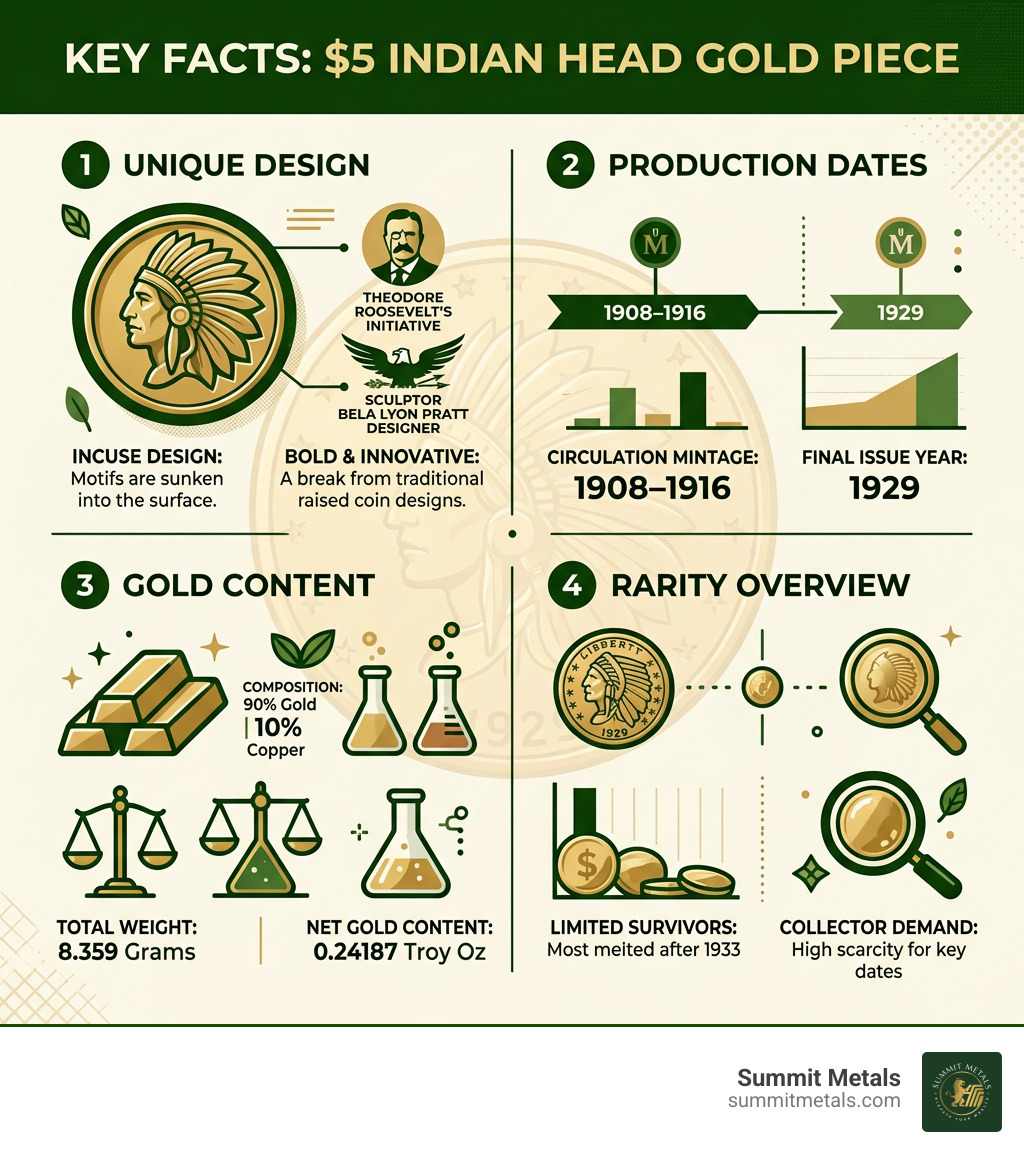
The 5 dollar indian head gold piece is one of the most historically significant U.S. gold coins ever made. Here are the fast facts:
| Feature | Details |
|---|---|
| Also known as | Indian Head Half Eagle |
| Designer | Bela Lyon Pratt |
| Minted | 1908-1916 and 1929 |
| Composition | 90% gold, 10% copper |
| Gold content | 0.24187 troy oz |
| Weight | 8.359 g |
| Diameter | 21.6 mm |
| Key feature | Only U.S. circulating coin with an incuse (recessed) design |
| Total varieties | 24 date and mint mark combinations |
This coin was born from President Theodore Roosevelt's push to make American coinage more beautiful. He commissioned sculptor Bela Lyon Pratt to create a design unlike anything the U.S. Mint had done before — with the imagery sunken into the surface rather than raised above it.
That single decision made it controversial at first. Some people worried the recessed areas would trap germs. Others thought it looked strange. Today, collectors and investors consider it one of the boldest and most beautiful coins in American history.
Most surviving examples are rare. The 1929 issue had a mintage of 668,000 — yet very few exist today because most were melted after President Franklin Roosevelt's 1933 executive order recalled gold coins from the public.
I'm Eric Roach, a former Wall Street investment banker who has spent years helping everyday investors use physical gold — including pre-1933 coins like the 5 dollar indian head gold piece — to protect and grow their wealth. In this guide, I'll walk you through everything you need to know about this remarkable coin, from its history and design to its value and what to watch for as a buyer.
Quick 5 dollar indian head gold piece terms:
The Vision of Theodore Roosevelt and the Great Collaboration
At the turn of the 20th century, President Theodore Roosevelt looked at the coins in his pocket and was, frankly, unimpressed. He viewed the existing U.S. coinage as "artistically of atrocious hideousness." Driven by a desire to see American money reflect the nation's growing global stature, he bypassed the traditional bureaucratic channels of the U.S. Mint to spark a numismatic revolution.
Roosevelt's initial partner in this "pet crime" was the legendary sculptor Augustus Saint-Gaudens. While Saint-Gaudens successfully redesigned the $10 Eagle and the $20 Double Eagle, his death in 1907 left the smaller denominations unfinished. Enter William Sturgis Bigelow, a close friend of the President, who suggested a radical new approach for the $2.50 Quarter Eagle and the $5 Half Eagle.
Bigelow proposed an "incuse" design—where the details are hammered into the coin rather than standing out in relief. This wasn't just for looks; the idea was that a recessed design would be protected from wear and allow the coins to stack more easily. To bring this vision to life, Roosevelt and Bigelow turned to Boston sculptor Bela Lyon Pratt.
Pratt’s task was to create a design that was truly American. Unlike previous coins that often featured Caucasian models wearing Native American headdresses, Pratt sought to depict a realistic Native American figure. This vision resulted in the 5 dollar indian head gold piece, a coin that remains a testament to one of the most significant artistic collaborations in U.S. history.
Innovative Design and Initial Public Backlash
When the 5 dollar indian head gold piece first hit the streets in 1908, it wasn't exactly greeted with open arms. The design was so that it genuinely confused the public. Because the entire design—the Indian Chief on the obverse and the Eagle on the reverse—was sunken into the flat surface of the coin, it felt "backwards" to people used to the raised relief of the Liberty Head gold coins.
Unique Features of the 5 Dollar Indian Head Gold Piece
The most striking feature is, of course, the incuse strike. This technique was inspired by ancient Egyptian reliefs and was intended to keep the "high points" of the design below the actual surface of the coin to prevent rubbing and wear.
On the obverse, we see a Native American male in a full war bonnet, surrounded by 13 stars and the word "LIBERTY." The reverse features a proud bald eagle standing on a bundle of arrows entwined with an olive branch. Interestingly, the rim of the coin contains 46 stars, representing the number of states in the Union at the time of its debut.
The "Germ" Controversy and Design Criticism
Believe it or not, the biggest complaint wasn't artistic—it was hygienic. Shortly after its release, a prominent numismatist named Samuel Chapman wrote a scathing letter to President Roosevelt. He claimed that the recessed areas of the coin would become "filthy" and act as a breeding ground for "germs and disease." He even went so far as to call the depicted Indian "emaciated."
While modern science (and common sense) eventually put the germ fears to rest, the design continued to face internal hurdles. The Mint's Chief Engraver, Charles E. Barber, made several modifications to Pratt's original models. Pratt was reportedly furious, claiming the Mint had "knocked spots" out of his work and made a "mess of it." Despite the drama, the coin moved into production, eventually becoming a beloved icon of American numismatics.
Production History and the Impact of World War I
The 5 dollar indian head gold piece was struck at four different mint facilities: Philadelphia (no mint mark), Denver (D), San Francisco (S), and New Orleans (O). Production was steady from 1908 through 1916. However, as the world plunged into the chaos of World War I, the economic landscape changed drastically.
Gold began to disappear from circulation. As the price of gold rose and the newly established Federal Reserve System began issuing more paper banknotes, the public began hoarding gold coins or using them primarily for international settlements. Consequently, the U.S. Mint halted production of the half eagle after 1916.
For over a decade, the $5 Indian Head was absent from the Mint's production schedule. It made a brief, final appearance in 1929. However, the timing couldn't have been worse. The stock market crash of 1929 and the onset of the Great Depression meant that very few of these coins actually made it into the hands of the public.
The End of an Era: Executive Order 6102
The final nail in the coffin for the 5 dollar indian head gold piece—and all circulating U.S. gold—came in 1933. Facing a massive banking crisis and a run on gold reserves, President Franklin D. Roosevelt issued Executive Order 6102. This order essentially "criminalized" the private possession of gold bullion and coins, requiring citizens to deliver their gold to the Federal Reserve in exchange for paper currency.
This event was devastating for the 1929 mintage. Although 668,000 pieces were struck in Philadelphia that year, the vast majority were still sitting in Treasury vaults when the recall happened. They were subsequently sent to the melting pots. This historical "gold meltdown" is why many dates in the Indian Head series, particularly the 1929, are so incredibly rare today.
Today, these coins are classified as "Pre-33 Gold," a category highly prized by investors. Because they have a legal tender face value, they offer a layer of authenticity and historical protection that simple gold bars do not.
Comparison: Gold Coins vs. Gold Bars
| Feature | Pre-1933 Gold Coins | Modern Gold Bars |
|---|---|---|
| Intrinsic Value | Based on gold content | Based on gold content |
| Numismatic Value | Significant (rarity/history) | None to minimal |
| Legal Tender | Yes (Face Value) | No |
| Liquidity | High (Collectors & Investors) | High (Bullion Dealers) |
| Counterfeit Risk | Lower (Complex designs/history) | Higher (Requires strict testing) |
| Exit Strategy | Best for long-term wealth | Best for pure weight plays |
For those looking to build a resilient portfolio, we often recommend an exit strategy that involves storing your metals in a private vault. This keeps your assets liquid and secure, allowing you to sell back to us at competitive rates when the time is right.
Collecting the 5 Dollar Indian Head Gold Piece
For the modern collector, the 5 dollar indian head gold piece represents a finite series that is actually possible to complete, though it requires patience and a healthy budget. There are 24 different date and mint mark combinations to track down.
Key Dates for the 5 Dollar Indian Head Gold Piece
If you are looking for the "trophies" of this series, you need to keep an eye out for these specific issues:
- 1929 (Philadelphia): As mentioned, most were melted. It is the undisputed king of the series.
- 1909-O (New Orleans): This was the only year the New Orleans mint produced this coin, and the mintage was a tiny 34,200 pieces.
- 1911-D (Denver): While not as rare as the 1929, high-grade examples are difficult to find and highly sought after.
- 1908-S (San Francisco): Another low-mintage date (62,000) that carries a significant premium.
Grading and Authenticity
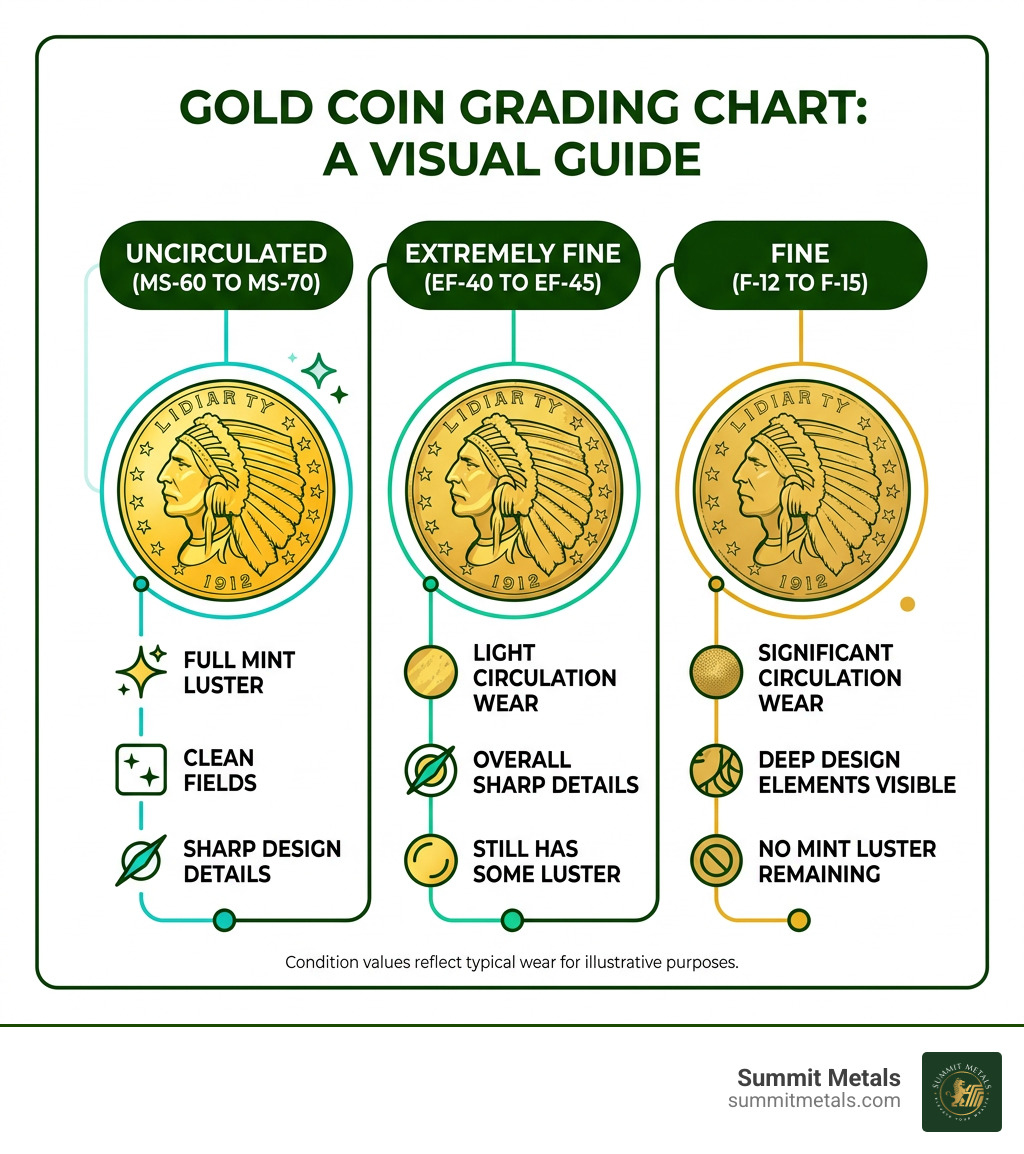
Because of the unique incuse design, grading these coins can be tricky. On a standard coin, you look for wear on the highest points. On a 5 dollar indian head gold piece, the "high points" are actually the flat fields of the coin. If the fields are scratched or dull, the coin has seen circulation.
We always recommend buying coins that have been certified by professional services like NGC or PCGS. This ensures the coin is real gold and accurately graded. Prices for these coins vary wildly based on condition. For example, an MS-62 example might trade between $1,400 and $1,800, while a top-tier MS-65 specimen can easily fetch $8,500 or more (prices at time of publication).
Why This Coin Belongs in Your Portfolio
Whether you are a seasoned numismatist or a first-time investor, the 5 dollar indian head gold piece offers a unique combination of intrinsic value and historical significance. At Summit Metals, we believe in making gold ownership accessible and consistent.
That’s why we promote our Autoinvest program. Much like a 401k, Autoinvest allows you to dollar-cost average your way into a gold position by shopping with us every month. By buying regularly, you smooth out the volatility of the gold market and build a substantial "private reserve" over time.
Investing in these coins isn't just about the 0.24187 ounces of pure gold; it’s about owning a piece of the "Great Artistic Renewal" of American coinage. These were the last $5 gold pieces ever struck for circulation in the United States, marking the end of a golden era that began in 1792.
If you're ready to start your collection or add to your investment holdings, we invite you to explore our authenticated inventory. And remember, when it's time to realize your gains, you can always sell to us. We pride ourselves on transparent, real-time pricing and a straightforward liquidation process.
Discover more about the legacy of American gold coins here.
Common Questions About the $5 Indian Head
How can I tell if my coin is a real 5 dollar indian head gold piece?
Authenticating an incuse coin is difficult for the untrained eye. Check the weight (8.359g) and diameter (21.6mm). Look closely at the "BLP" initials (for Bela Lyon Pratt) located just above the date. However, the only way to be 100% sure is to purchase a coin certified by a third-party grading service or have it tested by a reputable dealer like us.
Is the $5 Indian the same as the $2.50 Indian?
They share the exact same design! The $2.50 version is known as the Quarter Eagle. It is smaller (18mm) and contains roughly half the gold (0.12094 oz). The $5 Half Eagle is the "big brother" and was generally used more in daily commerce than the Quarter Eagle, which was a popular Christmas gift in the 1920s.
Why is the 1929 mintage so expensive if they made 668,000 of them?
Mintage numbers can be deceiving. While 668,000 were minted, the vast majority never left the Treasury before the 1933 recall. Almost the entire mintage was melted down. Only a few hundred are estimated to have survived, making it one of the "holy grails" of 20th-century gold.
For more information on the wide world of precious metals and how to protect your future, check out our Ultimate Buyer's Guide to American Gold.