What Makes the 1862-S Half Dollar Special?

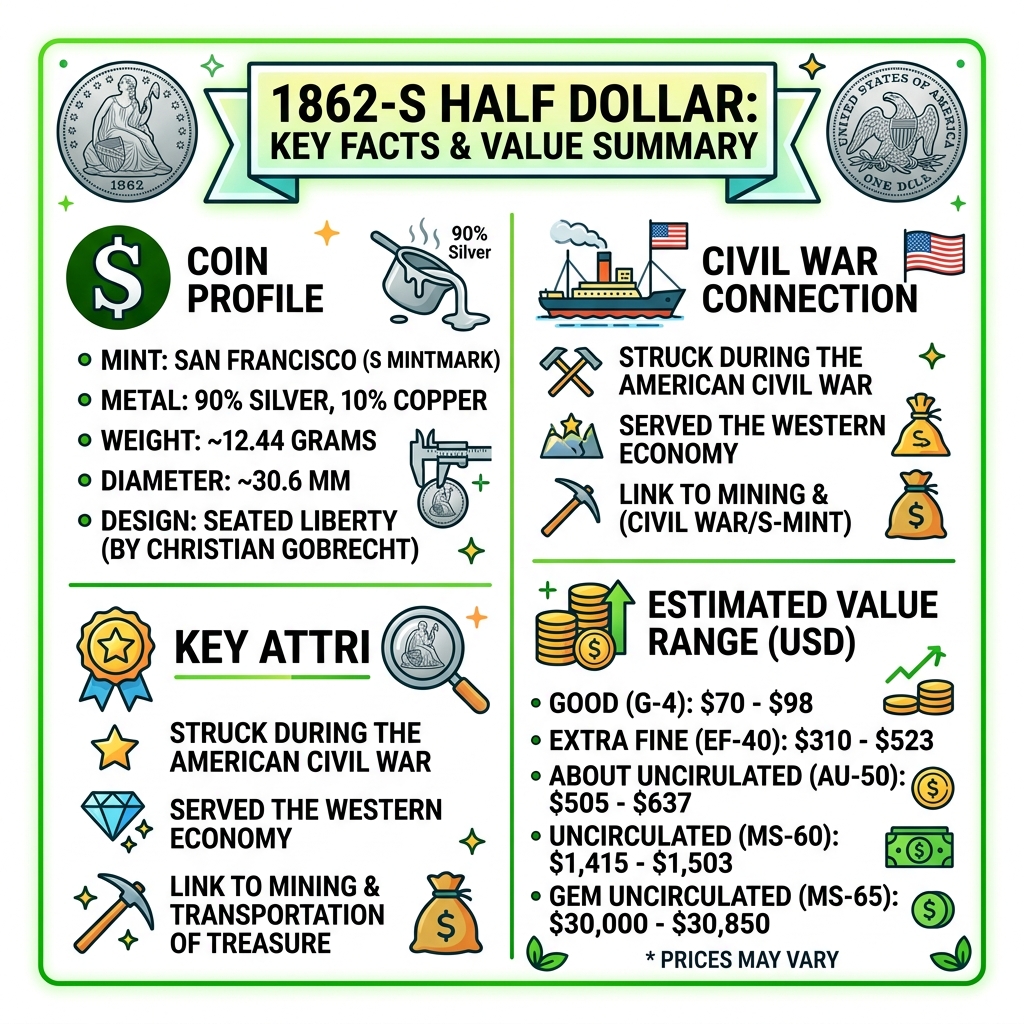
The 1862 s half dollar is a fascinating piece of American history, sought after by collectors for its ties to the Civil War era and its unique characteristics. If you're looking to understand its value, here's a quick overview of estimated prices based on condition (prices shown are at the time of this publication):
| Grade | Estimated Value (USD) |
|---|---|
| Good (G-4) | $70 - $98 |
| Extra Fine (EF-40) | $310 - $523 |
| About Uncirculated (AU-50) | $505 - $637 |
| Uncirculated (MS-60) | $1,415 - $1,503 |
| Gem Uncirculated (MS-65) | $30,000 - $30,850 |
This guide will dive deep into everything you need to know about this iconic coin. We'll explore its background, design, rarity, and what drives its value in today's market. Understanding these details is key to both appreciating and appraising your 1862-S Seated Liberty Half Dollar.
I'm Eric Roach, and I bring a background in Wall Street finance and hands-on precious metals insight to help you understand market cycles and value. My expertise with coins like the 1862-S half dollar ensures you get clear, actionable guidance on your numismatic investments.
Historical Context and Christian Gobrecht’s Design
The story of the 1862 s half dollar begins during one of the most tumultuous periods in American history: the Civil War. While the Eastern United States was embroiled in bloody conflict, the San Francisco Mint was busy striking silver to keep the Western economy moving.
The design itself is a masterpiece of 19th-century neo-classical art. Originally conceived by Thomas Sully and prepared for the dies by the legendary Christian Gobrecht, the "Seated Liberty" motif features Liberty sitting upon a rock. In her left hand, she holds a staff topped with a Phrygian cap—a symbol of freedom—while her right hand rests upon a shield inscribed with "LIBERTY."
The 1862-S belongs to the "Type 1" variety of the Seated Liberty series. In the numismatic world, this is often referred to as the "No Motto" variety. Why? Because the religious motto "In God We Trust" did not appear on the reverse of the half dollar until 1866. When you look at an 1862 s half dollar, you are seeing the design exactly as it was intended before the mid-war shift toward religious sentiment on coinage.
Collectors often reference the 1862 S 50C MS | Coin Explorer | NGC to see how few of these coins survived in Mint State. Most of these coins saw heavy circulation in the frontier towns and mining camps of the West, making high-grade survivors incredibly rare.
Technical Specifications and Silver Melt Value
When we appraise an 1862 s half dollar, we start with the physical fundamentals. These coins were workhorses of commerce, and their silver content provided the intrinsic value that people trusted during the uncertain war years.
- Composition: 90% Silver, 10% Copper
- Weight: 12.44 grams
- Diameter: 30.6 mm
- Edge: Reeded
- Mint Mark: 'S' (located on the reverse, below the eagle)
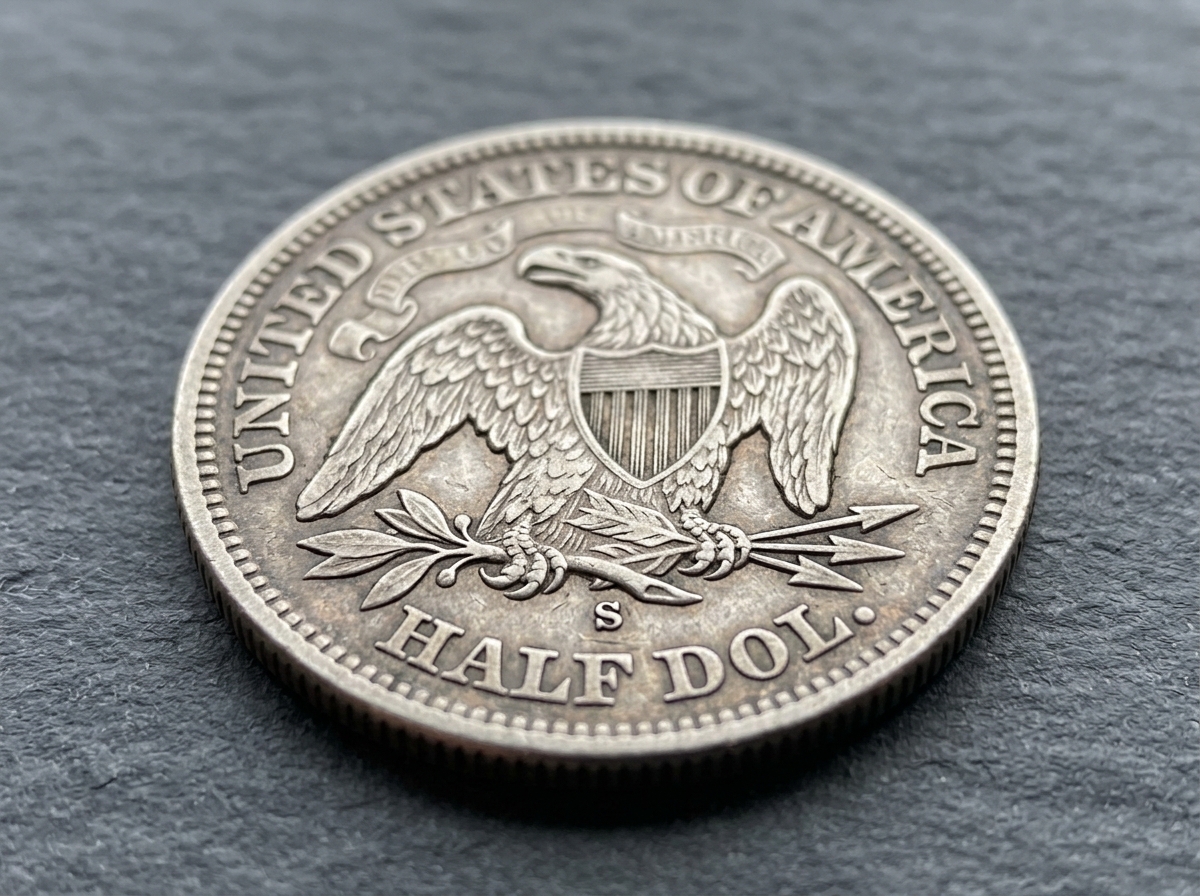
Even if a coin is so worn that the design is barely visible, it still holds "melt value." At the time of this publication, the silver melt value of an 1862 s half dollar is approximately $30.71. However, because this is a Civil War-dated coin from the San Francisco Mint, it almost always sells for a significant numismatic premium over its raw silver weight. For a broader look at how these silver values are calculated, you can check out our Half Dollar Coin Value Guide: Turning Coins into Cash.
Determining the Value of an 1862 s half dollar
The primary factor driving the value of the 1862 s half dollar is its mintage of 1,352,000. While this might sound like a large number, it is relatively low compared to modern standards. More importantly, the "survival rate"—the number of coins that weren't lost, melted, or worn down to nothing—is quite small.
Market Value Comparison (Estimated at time of publication)
| Grade | USA Coin Book Estimate | Estimated Retail Value | Recent Auction/eBay Average |
|---|---|---|---|
| G-4 (Good) | $98 | $70 | $35 - $60 |
| F-12 (Fine) | $173 | $114 | $100 - $138 |
| EF-40 (Extra Fine) | $523 | $310 | $250 - $338 |
| AU-50 (About Unc) | $637 | $505 | $470 - $634 |
| MS-63 (Mint State) | $3,403 | $3,280 | $1,780+ |
As you can see, there is often a gap between "book values" and "auction prices realized." Retail prices factor in the cost of inventory, expert research, and the guarantee of authenticity. Auction prices, such as those tracked on 1862 S Seated Liberty Half Dollar Prices | Ungraded, NGC, PCGS Values, represent what a buyer was willing to pay on a specific day, which can fluctuate based on the "eye appeal" of the specific coin.
For a comprehensive breakdown of all varieties, the 1862 S Seated Liberty Half Dollar Coin Value Prices, Photos & Info is an excellent resource for cross-referencing your find.
Grading Standards for the 1862 s half dollar
Grading is the most critical step in appraising your coin. A single grade jump can mean a difference of hundreds, or even thousands, of dollars. Professional services like PCGS, NGC, and ANACS provide third-party certification that "locks in" a coin's grade.
When we look at an 1862 s half dollar, we look for:
- Luster: In higher grades (AU and MS), the coin should have a "cartwheel" effect when rotated under a light.
- Strike: San Francisco coins of this era often show slight weakness on the stars or the eagle's feathers. A "strong strike" is highly desirable.
- Toning: Some collectors love "original skin"—a grey or colorful patina that proves the coin hasn't been harshly cleaned.
- CAC Approval: A green CAC sticker on a slabbed coin indicates that the coin is high-end for its assigned grade. For example, a PCGS AU53 CAC example sold for $600 back in 2013, a premium price for that grade.
Where to Find an 1862 s half dollar for Sale
If you are looking to add an 1862 s half dollar to your portfolio, you have several options. You can find uncertified examples on eBay for lower prices, but be cautious of "cleaned" or "damaged" coins that aren't disclosed. For those seeking investment-grade quality, reputable dealers or major auction houses like Heritage Auctions are the way to go.
Strategic Investing with Summit Metals: Autoinvest and Exit Strategies
At Summit Metals, we believe that building a precious metals portfolio shouldn't be a stressful game of timing the market. Whether you are collecting historical treasures like the 1862 s half dollar or stacking bullion for the future, consistency is the key to success.
The Autoinvest Advantage
We encourage our clients to utilize our "Autoinvest" program. Much like a 401k, this allows you to dollar-cost average your way into a strong position. By setting up a monthly purchase, you buy more silver when prices are low and less when they are high, smoothing out the volatility of the market. You can learn more about how to automate your wealth building here: More info about Summit Metals Subscriptions.
Coins vs. Bars: Which is Right for You?
While bars are great for bulk storage, many investors prefer coins. Here is why:
| Feature | Gold/Silver Coins | Gold/Silver Bars |
|---|---|---|
| Face Value | Legal tender status provides a layer of government protection against fraud. | No face value; purely based on weight. |
| Liquidity | Highly recognizable and easy to sell to any dealer. | May require assay or testing in some markets. |
| Collectibility | Potential for numismatic growth (like the 1862-S). | Value is tied strictly to the spot price. |
| Premiums | Generally higher due to minting costs. | Generally lower, giving you more metal for your dollar. |
Seamless Exit Strategy and Liquidity with Summit Metals
An investment is only as good as your ability to sell it. We don't just sell you metal; we provide a clear exit strategy. When you store your metals in a private vault through us, your assets remain liquid. If you decide it's time to cash out, you don't have to worry about shipping or security—you can sell directly back to us.
We offer:
- Real-time Pricing: No guessing games. You see what we see.
- Direct Buybacks: We are always in the market to buy authenticated metals. More info about selling to Summit Metals.
- Private Vault Storage: Keep your metals secure and ready for a quick sale at a moment's notice.
Frequently Asked Questions about the 1862-S Half Dollar
What is the mintage of the 1862-S Seated Liberty Half Dollar?
The total mintage for the 1862 s half dollar is 1,352,000. While this is a moderate mintage, the number of surviving specimens in high grades is very low.
How much silver is in an 1862-S Half Dollar?
Each coin contains 0.3601 troy ounces of pure silver. It is composed of 90% silver and 10% copper.
What are the key varieties of the 1862-S Half Dollar?
The most notable variety is the "Type 1 No Motto." There are also minor die varieties, such as the "Broken S" or "Broken 6," which can occasionally command a premium from specialist collectors.
Conclusion
The 1862 s half dollar is more than just a piece of silver; it is a tangible link to the American West during the Civil War. Whether you are appraising an old family heirloom or looking to diversify your investment portfolio with historical coins, understanding the nuances of grade and rarity is essential.
At Summit Metals, we are committed to helping you navigate precious metals with transparency and trust. Based in Wyoming, we leverage our bulk purchasing power to offer you competitive rates and real-time pricing that the "big guys" can't always match. From our Salt Lake City, Utah operations to our global reach, we are here to ensure your investment journey is secure.
Ready to start your journey or sell your collection? Visit us at Summit Metals today and see the difference that expert guidance and transparent pricing can make.