Why Gold Remains a Cornerstone of Financial Security

Why invest gold has been a question asked across millennia, and the answer remains remarkably consistent: gold offers unique protection for your wealth that few other assets can match. Whether you're looking to hedge against inflation, diversify beyond stocks and bonds, or simply preserve purchasing power through uncertain times, gold delivers tangible value that has stood the test of time.
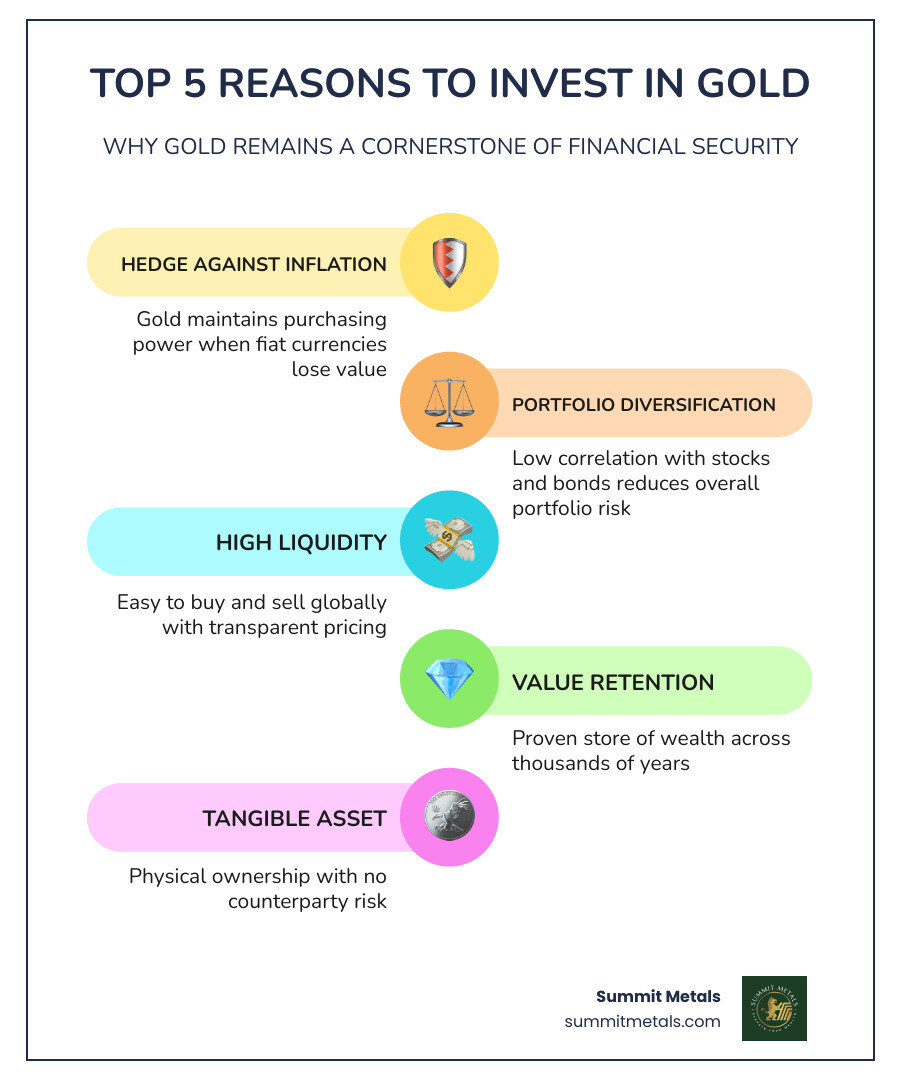
Top 5 Reasons to Invest in Gold:
- Hedge Against Inflation - Gold maintains purchasing power when fiat currencies lose value
- Portfolio Diversification - Low correlation with stocks and bonds reduces overall portfolio risk
- High Liquidity - Easy to buy and sell globally with transparent pricing
- Value Retention - Proven store of wealth across thousands of years
- Tangible Asset - Physical ownership with no counterparty risk
Gold's role as a financial anchor dates back at least 5,000 years to ancient civilizations who recognized its intrinsic worth. Unlike paper currency that governments can print at will, gold maintains scarcity—global mining output increases by roughly 1% annually. This fundamental limitation has helped gold preserve wealth through the rise and fall of empires, wars, economic crises, and the endless cycle of inflation and deflation.
The numbers tell a compelling story. Since 1971, when the U.S. dollar decoupled from gold, the precious metal has delivered returns similar to equities while outperforming bonds. Over the past two decades, gold has outperformed most major asset classes. In recent years, gold has surged to new highs as investors sought safety amid economic uncertainty and persistent inflation concerns.
What makes gold uniquely valuable today?
Gold serves multiple critical functions simultaneously. It acts as a diversifier because its price movements show historically low correlation to traditional investments like stocks and bonds. When equity markets tumble, gold often holds steady or rises. It functions as a safe-haven asset during periods of geopolitical tension—from wars to trade disputes to political upheaval. And it hedges against currency devaluation, protecting your purchasing power when inflation erodes the value of cash savings.
Central banks worldwide recognize gold's importance, continuing a multi-year trend of accumulating thousands of tons of gold for their reserves. This institutional demand, combined with consistent demand from jewelry manufacturing, growing industrial applications, and surging investor interest, creates a robust foundation for gold's value.
I'm Eric Roach, and during my decade on Wall Street advising Fortune 500 companies through multi-billion-dollar transactions, I witnessed how sophisticated institutions use gold as a defensive strategy to protect balance sheets—expertise I now apply to help individual investors understand why invest gold as part of a resilient wealth-building plan. Today, I channel that institutional knowledge to show everyday investors how physical gold can serve as a liquid, reliable hedge alongside traditional portfolios.
The Core Roles of Gold in a Modern Portfolio
For centuries, gold has been more than just a pretty metal; it's been a bedrock of financial stability. In today's dynamic investment landscape, understanding gold's core roles is crucial for anyone pondering why invest gold in their portfolio. It’s not about getting rich quick, but about preserving and growing wealth over the long haul, protecting what you’ve built from unexpected shocks.

Gold offers a unique blend of portfolio stability, long-term returns, wealth preservation, and risk reduction. Historically, the U.S. monetary system was based on a gold standard, a system that linked the dollar's value directly to gold for much of its history, as detailed in the Brief History of the Gold Standard in the United States. While that system ended, gold's fundamental value as a store of wealth did not.
A Hedge Against Inflation and Economic Uncertainty
Imagine a leaky boat – that's your purchasing power in inflationary times. Gold, in this scenario, acts as a patch, helping to keep your wealth afloat. As a hedge against inflation, gold tends to maintain or even increase its purchasing power when fiat currencies (like the U.S. dollar) lose value. This is because, unlike paper money, gold cannot be printed into existence. Its scarcity makes it a reliable store of value.
We've seen this play out repeatedly. During periods of significant economic turmoil or high inflation, gold often shines. For instance, in the 1970s, when stagflation gripped the economy, gold prices soared from $35/oz to $850/oz by 1980. More recently, during periods of high inflation, gold prices have climbed to new record highs. When the U.S. CPI was higher than 5%, gold's average return was an impressive 27%.
Geopolitical tensions also send investors flocking to gold as a safe-haven asset. Recent history has shown that heightened geopolitical tensions can drive surges in the price of gold. In Salt Lake City, Utah, and across the nation, investors turn to gold when the world feels uncertain, seeking refuge from market volatility and political upheaval. Central banks, particularly in emerging markets, are also increasing their gold reserves, continuing a trend of significant annual purchases that signals global concerns about long-term economic stability.
A Powerful Portfolio Diversifier
One of the most compelling reasons why invest gold is its role as a powerful portfolio diversifier. Gold has a historically low correlation to traditional assets like stocks and bonds. What does this mean? When your stocks or bonds are taking a hit, gold often moves in the opposite direction or remains stable, acting as a "shock absorber" for your portfolio.
For example, during the 2008 stock market crash, gold prices rose, cushioning the blow for diversified portfolios. Even in the 2020s, as the stock market rose, gold continued its ascent, bucking traditional expectations. This unique behavior helps reduce overall portfolio volatility and risk. Since 1971, gold's return has been similar to equities and has outperformed bonds. In the last 20 years, it has outperformed most major asset classes, proving its mettle not just as a defensive play but also as a contributor to long-term returns. A small allocation—typically 5% to 10%—is often enough to significantly improve a portfolio's risk-adjusted returns.
A Liquid Asset with Universal Value
Gold is renowned for its liquidity and universal recognition. It's a global market, with high trading volumes that have increased by an average of 10% per year over the last two decades. This means it's relatively easy to buy and sell gold almost anywhere in the world, even when other financial markets are under stress.
As a tangible asset, physical gold offers something unique: freedom from counterparty risk. Unlike stocks or bonds, which represent a claim on an issuing entity, physical gold is an asset you hold directly. You don't need to worry about a company going bankrupt or a government defaulting on its debt. At Summit Metals, we understand that this direct ownership and security are paramount for our clients in Salt Lake City, Utah, and beyond. We ensure a seamless experience, offering transparent, real-time pricing and competitive rates for authenticated gold and silver, making it easy to buy and Sell your precious metals to us when the time is right.
Why Invest in Gold: Understanding Market Dynamics
The price of gold isn't static; it's a fascinating interplay of global forces. Understanding these dynamics is key to appreciating why invest gold remains a relevant question for savvy investors.
Key Drivers of the Gold Price
Several factors converge to determine gold's price:
-
Supply and Demand: This fundamental economic principle is perhaps the most significant.
- Supply: While gold is finite, its supply is influenced by mining output and recycled gold. Annual gold-mining output saw a decade of gains peaking at 3,300 metric tons in 2018 and 2019, with recent years seeing production levels around 3,500 metric tons. However, the global supply increases overall by only about a percentage point a year.
- Demand: Gold's global investment demand increased by an average of 10% per year over the last two decades. In recent years, investment demand has seen strong year-over-year growth. Jewelry manufacturing and industrial applications also form a significant part of total demand.
- Central Bank Purchases: Central banks, especially in emerging markets, have been increasing their gold reserves. They have been net purchasers of gold for over a decade, with annual purchases often exceeding hundreds of tons, a clear signal of gold's perceived stability.
- Investor Sentiment: Fear and uncertainty often drive investors to gold.
-
Macroeconomic Factors:
- Interest Rates: Generally, lower interest rates make non-yielding assets like gold more attractive.
- U.S. Dollar Value: Gold is priced in U.S. dollars, so a weaker dollar often makes gold cheaper for international buyers, increasing demand and price.
- Geopolitical Events: As mentioned, geopolitical tensions can trigger significant price surges.

Risks and Considerations for Gold Investors
While we advocate for gold as a crucial portfolio component, we also believe in full transparency. Investing in gold isn't without its considerations:
- Price Volatility: Gold prices can fluctuate significantly. After periods of rapid price increases, there can be corrections or stagnation. At times, investor attention may shift to other precious metals like platinum, causing their prices to rise, but these shifts are often temporary.
- Storage Costs: For physical gold, secure storage is essential, and this can incur costs (e.g., safe deposit boxes, specialized vaults).
- Insurance Costs: Protecting your physical gold against theft or loss requires insurance, adding another layer of expense.
- Lack of Income: Unlike stocks that pay dividends or bonds that pay interest, gold itself does not generate income. Its return comes solely from price appreciation.
- Currency Fluctuations: While a weaker U.S. dollar can boost gold prices, a stronger dollar can have the opposite effect, impacting returns for U.S.-based investors.
While physical gold offers unique advantages, it's important to consider storage and insurance. At Summit Metals, we focus on providing authenticated products, helping you minimize risks associated with authenticity, but the responsibility for secure storage remains yours.
Gold vs. Other Precious Metals
When considering why invest gold, it's natural to compare it to its glittering cousins: silver, platinum, and palladium. Each has unique characteristics:
- Gold vs. Silver: Gold has a much larger market value and tends to be less volatile than silver. Silver, often called "poor man's gold," has more industrial applications and can experience wilder price swings. Historically, silver often follows gold's movements, as suggested by History Suggests Silver Could Follow Gold’s Rise.
- Gold vs. Platinum/Palladium: Platinum and palladium are primarily industrial metals, heavily used in catalytic converters. Their prices are thus more sensitive to economic cycles and automotive demand. While other metals like platinum can see significant price spikes, gold generally remains the preferred choice for a safe-haven investment due to its historical stability and universal recognition.
While we specialize in gold and silver at Summit Metals, understanding the broader precious metals market is key. Gold's enduring role as a monetary metal gives it a stability often not seen in its more industrially-driven counterparts.
How to Invest in Gold: A Practical Guide
Now that we've explored why invest gold, let's dig into the practicalities of how to do it. The accessibility of gold has changed dramatically since the days when the U.S. dollar was directly convertible to gold, a process that ended definitively in 1971, as detailed in The end of gold convertibility. Today, investors have several avenues, but due diligence is paramount to avoid scams.
Physical Gold: Coins, Bars, and Rounds
Owning physical gold is the most direct way to invest. It offers tangible security and freedom from counterparty risk.
- Gold Bars: Available in various weights, from small gram bars to large kilobars. They typically have lower premiums per ounce compared to coins, making them cost-effective for larger investments. However, verifying authenticity for larger bars can be more complex.
- Gold Coins: These are often issued by sovereign governments (e.g., American Gold Eagles, Canadian Maple Leafs, South African Krugerrands). They usually carry a face value, which, while nominal compared to their melt value, provides legal tender status and an extra layer of fraud protection. Coins are generally easier to verify and are highly liquid, making them excellent for smaller, more flexible investments.
- Gold Rounds: Similar to coins but without legal tender status. They are privately minted and often have lower premiums than sovereign coins.
At Summit Metals, we offer authenticated gold coins and bars, ensuring you receive genuine products with transparent pricing. Our expertise helps you steer the choices, ensuring you get the best value for your investment in Salt Lake City, Utah, and beyond.
| Feature | Gold Coins (e.g., American Eagle) | Gold Bars (e.g., 1 oz, 10 oz) |
|---|---|---|
| Key Features | Legal tender, sovereign mint, standardized designs | Various sizes, often from private refineries, simpler designs |
| Best For | Smaller investments, easy portability, collectibility (some types) | Larger investments, maximizing gold weight per dollar |
| Premiums | Generally higher due to minting, legal tender status, recognition | Generally lower per ounce, especially for larger bars |
| Liquidity | Very high, widely recognized and traded globally | High, especially for recognized brands, but larger sizes less divisible |
| Fraud Protection | Face value (though nominal), government backing, intricate designs | Relies on reputable dealer, assay certificates, serial numbers |
| Face Value | Yes (e.g., $50 for a 1 oz American Gold Eagle) | No |
Why Invest in Gold with a Disciplined Strategy
Consistency is key in investing, and gold is no exception. We at Summit Metals strongly advocate for a disciplined, long-term approach to gold investment. That's why we've developed our Autoinvest program, allowing you to dollar-cost average your way into gold ownership.
Dollar-Cost Averaging (DCA) means investing a fixed amount of money regularly, regardless of the asset's price. This strategy helps mitigate volatility, as you buy more when prices are low and less when prices are high. It's a proven method for long-term wealth building, much like investing in a 401k. With Summit Metals' Autoinvest, you can set up consistent monthly purchases, taking the emotion out of investing and building your gold holdings steadily over time. It's a smart, hands-off way to secure your financial future.
Set up automated gold purchases with Summit Metals
Gold-Backed Financial Products
Beyond physical gold, investors can gain exposure through financial products:
- Gold Exchange-Traded Funds (ETFs): These funds hold physical gold on behalf of investors, offering a convenient way to trade gold like a stock. They provide liquidity and accessibility, with major examples like SPDR Gold Shares (GLD) and iShares Gold Trust (IAU). However, owning an ETF means you don't physically possess the gold, and there's a small expense ratio.
- Gold Mining Stocks: Investing in companies that mine gold offers leverage to gold prices; a small increase in gold's price can significantly boost a miner's profits. However, mining stocks also carry company-specific risks (management, production costs, geopolitical issues where mines are located) that are separate from gold's price performance.
- Gold Futures and Options: These are complex derivative contracts primarily used by experienced investors for speculation and hedging. They offer high leverage but come with significant risks and are not suitable for most long-term investors.
While these financial instruments offer exposure, they don't provide the same direct ownership and freedom from counterparty risk that physical gold does. At Summit Metals, we focus on providing authenticated physical gold products, ensuring you have direct ownership of a tangible asset. Our transparent, real-time pricing and competitive rates, achieved through bulk purchasing, make physical gold ownership accessible and trustworthy for investors in Salt Lake City, Utah, and beyond.
Frequently Asked Questions about Gold Investing
Let's address some common questions that arise when considering why invest gold.
How much of my portfolio should I allocate to gold?
There's no one-size-fits-all answer, but financial experts generally recommend a modest allocation. A small allocation, typically between 5% and 10% of your overall portfolio, is often considered sufficient to reap gold's diversification and hedging benefits without overexposing your assets to its volatility. This percentage depends on your individual risk tolerance, financial goals, and existing asset allocation. Gold is best viewed as a diversifier and wealth preserver, not necessarily a primary growth engine.
What are the tax implications of investing in gold in the USA?
In the USA, physical gold (bullion, coins) is generally treated as a "collectible" for tax purposes. This means that if you sell gold for a profit after holding it for more than a year, the long-term capital gains tax rate can be up to 28%, which is higher than the standard long-term capital gains rates for other assets like stocks (which can be 0%, 15%, or 20% depending on income). Short-term gains (held for one year or less) are taxed as ordinary income.
Gold ETFs can have varying tax treatments depending on their structure. Some are structured as grantor trusts that directly hold physical gold, and thus their gains may also be taxed at the collectibles rate. Others are structured differently and may have different tax implications.
It's crucial to consult with a qualified tax professional to understand the specific implications for your investments, as tax laws can be complex and subject to change. We at Summit Metals are experts in precious metals, not tax advice, so please seek professional guidance.
How can I avoid gold investment scams?
Unfortunately, the allure of gold also attracts fraudsters. Common scams include high-yield investment programs (HYIPs) promising unrealistic returns, advance fee fraud, counterfeit coins, and fraudulent mining companies. The CFTC even issued a warning titled 'Gold Is No Safe Investment' to highlight the prevalence of fraudulent claims.
Here's how to protect yourself:
- Be Skeptical of "Too Good to Be True" Offers: If an investment promises guaranteed high returns with little to no risk, it's almost certainly a scam. Gold's value fluctuates, and no legitimate investment can guarantee returns.
- Avoid High-Pressure Sales Tactics: Reputable dealers and advisors will give you time to make informed decisions.
- Demand Transparency: Insist on clear, transparent pricing and full disclosure of all fees and commissions. At Summit Metals, we pride ourselves on transparent, real-time pricing, ensuring you know exactly what you're paying.
- Verify Authenticity: When buying physical gold, purchase from reputable, established dealers who offer authenticated products. At Summit Metals, all our gold and silver products are authenticated, providing peace of mind to our clients in Salt Lake City, Utah, and beyond.
- Do Your Due Diligence: Research the company and individuals you're dealing with. Check for regulatory warnings or complaints.
- Beware of "Storage Scams": Some fraudsters claim to store your gold but never actually purchase it or misappropriate it. Insist on independent proof of storage and ownership if you choose a third-party storage solution.
By sticking with established, transparent dealers like Summit Metals, you significantly reduce your risk of falling victim to fraud.
Conclusion: Securing Your Future with Gold
In a world filled with economic uncertainties, inflation worries, and geopolitical tensions, the question of why invest gold becomes increasingly relevant. Gold's enduring value as a hedge against inflation, a powerful portfolio diversifier, and a universally recognized liquid asset makes it a prudent component of any long-term investment strategy. From ancient civilizations to modern financial markets, gold has proven its ability to preserve wealth across generations.
At Summit Metals, we are dedicated to making gold ownership accessible and trustworthy for investors in Salt Lake City, Utah, and beyond. As a Wyoming-based company, we leverage our bulk purchasing power to offer authenticated gold and silver products with transparent, real-time pricing and competitive rates. Whether you're making your first gold purchase or looking to systematically build your holdings through our Autoinvest program, we are here to help you secure your financial future with the enduring value of precious metals.