Why Understanding Silver Spot Price Matters for Your Wealth

How to buy silver at current spot price is one of the most searched questions among precious metals investors—and for good reason. Most buyers quickly find that the advertised "spot price" and the actual retail price differ significantly. Here's the reality:
You cannot buy physical silver at the exact spot price. The spot price reflects wholesale, institutional trades—often 5,000-ounce contracts that settle without physical delivery. When you buy physical silver, you pay:
- Spot price (the base market value)
- Premium (typically 2-15% or more, covering refining, minting, shipping, and dealer markup)
- Additional costs (shipping, insurance, sales tax in some states)
To get closest to spot price:
- Buy larger bars (100 oz bars have lower per-ounce premiums than 1 oz coins)
- Purchase during market dips when premiums narrow
- Use bulk discounts and volume pricing
- Pay with cash, check, or wire transfer (avoid credit card fees)
- Compare multiple online dealers for competitive pricing
- Consider secondary market silver with lower premiums
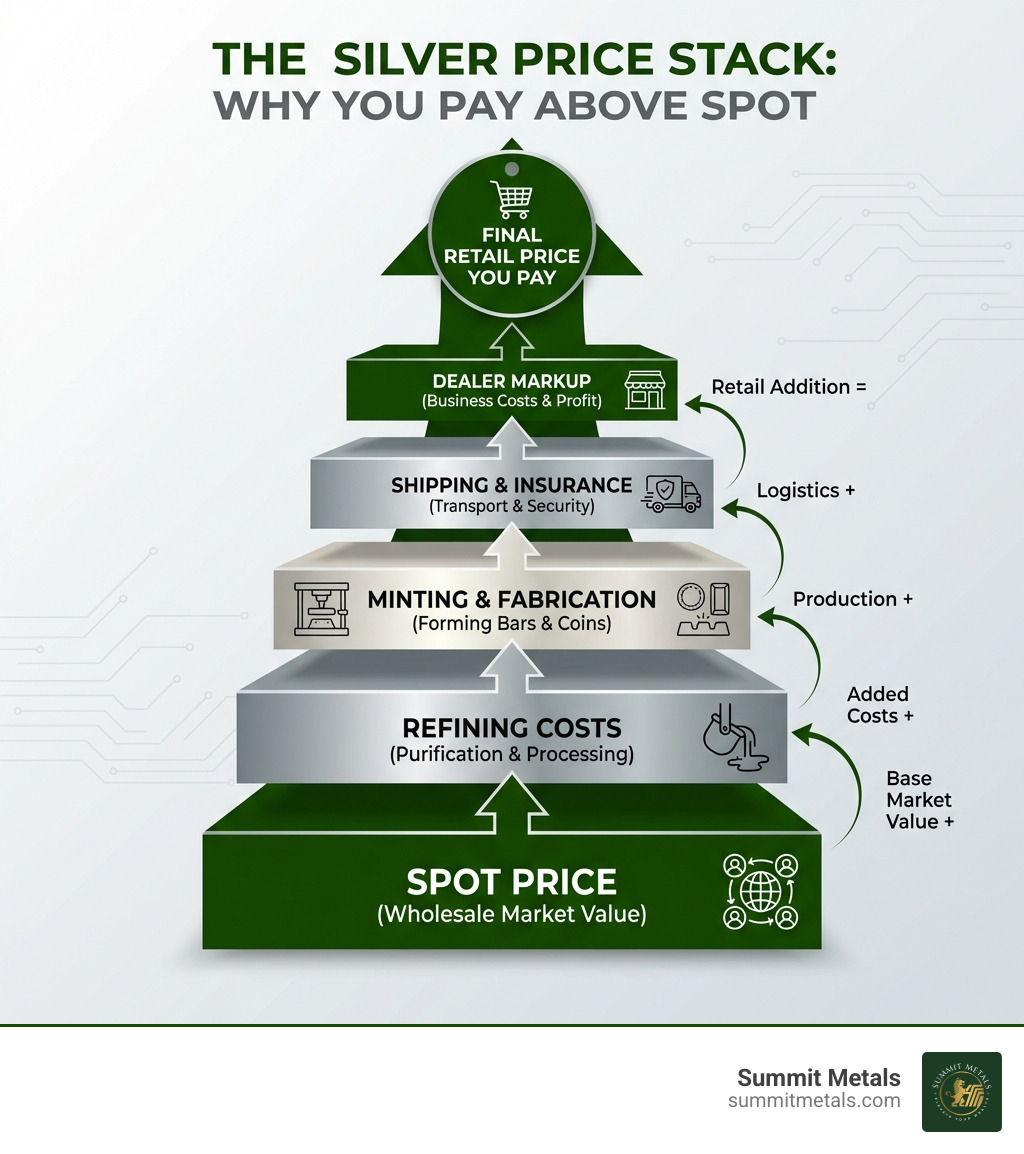
The silver price "stack" works like this: Spot Price -> + Fabrication Costs -> + Dealer Markup -> = Your Final Price. Understanding this breakdown helps you minimize what you pay above spot.
I'm Eric Roach, and after a decade guiding Fortune 500 clients through complex hedging strategies on Wall Street, I now help everyday investors understand how to buy silver at current spot price—or as close as physically possible. Throughout my career structuring multi-billion-dollar transactions and creating the first flat-fee stock trading company (later acquired by Morgan Stanley), I've learned that the same disciplined approach blue-chip companies use to protect their balance sheets can help individuals secure wealth through precious metals.
Learn more about how to buy silver at current spot price:
- physical precious metals
- precious metal broker
- silver investment strategies
Understanding How to Buy Silver at Current Spot Price
To steer precious metals, we first need to understand what "spot price" actually represents. Think of the spot price as the "raw material" cost. If you were buying a car, the spot price would be the cost of the raw steel, rubber, and glass before the factory ever touched it.
The silver spot price is determined by massive, institutional trading on global exchanges like the COMEX (Commodity Exchange) in New York and the LBMA (London Bullion Market Association). These markets trade "paper silver"—futures contracts and derivatives that represent the value of silver but rarely involve someone actually dropping a heavy box of metal on your doorstep.
When these institutions trade, they are often dealing in 5,000-ounce contracts. For a retail investor, that’s over 340 pounds of silver! Because these trades are massive and often digital, they can happen at the absolute "spot" value. However, for those of us wanting to hold the real thing, there is an extra cost covering production, logistics, and dealer operations.
Why You Can't Always Buy Physical Silver at Current Spot Price
It’s a bit of a running joke in the industry: everyone wants to buy at spot, but nobody wants to work for free. To get silver from a mine in the ground into a beautiful 1 oz round in your hand, several things must happen:
- Refining: Raw ore must be purified to .999 fine silver.
- Fabrication/Minting: The silver must be melted and struck into uniform bars or coins.
- Logistics: Heavy metal is expensive to ship and requires high-security insurance.
- Dealer Markup: Dealers like us at Summit Metals have to keep the lights on and pay our experts in Salt Lake City.
This total "extra" cost is known as the premium. In a normal market, you might see premiums between 2% and 15%. However, during times of high volatility or supply shortages, premiums can spike. If you see an offer to buy silver below the current market spot price, be extremely cautious—it’s often a red flag for fraud.
How to Buy Silver at Current Spot Price Using Bulk Discounts
If you want to get as close as possible to that elusive spot price, you have to think like a wholesaler. The general rule of thumb in silver is: The bigger the piece, the smaller the premium.
Think of it like buying cereal. A tiny individual-sized box at a gas station has a massive markup per ounce. A giant "family size" bag from a warehouse club is much cheaper per ounce.
For investors, this means looking at larger formats. While 1 oz rounds are popular, the labor required to mint one hundred 1-oz rounds is much higher than the labor required to cast a single 100 oz bar. By buying 100 oz silver Summit Metals bars, you significantly reduce the "fabrication" portion of your premium, putting more actual silver in your vault for every dollar spent.
Strategies to Minimize Premiums and Get Closer to Spot
Beyond buying in bulk, there are several "insider" tactics we recommend to our clients to keep their costs down.
One of the best-kept secrets is the secondary market. These are items that have been previously owned by other investors. They might have a few scratches or some "toning" (natural oxidation), but they are still .999 fine silver. Because they aren't "factory fresh," we can often offer Secondary market silver from Summit Metals at a fraction of the premium you'd pay for brand-new minted coins.
Another tip: Pay attention to payment methods. Most dealers (including us!) offer a discount—often around 4%—if you pay via bank wire or check instead of a credit card. Credit card companies charge us high processing fees, so when you pay with "cash" equivalents, we pass those savings directly back to you.
Comparing Online Dealers vs. Local Shops
Where you buy matters just as much as what you buy.
- Local Coin Shops (LCS): These are great for immediate gratification and anonymity. However, they have high overhead (rent, local security, physical storefront) which often translates to higher premiums.
- Online Dealers: Companies like Summit Metals operate with much larger volumes and lower overhead. This allows us to provide real-time, transparent pricing that is often much more competitive than the shop down the street.
We also offer price locking. Because silver moves by the second, we lock in your price the moment you checkout. This protects you from price swings while your payment is in transit.
Comparing Silver Bars, Coins, and Rounds: Which is Best?
Choosing the right format is a balance between cost (premium) and utility (liquidity and protection). Here is a quick breakdown to help you decide:
| Feature | Silver Coins (Govt Minted) | Silver Bars | Silver Rounds (Private Mint) |
|---|---|---|---|
| Premium | Highest | Lowest | Medium-Low |
| Legal Tender | Yes (Has Face Value) | No | No |
| Liquidity | Extremely High | High | High |
| Counterfeit Protection | Best (Sovereign Backing) | Standard | Standard |
| Best For | Security & Recognition | Bulk Investment | Low-Cost Stacking |
The Benefits of Government-Issued Coins
While we’ve talked a lot about how to buy silver at current spot price by choosing bars, there is a strong argument for paying the higher premium for government-issued coins like the American Silver Eagle or the Canadian Maple Leaf.
These coins carry a face value (e.g., $1 USD). While you would never spend a Silver Eagle at a grocery store for a dollar, that face value carries heavy legal weight. Counterfeiting a private silver round is a "regular" crime; counterfeiting a US Silver Eagle is a federal offense involving the Secret Service. This sovereign backing provides a level of fraud protection and instant recognizability that bars simply can't match. When it comes time to sell, you will often find that coins are the easiest to liquidate quickly.
The Long-Term Play: Autoinvest and Exit Strategies
Successful investing isn't just about the first purchase; it's about the habit. Many investors drive themselves crazy trying to time the "perfect" bottom of the market. Even with my Wall Street background, I can tell you: timing the market perfectly is mostly luck.
Building Wealth with Silver Subscriptions
The savvy way to build wealth is through Dollar-Cost Averaging (DCA). This is the same logic behind your 401k. By investing a set dollar amount every month, you buy more silver when prices are low and less silver when prices are high. Over time, your average cost per ounce usually ends up lower than if you had tried to "time" a single big buy.
We are big believers in this, which is why we offer our Autoinvest program. You can set up silver Autoinvest subscriptions to automatically add to your holdings every month. It turns wealth preservation into a "set it and forget it" strategy. You can find more info about Autoinvest services on our site to see how to get started.
Planning Your Exit: Liquidity and Storage
Buying silver is only half the battle; you also need a plan for when you want to turn that metal back into cash. This is your exit strategy.
If you store your silver at home, you have total control, but you also have the risk of theft and the hassle of shipping it back to a dealer when you're ready to sell. We recommend considering private vault storage. By keeping your silver in a professional, insured vault, it remains in a "liquid" state.
When you decide the time is right, you can Sell to us for a clear exit strategy. Because the metal is already in a secure facility we trust, we can often process your payout much faster than if we had to wait for you to mail us a box and then verify the contents.
Frequently Asked Questions about Silver Pricing
Can I buy silver at the exact spot price?
As an individual investor, virtually never for physical delivery. The spot price is a wholesale benchmark for 5,000 oz "paper" contracts. Physical silver requires refining, minting, and shipping, which always adds a premium. Your goal should be to minimize that premium, not eliminate it.
What is a fair premium for silver bullion?
In a stable market, a "fair" premium for silver bars or rounds is typically between 5% and 12%. For government-issued coins, expect 15% to 25% or more, depending on demand. If a dealer is charging 40% or 50% for standard bullion, they are likely overpriced.
Does the spot price include shipping and insurance?
No. The spot price is just the value of the metal. Shipping and insurance are separate costs. At Summit Metals, we aim for transparency—we offer free shipping on orders over a certain threshold to help you keep your total cost per ounce as low as possible.
Conclusion
At Summit Metals, we don't just sell metal; we provide a bridge to financial independence. Based in Wyoming with deep roots in Salt Lake City, Utah, we pride ourselves on being the transparent partner you need in an often-opaque industry. We offer authenticated gold and silver with real-time pricing that updates every few seconds, ensuring you always know exactly what you are paying.
Whether you are looking to make a one-time bulk purchase of 100 oz bars or want to start a 401k-style subscription through our Autoinvest program, we are here to help you steer the markets with confidence.
Ready to take the next step in your investment journey? Check out our guide on The Savvy Investor's Secret: How to snag silver bullion at spot price and start building your tangible wealth today.