What Is the Gold Price Spot Right Now? (June 2026)
The gold price spot is the live market price at which one troy ounce of gold can be bought or sold for immediate delivery. Here is a quick snapshot of current prices at the time of this publication:
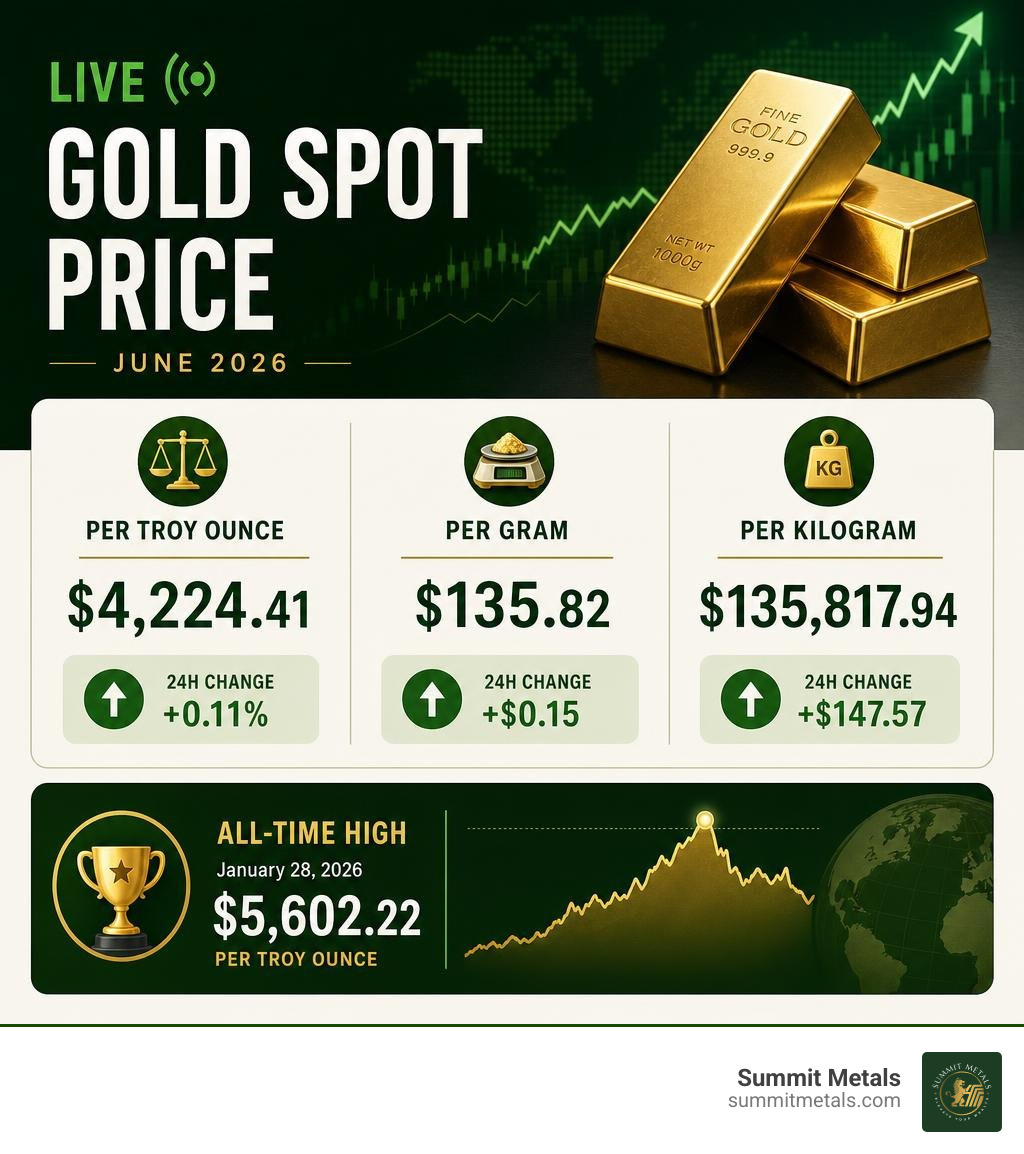
| Unit | Price (USD) | 24H Change |
|---|---|---|
| Per Troy Ounce | $4,224.41 | +0.11% |
| Per Gram | $135.82 | +$0.15 |
| Per Kilogram | $135,817.94 | +$147.57 |
Key facts at a glance:
- Gold hit an all-time high of $5,602.22 per troy ounce on January 28, 2026
- Gold is up 22.99% compared to one year ago
- Prices update in real time, every few seconds during market hours
- You cannot buy physical gold at exactly the spot price — dealers add a small premium to cover minting and distribution costs
- Gold trades 24 hours a day, Sunday through Friday, across exchanges in London, New York, Chicago, Zurich, and Hong Kong
Gold's recent climb reflects a mix of geopolitical tensions, central bank buying, inflation concerns, and a weakening US dollar — all forces that have historically pushed investors toward gold as a safe-haven asset. Whether you are tracking prices for the first time or monitoring daily fluctuations to time a purchase, understanding how the spot price works is the foundation of any smart gold investment strategy.
I'm Eric Roach, a former Wall Street investment banker and M&A advisor who has spent over a decade helping clients hedge risk through precious metals — including structuring gold-backed IRAs and monitoring the gold price spot to optimize entry points. In the sections below, I'll walk you through everything you need to know to invest with confidence.
Gold price spot terms to remember:
Understanding the Gold Price Spot Market and How It Is Determined
To successfully navigate the precious metals landscape, we must first pull back the curtain on how the gold price spot is actually calculated. Many investors assume there is a single, central computer somewhere compiling global transactions to spit out a price. In reality, the spot price is an aggregate representation of continuous trading across several massive global hubs.
The global gold market is divided into two primary environments: exchange-traded futures and the over-the-counter (OTC) market. The OTC market is a decentralized network of bullion banks, central banks, institutional investors, and dealers trading directly with one another. Because there is no centralized physical exchange for OTC trading, the spot price is calculated as the average of wholesale mid-point quotes provided by these massive market participants.
For real-time tracking, investors rely on platforms like Live Gold Spot Price Charts to see how these global forces shift demand second by second. To understand how this works globally, we look to the primary exchanges that drive price discovery every single day.
The Role of Global Exchanges in Setting the Gold Price Spot
Two primary entities dictate global gold valuation: the London Bullion Market Association (LBMA) and the Commodities Exchange (COMEX) in Chicago.
The LBMA represents the physical heart of the gold trade. Twice daily, at 10:30 AM and 3:00 PM GMT, major bullion banks participate in electronic auctions to set the "LBMA Gold Price" (historically known as the London Fix). This price is used as the benchmark for settling institutional contracts, physical bullion shipments, and large-scale mining transactions worldwide.
Meanwhile, the COMEX operates as the world's premier futures exchange. Futures contracts represent a legal agreement to buy or sell gold at a specified date in the future. The gold price spot you see on financial dashboards is heavily derived from the front-month (nearest-term) futures contract with the highest trading volume. Because market makers constantly arbitrage the difference between futures contracts and physical spot metals, the two markets move in near-perfect lockstep.
Beyond London and Chicago, major trading hubs in Zurich, Hong Kong, and Sydney ensure that gold is traded virtually 24 hours a day, following the sun across global time zones.
Bid Price, Ask Price, and the Spread Explained
When you look at a live feed of the gold price spot, you will often notice two other numbers displayed alongside it: the bid price and the ask price. Understanding these terms is vital to avoiding unexpected transaction costs.
- The Bid Price: This is the highest price a buyer (such as a dealer) is currently willing to pay you for your gold. If you are looking to sell, this is your primary reference point.
- The Ask Price: This is the lowest price a seller is willing to accept for that same gold. If you are looking to buy, this is the starting benchmark.
- The Spread: This is the difference between the bid and ask prices.
The bid-ask spread is essentially the cost of liquidity. In highly active markets with deep institutional volume, the spread is incredibly narrow—often just a few cents per ounce. For physical retail products, the spread is wider because it compensates dealers for their operational costs, shipping, insurance, and the risk of holding physical inventory. At Summit Metals, we leverage bulk purchasing power to keep our spreads and premiums highly competitive, passing those savings directly to our clients.
Key Factors Driving the Gold Price Spot in June 2026
The price of gold does not move in a vacuum. It is the ultimate economic thermometer, reacting to changes in inflation, monetary policy, currency valuations, and international relations.

Macroeconomic Indicators and Central Bank Policies
In June 2026, central banks remain at the center of the gold price narrative. Historically, gold shares an inverse relationship with real interest rates. When central banks like the Federal Reserve or the European Central Bank (ECB) raise interest rates, yield-bearing assets like bonds become more attractive, which can temporarily weigh on non-yielding gold.
However, inflation acts as the counterweight. When inflation runs hot—as evidenced by US producer prices climbing 6.5% year-over-year in May 2026—investors flock to gold to preserve their purchasing power. When fiat currencies undergo devaluation due to persistent monetary expansion, gold serves as a borderless, finite store of wealth. This is why central banks themselves have been historic net buyers of gold, aggressively expanding their reserves to diversify away from the US dollar and other fiat exposures.
Geopolitical Events and Safe-Haven Demand
Gold is the ultimate "crisis commodity." When geopolitical tensions flare, investor psychology shifts rapidly from wealth maximization to wealth preservation.
In recent months, market volatility has been driven by shifting dynamics in the Middle East. For instance, negotiations surrounding a potential US-Iran peace deal have caused sudden swings in energy markets. When oil prices fall on peace optimism, gold sometimes experiences brief downward corrections as systemic risk premiums subside. Conversely, when geopolitical conflicts threaten global supply chains, the resulting inflationary shocks drive immediate safe-haven inflows into gold, pushing the gold price spot higher.
To monitor these rapid fluctuations and historical trends across different market cycles, you can reference real-time charts on trusted global gold price tracking platforms.
Historical Context: Comparing Current Rates to All-Time Highs
To understand if gold is currently "expensive" or "cheap," we must look at where it stands relative to its historical trajectory.
Gold has demonstrated an average annual rate of return of approximately 7.78% over the long term from 1971 to 2022. This long-term upward march highlights its role as an exceptional wealth-preservation tool.
If you want to look at the broader historical charts spanning several decades to see this growth in action, interactive gold price charts provide a comprehensive look at gold's long-term historical performance.
Analyzing the January 2026 Peak of $5,602.22
On January 28, 2026, gold reached a historic milestone, peaking at an all-time high of $5,602.22 per troy ounce. This massive rally was fueled by a combination of intense geopolitical uncertainty, high inflation rates, and aggressive central bank buying.
Following that historic peak, the market entered a healthy consolidation phase. In June 2026, gold is trading around the $4,224 range. For seasoned investors, this pullback represents a classic market correction rather than a loss of faith in the asset. Historically, bull runs in precious metals consist of rapid upward spikes followed by periods of consolidation, creating attractive entry points for long-term buyers. You can track this specific price history using the Current Spot Price of Gold Chart.
Dollar-Cost Averaging vs. Lump Sum Buying: A Strategic Approach
When gold experiences volatility, trying to perfectly time the market's bottom can be incredibly stressful—and often counterproductive. If you buy a large amount all at once (lump-sum investing), you run the risk of buying at a short-term peak.
To mitigate this risk, we highly recommend dollar-cost averaging (DCA). With this strategy, you invest a fixed dollar amount at regular intervals (for example, monthly), regardless of the current spot price. When prices are high, your fixed investment buys less gold; when prices are low, your investment buys more. Over time, this averages out your purchase cost and removes the emotional stress of daily market fluctuations.
At Summit Metals, we have made this hands-free with our Autoinvest program. Think of it like a 401(k) for precious metals. You can set up a monthly subscription to automatically purchase physical gold or silver, slowly building your hard-asset wealth over time without ever having to worry about watching the daily tickers.
Physical Gold vs. Paper Gold: Choosing the Right Investment Strategy
When deciding how to allocate capital to gold, investors generally choose between physical bullion (tangible coins and bars) and paper gold (Exchange-Traded Funds, mutual funds, or futures contracts).
Paper gold offers convenience and high liquidity, but it comes with a major drawback: counterparty risk. When you own a gold ETF, you do not own physical gold; you own a share in a trust that holds gold. You cannot take delivery of that gold unless you are an institutional participant holding massive quantities. Furthermore, paper gold is subject to ongoing management fees (expense ratios) that compound over time. Over a 20 to 30-year holding period, these compounding fees can easily exceed the one-time premium you would pay for physical bullion.
Physical bullion, on the other hand, carries zero contractual or counterparty risk. It is a tangible asset that you hold in your direct possession or store in a private, secure vault.

Total Cost of Ownership: Premiums, Storage, and Taxes
To accurately calculate the cost of physical ownership, you must factor in three primary variables:
- Premiums: This is the amount you pay over the raw gold price spot. It covers the costs of refining, minting, security, shipping, and dealer operations.
- Storage: Storing gold securely is paramount. While some investors prefer home safes, others utilize professional, third-party private vaults. Private vault storage offers maximum security and, crucially, keeps your assets highly liquid.
- Taxes: Depending on your jurisdiction, physical gold may be subject to capital gains taxes upon sale. It is always wise to consult a certified tax professional regarding precious metals regulations in your local area.
Having a clear exit strategy is just as important as your buying strategy. That is why we promote our "Sell to Us" program. When you store your metals securely in our network of private vaults, you enjoy institutional-grade security alongside instant liquidity. If you ever decide to sell, you can liquidate your holdings instantly at transparent, real-time rates without the hassle of shipping physical metal across the country.
Gold Coins vs. Gold Bars: A Strategic Comparison
If you decide to buy physical gold, should you buy coins or bars? Both have distinct advantages depending on your investment goals.
Gold coins minted by sovereign governments (like the American Gold Eagle or Canadian Maple Leaf) carry a legal tender face value. This legal status provides an extra layer of federal fraud protection, as counterfeiting government currency carries severe criminal penalties. Coins are also highly recognizable worldwide, making them incredibly easy to liquidate.
Gold bars, conversely, generally carry lower premiums because they are cheaper to manufacture than intricate coins. They are highly efficient for bulk storage but lack the legal tender backing of sovereign coins.
| Feature | Gold Coins | Gold Bars |
|---|---|---|
| Premium Over Spot | Moderate to High | Low |
| Legal Tender Status | Yes (Sovereign Mints) | No (Private Mints) |
| Fraud Protection | High (Government-backed) | Standard |
| Liquidity | Extremely High | High |
| Best For | Retail investors, portability, legal protection | Bulk buyers, maximizing ounces per dollar |
Frequently Asked Questions About the Gold Price Spot
What is the current gold price spot per ounce, gram, and kilo?
As of June 2026, the spot price of gold is trading around $4,224.41 per troy ounce. Translated into smaller and larger weight denominations, this equates to roughly $135.82 per gram and $135,817.94 per kilogram. That these prices fluctuate constantly throughout the trading week as global market conditions shift. For the absolute latest live data, you can check live gold spot price dashboards.
Why can't I buy physical gold directly at the spot price?
The spot price represents the price of raw, unrefined gold traded in massive, multi-million-dollar wholesale contracts (typically 100-ounce or 400-ounce bars). To turn that raw gold into a beautiful, authenticated 1-ounce coin or 10-gram bar, it must be refined, minted, packaged, insured, and shipped. Dealers must also cover their operational overhead. The "premium over spot" is simply the markup that covers these manufacturing and distribution costs.
How does the US dollar impact the global gold price spot?
Gold is priced in US dollars globally. Because of this, there is a strong historical inverse correlation between the strength of the US dollar and the price of gold. When the US dollar weakens against other global currencies, it takes more dollars to buy the same troy ounce of gold, causing the dollar-denominated price of gold to rise. Conversely, a strengthening dollar can sometimes put downward pressure on gold prices. This makes gold an exceptional hedge against the long-term purchasing power erosion of fiat currency.
Conclusion
Navigating the precious metals market requires a reliable partner who values transparency as much as you do. At Summit Metals, based in Wyoming with offices in Salt Lake City, Utah, we are committed to providing authenticated gold and silver bullion at highly competitive, real-time rates.
Whether you are looking to make a one-time purchase or want to build long-term wealth steadily through our hands-free Autoinvest subscription, we are here to support your financial journey. A complete investment strategy includes a secure exit plan; with our private vault storage and seamless buyback options, liquidating your assets is as simple as a few clicks.
Ready to take control of your financial future?