Why Understanding Spot Price Matters Before You Buy
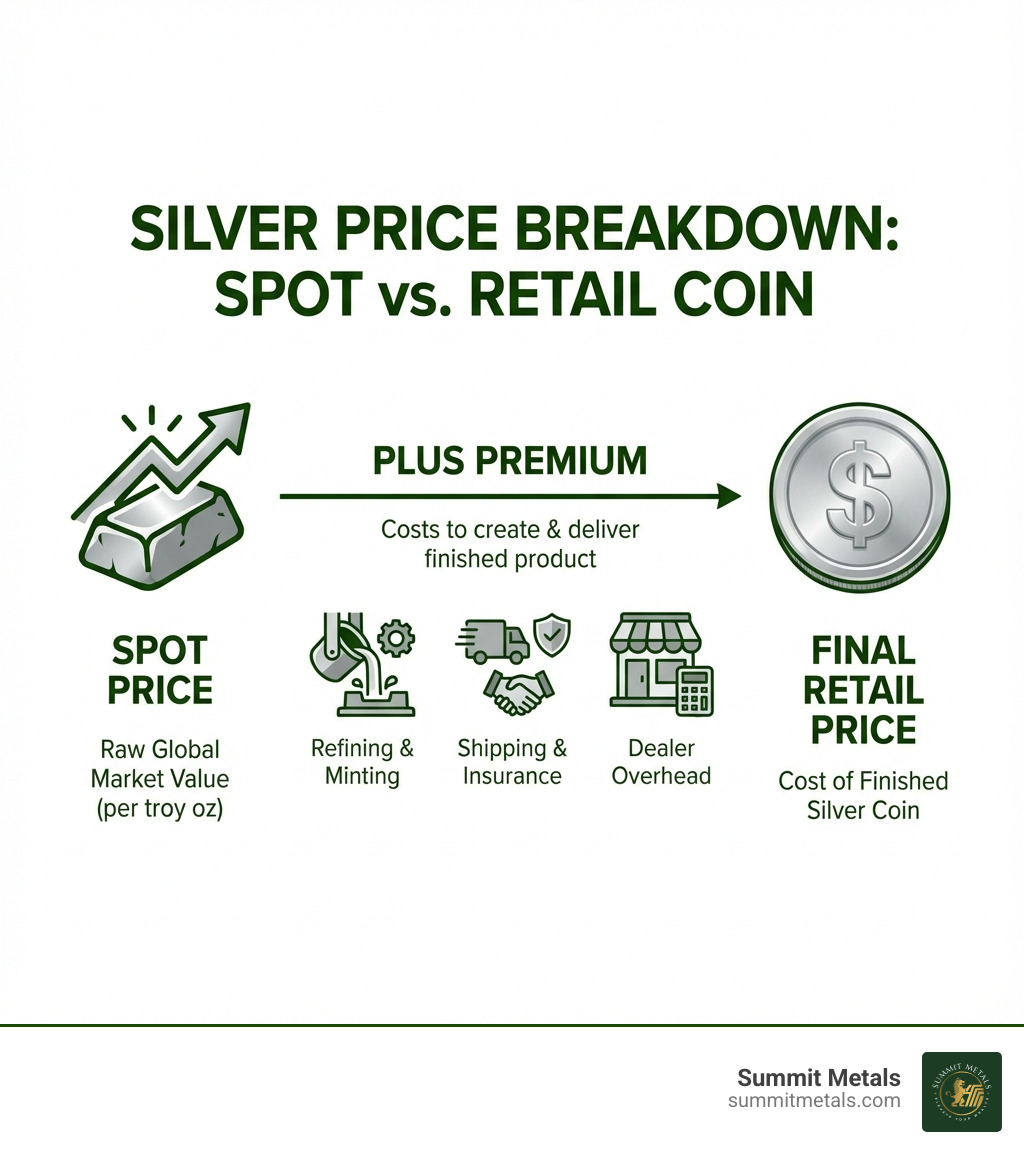
If you want to buy silver online at spot price, you need to know this upfront: you can't actually purchase physical silver at the exact spot price. The spot price represents the raw value of silver traded in bulk on global markets—not the cost of finished coins or bars. However, you can get very close by choosing low-premium products, buying in bulk, and working with transparent dealers. Here's the quick breakdown:
Key Facts:
- Spot price = current market value for immediate delivery of raw silver (per troy ounce)
- Final purchase price = spot price + premium (typically 2–15%+ per ounce)
- Premiums cover: refining, minting, shipping, insurance, dealer overhead
- Lowest premiums: large bars (100 oz, kilo), generic rounds, bulk purchases
- Goal: minimize premiums to get as close to spot price as possible
This guide will show you exactly how to steer online silver buying, choose the right products, and avoid hidden costs—so you can secure authentic silver at competitive prices.
I'm Eric Roach, and during my decade advising Fortune 500 clients on Wall Street, I learned how institutions hedge risk with precious metals—strategies I now use to help everyday investors like you buy silver online at spot price (or as close as the market allows). My mission is to cut through the complexity and give you the same disciplined, data-driven approach that billion-dollar treasuries use to protect their balance sheets.
To better understand how spot price is set on global markets, you can review the silver page on Wikipedia for background on silver as a traded commodity.
Quick look at buy silver online at spot price:
- physical precious metals
- precious metal broker
- silver investment strategies
What is 'Spot Price' and Why Does it Matter?
The 'spot price' of silver is the current price of one troy ounce of silver for immediate delivery—essentially the real-time wholesale price of raw, unworked silver. This price is determined by supply and demand on global markets, influenced by economic indicators, geopolitical events, and overall economic conditions. Key exchanges like COMEX (Commodity Exchange) in New York establish this benchmark through continuous trading of silver futures contracts. The price is quoted per troy ounce (31.1035 grams versus 28.35 grams for a standard ounce).
Can You Really Buy Silver Online at Spot Price?
No, you cannot buy physical silver bullion at the exact spot price. The spot price reflects raw silver traded in bulk on commodity markets—before it's transformed into coins, bars, or rounds. When purchasing physical silver, additional costs include refining to high purity (.999 or .9999 fine), minting or fabrication, packaging, shipping, insurance, and dealer overhead. These costs create the 'premium' above spot price. Your goal as an investor is to minimize this premium.
Understanding the Premium on Silver Bullion
Premiums typically range from 2% to 15%+ above spot price, depending on:
- Product Type: Sovereign coins (American Silver Eagles, Canadian Maple Leafs) carry higher premiums than generic rounds or bars
- Size: Larger denominations have lower per-ounce premiums
- Manufacturing Complexity: Detailed designs increase costs
- Brand/Collectibility: Recognized mints command higher premiums
- Market Conditions: High demand drives premiums up
Typical premium ranges:
| Product Type | Premium Range | Notes |
|---|---|---|
| 1 oz Generic Rounds | 5% - 10% | Lower costs, simple designs, private mints |
| 1 oz Sovereign Coins | 10% - 25%+ | Higher costs, intricate designs, legal tender status |
| 10 oz Silver Bars | 3% - 7% | Good balance of premium and size |
| 100 oz Silver Bars | 2% - 5% | Best per-ounce savings for serious investors |
| Kilo (32.15 oz) Bars | 2% - 6% | Similar to 100 oz bars, popular internationally |
How to Buy Silver Online at Spot Price (or as Close as Possible)
Since buying physical silver at spot price isn't feasible, focus on minimizing the premium through smart purchasing strategies.

Strategy 1: Choose Low-Premium Silver Products
Select products with lower manufacturing costs—typically silver bars and generic rounds valued primarily for metal content rather than numismatic value.
Comparison Chart: Silver Coins vs. Silver Bars
| Feature | Silver Coins | Silver Bars |
|---|---|---|
| Premium | Higher (10–25%+) due to minting and legal tender status | Lower (2–10%) due to simpler fabrication |
| Legal Tender | Yes, face value offers fraud protection | No, valued solely on metal content |
| Liquidity | Highly liquid and globally recognized | Very liquid from reputable mints |
| Storage | Less efficient for large quantities | Designed for efficient stacking |
| Numismatic Value | Can develop collector value over time | Purely metal investment |
Quick Decision Guide: 1 oz Rounds vs. 10 oz Bars vs. 100 oz Bars
| Feature | 1 oz Rounds | 10 oz Bars | 100 oz Bars |
|---|---|---|---|
| Premium | 5–10% over spot | 3–7% over spot | 2–5% over spot |
| Affordability | Very accessible | Moderate cost | High upfront cost |
| Best For | Beginners, flexibility | Balanced cost/flexibility | Long-term stackers |
Strategy 2: Buy in Larger Quantities
Larger silver products significantly reduce per-ounce premiums through economies of scale. A 100 oz or kilo bar almost always offers better per-ounce pricing than equivalent 1 oz coins. While upfront costs are higher, long-term premium savings are substantial.
Strategy 3: Use Dollar-Cost Averaging with Summit Metals Autoinvest
Market timing is nearly impossible. Dollar-cost averaging—investing fixed amounts at regular intervals—helps average your purchase price over time.
Summit Metals Autoinvest makes this effortless:
- Set a fixed monthly amount like a "precious metals 401k"
- Automatically dollar-cost average without timing markets
- Build your position in authenticated silver at competitive premiums
- Benefit from bulk-purchasing power and real-time pricing
Learn more about Summit Metals Autoinvest.
Vetting Dealers and Avoiding Risks
When you buy silver online at spot price (or close to it), the integrity of your dealer is paramount. The online market offers convenience, but it also presents risks, primarily counterfeit products and unscrupulous sellers. At Summit Metals, we pride ourselves on selling only authenticated gold and silver precious metals, ensuring trust and value for our investors in Wyoming and Utah.

Checklist for Choosing a Reputable Online Dealer
Before you commit to a purchase, do your homework. A reputable dealer will be transparent, secure, and well-regarded in the industry. Here’s what to look for:
- Strong Reputation & Reviews: Check independent review sites. Look for high ratings on platforms like the Better Business Bureau (BBB) and customer review sites like Shopper Approved. These provide insights into a dealer's customer service, product quality, and reliability.
- Transparent Pricing: A good dealer will clearly display their premiums and update prices in real-time based on the live spot price. They won't have hidden fees.
- Secure Payment Methods: Ensure they offer secure payment options and clearly outline any additional costs for credit card payments (as dealers often pass on processing fees). Bank transfers or checks can sometimes result in lower prices.
- Insured Shipping: Your precious metals should be fully insured during transit. Reputable dealers will provide discrete, insured shipping to protect your investment until it reaches your hands.
- Clear Policies: Look for clear terms and conditions, privacy policies, and return policies.
- Customer Support: Responsive and knowledgeable customer service is a hallmark of a trustworthy dealer.
How to Verify the Authenticity of Your Silver
Once you receive your silver, verifying its authenticity and purity is crucial. While buying from a trusted source like Summit Metals minimizes this risk, understanding verification methods offers peace of mind:
- Purity Standards: Most investment-grade silver bullion is .999 or .9999 fine silver. This purity should be clearly stamped on your product.
- Mint Marks: Reputable mints (like PAMP Suisse, Sunshine Mint, or sovereign mints) will have distinct, recognizable mint marks and serial numbers on their bars and coins. Familiarize yourself with these.
- Measurements: Use precise calipers and a scale to check the diameter, thickness, and weight against official specifications. A troy ounce of silver should weigh 31.1035 grams.
- Ping Test: For coins, a "ping test" can sometimes indicate authenticity. When lightly tapped, real silver coins produce a distinct, sustained bell-like ring, while fakes often produce a dull thud. Apps are available to assist with this.
- Magnetic Test: Silver is not magnetic. If a strong magnet sticks to your silver, it's a fake.
- Professional Testing: For ultimate certainty, take your silver to a professional precious metals dealer or assayer for testing. They can use tools like X-ray fluorescence (XRF) scanners, which non-invasively analyze metal composition.
By combining careful dealer selection with these verification techniques, you can confidently build your silver portfolio.
Market Factors That Influence Your Final Silver Price
Understanding market forces helps optimize your purchases when you buy silver online at spot price (or close to it).
Tracking Live Prices and Market Trends
Silver prices change minute by minute during trading hours. Summit Metals updates prices every few seconds to reflect current spot prices.
- Live Charts: Track silver prices across various timeframes. For context on precious metals trading, see silver price history on Wikipedia
- Price Tracking Apps: Mobile apps provide real-time alerts
- Market News: Monitor economic news, central bank policies, and geopolitical developments affecting supply and demand
Reputable dealers let you "lock in" prices at checkout, protecting against fluctuations during your transaction.
Key Considerations for First-Time Buyers
- Start Small, Think Big: Begin with 1 oz rounds or 10 oz bars, but remember larger bars offer better per-ounce value
- Understand Total Cost: Include premium, shipping, and potential sales tax
- Have a Storage Plan: Choose between home safe, bank deposit box, or precious metals vault
- Consider Exit Strategy: Understand how to sell if needed
- Use Autoinvest: Set up recurring purchases with Summit Metals Autoinvest for disciplined, automated buying
Buy Silver Bullion Online - Summit Metals.
Physical Silver vs. Paper Silver
When we talk about investing in silver, it's crucial to distinguish between owning physical silver and investing in "paper" silver assets. While both can be part of a diversified portfolio, they serve very different purposes and carry distinct implications.
Advantages of Owning Physical Silver
We believe in the tangible power of physical silver, especially for investors looking for true wealth preservation. Here's why:
- Hedge Against Inflation and Economic Instability: Physical silver has historically served as a reliable hedge against currency devaluation and inflation. During periods of economic uncertainty, its intrinsic value tends to hold up better than fiat currencies.
- Store of Value: Silver has been recognized as a store of wealth for millennia. Unlike paper assets, it cannot be printed or created at will, making its supply finite. This tangible nature helps it retain value against inflation.
- No Counterparty Risk: When you hold physical silver, there's no third party whose solvency or performance you depend on. You own the asset directly. In a crisis, this can be invaluable, as physical silver has historically been used as a form of currency during hyperinflationary periods.
- Usable in Crisis: While not its primary purpose for most, physical silver (and gold) can serve as a medium of exchange or barter in extreme economic scenarios.
- Privacy: Depending on how you acquire and store it, physical silver can offer a degree of privacy that paper assets cannot.
Disadvantages of Paper Silver
Paper silver refers to investments like silver Exchange Traded Funds (ETFs), futures contracts, or shares in silver mining companies. While these can offer exposure to silver price movements, they come with significant drawbacks compared to physical ownership:
- You Don't Own the Metal: With most paper silver, you don't actually own physical silver; you own a contract or a share that represents silver. This means you don't have direct control over the underlying asset.
- Counterparty Risk: ETFs and futures involve third parties (fund managers, brokers, exchanges). If these entities face financial difficulties, your investment could be at risk, even if silver prices are soaring.
- Management Fees: ETFs and other funds typically charge annual management fees, which can erode your returns over time.
- Market Manipulation Potential: The paper markets for silver are vast and complex, and some critics argue they are more susceptible to manipulation than the physical market.
- Leveraged Products: Silver futures contracts, for instance, are large-scale (typically 5,000 oz) and highly leveraged. While they can magnify gains, they can also lead to losses exceeding your initial investment, making them unsuitable for most individual investors.
For these reasons, we at Summit Metals advocate for owning physical, authenticated silver for true long-term wealth preservation and a reliable store of value.
Frequently Asked Questions about Spot Price Silver
We know you have questions, especially when navigating the nuances of buying silver online. Here are some of the most common inquiries we receive:
What is the most cost-effective form of silver to buy online?
The most cost-effective forms of silver to buy online, in terms of getting the lowest premium over the spot price, are typically larger silver bars (such as 100 oz or kilo bars) and generic silver rounds. These products usually have lower manufacturing costs compared to intricately designed sovereign coins, and the larger sizes allow the premium to be spread across more ounces, reducing the per-ounce cost. For instance, a 100 oz silver bar will almost always offer a better per-ounce price than a single 1 oz coin.
How does the gold-to-silver ratio impact my buying decision?
The gold-to-silver ratio tells you how many ounces of silver it takes to buy one ounce of gold. It's a valuable tool that investors use to gauge the relative value of the two metals. A high ratio (meaning it takes many ounces of silver to buy one ounce of gold) might suggest that silver is undervalued compared to gold, potentially indicating a good time to buy silver. Conversely, a low ratio might suggest silver is relatively expensive. While not a perfect indicator, many investors use this ratio to help decide whether to allocate new funds to gold or silver, or even to swap between the two.
Are there taxes when I buy or sell silver?
Yes, taxes can apply when you buy or sell silver, though the specifics vary.
- Sales Tax on Purchases: Sales tax on precious metals purchases depends on your state's laws. In Wyoming and Utah, for instance, there may be sales tax exceptions or thresholds for precious metals. It's crucial to check the specific regulations for your state of residence. These taxes are typically added at checkout based on your billing address.
- Capital Gains Tax on Sales: When you sell silver for a profit, that profit is generally subject to capital gains tax. The tax rate can depend on how long you held the silver (short-term vs. long-term capital gains). We always recommend consulting a qualified tax professional for advice specific to your financial situation, as tax laws are complex and can change.
Conclusion
Navigating precious metals, especially when you aim to buy silver online at spot price, requires a clear understanding of market dynamics and a strategic approach. While buying physical silver at the exact spot price is not possible due to the inherent costs of production and distribution, our goal at Summit Metals is to help you get as close as possible by minimizing premiums.
We've explored key strategies, including choosing low-premium products like large silver bars and generic rounds, and leveraging the cost efficiencies of buying in bulk. We also emphasized the importance of vetting reputable dealers and verifying the authenticity of your silver to protect your investment. Understanding market factors like volatility, the gold-to-silver ratio, and how to track live prices empowers you to make informed decisions.
Owning physical silver offers unique advantages over paper assets, providing a tangible store of value, a hedge against inflation, and freedom from counterparty risk. For a disciplined approach to building your silver holdings with competitive, real-time pricing, consider setting up a recurring purchase plan with Summit Metals Autoinvest. This automated strategy allows you to dollar-cost average your way into a stronger financial future, just like investing in a 401k. We're here to provide transparent pricing and authenticated metals, ensuring trust and value for your investment journey in Wyoming and Utah.