Is Gold Worth Investing In? The Honest Answer

The advantages and disadvantages of gold come down to this: gold is one of the best tools for protecting wealth, but it is not the best tool for growing it.
Here is a quick breakdown before we dive deeper:
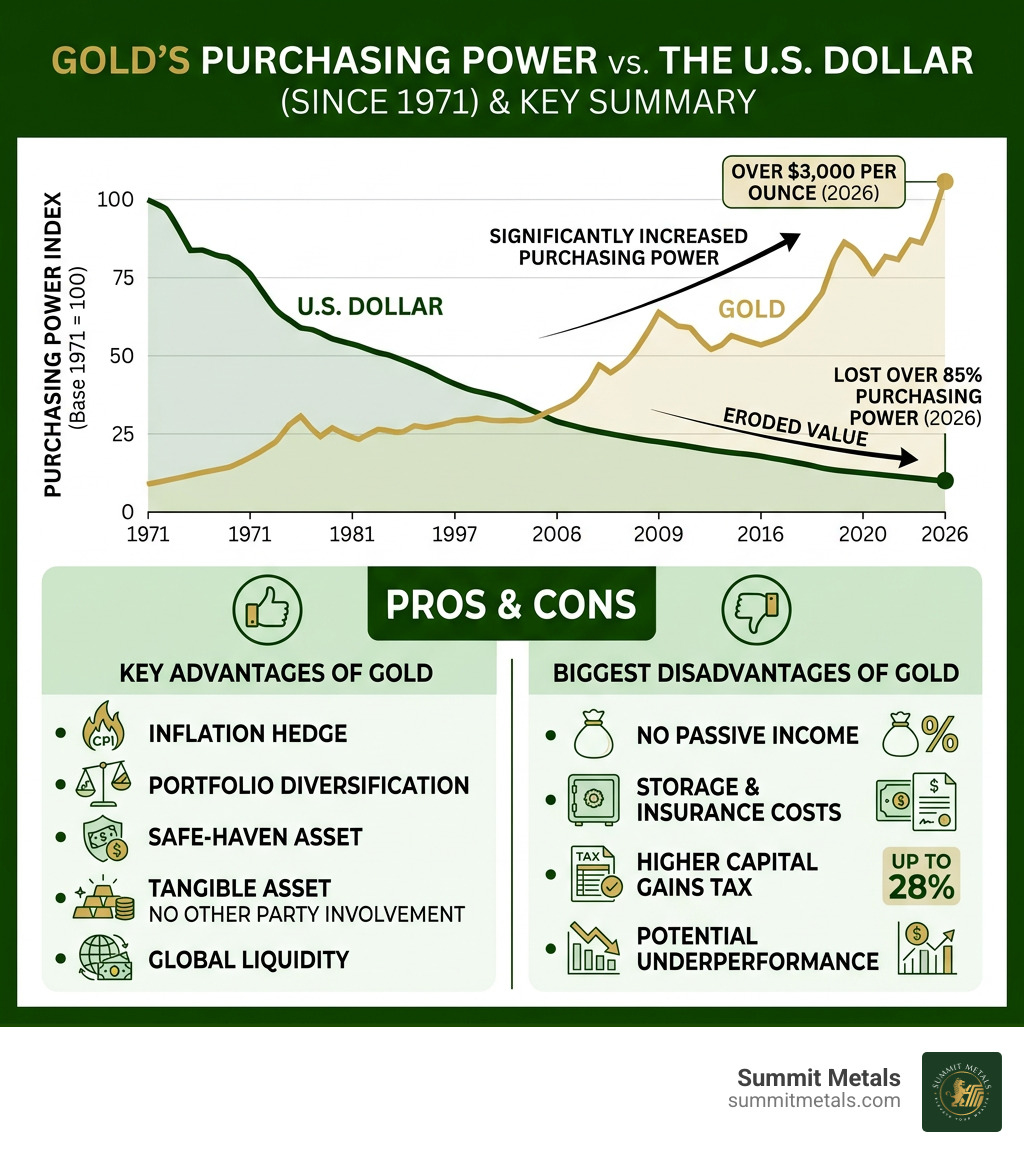
| Details | |
|---|---|
| Best advantages | Hedge against inflation, portfolio diversification, safe-haven during crises, tangible asset with no counterparty risk, globally liquid |
| Biggest disadvantages | No passive income (dividends or interest), storage and insurance costs, higher capital gains tax (up to 28%), can underperform stocks over long periods |
| Best for | Long-term wealth preservation, inflation protection, portfolio diversification |
| Not ideal for | Investors needing regular income, short-term traders, those seeking maximum growth |
| Recommended allocation | 5%–10% of your total portfolio |
Since 1971, the U.S. dollar has lost over 85% of its purchasing power. Over that same period, gold climbed from $35 per ounce to well above $3,000 — a gain no savings account has come close to matching. Yet equities have outperformed gold by roughly 16 times since 1974. That tension — real protection vs. real opportunity cost — is exactly what makes gold one of the most debated assets in investing.
Gold is not a get-rich-quick play. As one perspective in the precious metals industry puts it: "You don't own gold because you expect to get rich; you own it because you want to stay rich." That framing captures the core logic behind every serious gold allocation.
This guide cuts through the noise. Whether you are evaluating gold for the first time or rethinking your current allocation, you will find everything you need here to make a clear-earned decision.
I am Eric Roach — a former Wall Street investment banker who has spent over a decade advising on risk, hedging, and portfolio structure, and now helps everyday investors navigate the advantages and disadvantages of gold and other precious metals through Summit Metals. Understanding where gold fits — and where it does not — is the foundation of every smart allocation I have helped clients build.
The Core Advantages and Disadvantages of Gold

When we talk about the advantages and disadvantages of gold, we aren't just talking about shiny objects. We are talking about a fundamental shift in how you view your "economic energy." Most of us are taught to measure our wealth in dollars, but as we’ve seen, the dollar is a moving target—and usually, it's moving down.
Evaluating gold as an investment requires a look at your own risk appetite. Are you looking for the thrill of a tech stock that might double overnight, or are you looking for the quiet confidence that your retirement fund won't evaporate if a bank in a different time zone fails? For a deeper dive into these nuances, you might find Beyond the Hype: A Realistic Look at Gold as an Investment quite helpful.
Market sentiment often swings between "Gold is a relic" and "Gold is the only safe thing left." The truth usually sits comfortably in the middle. Gold requires a long-term horizon. If you buy gold today expecting to sell it for a profit next Tuesday, you’re probably in the wrong asset class. But if you’re looking at a five, ten, or twenty-year window, the historical stability of gold becomes its greatest strength.
Key Advantages of Investing in Gold
The primary reason we see investors flocking to gold is its role as an inflation hedge. Unlike paper currency, which central banks can print at will, the supply of gold is limited by the physical difficulty of pulling it out of the ground. This scarcity is why gold holds its value well over decades and even centuries.
Another massive plus is portfolio diversification. In the investing world, we look for "uncorrelated assets"—things that don't move in lockstep with the stock market. When the S&P 500 takes a tumble, gold often stands its ground or even rises. This was clearly seen during the Global Financial Crisis, where gold increased by more than 25% while the stock market fell by over 50%.
Because gold is a tangible asset, it carries no counterparty risk. If you hold a physical coin in your hand, its value doesn't depend on a company staying solvent or a website staying online. It is yours, it is real, and it has global liquidity. You can take a Krugerrand to almost any city in the world, from Salt Lake City to Singapore, and find someone willing to trade it for local currency. For more on these benefits, check out The Midas Touch: Exploring the Benefits of Gold Investment.
Primary Disadvantages of Gold Ownership
We would be doing you a disservice if we didn't mention the downsides. The most cited "con" is that gold provides no passive income. It doesn't pay dividends like a stock, and it doesn't pay interest like a bond. Its "return" is based purely on price appreciation.
Then there are the carrying costs. Owning physical gold means you have to think about storage and insurance. Whether you buy a high-quality home safe or pay for a spot in a professional vault, those costs eat into your total return. In a professional setting, storage fees typically range from 0.4% to 1% of the gold's value annually.
Price volatility is also a factor. While gold is stable over the long run, its short-term price can swing wildly based on geopolitical news or interest rate changes. Furthermore, the IRS views gold as a "collectible," which means it is subject to a higher capital gains tax rate of up to 28%, compared to the 15-20% you might pay on stocks. Avoiding these traps is easier when you know what to look for; we recommend reading Top Gold Investing Mistakes and How to Avoid Them to stay ahead of the game.
Gold as a Strategic Hedge and Diversifier
In times of economic uncertainty, gold acts like a financial umbrella. When the "rain" of inflation or currency devaluation starts, you’ll be glad you have it. Since the gold standard ended in 1971, the U.S. dollar has lost over 85% of its purchasing power. To put that in perspective, what $1 could buy in 1971 now requires nearly $10. Gold, meanwhile, has risen from $35 per ounce to over $2,600 (and recently even higher).
Research from the Federal Reserve Bank of Chicago has shown a strong positive correlation between pessimistic consumer expectations and gold prices. Basically, when people get worried about the future, they buy gold. This makes it a premier safe-haven asset during geopolitical tensions or banking crises. If you want to understand why metals hold this unique status, Why Gold and Silver: Understanding Their Value as Safe Haven Assets is a great resource.
Diversification and Portfolio Stability
The magic of gold in a portfolio is its "non-correlated" nature. It doesn't care about quarterly earnings reports or CEO scandals. During six of the last eight major stock market crashes, gold prices actually went up. This inverse relationship helps smooth out the "volatility bumps" in your wealth over time.
Even the world's most powerful institutions agree. Central banks added over 1,000 tons of gold to their reserves in 2023 alone. If the people who print the money are buying gold to protect themselves, it might be worth considering for your own "personal central bank." For a balanced view on whether this fits your goals, see Is Gold a Good Investment.
Autoinvest with Summit Metals: Dollar-Cost Averaging for Precious Metals
One of the biggest hurdles for new investors is "timing the market." People often wait for a price drop that never comes, or they buy at the very top during a panic. We have a solution for that: Summit Metals Autopay.
Think of this as a 401k-style approach to precious metals. By setting up a monthly subscription, you practice "dollar-cost averaging." You buy a set dollar amount of gold every month, regardless of the price. When prices are high, your dollars buy a little less; when prices are low, your dollars buy more. Over time, this lowers your average cost basis and removes the emotional stress of trying to time the perfect entry point. It’s a disciplined way to build generational wealth without having to stare at price charts all day. You can find more info about Summit Metals Autopay services on our website.
Comparing Ways to Invest: Physical Bullion vs. Digital Exposure
How you choose to hold your gold is just as important as why you’re buying it. There’s a world of difference between holding a Canadian Maple Leaf in your safe and owning shares in a gold ETF. Each has its place depending on your goals. For a breakdown of these differences, read Physical Bullion vs Gold & Silver ETFs: Pros and Cons.
Physical Gold: Coins vs. Bars
If you decide to go physical, you generally have two choices: coins or bars. At Summit Metals, we provide both, but they serve different purposes.
| Feature | Gold Coins (e.g., Vienna Philharmonics)) | Gold Bars |
|---|---|---|
| Legal Tender | Yes, they have a face value. | No, they are bullion only. |
| Fraud Protection | High (counterfeiting legal tender is a major crime). | Moderate (requires assay/testing). |
| Premiums | Higher (due to minting costs). | Lower (more gold for your dollar). |
| Liquidity | Very High (recognizable everywhere). | High (especially for standard sizes). |
| Best For | Small transactions, privacy, and security. | Large-scale wealth storage. |
Coins like the Krugerrand or the Maple Leaf are iconic. Because they are government-minted, they are highly regulated and easily recognized by any dealer in Salt Lake City or beyond. Bars, on the other hand, are the choice for the "efficiency seeker." If you want the lowest price per ounce, bars are usually the way to go, especially in larger sizes like 100-gram or 1-kilo weights.
Paper Gold and Digital Exposure (ETCs & ETFs)
For those who want to speculate on the price of gold without the "burden" of physical ownership, ETCs Exchange-Traded Commodities and ETFs are popular. They are highly liquid—you can buy or sell them with a click on your phone.
However, "paper gold" comes with counterparty risk. You don't actually own the gold; you own a piece of paper that promises to track the price of gold. If the financial system faces a true systemic meltdown, that piece of paper might not be as helpful as a physical coin. Additionally, you'll pay ongoing management fees that can eat into your profits over time.
Practical Considerations: Costs, Taxes, and Exit Strategies
Owning gold is a responsibility. If you choose physical gold, you need to account for storage fees, which generally run between 0.4% and 1% of the value per year if you use a professional depository. You also need to ensure your gold is authenticated. At Summit Metals, all our products are authenticated to ensure they meet the highest purity standards (typically .9999 fine gold).
Tax Implications and Capital Gains
In the United States, gold is taxed differently than stocks. The IRS classifies gold as a "collectible." If you hold your gold for more than a year, your long-term capital gains tax rate is capped at 28%. This is significantly higher than the 15% or 20% rates applied to most stocks and bonds. It’s vital to keep meticulous records of your purchase prices (your "cost basis") so you don't overpay when it comes time to sell.
Seamless Liquidity and Your Exit Strategy with Summit Metals
An investment is only as good as your ability to get out of it. Many people buy gold but never think about the "exit strategy." This is where we differentiate ourselves. We don't just want to sell you gold; we want to be your long-term liquidity partner.
We offer private vault storage options that keep your metals secure and fully insured. The best part? If your gold is stored with us, it remains "liquid." You don't have to worry about packing it up and shipping it back to us. With our "Sell to us" program, you can liquidate your holdings instantly at transparent buyback prices. We pride ourselves on competitive market spreads, ensuring that when you're ready to turn your gold back into cash, you get the best possible value. For details on how we handle buybacks, visit more info about selling your gold to Summit Metals.
Frequently Asked Questions about Gold Investing
Is gold a better investment than silver?
"Better" depends on your goals. Gold is the ultimate wealth preserver—it’s less volatile and more of a "pure" currency play. Silver has more industrial demand (used in solar panels and electronics), which can lead to higher growth potential but also much higher volatility. Silver is often over 10% more volatile than gold. If you’re near retirement, gold is usually the safer bet. If you’re younger and looking for more "pop," silver might have a place.
How much of my portfolio should be in gold?
Most financial experts suggest an allocation of 5% to 10%. This is enough to provide a "buffer" during a market crash without dragging down your long-term growth from equities. If you are particularly worried about the economy, some investors go as high as 15-20%, but we generally recommend staying in that 5-10% sweet spot for a balanced approach.
What are the biggest risks of physical gold?
Theft is the most obvious risk if you store it at home. That’s why we recommend professional vaulting or a very high-quality, bolted-down safe. There is also the risk of buying counterfeit products from unreputable dealers. Always work with an established company that offers transparent, real-time pricing and authenticated bullion. For more tips on avoiding these pitfalls, revisit our guide on Top Gold Investing Mistakes.
Conclusion
Deciding to invest in gold is a major step toward financial sovereignty. While the advantages and disadvantages of gold are real, the historical record is clear: gold is the only asset that has never gone to zero in over 5,000 years.
At Summit Metals, we make the process simple and transparent. Based in Wyoming with a presence in Salt Lake City, Utah, we leverage our bulk purchasing power to provide you with competitive rates that most local shops can't match. Every ounce we sell is authenticated, ensuring you receive exactly what you paid for.
Whether you are looking to make a one-time purchase or want to start a disciplined Autoinvest plan, we are here to help. Don't wait for the next financial storm to start outfitting your boat. Start building your gold portfolio today with Summit Metals and take control of your financial future.